
SaaS content writing is the writing that explains a software product to the people who choose, buy, and use it. Much of it lives outside the blog, on product, pricing, and integration pages, in emails, and in the help center, where each page answers the question a reader has before the next step.
When an AI tool mentions a vendor, 71% of the AI-using US B2B professionals in Semrush's survey visit that vendor's website. The product, pricing, and integration pages then need accurate facts that let those visitors check what the answer said.
For SaaS, fintech, and AI companies, a page that leaves the prospect's question unanswered pushes the evaluation to a sales call the prospect may never book. This guide shows what SaaS content writers produce, how to write each format so it moves a reader to the next step, and how AI changes the work in 2026.
Key takeaways
- SaaS content writing reaches well beyond the blog, from product and pricing pages to emails, the help center, comparisons, and case studies.
- Each format serves a primary question at one stage, so the gaps closest to a purchase decision usually come before the blog.
- Specific copy needs specific inputs, which means interviews with customers, sales, support, and product experts before the first draft.
- Google puts original, non-commodity content above its other AI search advice and treats pages mass-produced mainly to manipulate rankings as spam, however they are made.
- Signups, demo requests, and pipeline judge the work, with traffic as an early signal rather than the goal.
What is SaaS content writing and what does it bring to a company?
SaaS content writing is the process of explaining, teaching, and demonstrating how a product solves the audience's problems, and the places where that explaining happens have widened. A company's review platform profiles now count too, because AI chatbots describe a vendor from those profiles and its social media as well as its website, as G2 points out.
The work is narrower than SaaS content marketing, which adds strategy, distribution, and budget. It overlaps with copywriting, which persuades readers to act in ads, emails, product pages, and other formats.
Three things set SaaS writing apart. A B2B SaaS purchase usually involves several people, and the user, the budget owner, the security team, and finance each look for a different answer. The help center keeps working after the signup. Technical facts must be exact, and fintech and AI claims need a named compliance or legal reviewer before they go live.
How can SaaS content help a company achieve higher profits?
Content earns its keep by bringing in people who already have the problem and moving them toward a trial or demo without a payment for each visit. A company weighs that against the full cost of writing and maintaining it. Omnius's memo puts the economics plainly: "Paid channels stop producing the day the budget stops, whereas search behaves like an asset rather than an expense." Companies hire writers for that job and want the content to:
- increase traffic to the website;
- achieve a higher conversion rate;
- increase click-through rates from search and email;
- bring more signups;
- drive interest from people looking for a product and from casual readers;
- bring more qualified leads, demo requests, and pipeline.
A feature list alone leaves a prospect to work out whether the product fits. People search for a fix to their problem, so the content shows the product solving it, with the features and proof behind the claim.
For about half of the people who buy B2B software, that search now starts in an AI chatbot more often than in Google, alongside Google rather than instead of it. G2's March 2026 survey put the share at 51%, against 29% in G2's 2025 report, and G2 reads that as the shortlist moving inside AI answers.
When an AI answer names several vendors, Semrush's respondents most often notice the one that fits: 53% notice the vendor that matches their use case, while 7% notice a name they recognize. That line in the answer can draw on what the web says about each company, including the pages the company writes itself.

TrustRadius found that 94% of the technology purchasers who used AI fact-check its answers at least some of the time. Product pages need verifiable facts for that check, including a clear correction when an AI answer gets the product wrong.
Four dated developments from the last six months raise the bar for these pages:
- May 15, 2026: Google published a guide to its generative AI features that puts valuable, unique, non-commodity content first.
- July 8, 2026: Semrush reported 41% of US B2B professionals who use AI at work start vendor research in AI and check the answer in search.
- August 31, 2026: Google finished rolling out Search Console's generative AI report, which shows AI Overview and AI Mode impressions by page.
- October 15, 2026: Google said it had substantially increased the inline links in AI Mode and AI Overviews.
What are a SaaS content writer's responsibilities?
In general terms, SaaS content writers build the path from a reader's first question to a purchase or a subscription. Each format serves a primary question at a particular stage of that path, as the table shows:
| Stage | Formats | The question each answers | Fix first when |
|---|---|---|---|
| Finding the problem | Blog posts, guides, research | What is causing this problem, and how do others solve it? | The blog ranks but brings no trials |
| Evaluating options | Product, use-case, integration and comparison pages, documentation, review profiles | Does it fit our use case, work with our tools, and beat the alternatives? | AI answers or prospects describe the product wrongly |
| Deciding | Pricing and security pages, case studies, landing pages, emails | What does it cost, is it safe, and who like us uses it? | Demos stall on the same questions |
| Using and renewing | Onboarding emails, help center articles | How do we get the result we paid for? | Support tickets repeat the same questions |
1. Product descriptions that show the problem solved
A software company's product lives online, so its descriptions do the job of a sales presentation. They have to read well on every page, app store, and marketplace where the product appears. A strong description opens on the problem it solves and for whom, then shows the product doing the job.

Truffle's online ordering page does that in its first screen. It names the restaurant's job, states the outcome, and lists four things the software does before it asks for a demo, all in plain words. Writers support pages like this with product screenshots, client testimonials, and infographics that explain the product's value.
The facts people check belong on the page in plain text: use cases, integrations, security certifications, and how pricing works. Google's guide describes AI agents that compare product specifications for people, with browser agents reading a page's screenshots, its code, and its structure. A fact that sits only in a sales deck is missing from the public pages those agents and AI answers read.
2. Landing pages with a clear next step
Landing pages are where prospective customers learn what the company offers and what its software does. Beside the copy that persuades visitors to commit, the next step belongs on the first screen, whether it is a trial, a demo, or a signup, and again after the proof.

Crazy Egg's homepage puts a single field and button under its headline, with the trial terms, a 30-day free trial that can be canceled anytime, written below them.
A landing page for a single campaign keeps that focus on one audience, problem, and offer, with the proof for that offer on the same page.
3. Emails that nurture, onboard, and convert
Radicati's forecast, as reported by Statista, put the emails sent and received every day in 2025 at about 376 billion, so a SaaS company's emails land in crowded inboxes. Each email needs a clear job there, usually sending the reader to the page that answers their question.
Drip campaigns, welcome emails, newsletters, and well-built cold emails all have their uses. During a trial, onboarding emails teach a new user the action that shows the product's value, so the trial reaches that point before it ends. Each email in the sequence links to the help article or the in-app screen that completes the next step.
A follow-up after a sales call works the same way. It ties the product to the problem the prospect named and asks for a single next step, as in the example below.

The same three-part shape suits each onboarding email in a trial, stating the problem in the reader's words, what the product does about it, and one next step.
4. Help center and knowledge base articles
A knowledge base article explains in depth how the product solves a specific problem, and clear articles show new users the steps and prerequisites for each task. They also let teams moving from another tool judge the work a switch involves.
Writers keep each article short, task-based, and easy to navigate, and every article has an owner who reviews it whenever a release changes the task. Current customers use the help center as their how-to source, so a good article can answer a question before it becomes a support ticket.
Nike's help center shows the principle: a search box first, then answers to the most common questions a click away. The same layout works for software, and at AI and developer-tool companies the documentation also serves evaluation, since prospects can read how the product behaves before they sign up.

5. Comparison and alternatives pages
Comparison pages answer one of the most direct questions in an evaluation: how one product compares with another. In Semrush's survey, 56% of respondents ask AI tools for direct vendor comparisons, so an honest, current comparison gives both the reader and the AI answer something specific to work with.
A good comparison page says who each product fits, states the facts that differ, and dates them. Google's guide says that creating separate content for every variation of a query, mainly to manipulate rankings or AI responses, violates its scaled content abuse policy. So a company writes pages for the pairings prospects compare, rather than a page for every competitor and phrasing.
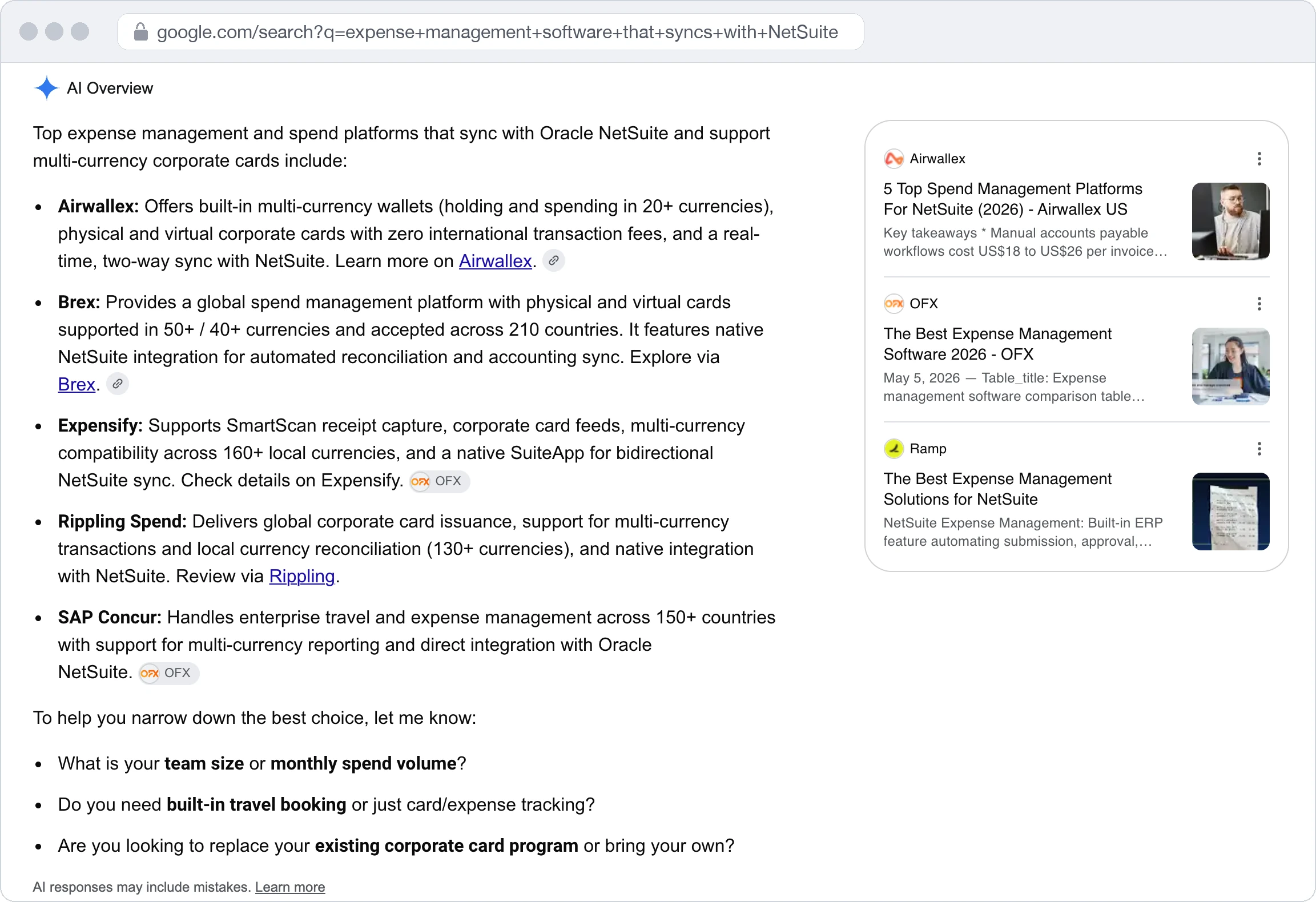
The pattern shows up in real answers. On October 27, 2026, a Google search for multi-currency expense software that syncs with NetSuite returned an AI Overview naming five products. It described each one by its currency support and its NetSuite sync. All three source cards beside it linked to vendors' own comparison pages, from Airwallex, OFX, and Ramp.
6. Case studies with measured results
A case study, or customer story, is the proof page. It tells a customer's problem, what changed after the product went in, and the measured result. The best ones quote the person who owns that result, such as a controller or a head of support. A strong one opens on the result, then gives the starting point, the change, and the time it took. Case studies answer who like us uses it?, which the worked example below shows a finance lead checking before a demo.
Which SaaS content to write first
The work starts with an inventory that places every existing page in the table above, so the empty stages show which formats are missing. The order then starts with the pages closest to a purchase decision, which answer the top complaint in Semrush's survey, where 33% call AI recommendations too generic for their use case:
- Product, pricing, integration, and security facts in plain text on the website's own pages.
- Comparison and alternatives pages for the comparisons prospects make.
- Case studies with measured results.
- Onboarding emails and help center articles.
- Guides and blog posts on the problems the product solves.
The business model changes where the list starts:
- Sales-led companies start with comparison, case study, and security pages.
- Product-led companies start with onboarding emails and the help center.
- AI and developer-tool companies start with documentation.
- Fintech companies start with the claims their compliance team has reviewed.
Pricing pages earn their place through clarity about how pricing works, even when sales gives the final quote. In Semrush's survey, 27% say AI answers miss real pricing. Our SaaS pricing transparency analysis of ChatGPT answers about AI customer service vendors found that ChatGPT still gave a price for every vendor whose pricing page showed none.
What marketing strategies do SaaS content writers use to drive sales?
SaaS content writers rely on six practices, from audience research to testing, to turn product knowledge into pages that earn a trial or a demo.
1. Know the audience and where it researches
Audience research is never finished. When Salesforce launched in February 2000, its launch event was themed around The End of Software, at a time when most business software was still installed on local machines. As broadband made hosted software practical, the questions prospects asked changed, and content had to answer new ones about response time and reliability.
Where people research changes too. For B2B software that now includes AI tools: seven in ten of Semrush's respondents use ChatGPT for product research, and six in ten use Google Gemini. People type their problem into those tools, so the writer needs it in their words.
Those words come from interviews. Wynter's guide to customer research, whose author has watched more than 1,800 B2B companies run research on its platform, splits the people worth researching into customers, lost deals, prospects who are shopping, and companies in the category not yet shopping. It warns: "Most teams only talk to the first group. That's survivorship bias." Customers explain why the page worked on them, while lost deals show the real reasons a company loses, and to whom.
Wynter's September survey of B2B SaaS marketing leaders shows where that gap opens. Of those leaders, 92% learn from sales conversations, yet only 9% based their last big decision mainly on research with the target audience. A product marketing leader at an enterprise SaaS company described how that happens: "Asked sales what they think, we argued about our opinions, and no one bothered to ask anyone in our target audience. We defaulted to guessing like we usually do."
What to do: interview customers, lost deals, sales, support, and product experts before writing a new page, and ask what started the search, what else they tried, and what nearly stopped the decision, in their own words. Wynter's guide, drawing on Hennink and Kaiser's 2022 review, plans 9 to 17 interviews per segment for a focused question and a similar group.
- ✔ A page that opens on the problem in customers' words, such as month-end close takes two weeks because receipts arrive late.
- ❌ A page that opens on the company's mission and its founding story.
2. Research keywords and the questions people ask
Keyword research shows SaaS writers the terms people use for the problems the product solves. Tools such as Google Keyword Planner and AnswerThePublic show them by country, and the SaaS keyword research guide covers the method.
Search intent matters more than volume. Queries often run from the problem (why is month-end close slow) to the category with a use case. They then move to alternatives and "vs" searches, and finally to the brand with pricing. Each step maps to a format in the table above. Search Console also shows the long, question-style queries that read most like prompts to AI tools. A custom (regex) query filter for how, what, and why in its Performance report lists them.
Advanced Web Ranking's 2026 study puts the first result on Google US desktop at 20.02% click-through in July 2026 across all results pages, and at 9.69% on pages with an AI Overview. Backlinko's long-quoted 27.6% comes from an older dataset.

The relative drop is steeper still at positions two and three, and below the fifth result both curves stay under 1%. Fewer clicks reach each result, so the page that gets the visit has to answer the question at once.
What to do: research keywords by country and intent, add Search Console's question-style queries, and give each distinct need its own page, with close variations folded into one.
- ✔ A page built around expense software that syncs with NetSuite, a query with its constraint in it.
- ❌ A page built around best expense software, a head term with no constraint in it.
3. Keep the audience at the center and pass the logo swap test
Customers pay for the problem a product solves. A blockchain add-on offered for an extra $50 with no gain in security is the kind of feature a head of technology declines in one sentence, however proudly the vendor's page describes it.
Category leaders' homepages often stop at describing the category. Wynter's benchmark ran sampled homepages in 61 B2B categories through its Sameness Checker tool. The tool scores messaging overlap on a Sameness Index from 0 to 100, where 100 means a competitor's logo could replace the company's own without a reader noticing. The average was 56.6, and only 12.1% of the average page's messaging said something no competitor in its comparison set says.

In Wynter's sample, expense management, the category in this guide's examples, ties with email marketing for the highest overlap, at 71.6. Wynter's quick check is the logo swap: take the homepage headline and subhead, then, in Wynter's words, "Put a competitor's logo on top. Does it still work? If yes, it's not positioning. It's category description."
Wynter pairs the test with a distinction from R. Eric Reidenbach's 2009 book Listening to the Voice of the Market. Qualifiers are the claims every serious vendor must make, and determiners are the reasons the winner wins. Wynter names security certifications, ease of use, integrations, and AI as the usual qualifiers in B2B SaaS, and with 99.1% of those homepages claiming AI or automation, an AI label alone does little to set a product apart.
Plain words help, as long as they keep the facts people check, such as which plan includes the NetSuite sync or how long setup takes.
What to do: lead each page with a determiner in the customer's words, move qualifiers further down with proof, and run the logo swap test on every headline.
- ✔ A billing page that leads with what changes for the finance team, such as invoices sent and reconciled without spreadsheets.
- ❌ The AI-powered, all-in-one platform for modern finance teams.
4. Use visuals to show the product
A picture is worth a thousand words still holds online, where custom visuals show the product's workflow, inputs, and results. On a product page, the strongest visual is the product doing the job.
Short videos and animations work well in knowledge base articles, where they answer how do I and where do I find questions. Google's guide adds that its AI features can show relevant images and videos from pages in an answer.
What to do: show the product's real screens on product pages and in the help center, and give every informative image alt text that says what it shows.
- ✔ A screenshot of the report a customer sees after setup, with the number that matters highlighted.
- ❌ A stock photo of a team around a laptop above the feature list.
5. Use a call to action to reach one goal
A call to action (CTA) appears in most SaaS types of content, usually where the reader knows enough to act. It tells the reader what to do next, which for software often means a free trial or a demo. The wording has to be clear and concise and leave no room for interpretation.
A compelling CTA says something like "Sign up for a free trial". The best CTA wording tells people where the click leads, and the next page delivers what it promised. The button has to be easy to spot, with strong contrast against the page, and on a landing page it also belongs near the top.

On Crazy Egg's pricing page, one primary action across every plan gives each visitor an obvious next step.
What to do: give each page a primary call to action that fits its stage, and turn the other paths into plain links.
- ✔ Plan buttons that all lead to Start a free trial, with one primary action across the page.
- ❌ Four equal buttons in one section, from a demo request to a guide download.
6. Learn from tests and measure what each page produces
A/B testing is among the most common practices for SaaS writers: it shows two versions of a page to visitors at random during the same period and compares the outcomes. For example, a company can test a product description about profit against one with an emotional angle, with demo requests as the primary outcome. The sample, duration, and stopping rule are set before launch.
Some trendy descriptions bring a lot of traffic at first and then fade, while others grow steadily for longer, so a test runs its full planned period. The result that counts is the action a page produces, and each measure shows part of it:
| Measure | Where to read it | What it catches | What it misses |
|---|---|---|---|
| Completed signup and demo forms per page, against the page's sessions | GA4 key events | The pages that turn a visit into a lead | Visits that convert later on another page |
| Pipeline by first touch and by any touch | The CRM | Which pages sit on the path to real deals | People who never fill in a form before a sales call |
| Branded search and direct visits | Search Console and GA4 | Changes in branded demand and visits with no identified referral source | Whether AI, ads, referrals, or another source created that demand |
| A self-reported discovery field | The demo or signup form | Sources people remember, such as AI answers, podcasts, and peer advice | Influences people skip, forget, or misremember |
| Sessions from identified AI referrers | GA4 session source / medium | Visits that carry recognizable AI referral information | Mentions without a click, and AI visits with no referral information |
When a page's traffic cannot reach the planned sample, a message or preference test with 30 to 50 people from the target audience shows which version reads better. At 50 people a vote share still carries a margin of error of about ±13 points, so Wynter treats a narrow win as a tie. Wynter, which sells these tests, also warns that "preference is not conversion". The guide to measuring SaaS content covers the reporting.

What to do: decide the measure and the decision rule before a test starts, test one element at a time where traffic allows, and report signups, demos, and pipeline per page.
- ✔ A headline test judged against its planned sample, duration, and decision rule, with demo requests as the primary outcome.
- ❌ A winner called before the planned sample and decision rule were met.
How AI is changing SaaS content writing
AI reaches SaaS writing from two sides, because many prospects read AI answers before they reach a page and writers use AI tools to produce pages. Both raise the bar for whoever writes them.
What happens when a finance lead asks ChatGPT to compare software?
A worked example with invented vendors, shaped like the real answer in the comparison section, shows the path. A head of finance at a mid-sized company asks ChatGPT for expense management software that syncs with NetSuite, supports cards in three currencies, and fits a mid-market budget. Prompts like this are common, since 61% of Semrush's respondents describe their use case in AI tools and 45% add constraints such as budget or compatibility.
- The prompt carries the constraints: NetSuite, three currencies, and a budget band.
- The answer names three vendors, Vendor A, Vendor B, and Vendor C, each with a one-line summary.
- The finance lead checks the answer, as most of Semrush's respondents do after an AI mention.

- The finance lead opens each vendor's integration, cards, pricing, and security pages, looking for the answer to each constraint.
- Vendor A gets the demo request, because its pages already answered the questions, while Vendor B and Vendor C leave them for a sales call that may never happen.
| The question | The page that answers it | ✔ Vendor A's page states | ❌ Vendor B's page says |
|---|---|---|---|
| Does it sync with NetSuite? | Integration page | Which records sync, in which direction, how often, and which plan includes it | "Integrates with the tools finance teams already use" |
| Do the cards work in our three currencies? | Cards page | The supported card currencies, where cards can be issued, and the currency fees | "Spend anywhere in the world" |
| What will it cost us? | Pricing page | The pricing model and what changes the price, such as cards or entities | "Contact sales for pricing" and nothing else |
| Is it safe for our data? | Security page | The certifications held and how to request the audit report | "Enterprise-grade security" |
| Who like us uses it? | Case study | A 200-person company's close time before and after, in its controller's words | A logo wall with no story behind it |
AI chatbots such as ChatGPT describe a vendor from its website, its review profiles, and its social media, as G2 points out. So the same pages can shape the answer before the visit.
Google says its AI features are rooted in its core Search ranking and quality systems. They only link pages that are indexed and eligible to show a snippet, on websites included in generative AI features in Search Console. On October 15, Google also said it had increased the inline links in AI Mode and AI Overviews and would show them higher more often, so readers can open a cited page while they read the answer.
How to use AI tools in SaaS content writing
Google's position on AI-assisted writing has not moved since February 2023: "Appropriate use of AI or automation is not against our guidelines." Google's current guidance adds where it helps, in research and in giving original content a structure. In practice the risky part is the figures, since a model predicts likely text and can produce a plausible number with no source behind it, so every figure goes back to its source before the page ships.
The same page sets a condition: "It is critical to manually factcheck and review all AI-generated content for accuracy and trustworthiness before publishing." The page also warns about volume, since Google's spam policy treats many pages generated mainly to manipulate search rankings, and not to help users, as scaled content abuse, however they are made.
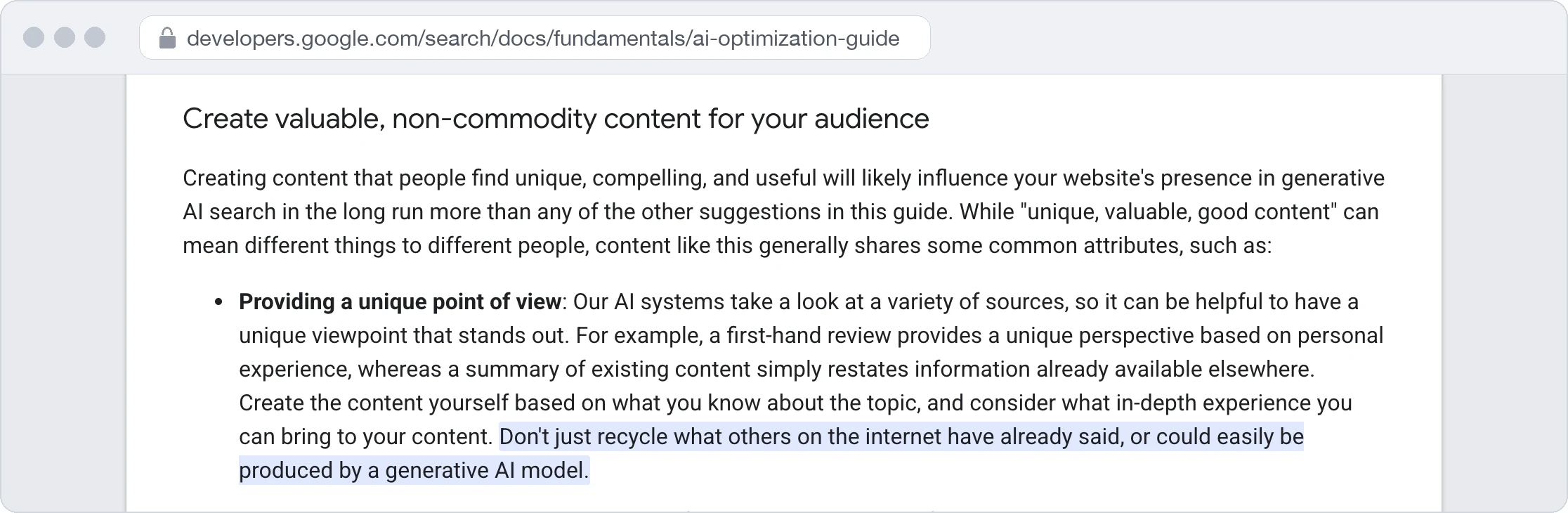
Google's guide to AI features says unique, non-commodity content will likely influence a website's presence in AI search in the long run more than any of its other suggestions. Kieran Flanagan, HubSpot's senior vice president of marketing, AI, and go-to-market, gives his view of what marketers see: "More content today comes from AI than from humans, and most of it is forgettable. Audiences are already learning to tune out anything that reads generic."
An editorial standard keeps AI on the work around the writing:
- AI tools transcribe and summarize interviews, cluster support tickets and call notes, propose outlines, and check consistency.
- People choose the angle and the claims, write the page, and verify every fact and figure.
- People approve the page and own it after it goes live, including the facts that change with each release.
Who should write SaaS content: in-house, freelance, or an outside team?
Companies give SaaS content writing to in-house specialists, freelancers, or an outside team. Freelancers add capacity for defined projects, and an outside team can bring a steady process. The deciding factor is access to customers and product experts, then technical depth, volume, and compliance review. The comparison of outsourced and in-house writers covers the trade-offs.
As a rule of thumb, an in-house writer fits a product that changes every month, and a freelancer fits well-briefed pages on stable topics. An outside team fits a company without a content lead that also needs the process and the measurement. Whoever writes, the brief shapes the result. A SaaS content brief carries:
- the search intent and the question the page answers;
- the reader's role and stage;
- the interview notes and the product expert to check with;
- the determiner to prove, and its proof;
- the facts, each with an owner and a date;
- a primary call to action and the internal links.
A draft is ready when it passes the logo swap test, every fact is verified, the main question is answered in the first screen, and the page has one clear primary call to action. The list of SaaS blog writing companies helps compare outside writing teams.
How Omnius approaches SaaS content writing
People write and edit Omnius content, and AI handles the work around the writing. Omnius's memo sets the standard for AI-assisted work: every page has to add judgment, context, taste, ownership, or technical depth that a model cannot provide on its own. As the memo puts it, "Models can process, generate, and recommend, but strategy still needs human judgment." Omnius's technology reduces the collection, monitoring, and repetitive analysis around that judgment. The work runs in four parts, from interviews and messaging through the writing to measurement per page.
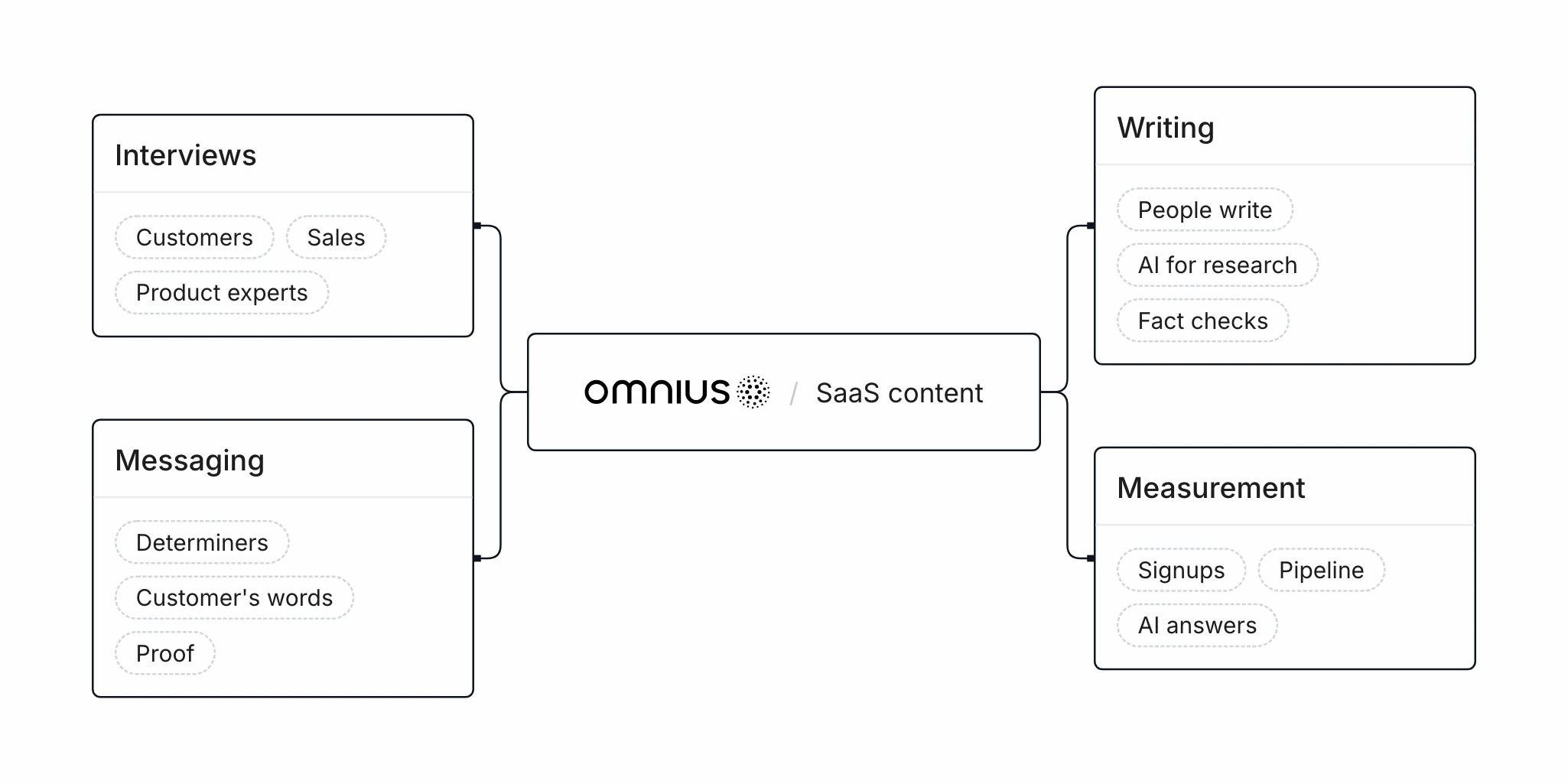
Omnius's SaaS content writing page explains how the work runs.
FAQ
How to learn SaaS content writing?
Learning SaaS content writing starts with the industry and the people who choose software. The core skills are turning complex features into plain benefits, interviewing customers and experts, knowing SaaS metrics such as churn and customer acquisition cost, and SEO around the problems people search for. Studying strong SaaS content and asking for feedback refine them.
What do SaaS writers write about?
SaaS writers write about the product, its features and benefits, the problems it solves, industry insights, case studies and customer stories, blog posts, user guides, tutorials, and thought leadership. Beyond the six formats above, the work covers white papers, ebooks, ROI calculators, release notes, in-app and onboarding copy, and documentation. The goal is to engage, educate, and convert readers into customers.
How does a SaaS company create a content strategy?
A SaaS company creates a content strategy by defining its audience, setting goals, researching keywords, planning content types, building an editorial calendar, and measuring performance. The strategy holds up when it rests on audience evidence, such as the problems customers describe in interviews. Its goals need a measure the company tracks.
How to write a SaaS blog?
A strong B2B SaaS blog post starts with a specific title, introduces the problem the product solves, explains the benefits, gives a real example, and ends with a call to action. Short, plain sentences help readability. Google's spam policy lists automated rewording, such as synonymizing, among its examples of scaled content abuse.
Should SaaS content be written with AI?
SaaS content can use AI, as long as people check it and add what only the company knows. Google says appropriate use of AI is not against its guidelines, and its review advice covers titles, meta descriptions, structured data, and alt text as well as the body.
How is SaaS content writing different from SaaS content marketing?
SaaS content writing is the writing itself, while SaaS content marketing is the wider program around it: strategy, distribution, budget, and measurement. A company can have a strong content marketing plan and still lose deals if its product, pricing, and comparison pages stay generic.
Methodology
This update keeps the structure and examples of the earlier guide, first published in June 2023, and brings its facts to October 2026.
- Google's documentation. The guidance on AI-generated content, the generative AI features guide, and the spam policies, read from October 18 to 27, 2026.
- Surveys. G2 (1,076 people who buy B2B software, March 2026), Semrush (519 US B2B professionals who use AI at work, March to April 2026), Wynter (100 B2B SaaS marketing leaders, September 2026), and TrustRadius (1,862 technology purchasers, January 2026).
- Benchmarks and click data. Wynter's Sameness Checker tool scored 445 category-leader homepages, separately from its survey. Advanced Web Ranking supplied click data (about 1 million tracked Google US desktop results pages a month, July 2026). Each of these publishers sells products related to what it measured.
- Images. The Truffle, Crazy Egg, Nike, and Google screenshots were captured on October 27, 2026. The email is an example written for this guide, and the A/B testing cycle comes from the earlier version.
- Examples. Vendor A, Vendor B, and Vendor C are invented for the worked example.
Sources: Google, guidance on generative AI content · Google, AI features guide · Google, spam policies · Google, AI-generated content (2023) · Google, controls for website owners · Google, inline links update · Wynter, B2B customer research · Wynter, marketing decisions survey · HubSpot, state of generative AI · TrustRadius, 2026 Buying Disconnect report · Backlinko, Google CTR stats · Statista, daily emails