.png)

Search-like activity is increasingly split between traditional search engines and AI assistants. Google now processes more than five trillion searches per year, while ChatGPT handles billions of prompts every day.
And both are still growing.
This dual ecosystem shapes how information is found, evaluated and acted on across the web.
Traditional search continues to route most visits and revenue. AI assistants, meanwhile, are becoming a default layer for understanding topics, comparing options and drafting decisions.
There is growing interest from companies that depend on organic growth, as a larger share of research and problem framing now happens inside AI interfaces. At the same time, the absolute volume and market share of Google Search remain dominant.
So organisations are looking closely at how demand, discovery and referral traffic are split between Google and AI assistants.
This report provides a structured overview of the ChatGPT vs Google search landscape in 2025, highlighting key metrics, behavioural patterns, algorithmic differences and implications for SEO and GEO.
1. Scale: Google Still Outpaces ChatGPT by a Wide Margin
1.1 Data
Key quantitative benchmarks for 2025:
- Google Search
- More than five trillion searches per year (≈13-14 billion searches per day), according to Google’s 2025 disclosure reported by Search Engine Land.
- Over 90% share of global search engine usage in most market-share reports.
- More than five trillion searches per year (≈13-14 billion searches per day), according to Google’s 2025 disclosure reported by Search Engine Land.
- ChatGPT
- Around 2.5 billion prompts per day, based on OpenAI figures reported by TechCrunch and The Verge.
- Approximately 700-800 million weekly active users and billions of visits per month, as aggregated in the DemandSage ChatGPT statistics.
- Around 18 billion messages per week are sent by roughly 700 million users by July 2025, representing about 10% of the world’s adult population, according to the NBER working paper How People Use ChatGPT.
- Around 2.5 billion prompts per day, based on OpenAI figures reported by TechCrunch and The Verge.
Data callout: Based on these sources, Google currently processes hundreds of times more search-like actions per year than ChatGPT, but both operate at global scale.
Table 1. Approximate scale: Google Search vs ChatGPT (2025)
1.2 Analysis
The numbers show that Google remains the dominant infrastructure for search-like actions. Its annual search volume and daily query counts are still several orders of magnitude higher than ChatGPT’s prompt volume.
At the same time, ChatGPT has clearly reached internet-scale adoption. Handling billions of prompts per day and hundreds of millions of weekly active users places it in the same category as the largest consumer internet platforms.
Traditional search has not collapsed under the pressure of AI assistants; instead, both channels have grown. Google’s total yearly searches increased beyond five trillion, while ChatGPT expanded from a new product to a globally used assistant in a short timeframe.
1.3 Implications
For organic growth and measurement, this means that Google Search is likely to remain the primary source of organic sessions for most sites in the near term.
ChatGPT and similar tools represent a second layer of search-like activity, with significant reach and a distinctive impact on how people frame problems, options and criteria.
The realistic scenario for the next 12-24 months is coexistence: traditional search defines the bulk of measurable traffic, while AI assistants increasingly influence decisions before any visit occurs.
2. Behaviour: Users Treat Search and AI Assistants Differently
2.1 Data
Observed behaviour in ChatGPT and Google Search is different, even for similar topics.
For ChatGPT, the NBER study How People Use ChatGPT finds that prompts are concentrated in a few categories: information seeking and fact-finding, explanation and summarisation, practical guidance and planning, and writing, rewriting and coding tasks.
Many interactions follow a multi-step conversational pattern: an initial question, a generated answer, and follow-up prompts that refine or extend the task.
For Google Search, analyses of hundreds of millions of queries by SparkToro and Datos, including the 2024 Zero-Click Search Study and the State of Search reports, show a different pattern.
Users typically search, scan the SERP and click one or two results. Simple informational queries often end on the results page, and a large portion of queries are navigational or transactional.
.webp)
Table 2. Typical behaviour patterns: Google vs ChatGPT
2.2 Analysis
These patterns indicate a division of roles.
Google Search is primarily used to reach specific destinations and to complete actions. A typical journey is task- or site-oriented and ends when the relevant page is found or an action is performed.
ChatGPT is primarily used to understand, design or draft. It is more often involved where a topic must be clarified, a process broken down or a plan created. The interface supports iteration and refinement, making it suitable for complex or open-ended questions.
In many cases, the two systems are sequenced: a conversation in ChatGPT produces clarity or a draft, and then traditional search or direct navigation is used to access documentation, interfaces or pricing pages.
2.3 Implications
From a discovery perspective, traditional search remains critical at the point of action, where sessions turn into sign-ups, purchases or deeper evaluations.
AI assistants increasingly act upstream, shaping how problems are defined, which categories are considered and which vendors enter the initial shortlist.
The question is therefore not only where users click, but where they form their understanding before reaching the SERP or the site.
3. Traffic: Zero-Click Behaviour Limits Measurable Visits
3.1 Data
Zero-click studies provide a clearer view of how often searches result in traffic.
The SparkToro 2024 Zero-Click Search Study and related coverage in Search Engine Land report that in the analysed period:
- 58.5% of Google searches in the United States ended without a click to any external website.
- 59.7% of Google searches in the European Union ended in the same way.
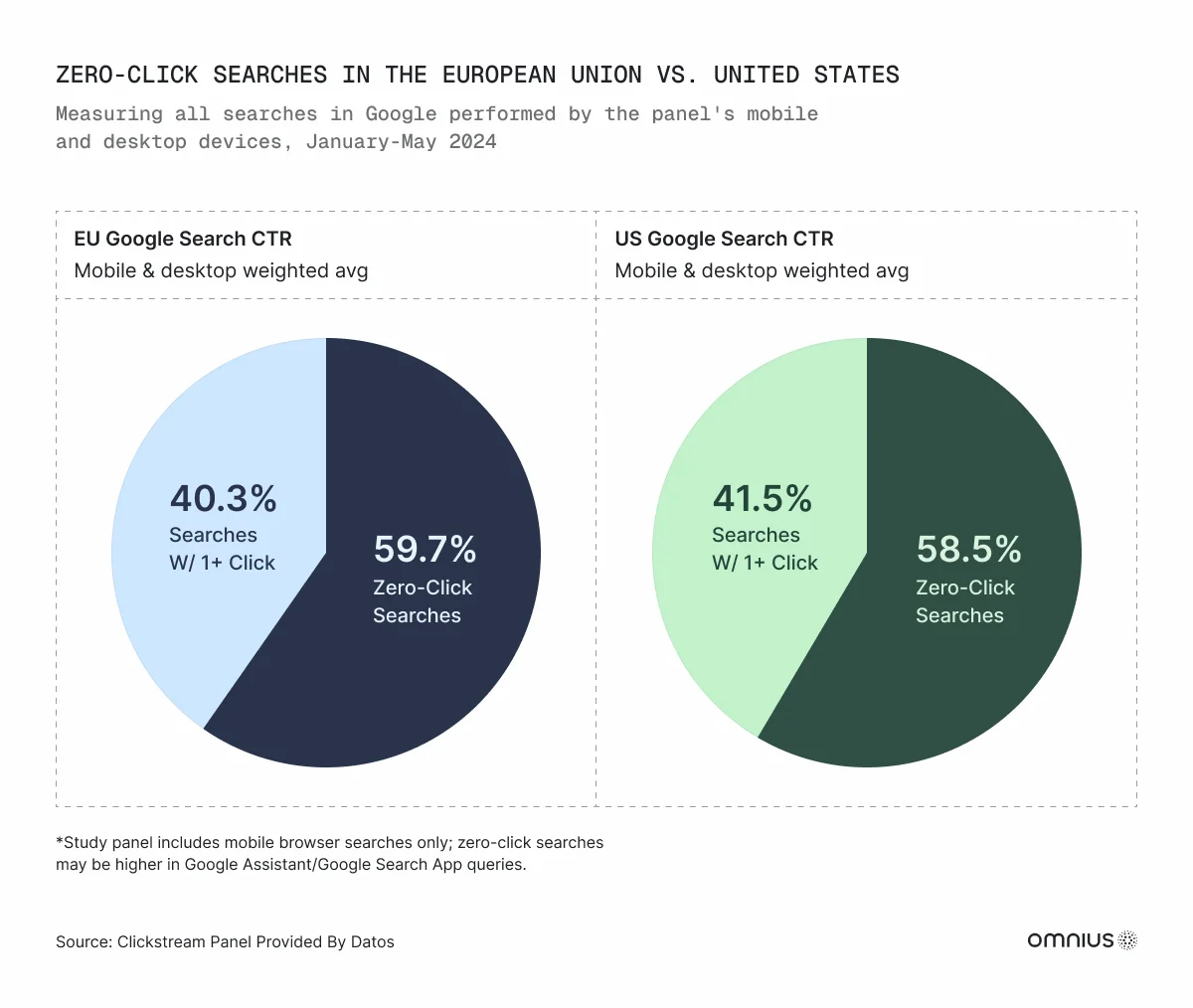
Only about one-third of searches led to a click on a non-Google result, with the remainder ending on the SERP, going to another Google property or turning into a new query.
Despite this, the Datos State of Search reports and related analyses conclude that traditional search engines, with Google at the centre, remain the largest overall source of referral traffic for most websites.
For AI assistants, internal case studies and public examples summarised in resources such as the AI Search Industry Report 2025 and the overview of AI search monitoring tools point to a similar constraint in a different environment.
Many ChatGPT sessions end with the answer inside the interface, without any external click. When external links are followed, they tend to be few in number but highly focused.
Data callout: In both Google Search and AI assistants, a majority of search-like interactions are zero-click, but AI-originated clicks often correspond to later-stage, high-intent behaviour.
3.2 Analysis
The data shows a dual constraint.
Traditional search engines generate enormous query volume but allow fewer queries to translate into visits, especially for simple informational needs that can be satisfied on the results page.
AI assistants address many questions directly in the conversation, resulting in lower total outbound click volume, but stronger pre-filtering when a click is finally presented.
Both systems therefore capture a large share of user attention and information consumption without always passing that attention on to websites as measurable sessions.
3.3 Implications
For organic measurement and strategy, search-originated sessions represent only a subset of the influence exerted by Google and AI assistants on user decisions.
Zero-click behaviour reduces the ratio of searches to sessions, particularly for informational queries, even when visibility in SERPs remains strong.
AI-originated visits highlight a small but especially valuable segment of traffic: users who arrive after consuming an explanation that has already placed a brand or product in a relevant context.
This reinforces the need to consider both visibility in interfaces (SERPs and AI answers) and conversion quality of the sessions that do occur.
4. Algorithms: AI Assistants Reason, Search Engines Rank
4.1 Data
Traditional search engines and AI assistants differ in how they select and present information.
For Google Search, ranking is based on a pipeline of crawling, indexing and signal-based ordering. Signals include relevance, link patterns, user interaction data, structured data and measures of expertise and trust. The output is a SERP with organic links, ads and rich elements such as featured snippets, “People Also Ask” boxes, image and video carousels, local packs and AI Overviews.
For ChatGPT and similar LLM-based assistants, the system interprets the input with a large language model, retrieves information from training data and, where browsing is enabled, from a limited set of live pages. It then composes a single answer or a small number of answers with a small set of citations.
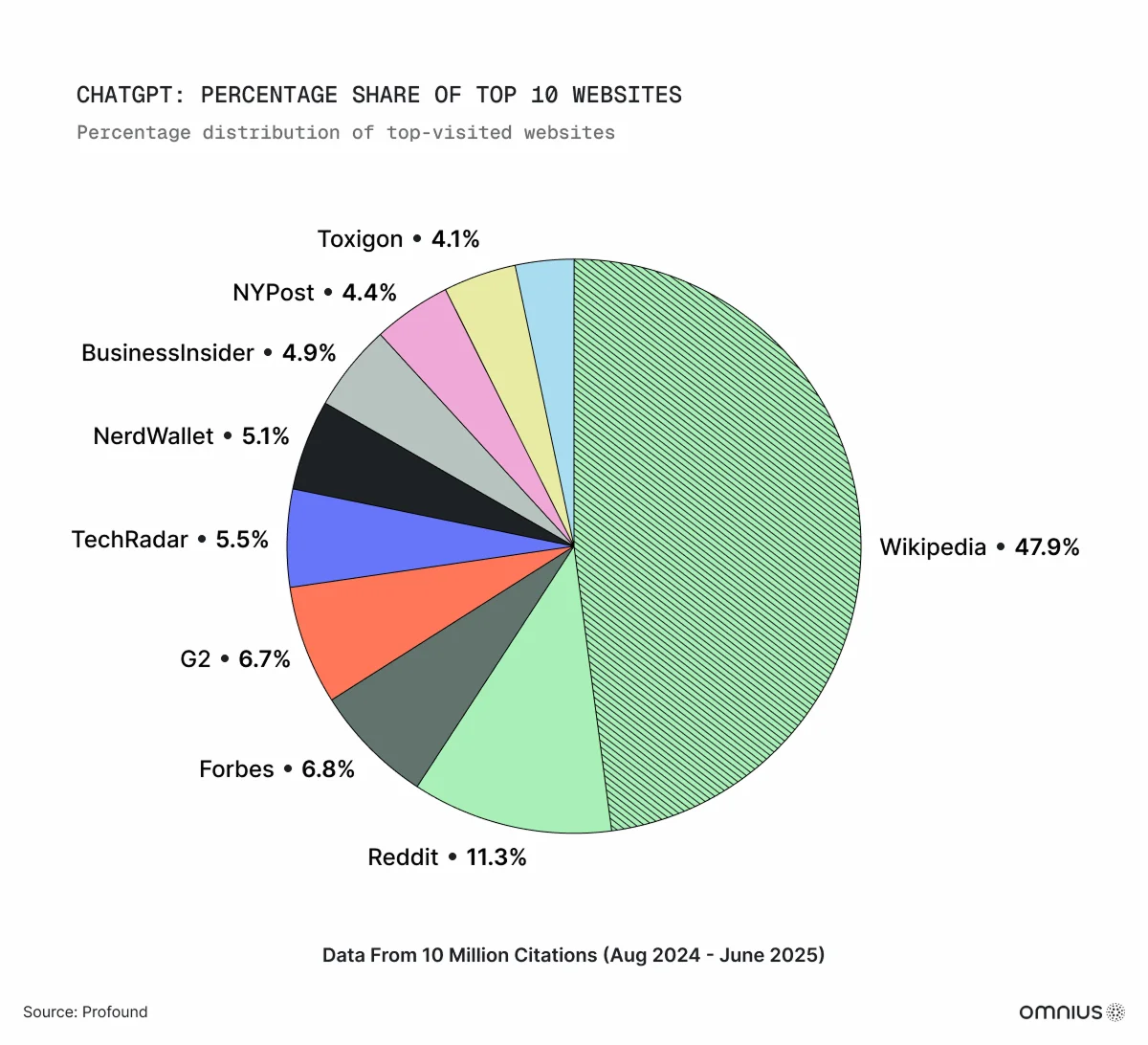
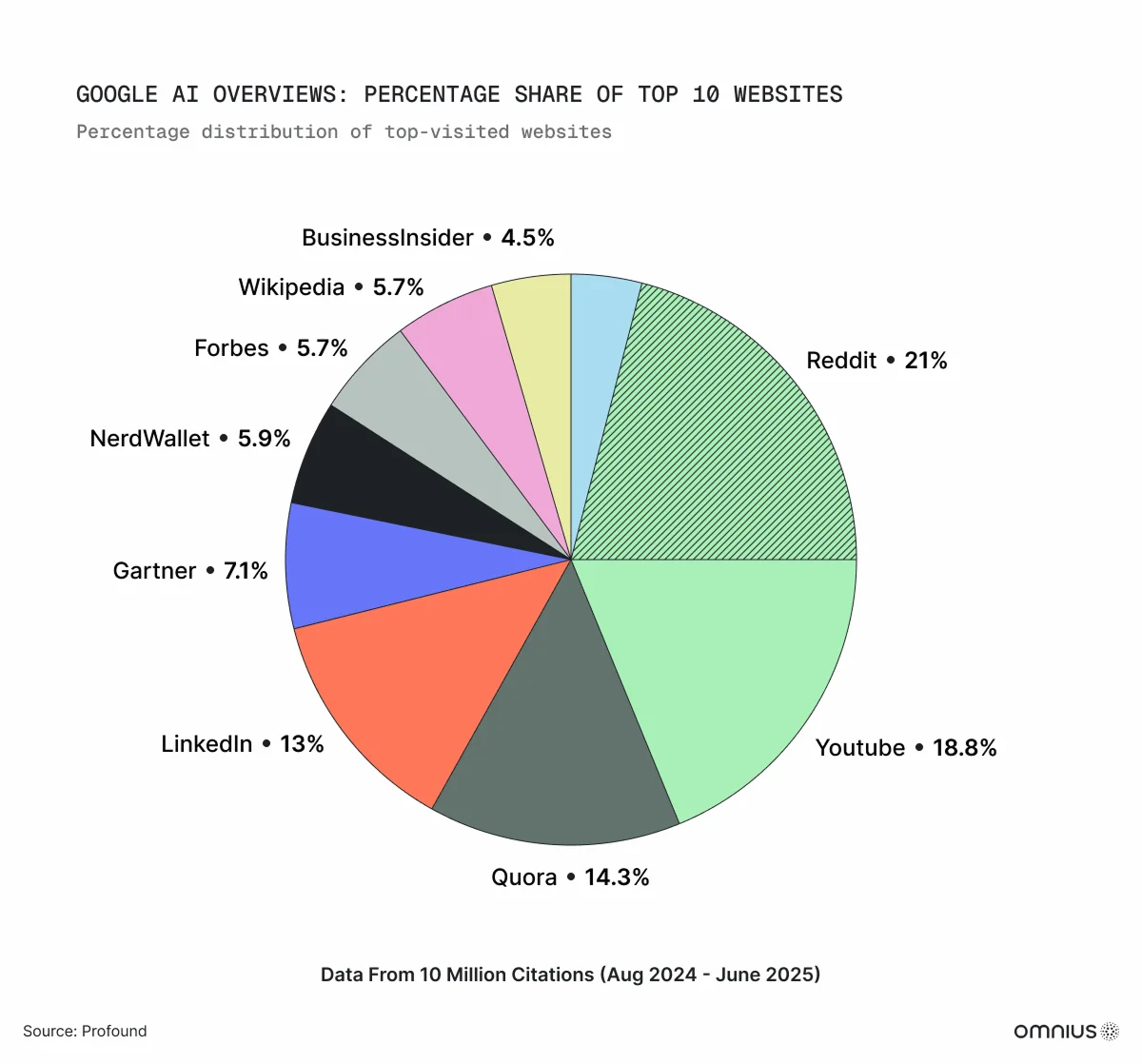
Cross-engine analyses, including Google vs ChatGPT & AI Platforms Q1 2025, show that generative engines repeatedly rely on a relatively small set of domains in each topic area and often cite the same sources across related questions.
Table 3. Selection logic: search ranking vs generative reasoning
4.2 Analysis
These differences create two distinct visibility regimes.
In Google Search, visibility depends on relative position in a ranked list or rich element. Multiple domains can appear prominently and share user attention for a query.
In ChatGPT, visibility depends on selection into a small internal shortlist of sources for a given topic. The model consolidates multiple documents into a single narrative and surfaces only a few references.
This leads to higher concentration of exposure in AI environments: a small number of domains receive most of the citations for a topic, while others remain invisible even if they are indexed and available.
4.3 Implications
For content and SEO teams, optimisation is no longer only about ranking higher than competitors in traditional SERPs. It also includes becoming one of the default domains that models choose to cite, reducing ambiguity through clear entity definitions and increasing factual density and precision so that models can safely extract and reuse information.
Competition shifts from “one of ten blue links” to “one of a few trusted citations” in generated answers.
5. Optimisation: SEO Foundations Hold, GEO Extends into AI
5.1 Data
Traditional SEO continues to rely on familiar foundations: technically healthy sites, structured information architecture and internal linking, and content that matches search intent and earns relevant links. The Complete B2B SEO Hub documents these fundamentals for B2B contexts.
Analyses of AI search visibility are summarised in resources such as the GEO Industry Report 2025 and the AI Search Industry Report 2025.
Practical guidance on GEO and AI search can also be found in topic-focused articles such as How to Rank on ChatGPT, How AI & LLM Tracking and Monitoring Tools Really Work and the list of AI search monitoring tools.

Across these resources, several content characteristics appear repeatedly: clear entity naming, answer-first layouts, higher factual density and systematic monitoring of AI citations.
5.2 Analysis
These patterns point to a layered optimisation model. Traditional SEO focuses on making it easy for search engines to discover, understand and rank content. GEO and AI search optimisation focus on making it easy for generative engines to summarise and safely quote that content.
The same page structures - clear definitions, hierarchical headings and concrete data - tend to support both ranking in SERPs and selection in LLM answers.
5.3 Implications
In practice, classic SEO is not replaced by AI search work; it remains the foundation for visibility. GEO adds a second layer that aligns content with the way models reason and cite sources.
Monitoring shifts from watching only rankings and organic sessions to including AI citations and mentions as part of the visibility picture, as described in resources such as It’s SEO + GEO, Not SEO vs. GEO and Technical SEO for AI Search.
Organisations that treat AI search as an extension of SEO, rather than as a separate or competing channel, are better positioned to benefit from both ranking logic and reasoning logic.
6. Outlook: AI Gains More Upstream Power in the Next 24 Months
6.1 Data
Several trends are visible in recent data:
- Total Google Search volume has increased to more than five trillion searches per year, with significant growth reported between 2024 and 2025.
- ChatGPT prompt volume has reached around 2.5 billion prompts per day, with hundreds of millions of weekly active users, based on OpenAI-related reporting and aggregated statistics.
- Zero-click rates remain above 50% in major markets, limiting the proportion of queries that become external sessions.
6.2 Analysis
Based on these patterns, the likely 12-24 month scenario includes a higher proportion of early-stage research beginning in AI assistants, especially for complex, multi-constraint questions, and increasing integration of AI prompts into productivity tools, browsers and communication platforms.
User journeys alternate between conversational steps (clarifying needs and options) and SERP or direct navigation steps (checking interfaces, pricing and implementation). The gap in aggregate volume between Google Search and ChatGPT is expected to remain large, but the influence of AI answers on perception and shortlists is likely to grow.
6.3 Implications
Over this period, “organic performance” is likely to be defined less by a single channel and more by a combined view of visibility across search and AI layers. Practical implications include tracking presence not only in SERPs and AI Overviews, but also in AI assistant citations; recognising that some high-value sessions will be AI-assisted upstream, even if they appear as direct or organic traffic; and aligning content and technical work with both ranking logic and reasoning logic.
This blended reality suggests that ChatGPT vs Google search is not a zero-sum equation, but a description of how different systems share and shape the search-like workload.
7. Key Findings
The analysis across sections leads to several key findings:
- Google Search still processes many times more search-like actions than ChatGPT and remains the core source of search-originated traffic, while ChatGPT operates at global scale with billions of prompts per day and hundreds of millions of weekly users.
- Traditional search and AI assistants occupy distinct roles in the user journey: search engines are central for navigation, interfaces and transactions, whereas AI assistants are central for explanation, planning and upstream research.
- Both systems show high zero-click rates, but AI-originated clicks often correspond to later-stage, high-intent visits, making them particularly valuable despite lower absolute volume.
- Ranking-based and reasoning-based mechanisms create two visibility regimes: one focused on SERP position and one focused on selection into a small set of trusted sources.
- Effective strategies increasingly combine classic SEO fundamentals with GEO and AI search optimisation, focusing on entity clarity, factual density and answer-first structures to secure visibility in both SERPs and AI-generated answers.
Conclusion
By 2025, the relationship between ChatGPT and Google Search is best understood as a layered search ecosystem built on two different but connected systems: ranking-based search engines and reasoning-based AI assistants.
Google remains the dominant actor by volume, processing trillions of queries per year and driving the majority of search-originated sessions and revenue. ChatGPT, meanwhile, operates at massive scale in its own right, handling billions of prompts per day and shaping how people understand topics, compare options and prepare to make decisions.
The behavioural, algorithmic and traffic patterns described in this report point toward a long-term landscape in which traditional search defines where and how often content is surfaced, and AI assistants increasingly define how that content is framed, compared and interpreted before a session takes place.
For organisations that depend on organic growth, the central shift is from optimising for a single list of links to optimising for cross-engine visibility: presence in SERPs, presence in AI-generated answers and consistent, trustworthy information across all surfaces.
Omnius documents this blended reality through its SEO, GEO and AI search research, including the GEO Industry Report 2025, the AI Search Industry Report 2025, the Google vs ChatGPT & AI Platforms Q1 2025 analysis and the Complete B2B SEO Hub, providing a factual basis for decisions in an environment where both traditional search and AI assistants jointly shape discovery and demand.
FAQ
Q1. Is ChatGPT currently taking market share away from Google Search?
Available data indicates that AI assistants are adding a new layer of search-like activity rather than causing a collapse in traditional search. Google’s total yearly searches have continued to grow, passing five trillion searches per year, while ChatGPT prompt volume has scaled to billions of prompts per day. The more visible change lies in how often queries are resolved without clicks, and in how much early-stage research now takes place inside AI interfaces instead of on SERPs.
Q2. How large is ChatGPT compared with Google in terms of usage?
ChatGPT processes roughly 2.5 billion prompts per day and has an estimated 700-800 million weekly active users, which corresponds to around 10% of the global adult population. Google Search, by comparison, handles more than five trillion searches per year and around 13-14 billion searches per day, with over 90% share of the global search engine market. In aggregate, Google still processes many times more search-like actions than ChatGPT, even though both systems operate at global scale.
Q3. Does it make sense to optimise specifically for AI search if Google still dominates?
Google Search remains the primary source of organic sessions for most sites and continues to be the main reference point for measuring search performance. At the same time, early case studies and monitoring data show that visitors arriving from AI assistants such as ChatGPT and Perplexity often display higher intent and stronger conversion behaviour, because they reach a site after reading a contextualised explanation that already positions a product or brand as relevant. In practice, optimisation strategies increasingly combine traditional SEO for SERPs with GEO and AI search work aimed at securing citations and accurate descriptions inside AI-generated answers.


.png)

.svg)
















.svg)



























.svg)