.png)

Did you know that 65% of businesses have noticed better SEO results with the help of AI?
Artificial Intelligence is now beneficial almost everywhere. It’s becoming part of every business where automation can be a good approach for improving the current manual and slow workflow.
Since AI is growing rapidly in its capabilities, processes, speed, knowledge, and data, it's creating opportunities for new technologies to build even better solutions.
That's how the idea and creation process of AI agents were built. Why do things manually when you can use an agent that does them for you faster?
AI agents are now part of all niches, so SEO is never left behind.
In this guide, we will walk you through essential things you need to know about AI SEO agents, what they are, the benefits of using them, key use cases and functionalities, limitations, and the implementation process.
Let’s dive in!
What are AI SEO agents?
AI SEO agents are systems built with AI that automate manual SEO tasks with minimal or no human intervention.
Unlike traditional SEO tools that are assistants. AI SEO agents actually do the work. You give them a goal, such as "optimize our blog posts for featured snippets" or "fix technical SEO issues across the site," and they figure out how to accomplish it.
They don't just hand you a report: they scan your content, rewrite meta descriptions, update heading structures, and implement schema markup without waiting for your approval on each change.
The difference is autonomy. A regular tool is a calculator that waits for your input. An agent is more like hiring someone who knows what needs to be done and gets on with it.
For example, if Google's algorithm changes and suddenly prioritizes different ranking factors, a traditional tool won't know or care. You'd need to read about the update, figure out what it means, and adjust your strategy. An AI agent monitors these changes, recognizes the pattern in ranking shifts, and modifies its approach accordingly; often before you've even heard about the update.
That's the core idea: less time telling tools what to do, more time on strategy, while the execution happens automatically.
Benefits of AI SEO Agents
Here are some of the benefits of using AI SEO agents in your daily SEO workflows:
- Reduce time for manual (repetitive) tasks - Tasks that take hours manually get done in minutes, freeing up your schedule for work that actually requires thinking.
- Reducing the cost of hiring a new employee for simple tasks - An agent subscription costs $1,200-$6,000 yearly compared to $50,000-$80,000 for an SEO specialist who'd spend most of their time on repetitive work anyway.
- Fewer mistakes/errors in execution - Agents don't get tired or distracted on the 247th page audit, so they catch duplicate meta descriptions and broken links that you'd inevitably miss.
- Better work-life balance (less burnout) - Stop spending your evenings manually checking rankings and your weekends fixing technical issues that an agent handles automatically.
- Faster results and revenue growth - Optimizations that would take months to implement manually happen in days, which means you start seeing traffic and revenue increases sooner.
- Scale revenue without scaling headcount - A two-person team with agents can manage the traffic growth that would normally require hiring four more people.
- Competitive edge over manual competitors - While your competitors spend weeks planning their next content update, you've already analyzed the data, implemented changes, and moved on to the next opportunity.
Use Cases of AI SEO Agents in Practice (Where to use AI SEO agents in daily SEO workflows?)
Properly using AI SEO agents in your daily SEO workflows can really help you improve your work performance.
Here are the use cases where properly using AI SEO agents can help:
1. Keyword Research
The keyword research process is typically a manual task that requires sorting the right keywords from a large list of keywords.
AI SEO agents can handle the manual sorting part of keyword research after you give them the right information about your business and how you would like to expand your website.
Instead of manually sorting through thousands of keywords in spreadsheets, agents can automatically cluster related keywords into main topic groups that align with your business goals.
The agent can also suggest which keywords and clusters you should prioritize based on the competitor landscape.
For example, if you're targeting "email marketing" but missing opportunities around "email automation workflows" or "transactional email best practices," the agent flags these gaps and prioritizes them based on search volume and difficulty.
This helps SEOs with their keyword research, from manually sorting and classifying which keywords to focus on to a strategic roadmap that shows exactly where to invest their content efforts for maximum impact.
2. Technical SEO
Technical SEO agents run automated audits on your selected timeframe, whether that's weekly, biweekly, or monthly. You set the schedule once, and the agent continuously monitors your site without requiring manual intervention.
These agents go beyond just reporting issues. They actually implement SEO best practices across your site, such as:
- Updating title tags that are too long, too short, missing or duplicate
- Rewriting duplicate meta descriptions, and
- Fixing improper heading tag structures (like when pages skip from H1 to H3).
- Implementing schema markups properly where they are missing
- Suggesting page speed improvements
The agent also discovers internal linking opportunities by analyzing your content relationships and suggesting where links would strengthen topical authority.
For a site with hundreds of pages, this automated internal linking strategy can significantly improve how search engines understand and rank your content, all without you having to review every page manually.
For example, AtomicAGI breaks this down into dedicated technical SEO agents, each handling a specific part of the process.
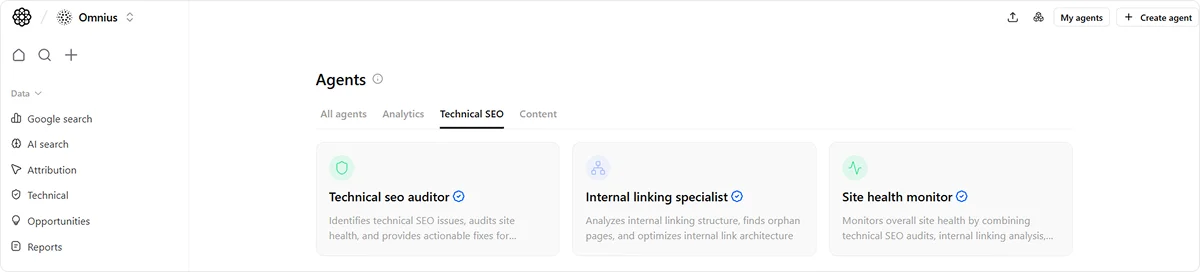
The Technical SEO Auditor identifies issues and provides actionable fixes, the Internal Linking Specialist finds orphan pages and optimizes your link architecture, and the Site Health Monitor ties everything together by continuously tracking overall site health across audits and internal linking.
This way, instead of one agent trying to handle everything at once, each task gets its own focused agent working on it.
Note: It’s important to initially test the AI SEO agent for these implementation steps to ensure that all tasks are completed accurately and won’t harm the current SEO performance.
3. Off-Page SEO
AI SEO agents can automate the discovery process for great link-building opportunities.
They scan your niche to identify high-authority sites that link to your competitors but not to you, find broken links on relevant sites where your content could serve as a replacement, and discover unlinked brand mentions that you can convert into backlinks.
Beyond finding opportunities, agents help you manage your backlink profile by identifying toxic links that could harm your rankings.
The agent analyzes your current backlink portfolio that you shared with them, flags suspicious or low-quality links based on metrics like spam scores and relevancy, and helps you create a disavow file for Google.
This automated backlink health monitoring means you're not caught off guard by negative SEO attacks or algorithm updates that penalize poor-quality links.
The agent continuously watches your link profile and alerts you when action is needed, turning backlink management from a quarterly panic into an ongoing, manageable process.
4. Content Optimization
AI agents analyze your existing content against top-ranking competitors to identify gaps in coverage, suggest additional subtopics to include, and flag grammatical errors or readability issues.
They don't just point out problems but actually rewrite sections to improve clarity and SEO performance.
For instance, if your article on "email marketing strategies" ranks on page two, an agent compares it to the top five results and discovers they all cover "A/B testing" and "segmentation tactics" in detail, while your piece only mentions them briefly.
The agent then generates expanded sections on these topics, incorporating relevant keywords and maintaining your brand voice.
Agents also create content outlines for new articles based on keyword research, ensuring you cover all the semantic variations, secondary keywords, and FAQs that users actually search for.
Note: Make sure that AI SEO agents are not doing the whole article creation process; they can assist, create an outline or give recommendations, but take care not to give them to write the whole article, because Google may eventually penalize you for this.
5. Review Monitoring
Your online reputation directly impacts SEO performance, but manually checking review sites is time-consuming. AI agents continuously monitor review platforms like Google Business Profile, G2, Yelp, Trustpilot, industry-specific review sites, and other websites that mention your website, either in a positive or a negative way.
When negative reviews appear, the agent alerts you immediately so you can respond before the damage compounds. It can even draft professional response templates based on the specific complaint, maintaining a consistent brand voice while addressing customer concerns.
The agent also tracks review sentiment trends over time, identifying recurring issues that might indicate bigger problems with your product or service. If five customers mention slow shipping in the same week, you'll know to investigate your logistics rather than treating each complaint as an isolated incident.
6. Competitor Analysis
Instead of manually visiting competitor sites and taking notes, AI agents continuously track what your competitors are doing and alert you to significant changes. They monitor new content publications, keyword ranking shifts, backlink acquisitions, technical implementations like schema markup or site speed improvements, and changes in content strategy or site structure.
For example, if your main competitor suddenly starts ranking for a cluster of keywords you haven't targeted, the agent identifies the content they published, analyzes why it's performing well, and suggests how you can create something better.
It might discover they've added comprehensive FAQ sections with schema markup, which explains their improved visibility for question-based searches.
The agent generates regular competitive intelligence reports showing where you're gaining or losing ground, which saves hours of manual analysis and ensures you never miss an important shift in your competitive landscape.
Implementation of AI SEO Agents
Successfully implementing AI SEO agents requires a methodical approach. Here's how to do it right:
1. Test Before You Commit
Before integrating any AI SEO agent into your daily workflow, run thorough tests to understand what it can and can't do for your specific needs.
Don't force an AI SEO agent into your routine just because it's trending or because competitors are using it. An agent that works perfectly for their SEO practices might not fit yours at all.
Set up a testing environment or select a small section of your site to evaluate the agent's performance. Monitor how it handles your specific use cases, whether that's technical audits, content optimization, or keyword research.
2. Start Small and Scale Gradually
After initial testing proves successful, begin incorporating the agent slowly into your workflow. Don't automate everything at once.
Start with low-risk, repetitive tasks like meta description updates or keyword clustering. Monitor the results closely for the first few weeks. Once you're confident in the agent's performance on simple tasks, gradually expand its responsibilities to more complex operations.
3. Establish Oversight and Quality Control
If you're an SEO manager or agency owner, collect weekly feedback from SEO specialists working with the agent. Understand what's working, what's frustrating, and where the agent needs improvement.
Require SEO specialists to verify that tasks completed by the agent are correct and properly structured. Bugs, issues, and technical problems happen, so never adopt a fully automated, "set it and forget it" approach.
For example, an agent might change a perfectly performing title tag, which could harm CTR and directly impact business revenue. These mistakes are rare but brutal when they happen, which is why human oversight remains essential.
4. Set Clear Guardrails
Define which tasks the agent can complete autonomously and which require human approval.
For instance:
Autonomous tasks: Duplicate meta description fixes, internal linking suggestions, keyword clustering, technical audit reporting
Approval required: Homepage changes, high-traffic page optimizations, brand-sensitive content updates, major structural changes
5. Create Feedback Loops
Agents improve through feedback. When the agent makes a mistake or produces suboptimal results, document it and adjust the agent's parameters accordingly.
Most AI SEO agents learn from corrections, so treating errors as training opportunities rather than failures will improve performance over time.
6. Integrate with Your Existing Tools
Incorporate the capabilities of AI SEO agents with your current SEO tools. Connect the agent to your current tech stack through API integrations. Most agents work alongside analytics platforms, CMS systems, and ranking trackers rather than replacing them.
Proper integration ensures the agent has access to all necessary data and can implement changes without requiring constant manual input from your team.
3 Best AI SEO Agents on the Market to Use in 2026
Here is the list of the 3 best AI SEO agents on the market that SEO professionals can use and incorporate into their workflows:
1. AtomicAGI
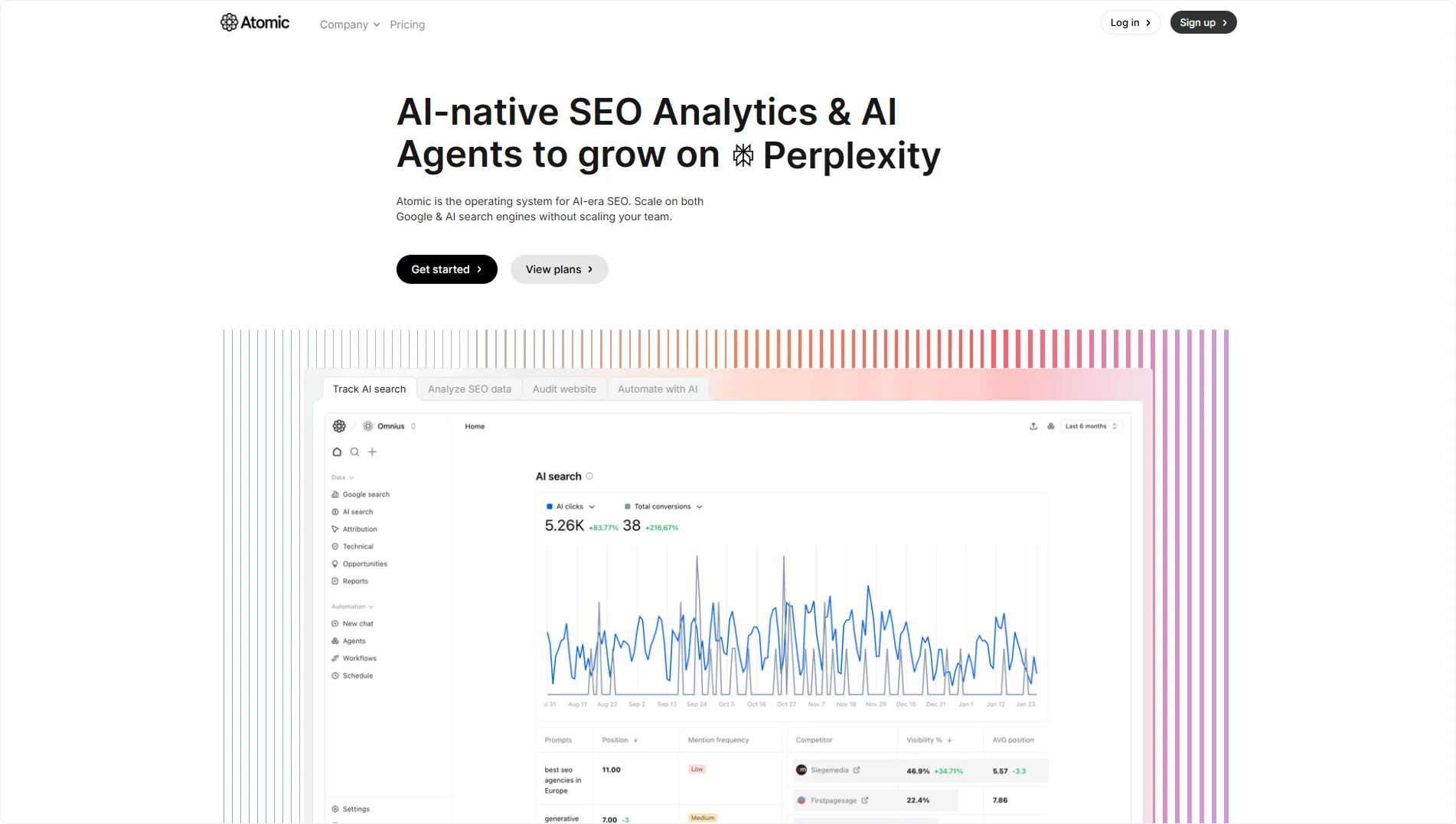
AtomicAGI is an AI SEO agent that analyzes your data and executes SEO tasks automatically based on your own proprietary data combined with a constantly updating knowledge base.
This means the agent produces recommendations and actions that are specific to your website's context, not generic suggestions.
What separates AtomicAGI from other AI SEO agents is its three-layer system: it tracks and analyzes your data, translates that data into specific actionable opportunities, and then uses AI agents to execute the work, all without you having to manually manage each step.
On top of that, AtomicAGI lets you build custom workflows that orchestrate multiple agents together. For example, the agent can pull data from Google Search Console, cross-reference it with Analytics, execute optimization tasks, publish updates directly to your CMS, and send notifications to your team via Slack, all in one automated process. No coding required.
Best for: SEO teams that want an AI agent that doesn't just report findings but actually executes tasks automatically using data specific to their own website.
Key Features:
- AI agents that work on your proprietary SEO data, reducing hallucination and producing site-specific recommendations
- Custom workflow builder that connects multiple agents, data sources, and tools into multi-step automated processes
- Three-layer system covering data analysis, data processing, and data automation in one platform
- Tracking across both Google and AI search engines, including visibility inside LLMs and technical performance
- Direct integrations with Search Console, Analytics, CMS, and Slack — no coding needed
Pricing: AtomicAGI offers a free tier to get started with no credit card required. Paid plans start at $10/month on the Starter plan, scaling up to Team and Enterprise tiers with more data, crawl credits, and custom pricing.
2. Chatsonic (by Writesonic)
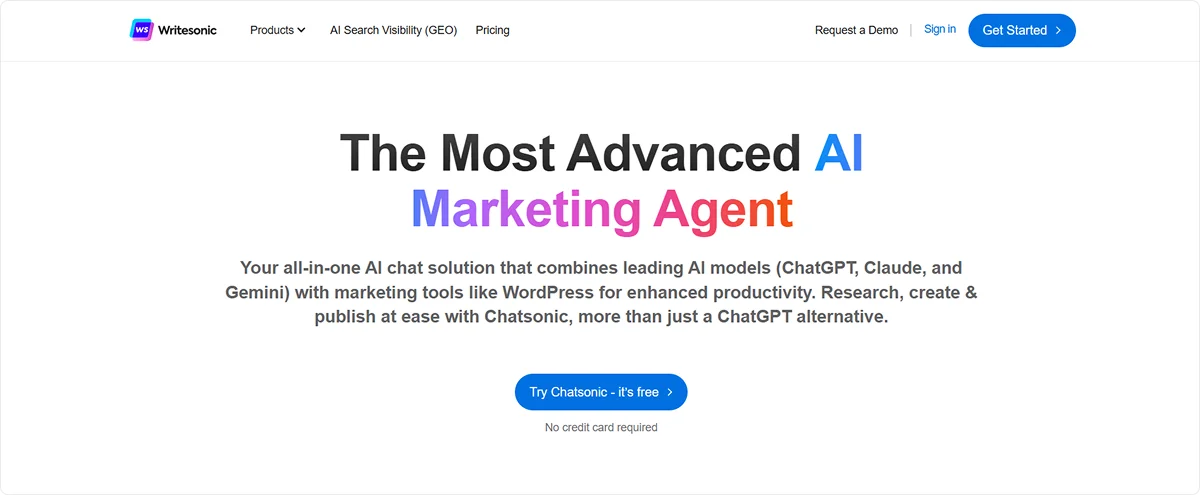
Chatsonic is an AI SEO agent designed to handle end-to-end SEO workflows, from keyword research and competitor analysis all the way through to content creation and publishing, using a single conversational interface.
Instead of jumping between multiple tools, the agent pulls live data from Ahrefs, Google Search Console, and other platforms on its own, runs the analysis, and delivers ready-to-act reports. This makes it one of the most practical AI SEO agents for teams that want to cut down on tool-hopping and get results faster.
Best for: Content marketers and SEO teams who want an AI agent that handles the full workflow from research to optimized content in one place.
Key Features:
- End-to-end SEO AI agent that automates research, analysis, content creation, and publishing in one workflow
- Live data integration with Ahrefs, Google Search Console, and Keywords Everywhere for real-time insights
- Automated keyword research and clustering with search volume, competition, and intent data
- Dedicated SEO mode for optimizing content with keywords, meta descriptions, and formatting
- Direct publishing to WordPress and brand voice customization using your own guidelines
Pricing: Chatsonic offers a free plan to start with. The paid plan begins at $16/month, with higher-tier plans through Writesonic scaling up to $199/month for larger teams and more advanced SEO workflows
3. Nightwatch (NightOwl AI SEO Agent)
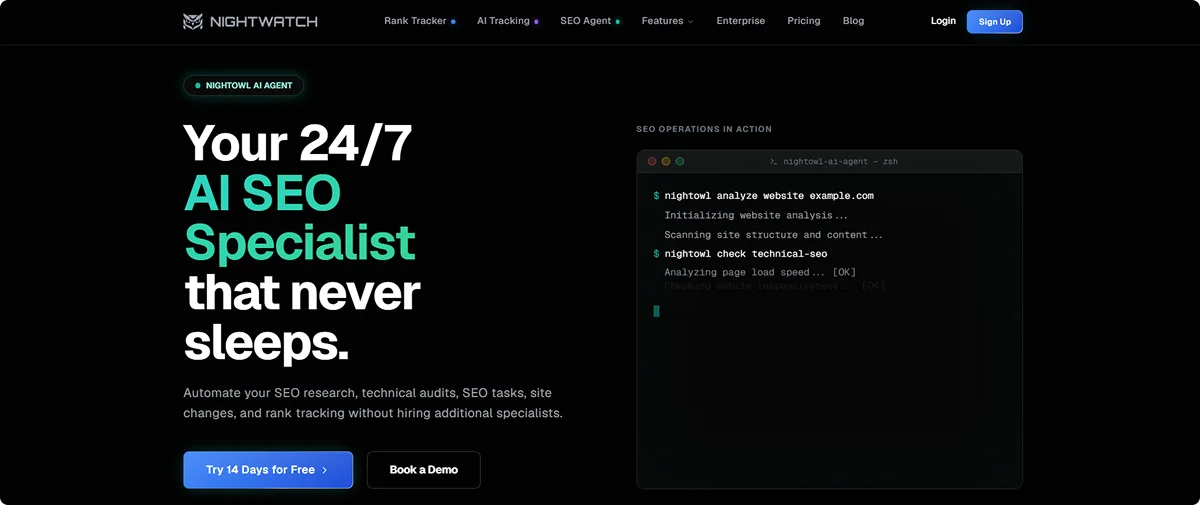
NightOwl is a 24/7 AI SEO agent built into the Nightwatch platform that autonomously audits your site, tracks rankings, researches keywords, and delivers ranked, actionable recommendations, without you having to manually dig through data or spreadsheets.
Instead of waiting for you to ask questions, NightOwl proactively scans your site, detects issues, and surfaces opportunities.
It also tracks how your brand appears inside AI-generated answers from ChatGPT, Claude, and Gemini, making it one of the few AI SEO agents that covers both traditional and AI search.
Best for: SEO professionals and agencies who want a fully autonomous AI agent that handles research, audits, competitor monitoring, and rank tracking around the clock.
Key Features:
- 24/7 autonomous SEO scanning that proactively surfaces ranked recommendations
- Automated technical SEO audits detecting missing H1s, broken links, crawl errors, and duplicate pages
- AI-powered keyword research and clustering grouped by intent and difficulty
- Competitor monitoring that tracks ranking shifts, content gaps, and SERP patterns across up to 5 competitors
- LLM keyword tracking to monitor brand visibility inside ChatGPT, Claude, and Gemini answers
Pricing: Nightwatch starts at $32/month on the Starter plan with 250 daily keywords tracked and up to 50 websites. Plans scale up to the Optimizer at $79/month and the Agency plan at $295/month for larger teams. A 14-day free trial is available on all plans.
Limitations of AI SEO Agents
While AI SEO agents offer significant advantages, they're not without drawbacks. Understanding these limitations helps you use them more effectively and avoid costly mistakes.
1. Technical Risks and Performance Issues - AI agents can introduce bugs or make incorrect implementations that harm your website's performance, such as changing high-performing title tags and damaging CTR, which directly impacts revenue.
2. Lack of Creative Judgment - Agents excel at data-driven optimizations but struggle with genuinely original ideas, brand storytelling, and content that requires deep industry expertise or personal experience.
3. Cannot Replace Strategic Thinking - Agents handle execution well, but don't determine your overall SEO strategy, target audience positioning, or business priorities; you still need humans to set the direction.
4. Setup Time and Learning Curve - Initial configuration requires significant time to set up integrations, define parameters, and train the agent on your business context before it becomes effective.
5. Generic Output - AI agents often produce content and recommendations that feel formulaic or too similar to what everyone else is doing, lacking the unique perspective and differentiation that makes content stand out in search results.
How to Choose Do You Really Need an AI SEO Agent?
Not every business needs an AI SEO agent right away. Here's how to determine if you're ready:
You should consider an AI SEO agent if:
- You're spending too much time per week on repetitive SEO tasks like meta description updates or keyword research
- Your site has hundreds or thousands of pages that need consistent optimization
- You're struggling to keep up with competitors who seem to implement changes faster
- Your SEO team is overwhelmed with tactical work and has no time for strategy
- You need to scale content production without sacrificing quality
- You want data-driven recommendations rather than guessing what might work
You might not need an AI SEO agent yet if:
- Your site has fewer than 50 pages and changes infrequently
- You're still figuring out your basic SEO strategy and target audience
- Your budget is under $100/month for SEO tools (focus on fundamentals first)
- You don't have clear goals or KPIs for measuring SEO success
- Your CMS or analytics setup isn't properly configured yet
- You prefer hands-on control over every small change to your site
Questions to ask before investing:
- What specific tasks consume most of my SEO time?
- Would automating those tasks actually move the needle on traffic and revenue?
- Do I have the technical infrastructure (analytics, proper tracking, API access) for an agent to work effectively?
- Can I dedicate time upfront to properly configure and train the agent?
- What's my backup plan if the agent makes mistakes or needs human intervention?
Start with a trial period if possible. Most platforms offer 14-30 day trials that let you test whether the agent actually saves time and improves results before committing to an annual subscription.
Conclusion
AI SEO agents are transforming how SEO work gets done by automating repetitive tasks and freeing up time for strategy and creative problem-solving.
The businesses seeing the best results use agents to amplify human expertise, not replace it. They automate execution while keeping humans in charge of strategy, brand voice, and major decisions.
However, agents aren't perfect. They require proper testing, ongoing oversight, and realistic expectations. The technical risks are real, and they can't replace strategic thinking or creative judgment.
If you're spending more time executing SEO tasks than planning strategy, an AI agent might be worth exploring. Start small, test thoroughly, and scale gradually as you see results.
The future of SEO isn't about choosing between humans and AI; it's about combining both to work smarter and deliver better results.


.png)

.svg)
















.svg)



























.svg)



.webp)