
AI search monitoring software runs a company's buying questions through engines such as ChatGPT, Google AI Mode, Gemini, and Perplexity. It then records where the brand appears, how it is described, and which pages the answers cite. The best AI search monitoring software also shows AI crawler visits, AI referral sessions in Google Analytics 4 (GA4), and Search Console performance, which help a team check access and outcomes beside the answers.
More than 1.2 billion people use ChatGPT each week, and AI visibility tools changed quickly in 2026, as Hall became part of Tracksuit and Bear AI became Specific Labs. For a SaaS, fintech, or AI company, the plan has to fit the reporting job, because a low price means little when it leaves out an engine the team needs. Every tool below was checked on November 10, 2026.
AI search monitoring tools compared at a glance
Engines and prices come from vendors' own pages, monthly unless marked, for example Writesonic's annual Starter.
The 26 best AI search monitoring tools in 2026
The ChatGPT and Gemini interfaces shared 5.4% of displayed source domains on average across 117 physical-product questions in a September 2026 preprint. We check engine coverage before comparing plans, because one engine's results do not describe another's.
1. Semrush AI Visibility Toolkit
Semrush's AI Visibility Toolkit extends traditional SEO tooling into generative search, so existing customers see AI citations in the platform they already use. Semrush has been an Adobe company since April 28, 2026.

How it works. Its research reports read stored answers captured from real requests, not APIs. Prompt Tracking runs the team's own prompts daily in Google AI Mode, AI Overviews, Gemini, and ChatGPT search.
Key features.
- Mentions, citations, share of voice, and sentiment against named competitors.
- An AI-readiness audit that checks which AI crawlers a website blocks.
- Google Analytics and Search Console data in a paid reporting add-on.
Pricing. The standalone toolkit costs $99 a month for one domain and 25 tracked prompts.
Limitations. Engines differ by report, and Claude and Copilot are not listed.
Who should choose it. SEO teams already using Semrush's SEO platform.
2. Ahrefs Brand Radar
Brand Radar combines Ahrefs' stored indexes of AI answers to millions of prompts with tracking for custom prompts. It shows how often a brand is cited in AI answers and how prominently it appears in AI Overviews, including the domains that compete for those citations.

How it works. Ahrefs runs more than 551 million prompts through ChatGPT, Perplexity, Gemini, Copilot, AI Overviews, and AI Mode and stores the answers. Prompt Tracking checks a team's custom prompts on a set schedule.
Key features.
- Mentions, citations, AI share of voice, and sentiment.
- Bot Analytics, which shows AI crawler visits and is free while in beta.
- Claude tracking for custom prompts, at 8 checks per update.
Pricing. Prompt Tracking comes with every paid plan from Lite at $129 a month, larger custom prompt packages start at $50 a month, and the AI Visibility Index starts at $199 a month.
Limitations. Custom prompts are priced in checks, so Claude and frequent updates use the allowance quickly.
Who should choose it. Brands invested in link authority and Google-centric visibility.
3. Profound
Profound is an enterprise AI marketing platform that pairs answer-engine tracking with AI Marketer agents for research, writing, and reporting.

How it works. A free seven-day trial runs 50 prompts a day on ChatGPT, Gemini, and Google AI Overviews, while Enterprise plans track up to nine answer engines on a tailored prompt plan.
Key features.
- Brand sentiment in answer engines, with the sources that drive it.
- Agent Analytics, which shows how AI bots view, cite, and refer to a website.
- FactCheck, which targets false statements about a brand in AI answers.
Pricing. For brands, the pricing page lists only a free Trial and a custom Enterprise plan.
Limitations. The trial covers three engines, and Enterprise pricing comes only from sales.
Who should choose it. Large organizations monitoring high-volume prompt sets across many engines.
4. Atomic AGI
Atomic AGI is an agentic marketing platform for AI search, built for SEO and marketing teams. It combines Search Console performance, tracked AI answers, and page-level AI referral data from engines such as ChatGPT, Perplexity, and Gemini.

How it works. Atomic runs each tracked prompt on the engines selected for it and compares the pattern over time, because AI answers vary from one run to the next. It collects answers through the engines' product interfaces as well as their APIs, to measure what people are likely to see.
Key features.
- Mentions, citations, and visibility against competitors, with cited sources sorted by type.
- Sentiment with recurring themes and the sources behind them.
- Crawler logs that show which AI bots request the website, from the Team plan.
- Conversion tracking and page-level AI referral data, with AI clicks counted as GA4 sessions from supported AI referrers beside Search Console performance.
- Model Context Protocol (MCP) access from Starter for assistants such as Claude.
Pricing. The Free plan costs $0 per project with basic AI search analytics, Search Console questions, and 7 days of history, while prompt tracking starts on Starter.

Atomic's pricing page lists four paid plans, each billed per project:
- Starter costs $40 a month for 75 prompt slots shared across up to 3 engines, with default checks every 72 hours and API tracking refreshed weekly.
- Team costs $100 a month for 240 prompt slots on up to 6 of 10 engines, adding Claude, AI Overviews, Grok, Copilot, Naver, and ERNIE.
- Team Max costs $200 a month for 420 prompt slots checked daily on up to 6 engines from a pool that also adds Meta AI and DeepSeek.
- Enterprise is custom, with custom engines and answer limits.
Who should choose it. SaaS, fintech, and AI companies that want AI answers, crawler logs, GA4 sessions, and Search Console data read together.
5. SE Visible by SE Ranking
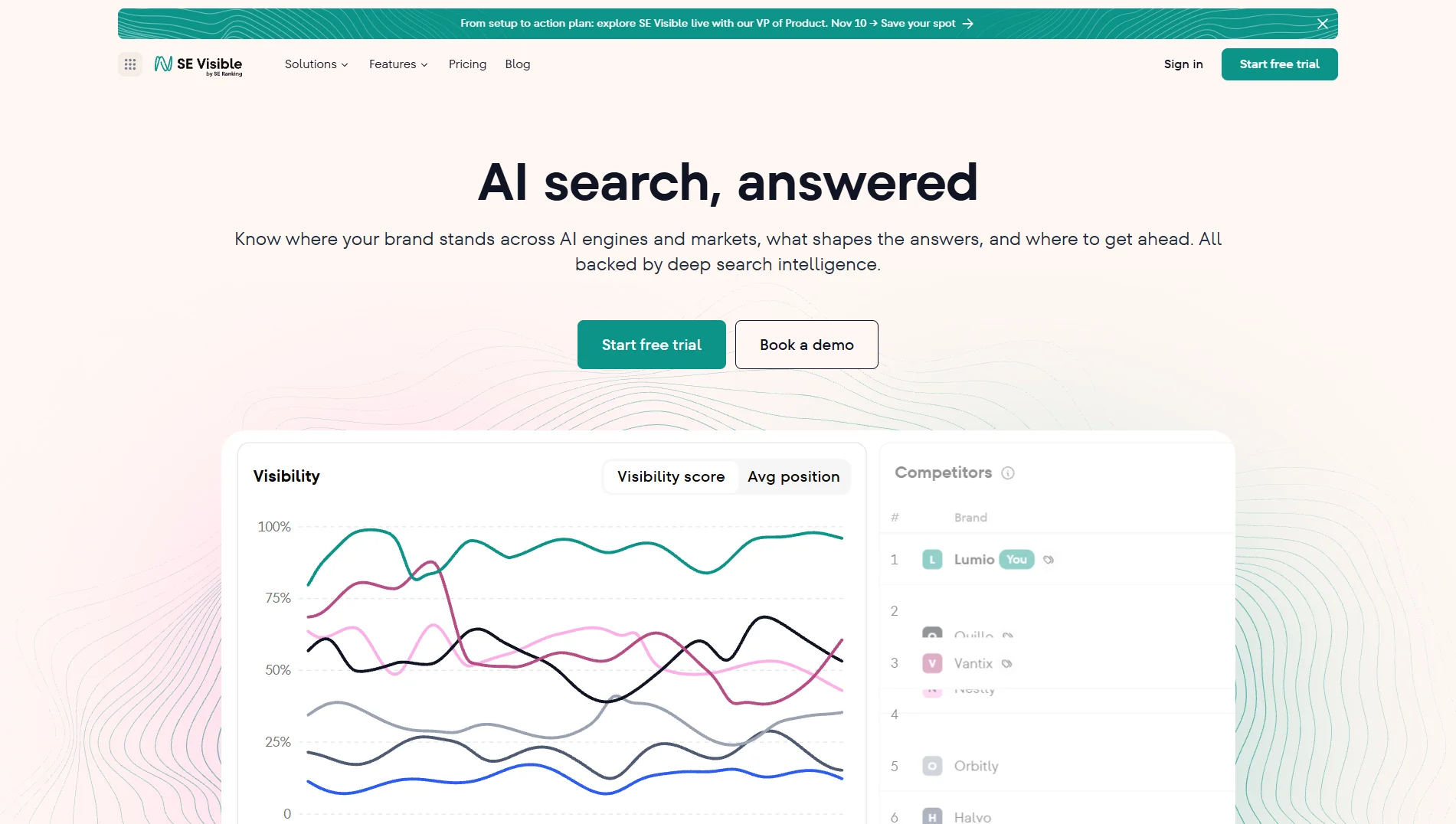
SE Visible is a standalone AI brand-visibility platform built by the SE Ranking team. It shows how a brand appears in AI-generated answers across ChatGPT, Gemini, Google AI Mode, Google AI Overviews, and Copilot, covering mentions, share of voice, sentiment, citations, and the sources behind each answer. Responses are collected through a real browser session in each engine's interface, the same surface a person uses, rather than through API calls.
Key Features:
- Visibility %, average position, share of voice, and sentiment, as one view or broken down by AI engine
- Competitor benchmarking against auto-suggested competitors, topic by topic and source by source
- Source analysis showing the domains and URLs AI relies on, including sources that cite competitors but not you
- Suggested prompts and topics at setup, with drill-downs into the prompts and URLs driving results
- Daily tracking, with markets set by country, city, or region
- Data Studio integration for auto-refreshing client reports
Ideal For: Agencies running AI visibility across a client book and in-house search and brand teams that need to see how AI platforms describe their brand.
Location: Global
Pricing: Three plans (Basic, Core, and Agency), each including ChatGPT, Gemini, Google AI Mode, Google AI Overviews, and Copilot, with no engine add-ons. Starting from $89/month.
6. Writesonic
Writesonic's generative engine optimization (GEO) suite helps brands create and optimize content that shows up in AI-generated answers. It combines AI visibility tracking with built-in content creation tools, so teams can identify gaps and fix issues without switching tools.

How it works. The entry plans track ChatGPT, Gemini, and Google AI Overviews, and Enterprise covers all eight platforms Writesonic supports. Enterprise's full Action Center turns gaps into content and outreach tasks.
Key features.
- Query-level analysis of AI mentions, citations, and visibility gaps.
- AI Bot Analytics and Search Console, with GA4 on Enterprise.
Pricing. Starter costs $79 a month billed annually for 50 prompts on three engines, and Growth costs $399 a month billed annually.
Limitations. The entry plans cover three engines, and sentiment analysis starts on Growth.
Who should choose it. Content teams that want tracking and AI writing in one subscription.
7. AIclicks
AIclicks is an AI search visibility tool for GEO. It allows teams to monitor brand visibility and share of voice across AI search engines and identify citation gaps where competitors are mentioned instead. Its recommendations then suggest the content and outreach that could close those gaps.

How it works. AIclicks says it queries engines through their user interfaces, though its pricing table labels several engines as API sources.
Key features.
- Brand mentions and share of voice, including AI Overviews.
- Third-party sources (Reddit, forums, news) that cite competitors but not the brand.
- Content and outreach recommendations, plus GA4, API, and MCP on Pro.
Pricing. Its Starter plan costs $59 a month for 30 prompts, with a 3-day free trial included.
Limitations. The entry plan covers 3 of the listed models, and the trial needs a card.
Who should choose it. Marketing and SEO teams focused on capturing traffic and citations from AI search engines.
8. Promptwatch
Promptwatch tracks brand visibility in AI answers next to real AI crawler activity on the website. When a brand misses answers that its crawl and citation data point to, Promptwatch hands the gap to content agents that draft, optimize, and publish a page.

How it works. Promptwatch collects answers by scraping the user interfaces of the AI models, with every model on every plan.
Key features.
- Crawler logs, citations, and clicks combined per topic.
- Tracks visibility, citations, and sentiment model by model, including ChatGPT, Claude, Gemini, Perplexity, Google AI Overviews, and Grok.
- Prompts built from a team's top Search Console and Bing queries.
Pricing. Essential costs $95 a month for 50 prompts, and Professional costs $245 for 150.
Limitations. The pricing page does not state a trial length.
Who should choose it. Brands that want visibility tracking and content production in one platform.
9. Surfer AI Tracker
Surfer AI Tracker is a monitoring tool for SEO teams and brands tracking visibility in AI search engines. Its AI Search Analytics plan scans daily for brand mentions and links in ChatGPT, Gemini, Google AI Overviews, AI Mode, and Perplexity, showing prompt-level data and competitor comparisons to guide content and outreach decisions.

How it works. Surfer, now at surfer.ai, collects answers from the AI apps people use rather than from APIs. Every plan refreshes daily except Standard, which updates weekly.
Key features.
- Tracking of brand mentions, links, and positions across five major AI engines.
- Competitor visibility benchmarks and top-cited sources for target prompts, with sentiment on most plans.
Pricing. The AI Search Analytics plan costs $95 a month, or $82 a month billed annually, for 50 prompts.
Limitations. The Standard plan tracks ChatGPT only, and no crawler or GA4 data is stated.
Who should choose it. SEO specialists and marketers optimizing content for generative AI results, especially teams already writing in Surfer.
10. Omnia
Omnia combines AI visibility tracking, citation analysis, recommendations, and content creation for engines like ChatGPT, Google AI Overviews, AI Mode, and Perplexity. It shows where a brand appears in AI answers and how to act on that data.

How it works. Every plan tracks ChatGPT, Perplexity, Google AI Overviews, and AI Mode, with Claude, Copilot, and Gemini added on request, and prompts run every 24 hours.
Key features.
- Prompt and topic-level discovery and monitoring, with sentiment analysis.
- Content creation to fill gaps where AI engines pull information from.
Pricing. Growth costs €79 a month for 25 prompts, or €63 a month billed annually, with a 14-day free trial and no card.
Limitations. Three of the seven engines come only on request, and no crawler or GA4 data is stated.
Who should choose it. Startups and scaleups looking to understand and improve how their products are seen by AI, on a euro budget.
11. Otterly.AI
Otterly.AI is an AI search monitoring platform that analyzes how engines mention and cite a brand, and it now adds prompt research and a content audit. Its Lite plan is one of the lowest-priced entries on this list.

How it works. Since its November 10, 2026, pricing change, new accounts and trials pick at least 3 of 7 engines (ChatGPT, Google AI Overviews, AI Mode, Perplexity, Gemini, Copilot, and Claude) per workspace.
Key features.
- Brand mentions and citations by engine against competitors.
- Agent Analytics, which reads server logs to show AI bots crawling the website, from Standard.
- A public API for exporting the data, from Standard.
Pricing. Lite costs $29 a month for 20 prompts on three engines, and Standard costs $189 a month, with a 7-day free trial for new users.
Limitations. Each Claude answer uses 3 credits against 1 for other engines.
Who should choose it. Teams that want a simple, low-cost start with daily answer tracking on a short prompt list.
12. HubSpot AI Search Grader
HubSpot's free grader, now called AI Search Grader, scores how AI models perceive a brand across five separate dimensions. HubSpot sells ongoing tracking as a separate product, HubSpot AEO.

How it works. The grader asks GPT-5.4 mini, Perplexity, and Gemini about the brand once, while HubSpot AEO tracks prompts on ChatGPT, Gemini, and Perplexity over time.
Key features.
- Brand perception scores, including sentiment and presence quality.
- Competitor share of voice and citation analysis in HubSpot AEO.
- Recommendations inside HubSpot for teams on its CRM.
Pricing. The grader is free and needs no account, and HubSpot AEO costs $50 a month for 25 prompts after a free trial.
Limitations. The grader is a one-time reading, and HubSpot AEO covers three engines, however many prompts are bought.
Who should choose it. B2B marketers building on HubSpot, or any team that wants a free first reading before paying for a tracker.
13. Brandlight
Brandlight is an AI visibility platform for large enterprises that pairs tracking with a dedicated AEO team. It also sells AI shopping and AI ads products to global brands.

How it works. Brandlight builds its reports on thousands of real buying questions, and its team works with the customer on technical and content fixes.
Key features.
- Visibility, sentiment, and share of voice against competitors.
- Technical diagnosis and fixes for crawl access and page markup.
- Managed support from AI strategists.
Pricing. Brandlight lists no price, and its sales call to action is a demo request.
Limitations. Its pages do not itemize engines or prompt limits by plan, so a marketing team needs a demo and a quote before comparing costs with self-serve tools.
Who should choose it. Global enterprise brands that want monitoring and a managed AEO team in one engagement, plus AI shopping and ads products.
14. Cognizo
Cognizo is an answer engine optimization (AEO) platform that tracks AI mentions, citations, and sentiment for a brand. It then creates and publishes content to fill the gaps it finds.

How it works. Cognizo runs a company's prompts on each engine its plan covers. Growth includes ChatGPT, Gemini, Google AI Overviews, AI Mode, and Perplexity, and Enterprise adds Claude, Meta AI, Grok, and DeepSeek.
Key features.
- AI mentions, citations, and sentiment against competitors.
- AI-optimized articles each month, published automatically.
- AI crawler analytics, GA4 sessions, an API, and MCP access.
Pricing. Growth costs $499 a month for 150 prompts on 5 platforms, with 8 articles a month.
Limitations. The entry price sits well above most dedicated monitors, Claude needs Enterprise, and no Search Console link is stated.
Who should choose it. Teams that want tracking and a steady flow of published content from one vendor, with the budget for both.
15. Evertune
Evertune is a marketing platform that pairs organic AI visibility tracking across major AI models with real-user prompt insights from EverPanel. It adds agents for AI ads and content.

How it works. On Pro and above, Evertune samples each prompt 100 times per AI model, so its scores rest on many runs rather than one answer. Plans differ in models and prompt credits.
Key features.
- Visibility across ChatGPT, Claude, Gemini, AI Overviews, AI Mode, Perplexity, Copilot, DeepSeek, and Meta AI.
- Bot Analytics and a website audit on Enterprise.
- An Ads Agent built on its GEO data.
Pricing. Starter costs $60 a month for 5,000 prompt credits across 5 models.
Limitations. Fact checking also needs Enterprise, Starter skips 100-sample runs, and prompt credits make plans hard to compare.
Who should choose it. Brands that want visibility tracking paired with real-user prompt insights, and advertisers planning to buy ads in AI answers.
16. Gauge
Gauge calls itself an agent-led growth platform that connects AI search visibility with how AI agents choose and use products. That focus suits developer-tool and software companies.

How it works. The self-serve Growth plan runs 600 prompts daily on ChatGPT, Google AI Mode, and Microsoft Copilot, while Enterprise adds AI Overviews, Gemini, and Perplexity.
Key features.
- Citation and source analysis with competitor tracking.
- AI crawler monitoring through the website's existing Cloudflare or Vercel setup.
- GA4 and Search Console data beside AI visibility.
Pricing. Growth costs $599 a month, Enterprise is custom, and no free trial is listed for this product on the pricing page.
Limitations. Growth covers three engines, so AI Overviews, Gemini, Perplexity, and sentiment analysis all need the Enterprise plan.
Who should choose it. Developer-tool and software companies whose customers also send coding agents to evaluate and compare products before they decide to buy.
17. Gumshoe
Gumshoe is an AI visibility platform that tests AI engines through detailed customer personas. It shows how AI recommendations for a brand differ across the customer personas a team tests.

How it works. A team defines personas, and Gumshoe runs their questions through official APIs for ChatGPT, Gemini, Claude, Perplexity, Grok, DeepSeek, and Muse Spark, capturing AI Overviews from live results. Monitoring is weekly on the entry plan.
Key features.
- A visibility audit with a brand leaderboard by persona.
- Citation and sentiment audits that show the sources AI relies on.
- Unlimited seats and a free sample audit that checks whether AI crawlers can reach the pages.
Pricing. The entry plan starts at $99 a month per project, and the top plan with all five audits costs $299 a month per project.
Limitations. API answers can differ from what people see in the apps, and each project covers one brand and product line.
Who should choose it. Teams that sell to distinct customer types.
18. Peec AI
Peec AI is AI search analytics for marketing teams, with visibility, position, and sentiment tracked daily against competitors.

How it works. Starter, Pro, and Advanced each run a choice of 3 models from ChatGPT, AI Mode, AI Overviews, Copilot, Gemini, and Naver. Perplexity is a paid add-on, and Enterprise adds Claude, Grok, and DeepSeek.
Key features.
- Visibility, position, sentiment, and share of voice against unlimited competitors.
- Source analytics with citation share and gap analysis.
- Crawl insights from content delivery network (CDN) and hosting logs, plus Google Analytics referrals and a Search Console connection.
Pricing. Starter costs $95 a month for 50 prompts, with a discount for annual billing.
Limitations. Each self-serve plan includes 3 models, and Perplexity costs extra as an added model.
Who should choose it. Marketing teams that want daily tracking on a short list of engines.
19. Goodie
Goodie is an end-to-end answer engine optimization platform covering research, monitoring, action, and revenue measurement for brands. Its pricing page also lists Google Analytics and Search Console integrations.

How it works. Goodie tracks ChatGPT, Gemini, Perplexity, Claude, AI Overviews, Meta AI, and Amazon's shopping assistant (listed as Rufus), with 5 models on the Core plan.
Key features.
- Mentions, citations, sentiment, and competitive share by engine.
- AI Agent Analytics, which shows how AI crawlers experience a website.
- A content studio and tracking for Amazon's shopping assistant.
Pricing. Core costs $354 a month for 110 prompts, or $295 a month billed annually, with a 7-day free trial.
Limitations. The entry price is several times that of the budget monitors.
Who should choose it. Brands that sell through AI shopping assistants and marketplaces as well as on their own website, and want both tracked.
20. ZipTie
ZipTie tracks a brand across up to seven AI search engines and shows which of those answers mention and cite the brand, prompt by prompt. Its team now runs two separate products, the original ziptie.dev and the newer ziptie.ai platform.

How it works. ZipTie captures answers from the live consumer products and charges per prompt check. Each project runs daily, weekly, or monthly.
Key features.
- Mentions, citations, and sentiment across ChatGPT, AI Overviews, AI Mode, Perplexity, Copilot, and Gemini.
- Search Console and, on paid plans, GA4 connected read-only.
- Unlimited seats, projects, and competitors.
Pricing. ZipTie charges $0.01 per prompt per engine check, with a 7-day trial of 25 daily prompts and no card.
Limitations. Its methodology page says, "we cannot see AI crawler hits (GPTBot, PerplexityBot and their peers)," which sit in a website's server logs.
Who should choose it. Teams that want to pay only for the prompts they monitor and read AI answers beside their Search Console data.
21. AthenaHQ
AthenaHQ combines AI visibility tracking across 11 models on its Starter plan with citation and competitor reports, plus on-page and off-page actions for answer engine optimization (AEO).

How it works. AthenaHQ counts usage in credits, where one credit equals one AI response. Topics and prompts are unlimited, and the credit total sets how much runs.
Key features.
- Visibility across ChatGPT, Perplexity, AI Overviews, AI Mode, Gemini, Claude, Copilot, Grok, DeepSeek, Meta AI, and Mistral.
- Sources, competitor insights, and sentiment.
- GA4 and Search Console integrations that connect AI visibility to traffic.
Pricing. The Essential plan is free with 300 credits, and Starter costs $295 a month for 3,600 credits.
Limitations. Extra credits and API access are paid add-ons, and the free plan covers 5 engines.
Who should choose it. Teams that want many engines, including Claude and Copilot, on a self-serve plan.
22. Bluefish
Bluefish describes itself as the agentic marketing platform for the Fortune 500, with an AI Monitoring Suite that tracks how AI represents a brand against competitors. It also sells optimization and measurement suites.

How it works. Bluefish tracks ten or more AI models daily, including Alexa for Shopping, and reports the source URLs behind its tracked answers.
Key features.
- Visibility and share of voice against competitors, by customer persona.
- Favorability scores for how positively AI portrays the brand.
- AI Accuracy, which checks AI claims against verified brand facts and traces wrong claims to their source.
Pricing. Bluefish publishes no prices, and its contact page sends prospects to the sales team for a demo.
Limitations. The full engine list, prompt limits, and price are not published on its website.
Who should choose it. Fortune 500 brands that need accuracy checks and persona-level reporting across many models.
23. Am I on AI?
Am I on AI? offers a simple dashboard to track whether and how a brand appears in generative search results, with weekly action items to improve it. It offers entry-level monitoring for SMBs and startups.

How it works. It scans a company's prompts on ChatGPT and Google AI Overviews, the two platforms its homepage shows, and turns the results into a personalized action plan.
Key features.
- Brand monitoring, competitor rank, and prompt tracking.
- Citation analysis with full citation data on Pro.
- Audience segments on the Prism plan.
Pricing. Pro costs $100 a month for up to 150 prompts, with a 7-day free trial.
Limitations. It covers two engines only, so answers in Gemini, Perplexity, Claude, and Copilot stay out of view.
Who should choose it. Marketing teams exploring generative visibility that mostly care about ChatGPT and Google AI Overviews and want weekly action items.
24. Rankscale
Rankscale is an AI visibility platform that tracks a brand across 17 or more engines on every plan, built for enterprises and SEO teams. Its AI Visits feature also reads Cloudflare data to show which AI bots read which pages.

How it works. Plans are credit-based, and the FAQ gives 0.25 credits per engine per prompt as the typical rate. Every plan covers the same engines, from ChatGPT and Perplexity to Claude, Gemini, AI Overviews, and AI Mode.
Key features.
- Citation, source, and competitor analysis on every plan.
- GA4 and Search Console connections, in beta, to link visibility to traffic.
Pricing. Essentials costs $17 a month, billed annually only, and Pro costs $99 a month for 1,200 credits.
Limitations. Essentials has no sentiment, bot visits, or exports, and answer volume depends on how many engines run and how often.
Who should choose it. SEO teams that want many engines on a small budget and accept credit-based pricing.
25. Scrunch
Scrunch helps companies get their websites ready for AI so they show up in answers and get cited, and Sitecore acquired it in June 2026. It pairs monitoring with an Agent Experience Platform for AI agents.

How it works. The Core plan runs 125 prompts on ChatGPT, Perplexity, Google AI Overviews, and Copilot, while Enterprise adds Claude, Gemini, Meta AI, AI Mode, and Grok.
Key features.
- Citations, sources, and sentiment against competitors.
- AI agent and bot traffic on the Core plan.
- Website audits, with Looker Studio, an API, and MCP on higher plans.
Pricing. Core costs $250 a month for 125 prompts and 5,000 responses, with a 7-day free trial.
Limitations. Core covers four engines, and Looker Studio, the API, and MCP require Enterprise, which is priced on request.
Who should choose it. Companies that want AI visibility tracking and agent-ready website work from the same vendor.
26. Nightwatch
Nightwatch is a rank tracker that connects LLM citations to keyword rankings, so AI visibility and Google positions sit in one report. It suits teams that already track keywords and want AI answers in the same place.

How it works. Nightwatch says it simulates real user interactions with each major LLM platform and updates AI visibility daily alongside its rank tracking.
Key features.
- AI prompts on ChatGPT, Gemini, Perplexity, AI Mode, and AI Overviews.
- Citations, sentiment, and share of voice against competitors.
- Keyword tracking on Google, YouTube, and Bing with a Google Analytics integration.
Pricing. Starter costs €79 a month billed annually for 50 AI prompts, with a 14-day free trial and no card.
Limitations. Claude needs Enterprise, and Starter caps AI tracking at 50 prompts beside its 500 keywords.
Who should choose it. Teams that want rank tracking and AI visibility on one bill.
How to choose an AI search monitoring tool
Most teams can narrow the 26 tools by the job the monitor has to do and the tools they already pay for.
Cadence, coverage, and price units separate similar plans, as Surfer's weekly Standard plan and ZipTie's per-check pricing show.

Nearly all 26 tools report the answers, but only 13 of their pages state AI crawler visits. Crawler logs help diagnose access, though they never prove that an answer cited a page, and engines also draw on existing search indexes. For search access, we check OAI-SearchBot, Claude-SearchBot, and PerplexityBot separately from training crawlers such as GPTBot and ClaudeBot, then read GA4 for referral sessions and Search Console for Google performance.
Before a trial, we read the free first-party reports (GA4's AI Assistant channel and Bing Webmaster Tools' Citation Share). We write 20 to 50 buying prompts from sales calls and run them in two tools for two weeks. We then compare mention rates (the share of valid completed answers naming the brand) on matched prompts, engines, markets, dates, and settings, and re-read pricing before purchase. Our guide to choosing prompts to track covers the prompt set.
How to read the numbers AI search monitoring tools report
Google reports that AI Overviews reach more than 2.5 billion monthly active users.

One answer is an anecdote. In a January 2026 study by SparkToro and Gumshoe, also on this list, 2,961 responses to 12 prompts in ChatGPT, Claude, and Google's AI search almost never repeated the same brand list. The most-mentioned brands still recurred across the changing lists. We therefore report mention rates per engine over repeated runs.
A score means little without its engines. StatCounter's chatbot referral shares leave out Google's AI Overviews and AI Mode, which Search Console reports on separately.
Visits and answer exposure are different measures. SE Ranking measured AI referrals at 0.32% of traffic across 101,574 websites connected to Google Analytics from January to April 2026. GA4's AI Assistant channel identifies visits from recognized assistants, such as ChatGPT, Gemini, and Claude, not everyone who saw a brand in an answer.
ChatGPT's share of AI chatbot referrals to websites fell from 80.47% in September to 51.03% in October in StatCounter's data, a one-month swing that shows how fast the engine mix moves.

Frequently asked questions
What are the best AI search monitoring tools?
By job, the best AI search monitoring tools are Semrush and Ahrefs for an SEO suite; Atomic, Peec AI, Gauge, and Goodie for crawl and traffic data; Otterly.AI and ZipTie for a low-cost start; and Profound for enterprise brands.
Which AI search monitoring tool is the most accurate?
This comparison does not name an accuracy winner, because no tool was tested side by side. A fair trial runs the same prompts, engines, country, language, dates, and settings in each tool, and checks each report against its saved answers.
Is there a free AI search monitoring tool?
Yes, free AI search monitoring options exist, with limits: Atomic's Free plan has no prompt tracking, AthenaHQ's Essential plan caps credits, HubSpot's grader is a one-time check, and GA4 and Bing Webmaster Tools offer free first-party reports.
How to measure AI search results?
AI search results are measured through brand mentions, citations, and share of voice across repeated runs of the same prompts, with AI referral sessions and conversions reported separately. Because a visibility score follows each vendor's own formula, we compare mention rates only on matched prompts, engines, markets, and dates.
Why are AI search monitoring tools important for SEO?
For SEO, AI search monitoring tools show which engines name the brand, which pages those answers cite, and which competitors win instead, so content and PR work can target the gaps.
How do AI search monitoring tools work?
AI search monitoring tools run prompts across AI platforms like ChatGPT, Perplexity, and Google AI Overviews to see which brands and sources appear in the answers. They track mentions and citations over time, and our explainer on how AI tracking tools work covers the mechanics.
How we monitor AI search at Omnius
At Omnius, synthetic prompt tracking sits beside search, technical, citation, and conversion data. From the prompts we track mentions, answer presence, citations, and competitors, then follow identified AI referrals to qualified conversions and pipeline, which come first in our reporting.
We check search crawlers separately from training crawlers. In our review of 500 enterprise websites, about 6% appeared to shut out ChatGPT's or Perplexity's search crawler by accident, even though robots.txt let it in.
Search engines, LLMs, and agents weigh information differently, but they all depend on a company being clear, consistently represented, and supported by evidence. We compare Google and AI representations against fixed prompts and baselines, check conflicting answers against verified entity facts, and review the sources behind them.
Methodology
This refresh re-checked the earlier list's 35 tools on November 10, 2026, against each vendor's homepage, product and pricing pages, and kept its order. Tools whose websites no longer offer the product or load, and tools now selling services, were removed, along with three unpriced tools absent from the ranking lists read. Scrunch and Nightwatch were added because many of those lists name them.
Prices are as stated on each pricing page that day, with annual figures given as a month billed annually, and "not stated" means the pages read do not say it. No tool was scored or tested side by side.
Sources
Vendor pages, read November 10, 2026: Semrush, Ahrefs, Profound, Atomic, SE Visible, Writesonic, AIclicks, Promptwatch, Surfer, Omnia, Otterly.AI, HubSpot AEO, Brandlight, Cognizo, Evertune, Gauge, Peec AI, Goodie, ZipTie, AthenaHQ, Bluefish, Am I on AI?, Rankscale, Scrunch, Nightwatch, Gumshoe and its methodology, Otterly.AI changelog, Atomic AI search docs.
Studies and platform sources: SparkToro and Gumshoe, January 2026, interface and API preprint, September 2026, SE Ranking AI traffic study, StatCounter AI chatbot market share, Google on AI Overviews users, OpenAI crawlers, Anthropic crawlers, GA4 AI Assistant channel, Bing Citation Share, Perplexity crawlers.
Omnius sources: Omnius technology, Omnius entity SEO, review of 500 enterprise websites (LinkedIn).