
To get cited by AI, a company needs pages that ChatGPT, Claude, Perplexity, or Google's AI Overviews and AI Mode can reach and that answer one of the searches each engine runs. Instead of a list of results, people now receive synthesized answers, and within those answers, only a handful of sources are cited.
Being cited is a different outcome from being named, though. In Semrush's June 2026 study, 61.7% of domain appearances in AI answers were source links while the answer never named the brand.
Whether a company is offering payroll automation software or an AI-driven compliance tool, an AI citation positions its page as a source. An answer can name the company without recommending it. This guide shows how each engine picks the pages it cites, what earns citations and names, which five strategies we use to pursue both, and how to measure them across repeated answers.

Key takeaways
- Open every search crawler first, because engines cite pages their search crawlers, partner indexes, or fetchers can reach.
- Count citations and mentions separately, since engines link many pages without naming the company behind them.
- Work on different websites for each engine, because in 2025 data ChatGPT leaned on reference sources and Google on blogs, forums, and video.
- Route each question type to the right pages, from own pages for pricing and product facts to third-party lists and reviews for comparisons and shortlists.
- Measure rates across repeated answers, since Ahrefs found half or more of first-day citations gone the next day.
Why AI citations matter in 2026
In traditional search, the goal is to rank on the first page of results. In 2026, the goal is also to be the source that AI pulls from when answering queries. That's what's known as answer engine optimization (AEO), and it requires new thinking.
More than 1.2 billion people use ChatGPT each week "to explore ideas, compare options and make decisions," OpenAI said on October 21, 2026. Unlike traditional SEO, where rankings can fluctuate and click-through rates vary, an AI citation often appears in the direct response to a user's question.
Whether it's a fintech startup offering anti-money laundering (AML) tools or a SaaS brand building human resources (HR) portal software, getting cited by AI does three things:
- Puts the company's content directly into AI-generated answers
- Links the brand with its evidence, when the answer also names it
- Puts cited pages in front of people researching vendors earlier in their decision journey
SERP rankings can shift daily, and AI citations shift between answers, so we track them as a rate across many answers. Once a company's content becomes a repeated reference, it keeps the company in front of readers, even as single citations rotate, without relying on paid ads or keyword bidding.
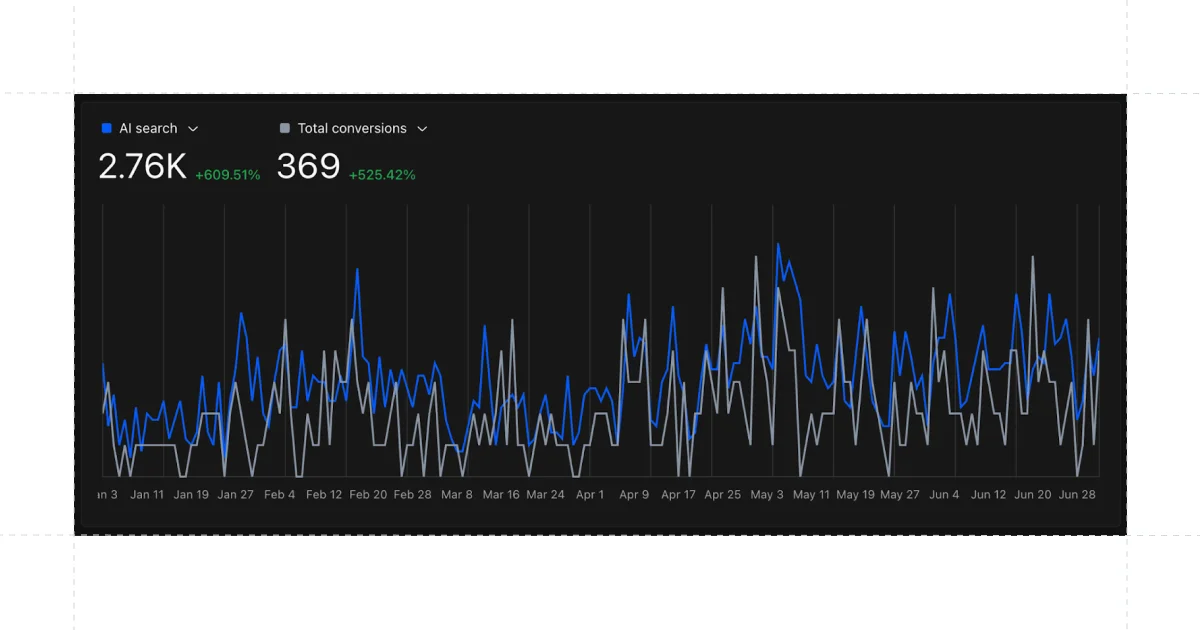
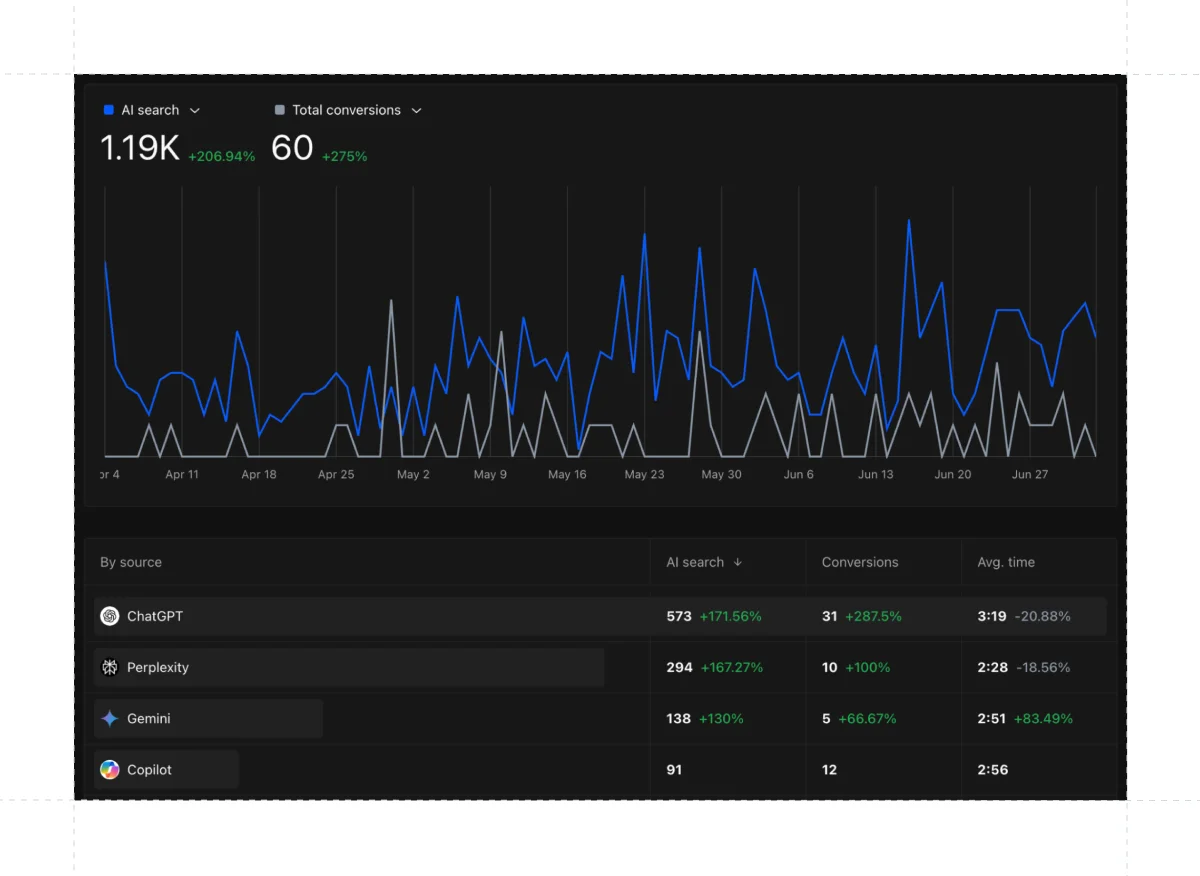
Do AI referrals convert? Across more than 1,200 publisher and news websites, Microsoft Clarity found that visitors from LLMs (large language models) clicked sign-up buttons at 1.66%, against 0.15% from search. We tracked AI visits and conversions on a B2B website we work on:
Three developments between June and October 2026 changed citation reporting and web search:
- June 16, 2026: Bing Webmaster Tools added Citation Share.
- August 31, 2026: Search Console's generative AI reports reached all websites.
- October 7, 2026: OpenAI brought a new GPT-6 model to more ChatGPT users and said the model "makes better decisions about when to look something up."
Being cited and being named are separate outcomes
ChatGPT linked a source in 87% of domain appearances but named the brand in only 20.7%, across Semrush's 115 prompts in 14 countries. Gemini did the reverse, and the study's author reported almost no overlap between the brands ChatGPT cited and the brands Gemini named for the same prompt.
Informational questions (what is, how does) named the appearing brand in 18% of appearances. Comparative and how-to questions named it in about 43%. We pair each informational guide with comparison and shortlist content on the same topic, so the company can earn both the link and the name.

Which types of websites AI engines cite
Across analyses of AI citations in ChatGPT, Gemini, and other LLM platforms, a clear pattern emerges: AI engines are selective, and their preferences differ by platform, vertical, and content structure.
The data, from a May 2025 analysis of almost 8,000 citations across 57 queries, reveals that Wikipedia, Reddit, and government websites still lead many citations, but specialized content from SaaS and fintech brands earns a share in B2B queries.
Especially in B2B, industry blog posts, original research, and expert content are frequently referenced in AI-generated responses.
What changes most is the shift toward format and intent. Here’s how three engines differ:
- ChatGPT favors reference and news sources, followed by blogs and comparison portals.
- Gemini leans on blogs, news, and YouTube, its single most cited domain.
- Perplexity pulls heavily from trusted expert sources, specialist review websites, and data-backed sources.
For fintech marketers, this means that publishing a detailed guide on How to streamline expense reporting with real-time data and a comparison piece such as Top 5 AML compliance tools for startups gives each engine a page to cite.

What makes content citation-worthy for AI
To be cited by AI platforms like ChatGPT or Gemini, a company needs to understand what these engines value most when selecting sources. We group them into four traits: authority, freshness, structure, and original content.
1. Authority & trust signals. Engines name companies the wider web already writes about. In Ahrefs' data, the more often a brand was mentioned across the web, the more often ChatGPT, AI Mode, and AI Overviews named it (correlations of 0.66 to 0.71). On the page itself, experience, expertise, authoritativeness, and trustworthiness (E-E-A-T) show in expert bios, company credentials, and transparent editorial processes. What to do: For fintech brands, this means showcasing audit reports and compliance evidence (e.g., SOC 2, PCI DSS) or linking to government regulatory bodies.
2. Freshness & relevance. AI assistants cited newer pages than Google's organic results in Ahrefs' study of 17 million citations, measured by a page's age since it was first seen. Outside AI Overviews, AI favors up-to-date sources, so a SaaS brand publishing a 2026 Payroll Benchmark Report gives engines a dated source. What to do: Update high-performing blog posts quarterly and add data from recent reports.
3. Structured content. Engines read retrieved pages for passages that answer each part of a question. Google says its systems "review the specific information from those retrieved pages." What to do: Answer each target question directly in the page's visible text, with clear headings and bulleted lists that make each answer easy to find. A Step-by-Step Guide to AML Compliance should state every step in its text.
4. Unique, non-AI language. Google tells publishers to offer "unique expert or experienced takes that go beyond common knowledge." First-party data, customer stories, and proprietary frameworks give an engine something new to cite. What to do: Avoid generic phrasing and publish data and frameworks only the company has.
Understand AI engine behavior: Tailor content for each engine
Each AI engine selects sources in its own way, and recognizing those nuances helps content to be surfaced and trusted in AI-generated answers. Whether a company is running a SaaS startup or scaling a fintech product, aligning with the preferences of each AI engine gives it a competitive edge in AI visibility.
Understanding how AI engines select and cite sources is the first step to building an answer engine presence and adapting a content strategy. Take a head of compliance at a small and medium-sized enterprise (SME) lender who asks How do lenders automate customer identity checks (KYC) during onboarding? This worked example follows each platform's documentation through five steps of retrieval-augmented generation (RAG):
- Deciding to search. ChatGPT may search when current facts would help, and Google shows an AI Overview only when it judges one useful.
- Turning the question into searches. ChatGPT rewrites the question, and Google uses query fan-out to run related searches such as KYC automation for SME lending.
- Retrieving pages behind access checks. ChatGPT searches OpenAI's crawl and partners such as Microsoft, and Google searches its own index. Pages must be available through these search or fetching routes.
- Reading passages. A guide that states the KYC steps under a matching heading gives the engine a passage that answers one search.
- Citing and naming. In Profound's late-2025 sample, ChatGPT turns with citations averaged about four sources. When the question is a comparison, Which KYC providers suit SME lenders?, the answer names vendors far more often.
Does a page cited today stay cited tomorrow? Half or more of the websites cited on day one were gone the next day, Ahrefs found across about 37,500 citations over 20 days. About 75% of citations that disappeared at least once returned before the study ended.
Even with identical searches, ChatGPT's cited websites changed 81% of the time. Ahrefs concluded that much of the churn happens after the search, when the engine chooses what to cite. "Don't judge AI visibility from one check," wrote Mateusz Makosiewicz, the study's author, so we read one missing citation as rotation until repeated answers over a week show the absence persists.

1. ChatGPT: The reference seeker
How it thinks: ChatGPT prioritizes well-established, fact-based sources with institutional authority. In 2025 data, it leaned heavily toward encyclopedic entries, major media outlets, and structured reference content. Websites that block OAI-SearchBot, OpenAI's search crawler, "will not be shown in ChatGPT search answers," except as navigational links. In Ahrefs' 2025 comparison, ChatGPT also cited the newest pages on average.
Sourcing behavior: Wikipedia had 10.1% of the citations among ChatGPT's top 50 sources in Ahrefs' November 2026 data.
What SaaS and fintech brands should do:
- Get featured in neutral, third-party publications like industry news websites or independent tech roundups.
- Keep pricing and product pages exact, because ChatGPT cited Ahrefs' own website for factual questions about Ahrefs on almost every day of its tracking.
Practical example: A B2B SaaS company offering invoice automation can get included in a comparison article on Top 5 Invoice Tools for Enterprises published on TechCrunch or a relevant government fintech hub.

Read more: How to rank on ChatGPT
2. Google Gemini: The balanced synthesizer of sources
How it thinks: Gemini, Google's AI assistant app (separate from AI Overviews in Search), blends blog content, professional reviews, and media like YouTube, offering a broader lens. It values both expert insights and peer validation.
Sourcing behavior (2025 analysis):
- News publications: ~26% (PCMag ~2%, Forbes ~2%)
- YouTube: ~3%, the highest single-domain share
- Wikipedia: present, but far less dominant
What SaaS and fintech brands should do:
- Publish in-depth blog posts that walk through real use cases or industry pain points.
- Create or collaborate on YouTube content, such as tutorials, explainers, or customer success stories.
- Pitch to authoritative media outlets that cover the vertical, such as Forbes or PCMag.
Practical example: A fintech app offering budgeting tools might publish a YouTube explainer titled How to Automate Business Budgets with AI, while also guest-posting on Zapier's blog with practical integrations.
3. Perplexity AI: The expert curator of sources
How it thinks: Perplexity acts like a research assistant that favors deep, factual content and reputable review platforms, often varying its preferences based on query context. PerplexityBot "is designed to surface and link websites in search results on Perplexity."
Sourcing behavior (2025 analysis):
- Expert review websites: ~9% (e.g., NerdWallet, Investopedia, Consumer Reports)
- Community content: selective, varies by industry
What SaaS and fintech brands should do:
- Aim to be reviewed or cited on trusted niche websites like G2, Capterra, NerdWallet, or Investopedia.
- Publish original research such as benchmarks, ROI calculators, or trend reports.
- Write comparison posts with real data, such as X vs. Y Compliance Platforms for SMEs.
Practical example: A regtech startup could publish a data-backed article comparing KYC requirements across countries and pitch it to outlets like Compliance Week or Investopedia.
Read more: How to rank on Perplexity
4. Google AI Overviews and AI Mode: The broad aggregator of many sources
How it thinks: AI Overviews source from the full spectrum of Google Search, including blogs, forums, LinkedIn, Reddit, and YouTube. They value well-structured, deep content over homepage links or thin landing pages. A page must be "indexed and eligible to be shown in Google Search with a snippet."
Sourcing behavior: AI Overviews favor ranking pages: In Ahrefs' March 2026 study of 4 million cited URLs, 37% ranked in Google's top 10 for the same query, though about a third didn't rank in the top 100. AI Mode cites many pages that don't rank for the exact question.
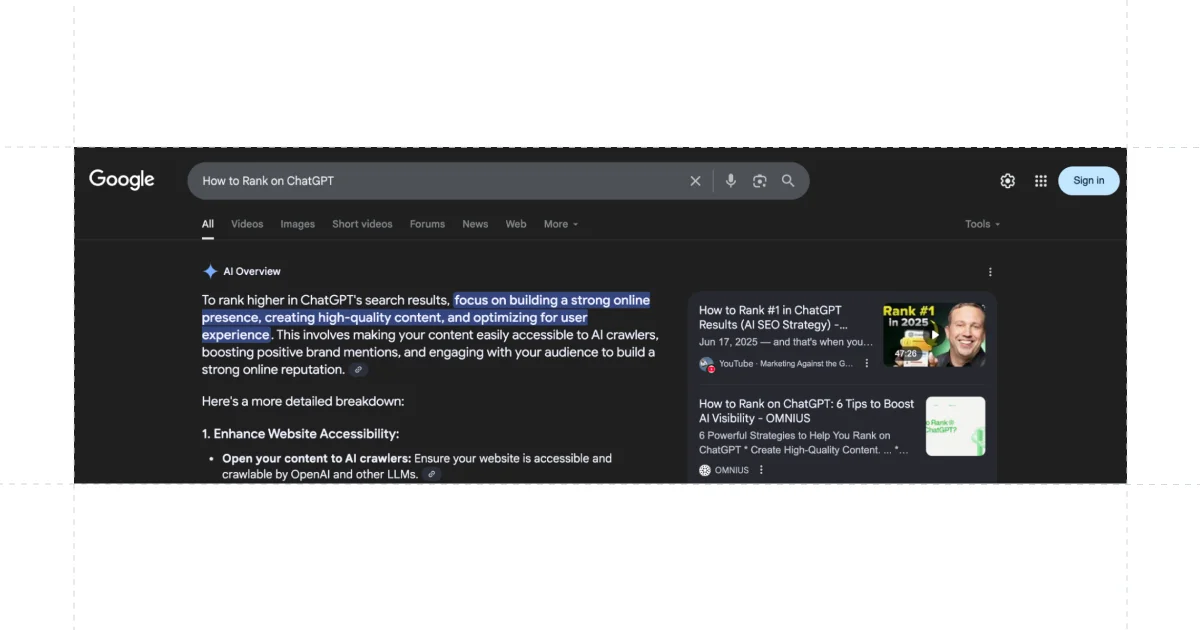
Reddit was the most cited individual domain in AI Overviews in the 2025 analysis. Google's AI Overview for How to Rank on ChatGPT shows the source cards in practice:
What SaaS and fintech brands should do:
- Focus on rich, evergreen content like listicles, step-by-step guides, and case studies.
- Engage in expert-driven communities (e.g., LinkedIn discussions or Reddit threads).
Practical example: A startup offering a lending API might contribute to a Reddit thread on small business financing, post a LinkedIn breakdown of open banking trends, and write a guide titled How to Integrate SME Loan Products via API.
5. Claude: The reader with outside search providers
How it thinks: Claude searches the web when a question needs it, through outside providers that Anthropic lists, among them Brave Search. Claude-SearchBot indexes pages for search, and Claude-User fetches a page on a person's request.
What SaaS and fintech brands should do: Allow Claude-SearchBot and Claude-User in robots.txt and firewall rules, then check Brave Search for key commercial queries.
Read more: Claude SEO for B2B companies
Think of each AI engine like one of five editors at a publication:
- ChatGPT wants sources with long-standing credibility.
- Gemini wants to see both expert and practical content.
- Perplexity wants specialists with depth and data.
- Google AI Overviews want a broad set of sources: blogs, voices, and real discussions.
- Claude wants pages its search or fetching tools can reach.
The more a company tailors its strategy to these personalities, the more likely its brand is to become a cited authority across multiple AI engines.
Which pages SaaS and fintech companies should optimize first
B2B SaaS firms and fintech platforms often publish in-depth guides, use gated content, or rely on compliance language, so they need to adjust their content strategy for generative engines. Four question types decide where we start:
| Question type | Example | Pages engines cite | Work first |
|---|---|---|---|
| Pricing and product facts | How much does an expense platform cost? | The company's own pricing and product pages | Exact, current facts in the page text |
| Reviews and comparisons | Is a corporate card platform worth it? | Review websites on Google's tools; own pages on ChatGPT | G2 and Capterra profiles, comparison pages with real data |
| Shortlists | Best AML compliance tools for startups | Lists, directories, and analyst reports | A place on the lists engines already cite |
| Informational | What is the difference between AML and KYC? | Guides and blog posts from many websites | First-party data and a direct answer under each heading |
The table follows a split Ahrefs saw across 22 questions about one brand. The same pattern held in the Omnius fintech AI visibility study of 360 ChatGPT and AI Mode answers. When a prompt asked for a shortlist, lists made up 32% of the citations, and when it checked named vendors, 89% of answers cited a named company's own website. We start with the question type where competitors get cited and the company doesn't, and leave alone the types it already holds.
For example, a fintech company publishing a 2,000-word guide on How Real-Time KYC Affects Customer Onboarding, with expert quotes and a direct answer under each heading, gives engines more to cite than a surface-level blog post.
Step-by-step framework to get cited by AI platforms
Getting cited by AI takes content that engines can reach, understand, trust, and extract. From analyzing thousands of AI citations, we group the work into five things: authority, structure, originality, discoverability, and clarity.
1. Lay the SEO foundation: Crawler access and indexing
Before AI models can cite a company's content, they need to find it, and they often rely on search results from Google and Bing. That's why traditional SEO is still the first step, starting with the crawlers each engine sends:
| Engine | Search crawler to allow | Training control | Fetcher on request |
|---|---|---|---|
| ChatGPT | OAI-SearchBot | GPTBot | ChatGPT-User |
| Claude | Claude-SearchBot | ClaudeBot | Claude-User |
| Perplexity | PerplexityBot | None listed | Perplexity-User |
| Google AI features | Googlebot, with pages indexed and eligible for a snippet | Google-Extended, for model training and grounding in Gemini Apps | None listed |
Blocking GPTBot doesn't remove a page from ChatGPT search answers, because OpenAI treats GPTBot and OAI-SearchBot as independent settings. A Search Console setting opts websites into Google's AI features by default, and nosnippet and max-snippet limit what they show. Content delivery network (CDN) and firewall rules have to let each search crawler through.
Ensure the technical SEO is solid (clean URL structures, fast page speed, mobile-optimized layouts, and a strong backlink profile), with key content in the HTML. Content that loads only with JavaScript can be missed by crawlers that don't render it. For fintech companies, strong backlinks might come from regulators, government portals, or industry alliances. For SaaS, high-authority reviews and product comparison pages are key.
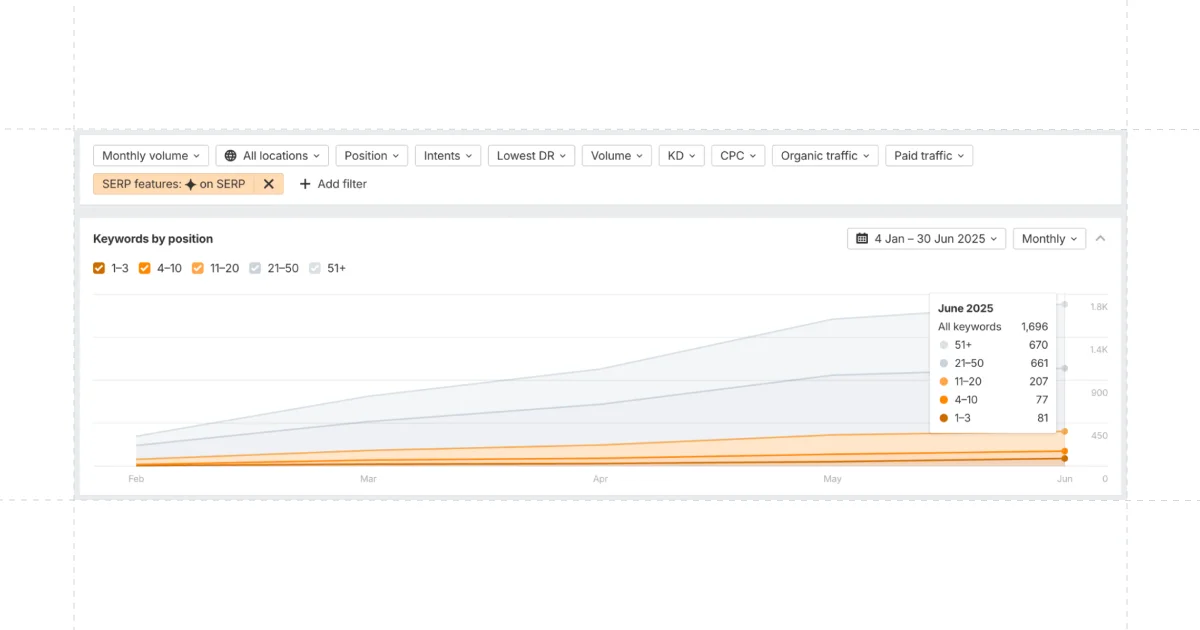
Does ranking still matter? Across 230 questions, ranking pages kept Google AI citations for a week about seven times as often, Ahrefs found. An Ahrefs report shows a website's rankings on keywords that trigger an AI Overview:
What to do: Check robots.txt and CDN rules for each search crawler, use the URL Inspection tools in Search Console and Bing Webmaster Tools to confirm the main content is in the crawled HTML, and keep key pages indexed.
2. Build topical authority around a niche
Query fan-out turns one question into several related searches, so pages should answer the customer's underlying problem and its related questions. Instead of chasing broad keywords, go deep: Ahrefs found almost no relationship (a correlation of 0.19) between a website's number of pages and how often AI answers name the brand.
A SaaS tool for employee expenses can build out a content cluster around topics like automated reimbursements, multi-country payroll, or ATO reporting for startups, where ATO is the Australian Taxation Office. Fintech brands offering lending platforms could own themes like buy now, pay later (BNPL) compliance or open banking integrations. This focused topical authority can increase perceived expertise in the eyes of both humans and machines.
Google adds a limit: Pages made for fan-out variations "primarily to manipulate rankings or generative AI responses" break its spam policy. What to do: Build one cluster per customer problem, combining closely related questions where that serves readers. For more on this, check out our article about how to rank on ChatGPT.
3. Define the company as an entity with structured data
Schema markup (like Organization, Article, and FAQ) helps machines understand a page's content structure and the company behind it. An entity is something a search engine can identify on its own, such as a company with its name, category, and profiles. When the same facts appear on the website and on LinkedIn, Crunchbase, G2, and Wikidata, engines can tie the mentions to one company. Our guide to entities in AI search covers the method. Here's how it looks:

Schema alone doesn't win citations, though. Ahrefs tracked 1,885 pages that added schema markup against 4,000 control pages, and adding schema showed no clear citation gain on AI Overviews, AI Mode, or ChatGPT over 30 days. Every page in that test was already cited before the change, and Google says structured data isn't required for its AI features.
How to implement them? Start with Organization markup on the homepage, which ties the website to the company's profiles. Then add structured data that matches the visible content to core educational and data-rich pages, for entity clarity. What to do: Keep the company's name, category, and facts identical across the website, its markup with sameAs links, and every third-party profile. Test it in the Schema Markup Validator.
Many websites also publish an llms.txt file, a proposed Markdown file that lists key pages for AI tools. Does it get pages cited? It doesn't decide which pages ChatGPT search may use, since robots.txt does that.

Google says the file neither harms nor helps visibility in its search. Coding agents do read llms.txt, and OpenAI, Anthropic, and Google publish one for their developer docs, so it fits a SaaS company's documentation.
4. Format content for answer engines
LLMs like ChatGPT, Perplexity, and Google's AI Overviews thrive on clarity. Bing says clear headings, tables, and FAQ sections help its AI answers reference content. Five formatting habits help:
1. Use headings that mimic natural language questions. Structure subheadings as questions people are likely to ask, such as What is the difference between AML and KYC? for fintech or How do I connect the API to Zapier? for SaaS. This improves scannability and makes it easier for LLMs and search engines to extract direct answers.
2. Start with a concise, direct answer. After the heading, open with a short 1- to 2-sentence summary that directly answers the question. Think of it as the chance to win a featured snippet or be selected by an AI engine for a quick citation.
3. Use bullet points, numbered steps, or tables. Bullet points suit lists, feature breakdowns, or pros and cons. Numbered steps suit guides or tutorials, and tables suit comparisons or structured data.
4. Keep paragraphs short and conversational. Stick to 2- to 4-line paragraphs max. This makes the content easier to read for humans and for LLMs parsing for summaries.
5. Match schema to the visible text. Article or Product markup should state only what the page shows. Google stopped showing FAQ rich results in May 2026, and it says there's no need to break content into tiny pieces for AI.
What to do: Rewrite the first two sentences under each heading on key pages so they answer the heading's question. Bonus benefit: This format also boosts the chances of winning Google featured snippets, People Also Ask boxes, and zero-click answers.
5. Publish original data and earn third-party corroboration
AI models look for trustworthy, unique insights, not recycled summaries. When answering user queries, they can draw on first-party data, proprietary research, and expert commentary over generic content. That's why showcasing a brand's unique perspective gives it an edge, and Google says a unique viewpoint can help because its AI features look at a variety of sources.
Worked example: A CRM platform could publish a report on Average B2B Sales Cycle Lengths by Industry based on 2,000+ anonymized customer accounts. Five steps turn a company's data into citable work:
1. Tap internal data sources. Identify metrics already collected, such as user behavior, product usage, conversion funnels, ticket resolution times, fraud trends, or lending volumes.
2. Create reports based on internal data. Turn this raw data into compelling reports: monthly or quarterly benchmarks, industry trends, or year-in-review summaries. Make sure to include clear visualizations (charts, graphs, tables) and contextual analysis from the team.
3. Add expert commentary. Layer the data with insights from in-house experts or trusted partners, such as quotes from the CEO, head of risk, or data science lead. In the 2023 paper that named generative engine optimization (GEO), the best tested content changes raised a visibility score in a simulated AI engine by up to 40%.
4. Package the data for sharing. A downloadable PDF report, a blog summary post, and short data graphics for social media multiply distribution. This makes it easier for AI tools and journalists to reference the work.
5. Earn third-party corroboration. Republish the insights on industry websites and newsletters, and pitch them to the publications engines already cite. In Ahrefs' study of 10,000 US brands, mentions in Reddit threads that rank on Google moved most closely with how often ChatGPT, AI Mode, and AI Overviews named a brand (a correlation of 0.75), ahead of news coverage (0.67). We record the third-party pages that recur in answers and pursue a place on them.
Google warns that seeking inauthentic mentions "isn't as helpful as it might seem." What to do: Publish one dataset per quarter with its method stated.
How to measure citation growth within AI platforms across repeated answers
A team that wants to earn AI citations also needs a way to track them. Unlike traditional SEO, where tools like Google Search Console or Ahrefs show impressions and rankings, AI citations change from one answer to the next. We measure citations, mentions, and referral outcomes over time.
1. Citations and mentions in ChatGPT, Gemini, and Perplexity across repeated runs
Start by prompting these engines with target questions (for example, best expense management tools for startups or what is AML compliance?) and look for the brand or URL in the cited results.
Some platforms like Perplexity explicitly list citations. Others, like ChatGPT, may require selecting Sources to view every cited link. However, manually checking each and every citation isn't feasible at volume. ChatGPT and other AI engines personalize responses, for example by location, so a team's own checks are likely to differ from what other people see. To measure citations accurately, we use Atomic AGI, our own analytics software, which identifies citation gaps and gives suggestions on how to act on them.
We run a fixed set of customer questions, drawn from the four question types in the table above, on each engine repeatedly. We report two rates over all runs, including those that cite nothing: runs that cite the company's pages and runs that name it. For example, 12 cited runs out of 40 give a 30% citation rate. Each run logs the engine, model, date, country, and search setting.
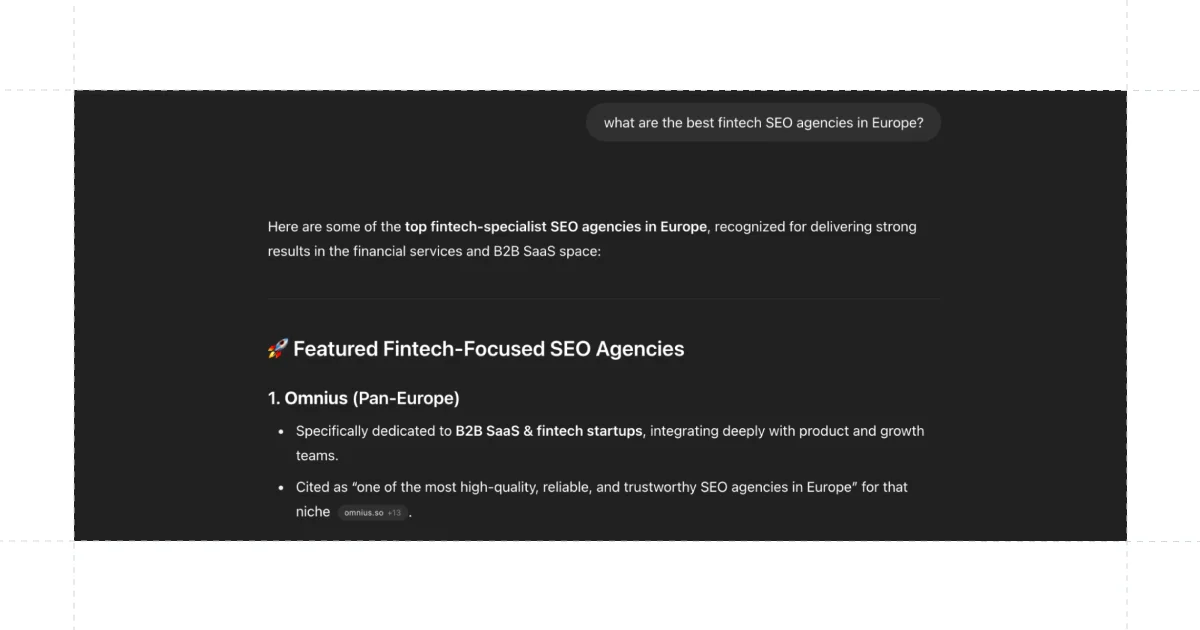
This ChatGPT answer about fintech SEO partners in Europe shows both outcomes at once: Omnius named in the text, with an omnius.so source link beside it.
2. Featured mentions in AI Overviews (Google) and in Bing's own reports
Google's AI Overviews often link directly to a few sources. Track whether the content appears as a linked answer in featured boxes using visual spot checks, but make sure to use Incognito mode for relevant results. Teams can also use tools like Ahrefs for tracking these positions and keyword progress.
Search Console's generative AI reports count a website's impressions in AI Overviews and AI Mode, and Bing Webmaster Tools reports AI citations and Citation Share for Microsoft Copilot, Bing, and select partners. Since November 10, 2026, OpenAI's Business Hub beta shows businesses their ChatGPT mentions, website clicks, and discovery topics above privacy thresholds. We read them monthly next to the prompt runs.
3. Traffic from LLM sources
Use urchin tracking module (UTM) tags where possible, especially in social shares, and monitor referral traffic from AI-based platforms in GA4's AI Assistant channel, which leaves out AI Overviews and AI Mode. Teams can also use analytics tools to monitor AI search traffic, such as Atomic AGI, which also tracks conversions coming through the LLM platforms.
How we at Omnius get a B2B business cited by AI
We treat a citation as a step on the way to pipeline, never as the goal. Our methodology ranks traffic, rankings, mentions, citations, and AI visibility below the commercial outcome, so the work starts from the questions that lead to revenue. We track mentions, citations, comparisons, and recommendations as separate outcomes, then plan for each.
The work runs in four parts:
- Machine access. In early June 2026, bots made about 57% of requests for web pages on Cloudflare's network. We use crawler logs, SEO audits, and LLM audits to find what blocks crawling, indexing, and retrieval.
- Entities. We resolve conflicting company data into one canonical record and track how engines represent the company against fixed baselines.
- Source coverage. We compare the sources engines cite again and again with competitors' coverage, and plan outreach where the company is absent.
- Measurement. We combine larger datasets, benchmarks, and repeated sampling to reduce noise and false positives.

FAQ
How do I get cited by ChatGPT?
Getting cited by ChatGPT starts with allowing OAI-SearchBot and keeping pages reachable for its search tools, which include partner providers. Each important question then needs a page that answers it plainly, and brands mentioned widely across the web, such as on G2, were named more often in Ahrefs' data.
Why is a website cited but the company not named?
A website is often cited without the company being named because the answer uses the page as a source of facts. In Semrush's data, short conversational prompts brought brand names almost every time, and well-known brands were often named without a link.
How long should content be to get cited by AI?
Content has no ideal length for Google's AI features, Google says, and pages should be made for their audience. We aim for a plain answer under every heading instead of a word count.
Methodology
This refresh checked the live article against documentation from OpenAI, Google, Perplexity, Anthropic, and Microsoft, read from October 20 to November 10, 2026. The per-engine source mixes come from a 2025 analysis of earlier models (GPT-4o and Gemini 2.0 Flash), so current answers can differ. Most studies cited here are run by companies that sell AI visibility software or involve consultancy researchers, and their correlations describe patterns, not causes.