This study of 360 ChatGPT and Google AI Mode answers shows that fintech AI visibility changes with the buying stage, as the sources behind a recommendation shift from one stage to the next. Omnius put 90 questions about 60 fintechs, from Stripe to Middesk, to both engines on October 27 and 28, 2026.
For a fintech marketing leader, that means a single AI search plan ends up working on pages that only some answers cite. Shortlist requests leaned on listicles, the "best of" lists on other websites, while vendor checks almost always cited the website of a company named in the question.
This article covers the sources ChatGPT and AI Mode cite at every stage, the room left for challengers on shortlists, the company signals that went with recommendations, and the pages and publishers we work on first.
Key takeaways
- Plan AI search work by buying stage, because lists made up 32% of shortlist citations and only 8% of problem-question citations.
- Keep the company's own pages exact, since 89% of vendor-check answers cited a named company's own website.
- Track ChatGPT and AI Mode separately, because ChatGPT leaned on companies' own pages and AI Mode on lists, YouTube, and forums.
- Expect challengers on the shortlist, since they took 38% of the panel's shortlist recommendations, although leaders were recommended more often.
- Treat company signals as associations, because only links with recommendations were measured and no cause was tested.
AI answers now shape B2B software purchases
A software purchase often starts in a chatbot. In G2's survey, published April 15, 2026, 51% of 1,076 people who choose or influence B2B software purchases said they start research with a chatbot more often than with Google.
AI also narrows the list, and the lists are short. Semrush found that 48% of 519 US B2B professionals who use AI at work used it to narrow a shortlist. TrustRadius found that 83% of 1,862 technology purchasers shortlisted three products or fewer, so a single place matters.
A finance chief might ask ChatGPT which corporate card platforms work with NetSuite. The answer names a handful of companies and links the pages behind them. Whether a company is in that answer is what fintech AI visibility means, along with which of its pages the engine cites.
In finance, it matters, because many of these conversations carry buying intent. Commercial intent accounted for 47.1% of the financial services and fintech conversations in ChatGPT, consumer and business, in Profound's data.
Three platform changes came between May and our runs: more brand links in ChatGPT, a new default model in AI Mode, and GPT-6.
- May 7, 2026: Profound saw ChatGPT add more links from brand names to their homepages. Daily OpenAI referrals to the financial services and fintech websites it monitors rose 60% at the same time.
- May 19, 2026: Google made Gemini 3.5 Flash the default model in AI Mode and said AI Mode had passed 1 billion monthly users.
- October 7, 2026: OpenAI began rolling out GPT-6, three weeks before our runs.
How the test worked. The 90 prompts were split evenly across three buying stages, and every prompt ran on both engines on both days. We counted two things in each answer, recommended companies and cited pages:
- A company is recommended when a heading, list item, table row, or bold lead puts it forward as an option, which can include an option outside the answer's final shortlist.
- A page is cited when the answer lists it as a source.
Answers also named companies they didn't recommend, so a mention alone didn't count. For instance, Stripe was named in 18 of 20 payments problem answers and recommended in 8.
The three stages covered business problems, shortlists, and checks on named companies:
| Stage | What the prompt asks | Example from the test | What we counted |
|---|---|---|---|
| Problem question | A business problem, with no vendor named | "How can a finance team stop chasing employees for receipts every month?" | Which of the segment's 10 companies the answer recommended |
| Shortlist | Vendors for a stated company and need | "We're a 120-person US tech company on NetSuite. Which corporate card and expense management platforms should we shortlist?" | Which of the segment's 10 companies the answer recommended |
| Vendor check | A named company's price, rivals, licenses, or reviews | "How much does Navan cost for business travel and expense management?" | Which of the named company's own pages the answer cited, and which rivals it suggested |
Read more: Fintech AI search research
Problem questions, shortlists, and vendor checks draw on different sources
The sources behind an answer changed with the stage. Problem questions cited a wide spread of websites, shortlist requests leaned on listicles, and vendor checks turned to a named company's own website.
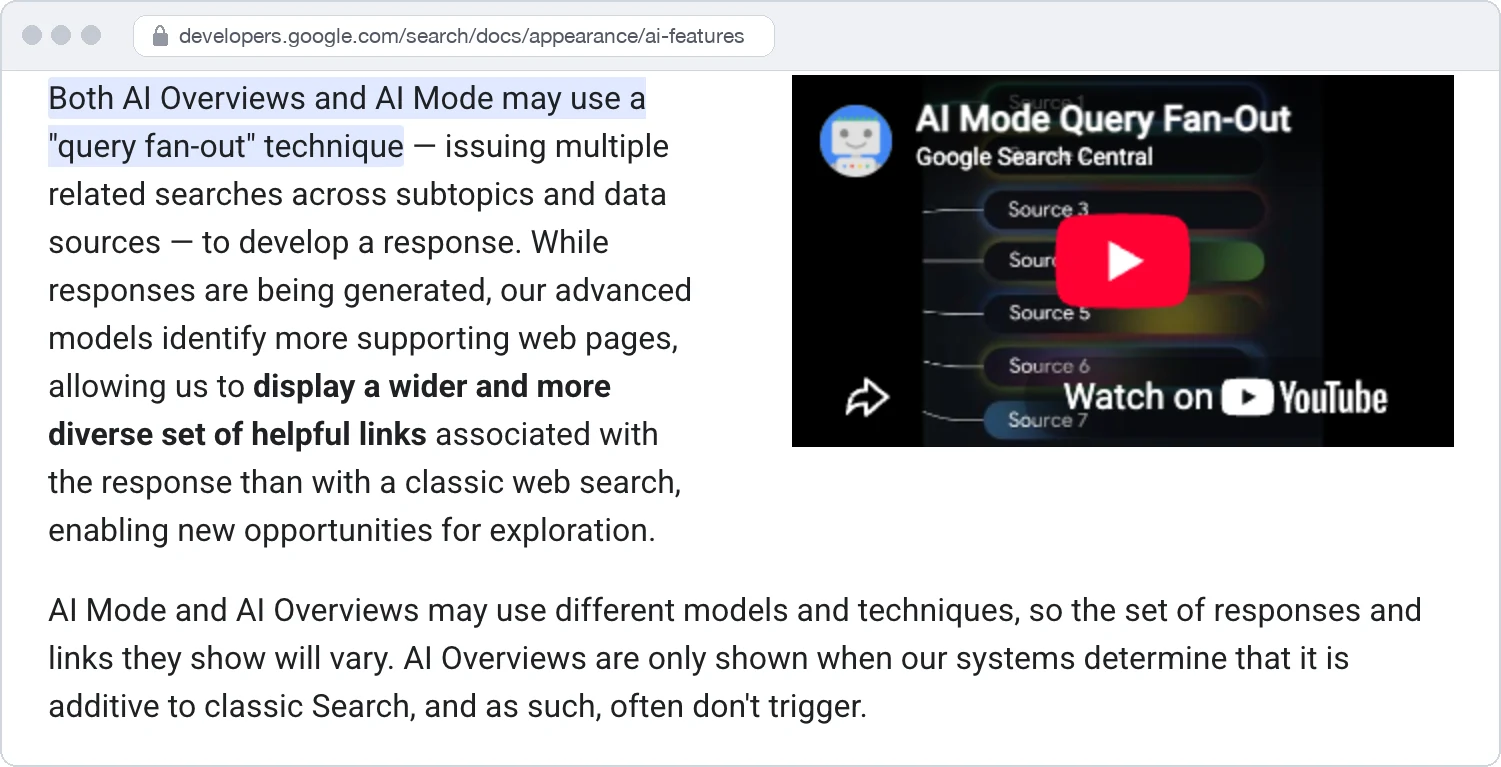
Why would one question reach different pages from the next? When the engines search, they can search for more than the question itself. ChatGPT search typically rewrites a question into one or more searches sent to its search partners, as OpenAI's help article describes. Google says AI Mode may fan one question out into multiple related searches.
Problem questions drew on a broad mix of websites. Other companies' pages took 29% of those citations and publishers 18%. The 60 panel companies' own pages, mostly blog posts, took about a quarter. On ChatGPT, regulator and government pages took 30% of problem-question citations, against 1.5% on AI Mode. Most came from compliance and banking questions, such as identity checks (KYC) and deposit insurance, where the rules sit on regulators' websites.
Shortlist requests turned to listicles, meaning other websites' best X, top N, alternatives, and X vs Y pages (the "best of" lists in the charts). A panel company's own list counts as its own page. Listicles jumped at the shortlist stage, to 32% of shortlist citations against 8% for problem questions. Almost a third of what a shortlist answer cited was a list on someone else's website.
Who writes those lists? The 368 list citations in shortlist answers came from 225 websites, among them other vendors' best X roundups and publishers such as NerdWallet and Forbes. The citations spread across many websites, so we audit those lists one segment at a time.

Lists in the shortlist: 93 of the 120 shortlist answers cited at least one list, 56 of 60 on AI Mode and 37 of 60 on ChatGPT, so a list can appear in most answers while making up a smaller share of all citations.
One shortlist shows the two engines side by side. The prompt asked which corporate card and expense platforms a 120-person US tech company on NetSuite should shortlist. ChatGPT recommended six companies and cited mostly their own NetSuite integration, pricing, and help pages.
AI Mode recommended five and cited 17 sources, among them Payhawk's, Airwallex's, and Ramp's own NetSuite roundups, two BILL posts, a Reddit thread, and three third-party lists. It recommended Airwallex in the same answer that cited Airwallex's own roundup.
Is the split peculiar to fintech? Outside data says no. In Peec AI's study for Wix of 75,000 AI answers on ChatGPT, AI Mode, and Perplexity, articles accounted for 45.48% of citations on informational queries. Listicles accounted for 40.86% on commercial ones.
Our problem answers used fewer lists than some outside data, though. Writesonic found listicles at 20% to 32% of citations in every prompt frame it tested, how-to questions included. Our problem prompts asked about business finance, such as card fees and month-end close.
Shortlist answers also cited the most sources, 9.6 per answer against 7.3 for problem questions and 6.8 for vendor checks. A May 2026 analysis of 20 ChatGPT purchase journeys found the same peak in the comparison stage. It counted 9.8 citations per answer that cited a source, on GPT-5.2 with high reasoning.
ChatGPT cites company websites more, and AI Mode cites more outside sources
Across all 360 answers, ChatGPT gave a larger share of its citations to companies' own pages. AI Mode spread its citations across more outside sources, such as lists, YouTube, and forums.
When asked what Navan costs for business travel and expense management, ChatGPT cited two pages: Navan's pricing page and a Navan blog post. AI Mode cited Navan's pricing page too, then nine more sources, including pricing estimators, G2's Navan pricing page, and Vendr.

One answer each proves little, but the split held across all 360. In shortlists, companies' own pages took 26 percentage points more of ChatGPT's citations than of AI Mode's, and in vendor checks the gap was 37 points. AI Mode gave lists 22 points more of its shortlist citations. It also cited YouTube in 38 of 60 problem answers, where ChatGPT cited none.
Much of the gap is a matter of share. AI Mode cited 1.5 to 1.9 times as many sources per answer. So a company's own page made up a smaller slice of a longer source list, even when the answer cited it. The NetSuite answer is an example, since AI Mode cited the vendors' own roundups and three third-party lists together.
Peec AI's 12 weeks of data point to the same pattern, with self-promotional listicles averaging 3.6% of its sampled software-review citations on ChatGPT versus 10.3% on AI Mode.
Reddit is the open question. A study of 380,000 AI answers to B2B software-buying prompts found that 9.26% of ChatGPT's citations went to community websites, mostly Reddit. Our 180 ChatGPT answers cited a single forum page.
The model behind an answer may matter too, and our runs didn't record it. In a 50-prompt Writesonic test at medium effort, ChatGPT's share of citations to brand websites rose from 47.2% on GPT-5.5 to 58.1% on GPT-5.6 Sol. For this reason, we track the two engines as separate channels and re-run the prompts when a model changes.
Challenger fintechs make AI shortlists, though leaders appear more often
Challengers made AI shortlists, though leaders were recommended more often. In each segment, the five companies with the highest market value (market cap, latest valuation, or acquisition price) are the leaders, and the other five are the challengers.
The challengers run from startups to billion-dollar companies. Mollie, Rapyd, and Spendesk, for example, have reported valuations of $1 billion or more.
How far ahead were the leaders? On average, a leader was recommended in 12.8 percentage points more of its shortlist answers than a challenger in its segment, and the gap was similar on both engines. That is an average across the two groups, so a single challenger could still beat the leaders in its segment. The test can't pin down the exact size of the gap, which could be a narrow lead or a wide one.
Challengers on the list: 117 of the 311 shortlist recommendations our 60 companies received went to challengers, and 74% of the 120 shortlist answers recommended at least one.

Stripe, a leader, was recommended in all 20 payments shortlists, but in two segments a challenger came out on top. In expense management, Spendesk was recommended in 12 shortlists against 9 for Pleo and 8 for Ramp. In accounts payable and receivable, Upflow was recommended in 9 against Tipalti's 8.
In compliance and identity verification (KYC), the challenger Sumsub came close, with 11 shortlists against 12 for the leader Persona. Our reading, which the counts don't test, is that a request's details leave room for a company that fits them. Airbase, outside our panel, is one example, as it joined Ramp and Brex for the 120-person NetSuite company on both engines.
An index of 1,161 answers to 99 fintech prompts across four engines found the same leader at the top. It named Stripe in 36.6% of answers and PayPal in 33%, too close to separate. Its prompts leaned toward consumers, so it can't show the B2B split.
Vendor checks almost always cite a named company's own website
Vendor checks usually cited a named company's own website. That happened in 107 of the 120 answers, or 89%, and for X vs Y prompts that name two companies, a citation to either one counted.
The cited page matched the question. On price questions, the pricing page made up 47% of the company's own citations. On review questions, the company's own review, testimonial, and customer-story pages took 15 of its 22 own citations, including Bluevine's and OFX's review pages and Alloy's client stories.
Regulation questions split between help-center pages (39%) and security pages (35%), too close to call a leader. The page types behind X vs Y questions are held back until their URLs are recoded.

When asked Ramp vs Brex: which is better for a Series B startup?, ChatGPT cited NerdWallet's comparison, Ramp's pricing page, Brex's versus page, and two other comparison posts. AI Mode cited eight sources, among them a YouTube video, a Reddit thread, Corpay's own comparison post, and four third-party comparison lists.
Vendor checks rarely suggested rivals. Across the 120 answers, the other companies we tracked were recommended only 16 times, spread over 12 companies, and never in business banking. To show up as the alternative, a company has to appear in a rival's check, and few did.
Review websites entered at this stage. Review platforms and editorial reviews made up 16.5% of vendor-check citations against 0.9% in shortlists. They appeared in 45 of the 120 answers. G2 was the review platform cited most, with 20 citations, then Capterra with 15, Trustpilot with 10, and TrustRadius with 8.
Outside data shows the same trend when a prompt names a brand. Across Writesonic's study of 282 million citations on eight platforms, listicles fell from 30.92% to 19.56% of citations on prompts that named a brand.
Review websites climbed in a separate dataset too, according to an analysis of 804,491 AI responses across 1,926 brands in mostly consumer industries. There, they rose from 1.51% of citations on best X prompts to 24.27% on should I choose [brand] prompts.
The definitions and sizes differ, yet all three datasets move in one direction, which makes this the result we're most confident in.

Authority, reach, and reviews went with fintech AI visibility at different stages
Market value told only part of the story, which raises the question of what else the recommended companies had in common. The test set 12 company signals against how often a company was recommended. Companies were measured only within their own segment, so a payments giant is compared only with other payments companies.
A signal counted only when its correlation was strong enough, survived a check against chance findings, and pointed the same way on both engines and on both days. Every result is a correlation across 60 companies (56 for website content), so it shows what went together and never what caused it.
In problem answers, the most-recommended companies had more authority and a pricing page with a real price. Companies were recommended more often when they had a higher Domain Rating, which is Ahrefs' score for the strength of a website's links. The same held for more referring domains (other websites linking to it), more organic traffic (estimated visits from unpaid search), and a pricing page that states a price.
Domain Rating, referring domains, and organic traffic also tend to move together, so they act more like one signal than three.
That stage rests on 68 recommendations, and six companies hold 50 of them. A published price may also just mark a self-serve product, and cost questions favor those, so we don't treat it as a lever on its own.

Wise and Airwallex were each recommended in 13 of their 20 problem answers, the most at that stage, yet their signals don't match. On October 27, Wise had a Domain Rating of 90 and an estimated 61.6 million monthly organic visits, while Airwallex had 81 and about 293,000.
Shortlist recommendations were linked to reach and documentation, as organic traffic and public docs or an API reference passed at this stage, while Domain Rating and referring domains didn't.
Rivals suggested in a vendor check had stronger links, security pages, and reviews. When a prompt asked about one company, the answer sometimes suggested a competitor instead. The companies suggested this way tended to have a higher Domain Rating, more referring domains, more security and compliance pages, and more Trustpilot reviews. Most of that pattern came from ChatGPT's answers.
These are the strongest correlations in the test, but they rest on just 16 recommendations, so we consider them worth watching but not acting on yet.
Branded search volume showed no detectable relationship at any stage, and neither did having a help center. The Wikipedia result stayed suggestive. We don't report blog-post or comparison-page counts, because the website inventory behind them missed pages on subdomains and some comparison URLs.
Falling short of our bar doesn't mean branded search plays no part. Ahrefs' study of 75,000 brands, published December 12, 2025, found a moderate link between branded search and ChatGPT visibility, a correlation of 0.352. With 60 companies, the test is too small to rule out a link of that size, and the two studies measured different companies and outcomes.
Ahrefs also found branded web mentions correlating at 0.66 to 0.71. We didn't measure mentions, and Domain Rating and referring domains may partly stand in for them here.
Where does authority act, then? Two studies, from SE Ranking and AirOps, point to retrieval:
- SE Ranking counted ChatGPT citations across 129,000 domains and reported that websites with over 32,000 referring domains were 3.5 times more likely to be cited than those with up to 200.
- An AirOps study looked one step later, at pages ChatGPT had already retrieved, and found no positive link between authority and citation. The first search result was cited 58.4% of the time, against 14.2% for the tenth.
Both studies count cited pages and leave recommended companies aside, so our reading is an inference: Authority may help a page get retrieved, and search position predicts much of the rest.
How to optimize for fintech AI visibility at each funnel stage
Our practice follows the stages and rests on the correlations above, which point to priorities without proving that any change lifts recommendations. The engine shapes every step too, since AI Mode leaned on lists, YouTube, and forums, and ChatGPT on companies' own pages and regulators. We work through five steps in the order a prospect meets them: problem questions, shortlists, vendor checks, review profiles, and page access.
- Earn authority for problem questions. Compare Domain Rating and referring domains with the segment's leaders in Ahrefs, or Authority Score in Semrush. Keep earning links and coverage from independent websites, and state at least one price in text on the pricing page.
- Get on the lists the engines cite. Run the segment's shortlist questions on both engines, record every cited list, and ask each publisher to include the company with current facts. Publish public docs where the product has them, and a roundup of the company's own where it fits.
- Answer the vendor check on the company's own pages. State prices on the pricing page, and keep product and comparison pages exact for X vs Y questions. Publish genuine customer reviews and stories, and give the regulation question its own page that names the regulator and license numbers. In our SaaS pricing research, ChatGPT quoted figures even when a vendor's pricing page or homepage showed no plan price. Its answers named marketplace listings and other websites as the sources.
- Keep review profiles current and answered. Start with G2, Capterra, Trustpilot, and TrustRadius, the review platforms vendor-check answers cited most.
- Keep the pages reachable. Allow OAI-SearchBot, since OpenAI says websites that block it aren't shown in ChatGPT search answers, apart from navigational links. Check in server logs that it reaches the pricing, product, and security pages, then use Search Console's URL Inspection tool to confirm that Google has indexed them. Google says AI Mode needs no special files or schema.

For the NetSuite shortlist, step 2 starts with the three third-party lists AI Mode cited and the vendors' own NetSuite roundups beside them.
We measure every stage on both engines and run every prompt on at least two days, storing the cited URLs of every answer as well as the companies it names. Shortlist recommendations held steady between our two days, while the rare alternatives in vendor checks shifted a lot.
That's why we judge a page by its share across repeated runs. A page that stays uncited goes back for review beside its results in other search channels. Blog volume and comparison-page counts stay off the scorecard until our inventory of them is recounted.
Start with the lists. Lists made up 40% of AI Mode's shortlist citations, so the list audit in step 2 comes before any new page.
How Omnius plans fintech AI search work
Omnius plans AI search work around the stage of each question. We're an SEO and AI search company for SaaS, fintech, and AI businesses, and every stage sends ChatGPT and AI Mode to different pages. In this test, the recommended panel companies overlapped more between days than the cited domains did, and we track recommendations and sources separately for that reason. Our fintech work has four parts, a stage map, a source audit, owned pages, and tracking:
- Stage map of the problem, shortlist, and vendor-check questions in each segment and market
- Source audit of the lists, review websites, and publisher pages each engine cites
- Owned pages that answer price, product, and regulation questions in text
- Tracking on ChatGPT and AI Mode across repeated runs

Atomic AGI, the AI search analytics software built inside Omnius, ran the 360 answers in this test and keeps each run for those readings.
More on how we work with fintech companies: fintech SEO and AI search.
FAQ
How can fintech companies get cited in AI search results?
Start with the sources each stage already cites. In this test, shortlist answers often cited third-party lists, while vendor checks cited a named company's own website. So our work starts with those lists and the company pages that answer price, product, and regulation questions.
Do review websites matter for fintech AI visibility?
Review websites mattered mainly at the vendor check in this test. Review platforms such as G2 and Capterra were cited in answers about a named company and rarely in problem or shortlist answers. Outside research also found higher review shares once a prompt named a company.
Does Wikipedia help a fintech appear in ChatGPT answers?
Wikipedia showed no clear link with recommendations in the test. It made up 0.1% of citations or less at every stage, and companies with an English Wikipedia article were recommended more often only at a suggestive level.
Do single blog posts and comparison pages get cited?
Single blog posts and comparison pages do get cited, such as Corpay's Ramp-versus-Brex post in an AI Mode vendor check. Panel companies' own blog posts also made up about a seventh of problem-question citations. The test can't yet say whether publishing more of them goes with more recommendations.
Do AI recommendations for fintechs change from day to day?
Single answers change, but in this test the shortlist and problem-question rates held steady between the two days, while the few rivals suggested in vendor checks shifted a lot. SparkToro found, in mostly consumer prompts, under a 1 in 100 chance that ChatGPT or Google's AI gives the same brand list in any two of 100 answers.
Methodology
We ran 90 prompts on ChatGPT and Google AI Mode on October 27 and 28, 2026, 360 answers in all, with a US setting, about 60 B2B fintechs, 10 in each of six segments, with Omnius clients left out.
Answers were coded with AI assistance under rules written before the runs, scored by script, and checked again on 20 answers a day, which matched every cited URL and 97% to 100% of recommendation flags.
Statistics. A company signal counted as a clear link only with a Spearman rank correlation of at least 0.30 within segments, a pass on a Benjamini-Hochberg check against chance findings, and the same direction on both engines and both days. The leaders' shortlist edge was 12.8 points, with a 95% interval of 5.2 to 20.7.
G2 review counts couldn't be collected, four companies' websites blocked the content reads, and three scoring errors found before publication are corrected. Omnius sells AI search services and runs the software that ran the prompts.
Sources
The sources fall into three groups: studies, surveys, and documentation.
- Studies: Profound, commercial conversations in ChatGPT, Writesonic, branded vs non-branded prompts, Writesonic, prompt frames, Writesonic, GPT-5.6 Sol citations, Ahrefs, brand visibility correlations, Wix Studio and Peec AI, most cited content types, Peec AI, self-promotional listicles, SE Ranking, ChatGPT citation factors, AirOps, the fan-out effect, and SparkToro, AI brand list consistency
- Surveys: G2, the answer economy, Semrush, how AI shapes B2B buying, and TrustRadius, 2026 B2B buying disconnect report
- Documentation: OpenAI, ChatGPT search, OpenAI, ChatGPT release notes, Google, Search at I/O 2026, OpenAI, crawlers, Google, AI features and websites, and Google, optimizing for generative AI features