SaaS pricing transparency took three forms in Wynter's April 2026 survey of 50 senior leaders at B2B SaaS companies, and 62% kept every price behind contact sales. The others showed prices for smaller plans or a full price list, and the reasons for hiding prices clustered around competitors, complexity, and discounting.
We tested what ChatGPT says when a company's pricing page or homepage shows no plan price. On 20 October 2026 we ran 300 prompts on ChatGPT about 20 AI customer service vendors, half with no plan price on the pages we captured, and a day later we reran 100 of them.
ChatGPT put a figure on all 10 contact-sales vendors, several of them from marketplace listings the vendors post themselves. Adding a budget to shortlist requests changed neither group's average recommendation rate by more than 3 points. So the stake is whose number a team sees before its first sales call, and this article shows how a pricing page can make that number the company's own.
What AI answers say about hidden SaaS pricing
Google AI Mode priced a vendor that publishes no price. On 18 October we asked it what an enterprise software vendor with no public price list costs. It called the pricing "famously opaque and not publicly listed on their website," then built a cost model from eight rival vendors' pricing posts and one contract-data source. It closed with cheaper alternatives, two of them with published prices.

The Cloud 100 study found the same pattern across six AI engines. In Kyle Poyar's Cloud 100 study with Profound, which tested about 7,600 answers to pricing questions, a vertical AI company with no public pricing page drew negative pricing language in 67 of 76 answers. Those answers leaned on sources such as Reddit threads and priced it anywhere from roughly $100 to $2,400 per user a month.
In the authors' words, "More often than not, the AI responses read like an indictment and cited dubious sources."
Price is also the fact brands most often find wrong when they check what AI engines say about them. In one AI visibility vendor's data on 32,556 facts that brands reviewed, 13.5% of pricing facts were flagged false.
A published price changes what the answer repeats. Asked on 18 October what Attio costs, AI Mode restated the CRM's own plans, Free at $0 and Plus and Pro at $35 and $79 per user a month billed annually, and it cited Attio's pricing page first. Both AI Mode answers stated a price, and only one stated the company's own.

These answers reach people early in a purchase. In G2's 2026 survey of more than 1,000 people who choose B2B software, 51% started their research with an AI chatbot more often than with Google, and they used chatbots to work through pricing and packaging options.
In TrustRadius's 2026 survey of people who choose technology for their companies, transparent pricing has topped their wish list for vendors four years running. Of those who used AI during a purchase, 94% said they fact-check its answers at least some of the time.
Three outside studies published since August put numbers on price errors, citation order, and price searches in AI answers:
- 17 August 2026: in Profound's audit of AI answers, pricing and billing were behind 24% of the inaccurate claims, more than any other topic.
- 2 September 2026: no Cloud 100 company had its own pricing page cited first in a majority of AI runs.
- 12 October 2026: in Ahrefs' data, "price" rose from 6.04% to 8.88% of the searches free ChatGPT ran behind its answers between August and September.
Our ChatGPT test checked that picture with fixed questions. We asked five questions about each of the 10 contact-sales vendors: what it costs, its unit price, its price against a rival, its entry price, and whether its prices are public. It named a figure in 38 of the 49 answers that completed, against 49 of 50 for the vendors that publish.
A day later, the same questions drew a figure in 43 of 50 answers. Of the 35 questions answered with a figure on both days, 29 gave the same first figure, in the same unit and currency and within 10%, and 6 did not.
Kustomer's pricing page states its choice in one line: "Every CX team's setup is different, so we don't post one-size-fits-all pricing."
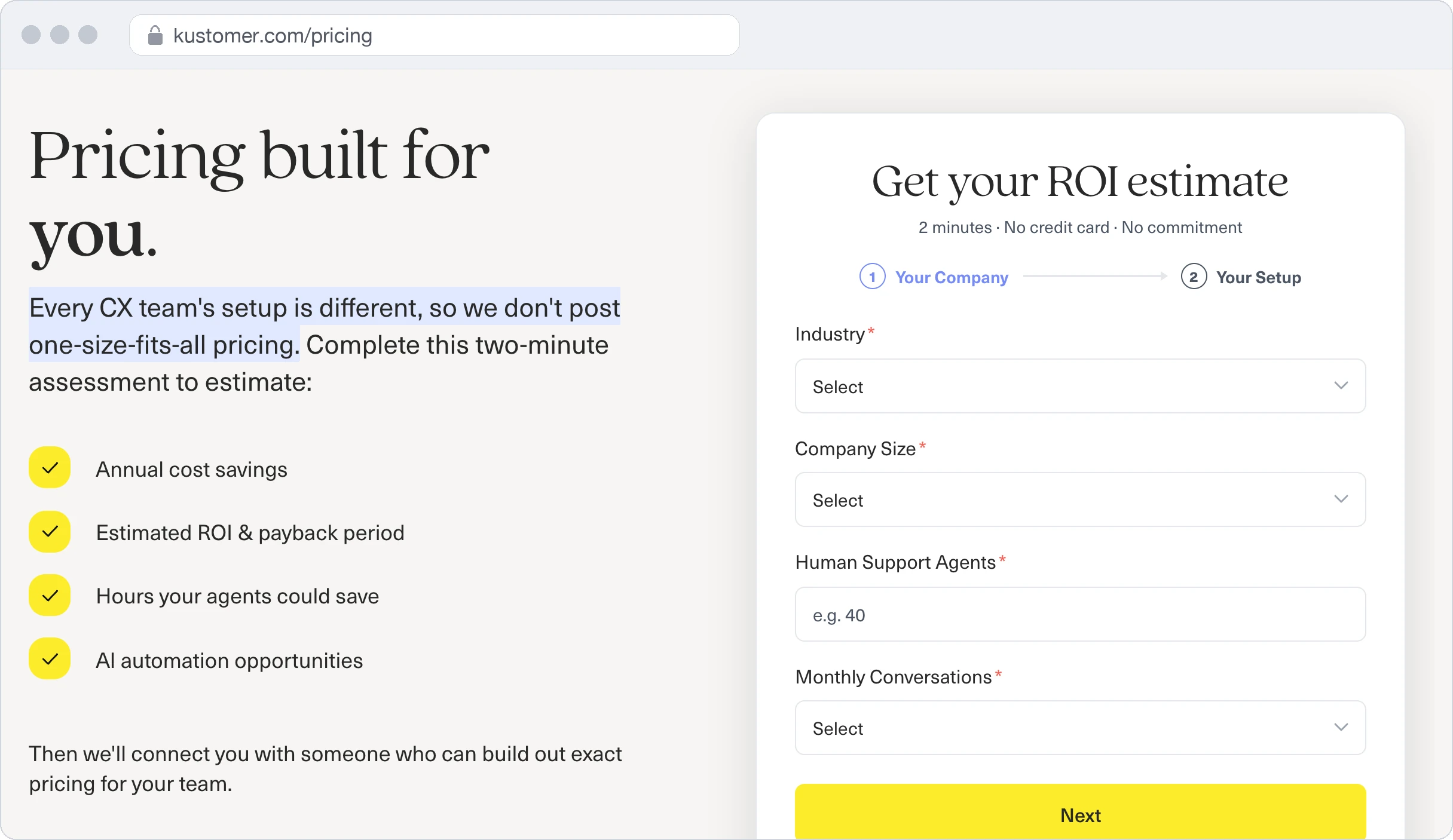
ChatGPT described publicly listed seat-based plans at $89 to $139 per seat a month, prices Kustomer's pricing page does not show. The answer that said so cited Kustomer's own blog, which carries those prices, and a development copy of Kustomer's website on a third-party server.
Hidden, in this test, means the vendor's pricing page, or its homepage where it has none, showed no plan price for its SaaS product when we captured it on 20 October. Four of the 10 contact-sales vendors, Ada, Cognigy, Maven AGI, and Gladly, list a price on a software marketplace under their own names. ChatGPT also named an SAP listing for Parloa.
Marketplace listings were the single source ChatGPT named most often for the first price an answer gave, in 16 of the 38 answers that gave one. ChatGPT presented 15 of those as listed prices. Because vendors post their own marketplace listings, these are outside numbers a vendor can correct itself.
Most of Ada's figures were marketplace prices. Across its answers, ChatGPT cited two AWS offers at $33,000 and $35,000 a year and a Salesforce AppExchange listing at $30,000, while Ada's pricing page shows none.
A vendor's own listing can stand in for a price list. Cognigy has no pricing page, yet ChatGPT gave its entry-level price as about $43,080 a year. That is the exact Basic package price on Cognigy's AWS listing, which the answer named but did not cite.
ChatGPT called Maven AGI's $25,000 AWS minimum "a publicly listed starting price." Maven AGI also states that minimum in a comparison article on its blog, while its pricing URL redirects to a demo request.

Where it named no listing, ChatGPT turned to contract-price data, pricing websites, and rival blogs. It put Decagon's median annual contract at about $432,750 and attributed it to Vendr's procurement data, yet Vendr's own website was cited in only one answer in the whole test.
Rival vendors' blogs were the outside pages ChatGPT linked most often. In 23 of the 38 answers with a price, ChatGPT linked a third vendor's website, usually a blog post that estimates the vendor's price. Across all 299 answers, ChatGPT labelled 92 of its 147 figures for these vendors as estimates and still stated them.
Few answers declined to price a hidden vendor. Of the 11 answers without a real figure, 10 gave no number at all, across eight vendors, and one gave only a hypothetical rate.
Hiding the price did not keep it out of ChatGPT's answers: it gave a figure for all 10 contact-sales vendors, and 16 of the 38 first figures came from marketplace listings the vendors post themselves.

One answer that cited only Forethought's pricing page explained why it gave no figure: "I wouldn't rely on third-party websites quoting specific prices without a verified offer from Forethought."
The three routes ChatGPT uses to reach a SaaS price
Hidden or published, a SaaS price reaches ChatGPT by three routes, alone or together, and a company controls only part of them:
- What the model learned. A price learned in training can reach an answer with no search at all. In Ahrefs' study of free, logged-out ChatGPT, only 14.4% of 66.6 million responses on every topic contained fan-out queries, the web searches ChatGPT runs behind an answer. Our records mark 297 of the 299 answers as searched, judged from their citations and search references, and they cannot show which figures came from memory.
- The vendor's own pages. In 289 of the 369 cases where an answer gave a figure for a publishing vendor, it also cited that vendor's pricing page. Across the Cloud 100 answers, companies' own pricing pages appeared in 46% but came first in only 12%.
- Other websites. Marketplace listings, contract-price data, review websites, and rival pricing posts are what ChatGPT names where the page states no number. In the Cloud 100 answers, the most cited outside sources were Vendr, Reddit, and G2.

In one budget answer for a 15-agent SaaS support team, ChatGPT linked Intercom's pricing page. It then quoted Fin's usage-based pricing: "Fin costs $0.99 per outcome, with no additional seat charge when used with an existing helpdesk."
A citation identifies a linked source, and it does not show that the quoted price came from that page. For contact-sales vendors, whose pages show no plan price, ChatGPT cited the pricing page in only 10 of the 54 answers that priced them.
Does a budget cost contact-sales SaaS vendors shortlist places?
Even with their own pages so rarely cited, contact-sales vendors lost few places as a group in our ChatGPT test. With a budget in the request, their average recommendation rate fell 2.8 percentage points and the publishing vendors' rose 0.8, a gap of 3.6 points.
By the rule we wrote before the run, the range for that gap between the two groups' changes stayed below 10 points for these 20 vendors and 100 requests. Other vendors or repeated runs could show a larger gap.
The budget sentence changed the answers far more than the lists. Of 100 shortlist answers with a budget, 91 stated at least one price, against 39 of 100 for the same requests without it. The budget answers carried 5.4 figures each, against 2.0.

One pair shows what the budget changed. The request read: "We're a 15-agent support team at a project management SaaS, handling about 8,000 conversations a month."
Without a budget, ChatGPT shortlisted Intercom, Zendesk, and Sierra, then named Ada and Decagon as other options.
The second version added "Our budget for AI is about $4,000 a month," and nothing else. ChatGPT then worked out that Fin's per-outcome price would use about 79% of that budget if Fin resolved 40% of conversations. It added Freshdesk for its "published session pricing," kept Ada as a secondary candidate, and dropped Sierra and Decagon.
The answer was direct about Ada: "Its pricing is not transparently published in the same way as Fin's, and third-party estimates vary." It would not assume Ada fits the budget "without a direct quote."
We wrote all 100 requests for support teams at SaaS, fintech, and ecommerce companies.
Without a budget, each publishing vendor was recommended in 31.6% of answers on average, against 11.1% for each contact-sales vendor. That starting difference goes with vendor type, since most contact-sales vendors are AI-native agents and most publishing vendors are suites, so the test measures only what the budget sentence changed.
Our primary test, written before the run, shuffled the labels "publishes" and "contact sales" at random across the 20 vendors. A gap that large, in either direction, appears about one time in five (p 0.19), so the 3.6-point gap could be chance.

Single vendors moved more than the groups did, so a group average says little about any one company. Zendesk, which publishes, lost 15 points across 98 pairs, leaving out the two pairs in which the team already used Zendesk as its help desk. Ada, which does not publish, lost 15 across all 100. Help Scout, which publishes, gained 10.
A controlled study measured a different outcome. In a Sprinklr team's study of 252,000 trials across 18 content factors on six AI models, a missing price was one of four factors that cut a post's chance of being cited first.
Each trial gave the model two anonymised consumer product posts, so the study tested which supplied source got the first citation. Our test measured which vendors an answer recommended.
How the budget level changes SaaS vendor shortlists
Behind the small overall gap, the result may split by budget level. The budget levels were built into the prompts, but only the generous split was planned as a check, so the tight and moderate splits are a pattern to confirm.

The three budget levels moved the two groups in different ways:
- Tight budgets (median $500 a month, 27 requests). ChatGPT added low-priced published plans, Help Scout from 9 to 16 of 27 requests and Tidio from 6 to 12. Zendesk fell from 27 to 14, and the answers that dropped it gave no Zendesk price. The gap between the groups was 2.6 points (p 0.77).
- Moderate budgets (median $4,000, 45 requests). The contact-sales vendors lost ground, Ada from 27 to 14 and Decagon from 7 to 1, and the gap between the groups reached 10.2 points (p 0.002).
- Generous budgets (median $66,000, 28 requests). The same vendors gained, Ada from 14 to 19 and Decagon from 11 to 15, while Freshdesk, which publishes, fell from 9 to 4. That 6.1-point swing toward the contact-sales group could be chance (p 0.14).
On 21 October, a retest of 25 of the 45 moderate pairs gave a gap of 7.6 points (p 0.08). Pooled with the first run, the gap was 8.4 points (p 0.02). Ada was recommended in 6 of the 25 requests with a budget against 12 without, and Decagon in 0 against 3.
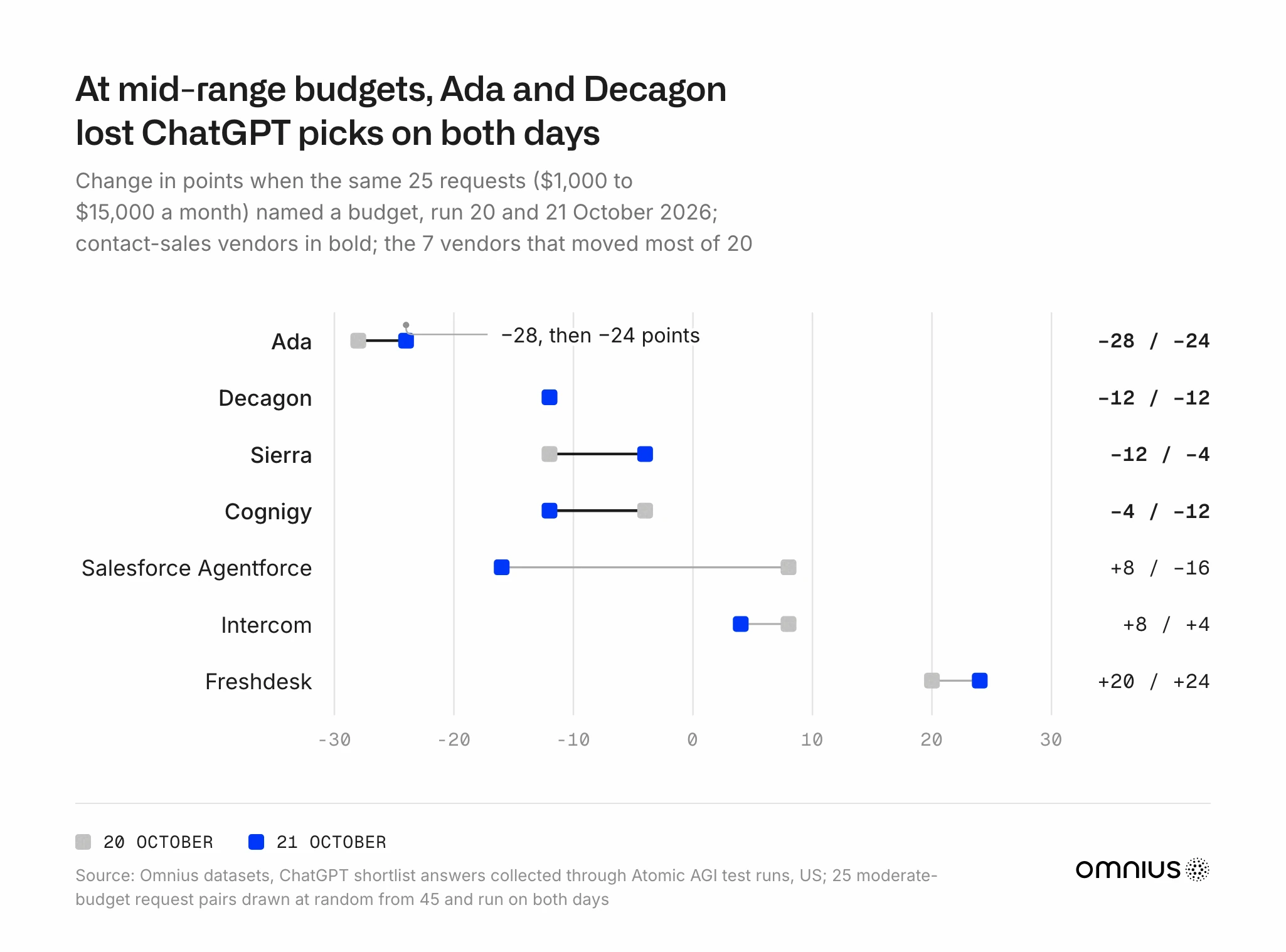
We read the split as ChatGPT treating a hidden price as an enterprise price, with fewer picks for those vendors at about $4,000 a month and more at about $66,000. The test cannot separate that from the vendors' market, because 8 of the 10 contact-sales vendors are AI-native agents that sell to enterprise customers.
How the reasons for hiding SaaS pricing play out in AI answers
What set contact-sales vendors apart was which number ChatGPT used for them. Wynter groups its respondents' reasons for that pricing strategy into "three anxieties": competitors seeing prices, a complex pricing structure, and "heavy discounting that makes list price fiction."
In Wynter's sample, 28% showed smaller plans while gating enterprise pricing, the same middle path that most publishing vendors in our test take, and 10% were fully transparent.
The test answers show how outside figures entered each of those three concerns:
- Competitor visibility. Rivals' pricing and comparison posts were among the citations in most answers with a figure, and one 20-agent Sierra budget drew on a cost model from Fin, "a Sierra competitor."
- Pricing complexity. The complexity reached the answer as ChatGPT's own estimate, built from the parts it found, budgeting about $15,000 to $40,000 or more a month for Sierra at 20 agents.
- Discounting. ChatGPT used reported contract data as a benchmark, such as Forethought's attributed median of $74,483 a year.

ChatGPT credited half the first figures for contact-sales vendors to a rival, a pricing website, or contract data. Where no figure appeared, a vendor could get an uncertain budget fit instead, as Ada did in the $4,000 answer.
Budget answers checked the outside figures against the stated budget too. One answer compared a $250,000-a-year budget with the Decagon contract median quoted earlier and said that budget "may be restrictive depending on the contract structure."
A placeholder on a listing is still a published number. For Sierra, ChatGPT named an AWS Marketplace listing that "displays a $1 million annual platform figure, but this is a private-offer pricing placeholder."
How to keep published SaaS pricing accurate in AI search
For vendors that publish, 784 of the 865 figures we could check (90.6%) matched the price list on the vendor's page that day. Another 76 matched a number the page carried in another version, so 860 sat somewhere on the vendor's own page.
An AI visibility platform's check of 7,594 AI price quotes, against pricing pages captured within 60 days of the answers, found a lower rate: 62.8% matched a listed price within 10%. Answers that also cited the pricing page matched 72.7% of the time, against 58.0% for those that did not, an association rather than proof of cause.

ChatGPT repeated a Salesforce rate that the visible card did not show. It gave Agentforce's conversation rate in 15 answers and cited Salesforce's page in 14 of them.
As we loaded the page from Europe, its Conversations card showed no rate. The page's HTML carried "$ 2 per conversation" beside the rate in other currencies, so the rate ChatGPT repeated sat in the code behind the card.
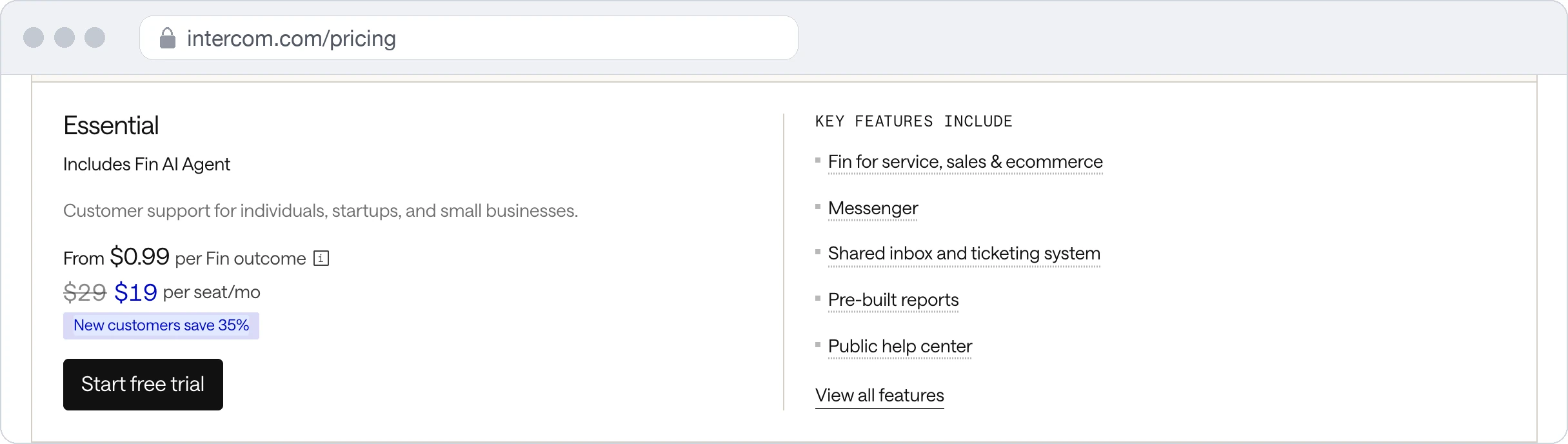
Intercom's page showed different prices during the day, and ChatGPT gave the higher one. As we loaded it from Europe, Essential showed $19 a seat in the morning, and that evening the page showed $29 struck through beside $19, with the badge "New customers save 35%."
The page's plain HTML text, which a crawler that skips JavaScript reads, carried no seat price for Essential in the morning or the evening.
ChatGPT gave $29, the price the evening page showed struck through, in 59 answers, citing Intercom's page in 55 of them, and the $19 offer reached a single answer.
Help Scout and Gorgias send their prices in the server's HTML, and 78 of 78 Help Scout and 94 of 96 Gorgias figures matched. In searchVIU's one-page test in October 2025, ChatGPT missed a price that JavaScript added after the page loaded, while Gemini returned it. A price in the HTML the server sends remains the safer default.
Prices on other first-party pages can still reach ChatGPT, even when the pricing page shows none. Kustomer's seat prices, absent from its pricing page but still in its own blog posts, came back in three answers. Prices also change often: PricingSaaS counted more than 1,800 pricing and packaging changes in 2025 among the top 500 SaaS and AI companies with public pricing, including AI add-ons that Notion and Slack later bundled into their plans.
Old amounts often outlast a price change, so each change needs its own check of the answers. An AI visibility platform tracked 706 cases in which a page AI answers cited replaced a dollar amount, mostly review, comparison, and product pages. In 48.3%, an answer given after its crawler detected the change still repeated the removed amount. On ChatGPT Search, 73.0% of 37 cases did.

The practical rule is one consistent price for each plan, billing term, and region. For each regional offer, the HTML, the rendered page, and any other published copy, such as a staging website, should state the same price and billing conditions. State an offer in text with its eligibility and conditions, keep any rate in the page code in line with what the card shows, and date each change.
Google's guidance for its AI features asks for important content in textual form. The schema markup guide explains why a price that exists only in JSON-LD, the structured data visitors never see, went unread by ChatGPT and Gemini in searchVIU's test.
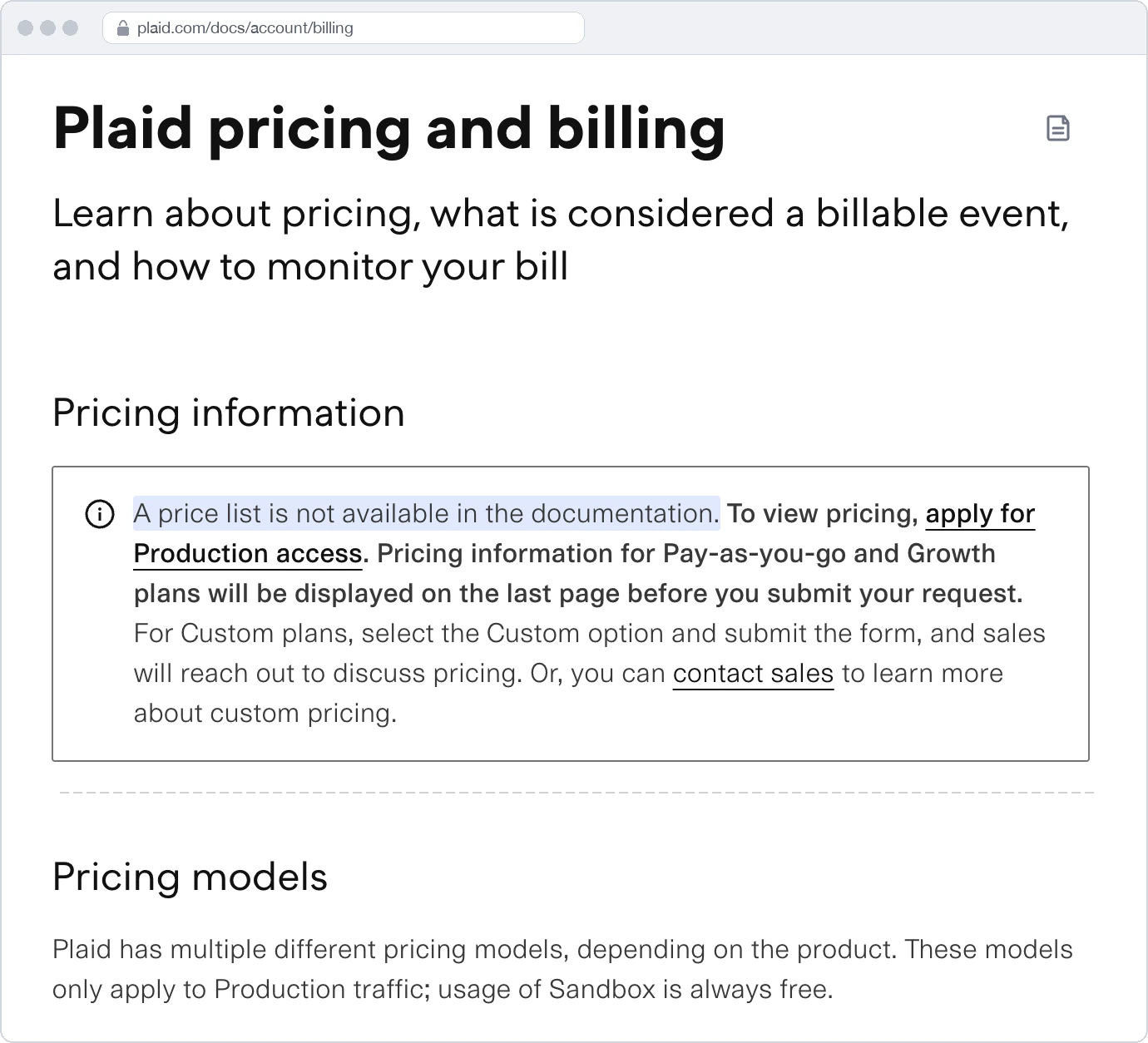
A page can also be the cited source without numbers. Plaid's billing docs state that "A price list is not available in the documentation" and then explain its pricing models. Cloud 100 answers about Plaid cited those docs 70% of the time.
What SaaS pricing transparency looks like, and how to check it
Between a full price list and Plaid's documentation, which has none, a transparent pricing page gives its pricing plans a starting price or a range, with its unit. Contact sales stays for the custom tiers, as 7 of the 10 publishing vendors in our test keep it. The entry price becomes public, while large deals and their discounts remain with the sales team.
The contact-sales vendors' dip came at mid-range budgets, in splits still to confirm, and as a group they gained places at large ones. We infer that a starting price matters most for deals in that middle band. The test could not check that, because it changed the budget in each request and never a vendor's pricing.
For a SaaS, fintech, or AI company with a tiered pricing model and a sales-led or hybrid go-to-market, each of its pricing tiers can state the following:
| Tier | What to state | When it fits | Example from the vendors' pricing pages, 20 October 2026 |
|---|---|---|---|
| Self-serve | The price, its unit, the billing period, and what is included | A standard package whose mandatory charges can be stated in full | Help Scout lists Standard, Plus, and Pro at $25, $45, and $75 per user a month, billed annually, and AI Answers at $0.75 per resolution |
| Sales-assisted | A starting price or a range with its unit, what drives the quote, and any minimum, platform, or onboarding fee | A real entry configuration, or variation with known bounds | Lorikeet lists Start at $2,100 a month, paid annually, with chat, email, and SMS resolutions at $0.99, and Scale at $5,100 a month |
| Enterprise | "Custom", why it is custom, what drives the quote, and what is included | Scope that is genuinely custom | Lorikeet's Signature tier reads "Custom" beside a $75K platform fee, and Zendesk's Suite Enterprise reads "Talk to Sales" beside three priced plans |
Outside per-seat SaaS pricing models, such as usage-based pricing and transaction fees, the page has to explain how the bill is calculated as well as state the number. We read these fintech and AI pages on 18 October 2026, and Payoneer and Plaid again two days later. Each explains how the bill is built, even where the exact price stays private:
- Transaction fees. Payoneer describes a "transaction-based pricing model, where fees depend on the payment type, payment method, currency, and payment corridor," lists typical fees, and offers a custom package above $50,000 a month.
- Subscription plus usage. Airwallex prices its US Grow plan at $12 per active Spend user a month plus a platform fee, says transaction fees still apply, and keeps Accelerate on custom pricing.
- Credits. Replit's pricing FAQ explains how agent usage is charged and that unused Pro credits roll over for two months, while Core credits reset each billing cycle.
- Custom contracts. Plaid's billing docs explain each pricing model and plan minimum without a price list.

We run four checks, in order of priority:
- Run the twin test. Ask ChatGPT the same shortlist with and without a budget, plus the five price questions. Log every figure, the source it names, the pages it cites, and whether the company made the list. Run each prompt on more than one day, daily for a week as the Cloud 100 authors suggest. Act on figures that are wrong, outdated, or missing their billing conditions, and on a company that drops out of budget answers across repeated runs.
- Align marketplace listings, then check the outside figures. For any product with a listing, state the unit and what the listing covers, and never leave a placeholder figure. Then search [company] pricing and look the company up on Vendr to find the outside figures ChatGPT may repeat, then correct or report any that are wrong.
- Check every version of the pricing page. View the page source, load the page with JavaScript off and from more than one region, and confirm each plan, billing term, and region carries one price. Keep staging copies out of search and redirect old pricing URLs. Check that robots.txt allows OAI-SearchBot, OpenAI's search crawler, since OpenAI says websites that block it are not shown in ChatGPT search answers, apart from navigational links.
- Date changes and state offers in text. Keep a dated change log, write each promotion as text with its conditions, and say which plan fits which team size. Update the price fields on review profiles too, such as G2, the third most cited outside source in the Cloud 100 answers.
Ask ChatGPT what the company costs on two different days. In our rerun, 6 of the 35 questions priced on both days came back with a different first figure, and 10 drew a figure on one day only.

Our agentic SEO guide makes the same case for a starting price or the drivers that set it, with the enterprise price list kept behind a request.
ChatGPT gave a price for every vendor in the test whose page showed none. The choice left to SaaS businesses is which number they put in front of ChatGPT, and whether every version of their own page states it the same way.
Methodology
The evidence behind this essay, and its limits:
- What we ran. We ran 400 ChatGPT prompts through test runs in Atomic AGI, the Omnius AI search tracking product, US, on 20 and 21 October 2026, about 20 AI customer service vendors. Ten state a price (Intercom, Freshdesk, Help Scout, Zendesk, Gorgias, Tidio, Salesforce Agentforce, Yellow.ai, Lorikeet, and Siena AI), and 10 showed no plan price on the pricing pages, or homepages, we captured from Europe (Decagon, Sierra, Ada, Forethought, Kustomer, Cognigy, Kore.ai, Parloa, Maven AGI, and Gladly). On 20 October we ran 100 shortlist requests with a budget, the same 100 without the budget sentence, and five direct price questions per vendor, and 299 of the 300 completed. On 21 October we reran 25 of the 45 moderate-budget pairs, drawn at random, and the 50 questions about contact-sales vendors.
- How we coded and scored. Answers were coded with AI assistance under written rules: which vendors an answer recommended, every figure with its unit, and the source it named. A second AI pass checked 40 first-day and 20 second-day answers against thresholds set in advance, and it matched 146 of 147 and 83 of 83 vendor mentions. The main comparison, the change in each group's average recommendation rate when a budget was added, was tested by shuffling the price labels across the 20 vendors, under a decision rule and a rerun rule written before the runs. A publishing vendor's figure matched when it was within 10% of a listed price in the same unit, and a first figure matched across days in the same unit and currency, within 10% of the larger amount. After the first analysis, we recoded hypothetical rates out of the figures and counted Intercom's $29 and Salesforce's $2 as numbers on the page.
- Limits. The test covers one engine, one niche, one country, and single-turn prompts with one run a day, which the planning simulation put at about 25% power to detect a 5-point gap. Pricing status was not assigned at random, and 8 of the 10 contact-sales vendors are AI-native agents, so the gap between the groups is an association, and because the budget request always ran first, an order effect is possible. The run data does not record ChatGPT's plan or model, the pages were captured from Europe while the runs were US, and a cited page shows a linked source, not where a figure came from.
- Interests. Omnius sells AI search services and runs the tracking product that ran the prompts. Kyle Poyar, who wrote the Cloud 100 study with Profound, an AI visibility software company, also advises software companies on pricing. PricingSaaS has been part of a pricing consultancy since October 2026, after its count was published, searchVIU sells SEO software with individual SEO support, and the price-accuracy and freshness studies come from an AI visibility platform we leave unnamed. The misinformation report's publisher also sells AI visibility software, and G2 and TrustRadius run software review platforms whose surveys are self-reported.
Sources
The studies, surveys, and pricing pages behind this essay:
- Studies: Growth Unhinged and Profound, Cloud 100 pricing study, Growth Unhinged, 2025 SaaS pricing changes, Profound, inaccurate AI claims, Ahrefs, ChatGPT search study, What Gets Cited (arXiv), Searchable, AI brand misinformation, and searchVIU, schema markup and AI
- Surveys: Wynter, B2B SaaS pricing study, G2, 2026 AI search insight report, and TrustRadius, 2026 B2B buying disconnect report
- Pricing pages and listings: Kustomer pricing, Kustomer blog, self-service platforms, Maven AGI blog, Decagon pricing, Intercom pricing, Salesforce Agentforce pricing, Help Scout pricing, Lorikeet pricing, Zendesk pricing, NiCE Cognigy on AWS Marketplace, Plaid billing docs, Payoneer pricing, Airwallex pricing, Replit pricing and plans, Google AI features documentation, and OpenAI crawlers