.png)
AI search optimization agency powered by proprietary technology to maximize the mathematical probability of positioning in LLM answers.
We build and own the technology behind our work, combining big data modeling, proprietary workflows, ontology, and vertical agents.






















.svg)


















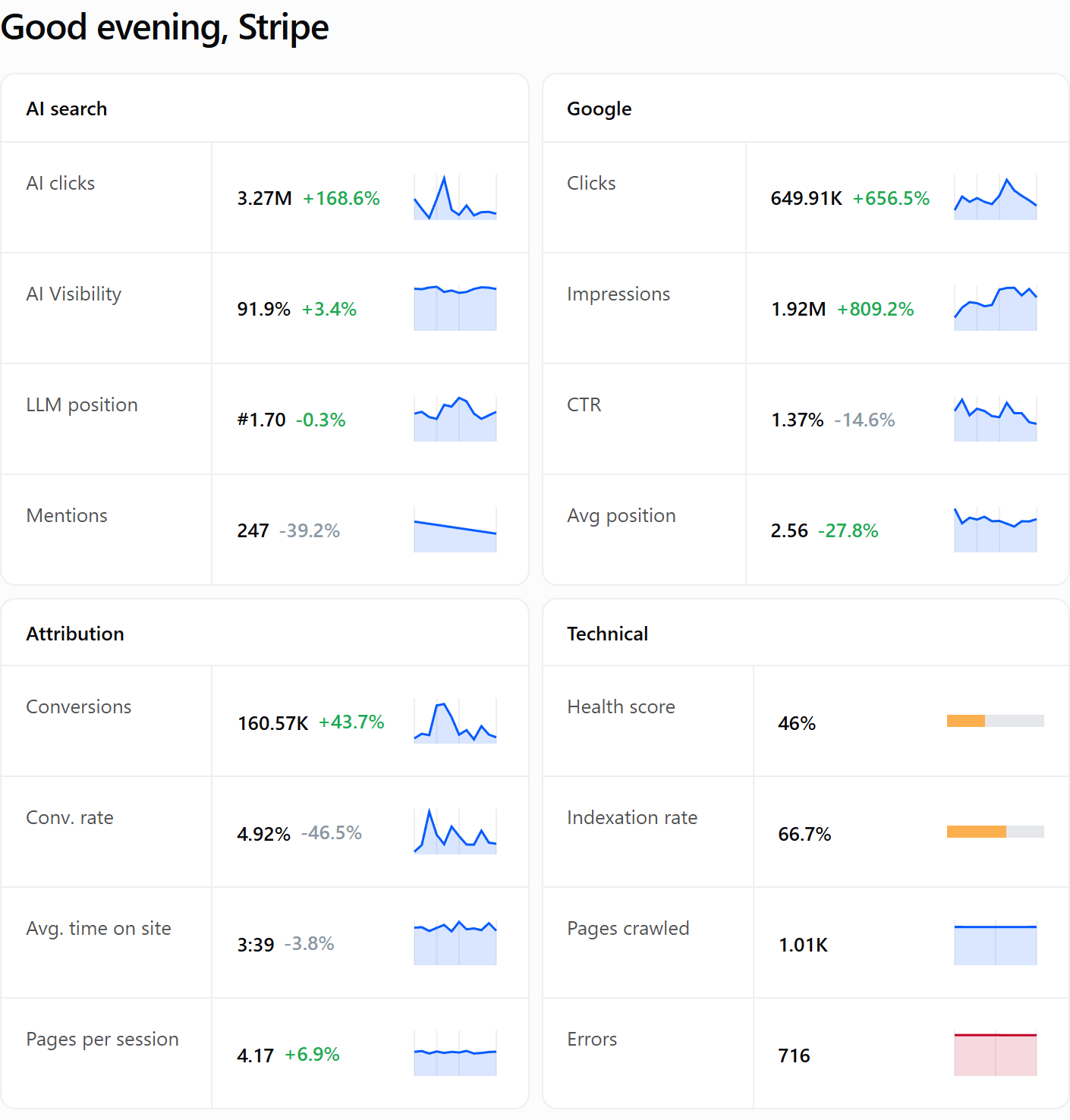



We believe that positioning in a (non-deterministic) AI search starts by objectively understanding it. Technology is a critical component of that process.

Technology makes more effective strategy and more efficient execution possible at the same time.
Strategy & prioritization
Model the company’s search market, identify demand and competitive whitespace, organize opportunities into entities and clusters, and weight them by intent, commercial value, evidence strength, probability of impact, and effort. Thousands of signals become a small number of defensible priorities.
Performance is interpreted relative to competitors and the wider market, separating genuine company progress from category or search-environment movement.
What matters. Why it matters. How strong the evidence is. What should happen next.
Context-grounded execution
The company model, ontology, positioning, clusters, priorities, and accumulated knowledge remain attached as strategy becomes real output. Workflows operate on live data and company context, with defined deliverables, QA gates, decision rules, and guardrails.
Measurement, audits & learning loops
Performance and readiness are measured continuously across Google, AI search, website behavior, technical infrastructure, attribution, conversions, and revenue.
Decay, gaps, anomalies, competitor movement, and machine-accessibility issues are surfaced; priorities are updated; and validated learning is written back into the system.
Successful patterns are encoded, failed assumptions are corrected, and changes in the search environment update what the system measures and recommends.
What our technology tracks and where the data comes from?
Why proprietary, object-personalized technology matters in AI search?

Synthetic prompt tracking is useful, but it samples a non-deterministic system and can turn noise into apparently precise visibility scores.
On its own, it does not explain why something happened, what commercial value sits behind it, or what should happen next.
At Omnius, synthetic tracking is one input inside a broader system of search, behavioral, technical, competitive, citation, attribution, and conversion data.
Synthetic tracking shows how companies, sources, and citations appear in generated answers. But those answers sit on top of a much larger search ecosystem.
AI systems discover and retrieve information through combinations of their own infrastructure, website access, third-party sources, and search indexes such as Google, Bing, and Brave.
Optimizing only the final AI answer means observing the last layer while ignoring many of the systems influencing it.
Effective optimization requires connected data across AI outputs, traditional search, technical accessibility, retrieval surfaces, citations, competitors, market movement, website behavior, attribution, and conversions.
This creates a complete view of both sides of the system: where answers are produced and where the information used to produce them is discovered, evaluated, and retrieved.
Multi-engine search requires optimizing the whole information ecosystem - not a single model, interface, or visibility score.
AI search changes by model, context, wording, conversation history, location, retrieval, reranking, entities, and other variables.
Our infrastructure is built around company-specific data, ontology, market structure, and object-level personalization - making each analysis and recommendation specific to the object it is optimizing.
Poor context does not just produce generic output - it creates false priorities. The wrong page, topic, technical fix, or competitor angle can sound reasonable enough to become work and quietly cost a quarter.
Good data is not simply more data. It means the right sources, a sufficient sample, verified and cleaned inputs, the right structure, clear processing rules, evaluation, and optimization against the right objective.
AI search must be observed at scale - across prompts, models, contexts, sources, competitors, and time - to distinguish persistent patterns from randomness.
But market-level averages alone are not enough. The data must also be narrowed to the company, entity, cluster, page, funnel stage, and specific object being optimized.
Mathematical functions then weight opportunity size, relative position, commercial value, evidence strength, probability of influence, and implementation effort. As outcomes are measured, confidence levels and decision weights can be updated.
The objective is not to predict or guarantee a single answer. It is to systematically increase the probability of favorable positioning across the relevant answer space.
Claude, GPT, MCPs, APIs, crawlers, connectors and raw datasets are increasingly available to everyone. If the next company can reproduce the same strategy and output with the same model and another connector, there is little defensibility in the work.
The model is not the differentiated layer. The advantage is the proprietary processed data, accumulated context, ontology, methodology, workflows, tools, and vertical agents surrounding it - and the quality of the system that supplies the model with the right context for each decision.
The entry barrier to AEO / GEO tooling can appear low because model APIs make generated outputs easy to produce.
Implementable value requires more: large-scale data processing, mathematical and statistical functions, stable calculations, traceable decisions, ontologies, databases, and purpose-built vertical tools and agents.
LLMs are used where probabilistic generation adds value-not where hallucination or inconsistent outputs reduce precision.
The value is in the precision and coordination of these components, not the API call itself.
Dashboards and reports still require people to monitor, interpret, and translate information into action.
Useful infrastructure works in both directions: it processes fragmented data into a small number of priorities, then carries those priorities and company context into briefs, workflows, technical changes, content, and measurement.
Outcomes update the models and decision rules behind subsequent recommendations.
Complex processing happens in the backend; the frontend returns simple, implementable value.
Our infrastructure operates in live search environments and real-world workflows.
Analyses, recommendations, and systems are put into practice; outcomes are measured; successful patterns are encoded, and failed assumptions are removed or adjusted.
Only methodology that survives real-world conditions becomes part of the system, creating technology continuously validated by use rather than built around hypothetical workflows.
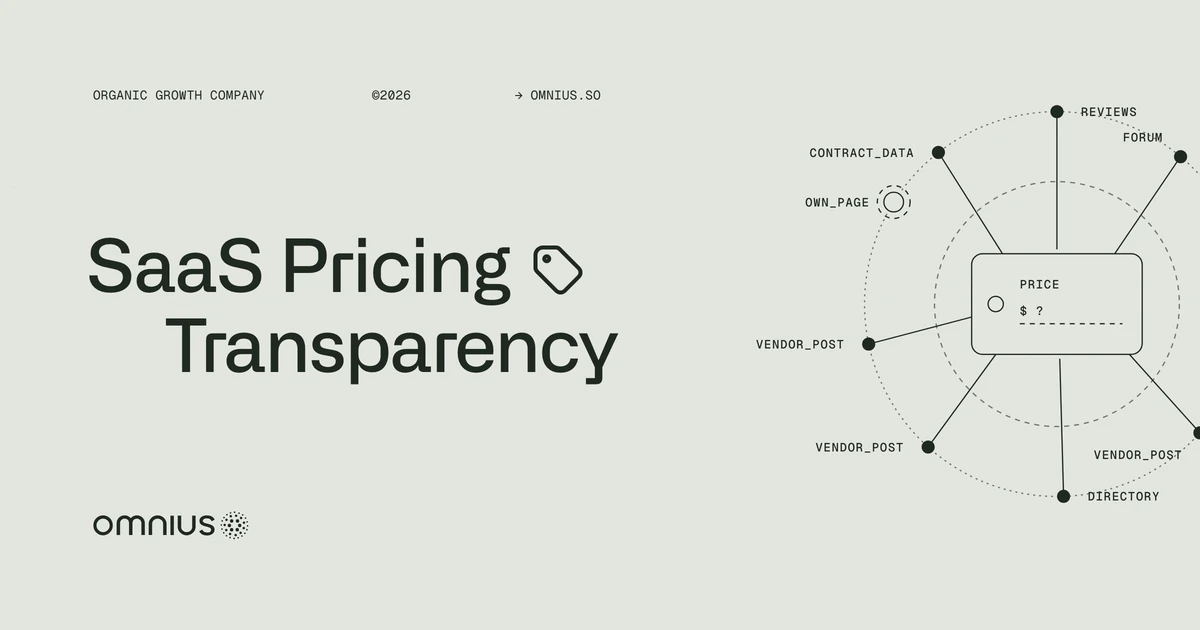
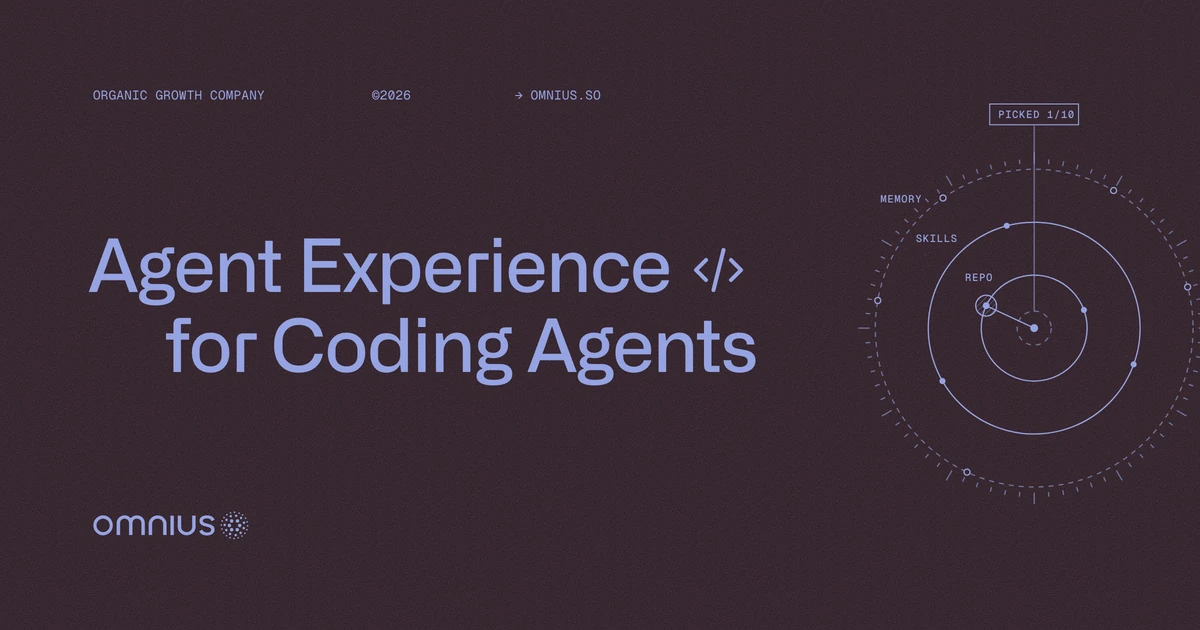
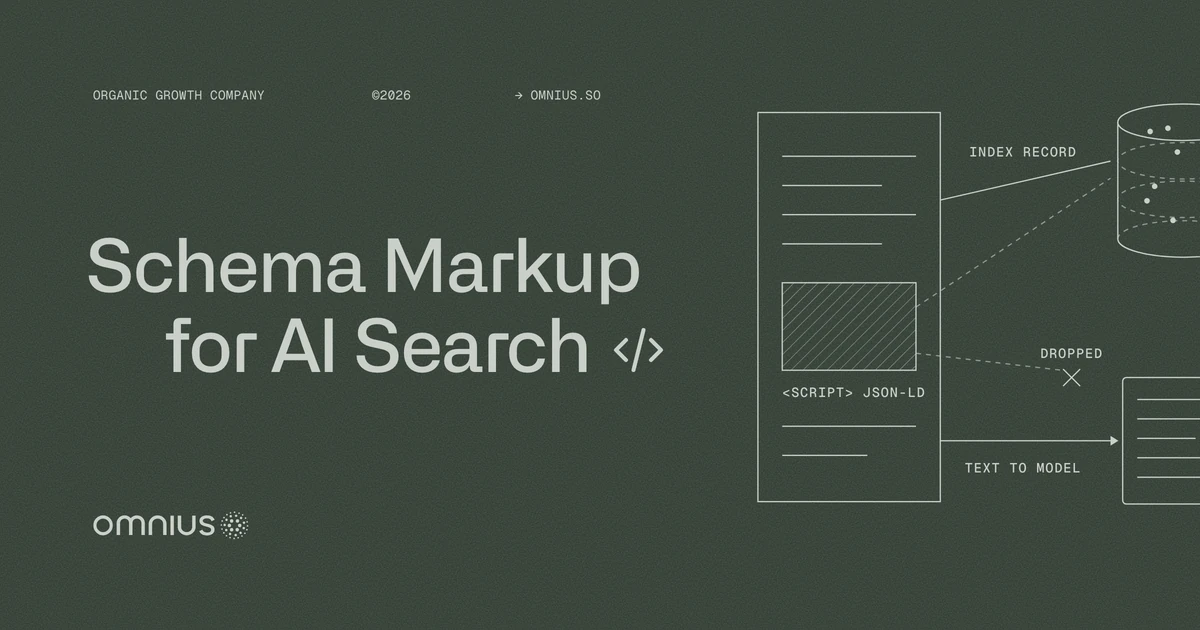
Our technology reveals how AI search behaves at scale. We publish what we learn through original AEO / GEO research and case studies.








.webp)



%20in%20SEO.webp)





Questions & Answers.
AEO / GEO technology helps companies understand and improve how they are discovered, interpreted, cited, and positioned in AI-generated answers. It combines AI search monitoring with search, technical, content, market, citation, behavioral, attribution, and conversion data.
SEO focuses primarily on visibility and performance in traditional search engines. AEO / GEO extends that work into generated answers, citations, retrieval systems, AI crawlers, and model-specific behavior. The two are connected because AI systems often rely on search indexes, websites, and third-party sources to discover and retrieve information.
No. AI search is non-deterministic and changes with the model, prompt, context, location, retrieval process, reranking, and time. Effective optimization measures patterns across these variables and increases the probability of favorable positioning rather than promising a specific answer.
No. Synthetic prompt tracking shows where a company appears, but not necessarily why, what the commercial value is, or what should happen next. Useful decisions require broader evidence from competitors, citations, technical accessibility, traditional search, website behavior, attribution, conversions, and revenue.
Omnius combines company-specific data, search ontology, market benchmarking, mathematical and statistical functions, proprietary workflows, and vertical tools and agents. The technology is built on in-house methodology and operational knowledge developed through years of delivering SEO and AI search services in live client environments.
Opportunities are evaluated against search intent, funnel position, relative market position, evidence strength, probability of impact, implementation effort, attribution, conversions, pipeline, and revenue. This helps prioritize work by probable business impact rather than visibility alone.
Omnius tracks positioning across traditional and AI search, including mentions, answer presence, citations, sources, competitors, technical and LLM readiness, topical and entity coverage, website performance, AI referrals, conversions, attributed pipeline, and revenue contribution.
Omnius is a B2B SEO and AI Search Optimization agency, not a software company. We develop and own proprietary technology as infrastructure behind our strategy, execution, and measurement.
Parts of the technology originally developed for our agency work were later made publicly available through Atomic AGI.

Omnius is a B2B SEO & GEO agency; partnering exclusively with SaaS, Fintech & AI companies. The result? Compounding growth made through organic positioning everywhere people search for information, including both Google & LLM search engines.