.png)

Embedding video on web pages is becoming a way to boost engagement and improve rankings inside the SERP.
The behavior backs it up: video now accounts for roughly 65% of global downstream internet traffic, a sign that people's content consumption preferences are shifting, and that offering video alongside your written content, rather than raw text alone, is a smart way to meet user need.
That extra time on page and lower bounce are exactly the signals search engines associate with content that answers the query.
This guide breaks down how embedding video improves SEO performance, the ranking levers it pulls, and how to measure the impact.
Key Takeaway
- Video improves rankings indirectly, not directly: Google has confirmed that dwell time and bounce rate aren't ranking factors, so a video won't lift your page just because people watch it. It works by strengthening the signals and assets Google does reward - engagement, backlinks, mobile performance, and overall page helpfulness.
- The win comes from better engagement, not the video itself: A well-placed video keeps visitors on the page longer (Wistia found 6 minutes with video vs 4.3 without), stops them bouncing back to the results, and gives your CTA and links more time to work, the pattern that signals a page satisfied the query.
- Placement and load speed decide whether it helps or hurts: Put the video high on the page, ideally above the fold, so it does its work immediately - but lazy-load it and reserve its space, or an above-the-fold embed can become your Largest Contentful Paint and drag down the Core Web Vitals that are a ranking factor.
Understanding How Embedding Video Improves SEO
Embedding video doesn't rank your page directly - it works by improving the signals that do influence rankings. That distinction matters, because a lot of video-SEO advice gets it wrong.
Here's the right version of it: Google has repeatedly stated that metrics like dwell time and bounce rate are not direct ranking factors.
So a video won't lift your page simply because visitors watch it. What it does is improve the underlying experience Google is trying to reward.
When a well-placed video helps someone understand your content faster, they stay longer, scroll further, and click back to the results less often - a pattern that signals the page satisfied the query. Google's systems are built to surface exactly that kind of result, whether the signal is measured directly or inferred through other means.
Video also strengthens genuine ranking factors on the way. It gives people a reason to link to your page, which builds the backlink authority Google does weigh heavily. It keeps mobile users engaged, which matters under mobile-first indexing, where Google crawls and ranks the mobile version of your site by default. And a page built around a clear, useful video tends to be a genuinely more helpful page - the quality bar Google's helpful-content systems are designed to reward.
In short: video is a lever on user satisfaction and authority, and those are what move rankings. The pages that win aren't the ones that simply have a video - they're the ones where the video makes the page measurably better at answering the question.
7 Ways Embedding Video Improves Your SEO Performance
Each of these works through the mechanism above; it strengthens the signals and assets that do.
Here's the overview, then the detail.
1. Longer time on page and deeper engagement
The most direct effect: people watch. When a video answers the question faster than a wall of text, visitors stay to watch it.
Wistia's analysis found visitors spent an average of 6 minutes on pages with video versus 4.3 minutes on pages without - about 1.4x longer.
That deeper engagement doesn't rank the page on its own, but it reflects the satisfaction Google's systems are built to reward, and it gives every other element on the page - your CTA, your internal links, your offer - more time to work.
2. Fewer bounces back to the search results
When someone clicks your result, skims for two seconds, and clicks back to Google to try the next link, that "pogo-sticking" is the clearest signal a page didn't deliver.
Video is one of the fastest ways to interrupt it. A short explainer near the top gives a restless visitor an easier path into your content than a dense opening paragraph - so they engage instead of bouncing back.
Bounce rate itself isn't a ranking factor, but keeping people from returning to the results is exactly the outcome Google's ranking systems are trying to produce.
3. More backlinks and stronger domain authority
Backlinks are a confirmed ranking factor, and video is unusually good at earning them. A genuinely useful tutorial, explainer, or piece of original video research is more linkable and more shareable than the equivalent text - people embed it, reference it, and pass it around.
Each of those links is a vote of confidence that lifts your domain authority. This is the lever with the most direct line to rankings, because you're not just improving a soft signal - you're building the off-page authority Google weighs heavily.
4. More space on the results page
A page with properly marked-up video can qualify for richer search results:
- video thumbnails,
- carousels, and
- enhanced listings that take up more visual space than a standard blue link.
Video already appears in roughly 62% of Google universal search results, and that prominence pulls clicks.
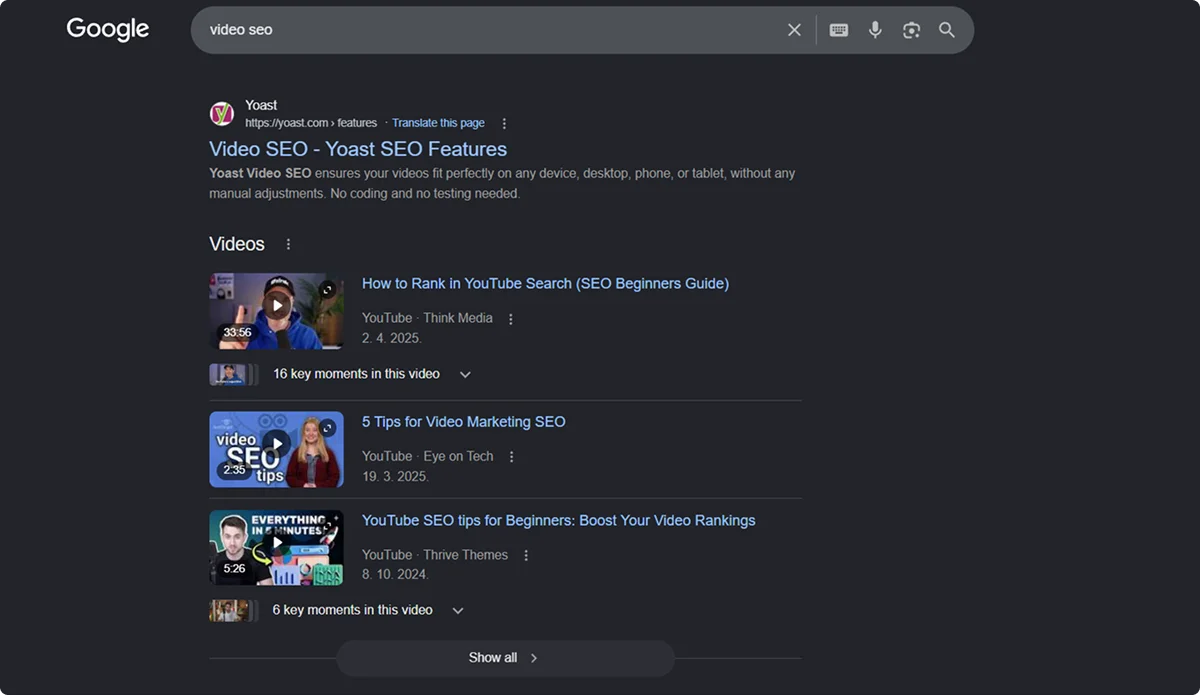
On a results page where your competitors are all text, being the one listing with a thumbnail is a meaningful click-through advantage.
5. Better performance with mobile users
Most video is watched on phones - around 75% of video views happen on mobile devices - and that matters more than it sounds.
Google uses mobile-first indexing, meaning it crawls and ranks the mobile version of your site by default. A page that keeps mobile users engaged is one that performs well on the exact version Google evaluates.
Video is naturally mobile-friendly:
- easy to consume on a small screen,
- easier than scrolling long text,
Which makes it one of the better approaches for holding the mobile audience Google is measuring.
6. Extra reach through YouTube search
YouTube is the world's second-largest search engine, and it's owned by Google. When you embed a video on your page and also publish it to a YouTube channel linked back to your site, you open a second discovery surface - the same asset can be found through Google search, Google video results, and YouTube search.
That widens your long-tail: individual videos each attract a small, specific audience that text alone might never reach, and every one of those visitors is a path back to your site.
7. A more helpful page and stronger trust signals
Good SEO increasingly rewards pages that are genuinely helpful, and video makes pages more helpful in ways text can't. For brands looking to add more video content to their pages, inVideo editor can help turn ideas into engaging visual content, with an online video editor that makes it easy to refine the videos before embedding them into web pages.
It explains complex things faster, puts a face and voice to your brand, and builds the kind of trust that turns a visitor into a lead. 65% of people have been convinced to buy a product or service by watching a video.
Behind every ranking is a real person deciding whether to trust you, and seeing real people, hearing real voices, and watching genuine stories builds that trust faster than any paragraph.
When users have a better experience, they behave in exactly the ways that tell Google the page deserves to rank.
How to Embed the Video in Your Content?
Where you place the video matters as much as whether you have one. The goal is to get it high on the page - ideally in the above-the-fold area, the part visitors see before scrolling - so it does its work immediately and Google registers it as a core part of the page rather than a buried afterthought.
1. Place it near the top, above the fold
The first thing a visitor sees shapes whether they stay or bounce. A video in that prime space captures attention right away, gives a restless reader an instant alternative to scanning text, and starts building the engagement signals from lever #1 the moment the page loads. It also puts your most engaging asset where Google's crawlers encounter it early, reinforcing what the page is about.
2. But don't let it wreck your load speed
Here's the trade-off most guides skip: an above-the-fold video is often the largest element on the screen, which means it can become your Largest Contentful Paint.
A heavy, poorly-loaded embed sitting at the top can slow the page enough to cost you the ranking the video was meant to help. The placement is right; the implementation has to match.
After the video implementation, do the speed page test inside PageSpeed Insights.
3. Lazy-load and reserve the space
Lazy-loading tells the browser to hold off fully loading the video until it's needed, so it doesn't block the rest of the page from rendering.
Pair that with a fixed aspect-ratio container so the layout doesn't jump as the video loads - an unreserved video slot is a common cause of layout shift.
Together these let you keep the video up top without paying for it in speed.
4. Surround it with relevant text
Google still can't watch your video - it leans on the words around it to understand what it's about. Embed the video inside genuinely useful written content rather than dropping it onto a bare page.
The text gives crawlers context, and the video gives readers a faster way in. They work together; neither replaces the other.
The Bottom Line
Embedding video doesn't earn rankings on its own - and any guide that promises it does is selling the myth we opened with.
What video does is quieter and more durable: it holds attention longer, gives restless visitors a reason to stay rather than bounce, earns backlinks Google actually counts, and makes the page genuinely more useful to the person reading it.
Those are the signals and assets that move rankings, and video strengthens all of them at once.
The pages that win aren't the ones that simply have a video bolted on. They're the ones where the video is placed high, loads fast, sits inside genuinely useful text, and makes the page measurably better at answering the question someone typed into Google. Get that combination right and video stops being decoration - it becomes one of the most reliable ways to lift both engagement and rankings on the same page.
At Omnius, we help SaaS, AI, and fintech companies earn more citations in LLMs, strengthen organic rankings on Google, and turn search visibility into measurable pipeline.
Ready to learn more about our process and the results we've achieved?
Schedule a free call and let's discuss how we can help you grow your business!


.png)

.svg)
















.svg)



























.svg)

.webp)