

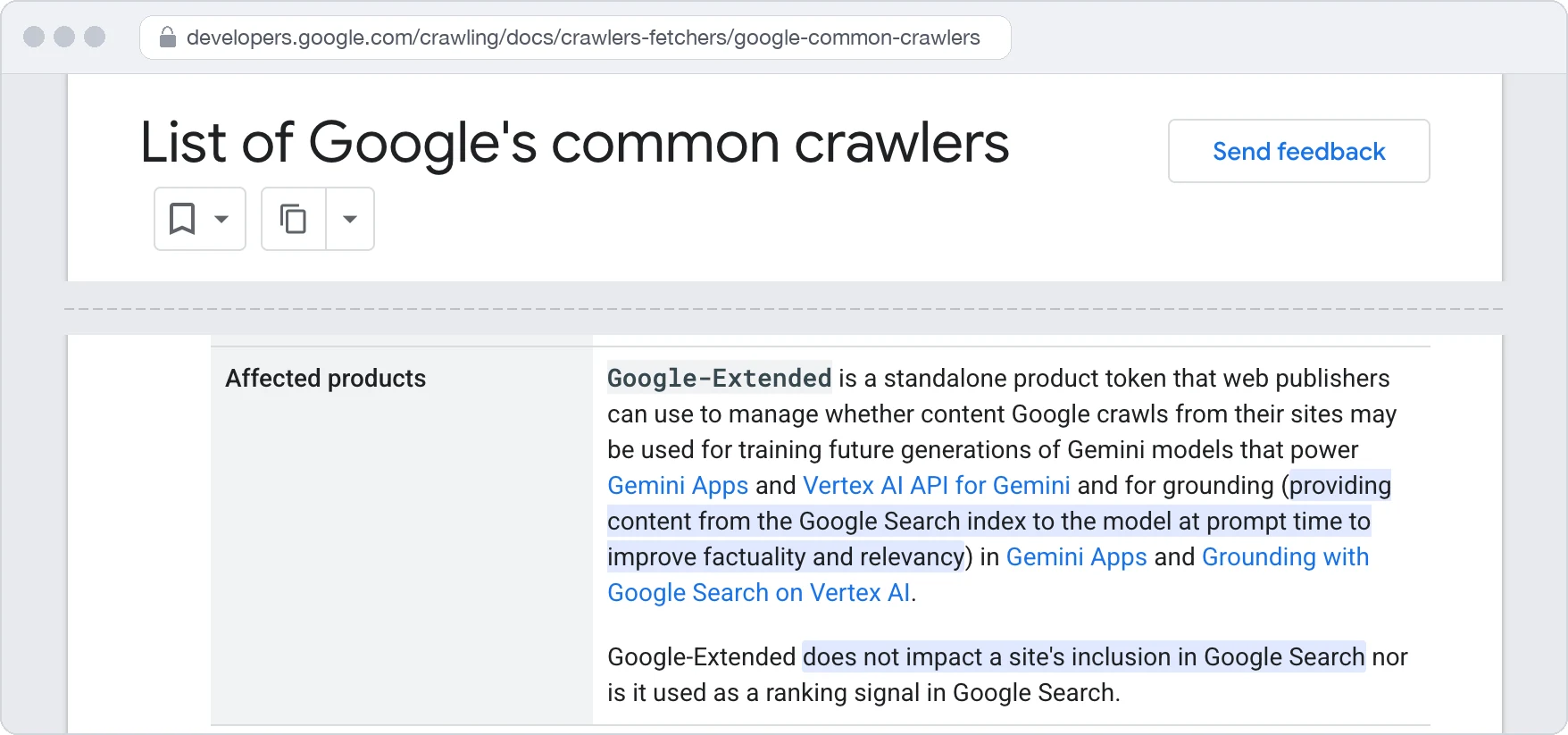
AI grounding is the step where an AI search engine retrieves web pages and writes its answer from extracts of them. Google's crawler documentation describes it as giving the model Search index content “at prompt time to improve factuality and relevancy.”
Grounded answers can still state what their sources do not say: in a 2026 study of AI Overviews, 11% of claims lacked support in the cited page text its checker could extract.
For SaaS, fintech, and AI companies, the lines an engine lifts shape what AI answers say about their prices, limits, and compliance, current or not. This guide shows how AI search turns a page into grounding text, what that text needs to be repeated correctly, and how to check the results.
Key takeaways
- AI grounding feeds page extracts to the model, so each key sentence should state the whole fact.
- Grounded responses often repeat what they lift, right or wrong, and most assistants tested in 2025 rarely declined.
- A citation shows which page a statement was linked to, which does not prove the page says it.
- Check each engine's controls first, then make key facts complete, consistent, and current.
What is grounding in AI, and why does it matter for AI search?
AI grounding, or grounding in AI search, connects an answer to source information retrieved as the model responds: web pages supply the facts, and citations tie statements to the pages behind them. An ungrounded answer rests on the training data of large language models (LLMs) alone.
Google's AI guide calls retrieval-augmented generation (RAG), a method that fetches documents before a model writes, “a technique (also known as grounding).”
Google Cloud's Check grounding API, a developer tool that checks answers against a company's own data, applies a stricter test. “If the claim is only partially entailed, it is not considered grounded,” so the tool counts a claim only when sources support all of it.
Enterprise grounding over a company's knowledge base uses the same mechanism, as the guide to RAG explains, while fine-tuning changes the model through extra training and supplies no sources on its own.
In June 2026, Google said AI Overviews had over 2.5 billion monthly users and AI Mode over one billion. Microsoft says its grounding infrastructure powers “Copilot, ChatGPT, enterprise systems from Nasdaq, and others.” At that reach, the extract an engine lifts shapes what many people read about a company.
Four dated events from the past six months made grounding visible to websites:
- June 2, 2026: Microsoft launched Web IQ, a set of grounding APIs that return passages to AI agents.
- June 3, 2026: Google began testing, first in the UK, a Search Console control over whether a website helps ground AI Overviews and AI Mode.
- August 31, 2026: Google rolled out the control and AI performance insights to every website worldwide.
- October 13, 2026: Bing added Topics Portfolio, a beta that groups a website's grounding queries and shows queries where other websites are cited.
How does AI search ground an answer in web pages?
Read together, Google, Microsoft, OpenAI, and Anthropic documentation covers four stages of grounding AI answers, from the model's searches to each statement's link; the sequence is our reading.

1. The model writes grounding queries. The first move is a search the model writes for itself. In the Gemini API, the model judges whether Google Search would improve the answer, a step Gemini's grounding documentation lists, and only then writes one or more queries. In Moz's runs, many prompts produced no grounding query at all.
These grounding queries look like long-tail searches that the model writes for its own use. Dr. Pete Meyers, a marketing scientist at Moz, calls them “searches run by machines, for machines,” and one query in Moz's Gemini sample reads BaaS pricing models subscription transaction hybrid. A third of the 5,333 queries Moz collected named a year.
One question can set off several grounding queries, so a page can be found through searches no person typed. Moz's Gemini prompts rarely produced more than one or two grounding queries. AI Overviews and AI Mode can run query fan-out, several related searches across a question's subtopics. Bing Webmaster Tools samples the grounding queries behind Copilot and Bing citations.

2. The engine retrieves ranked pages it may use. Each query retrieves pages through the engine's ranking systems, so search ranking still shapes which pages ground an answer. Google's AI features rely on “core Search ranking systems,” and a page must be indexed, eligible for a snippet, and included under Search Console's Search generative AI control, which is the default.
Google's patent on generative summaries lists the measures that can pick among eligible pages, from ranking position to freshness.
3. The engine extracts grounding snippets. An LLM's context window, the text it can read at once, is limited, so engines pass extracts of each page. Microsoft says Web IQ “returns passages and structured evidence objects,” extracts that keep their source, metadata, and local context.
One practitioner's analysis of 7,060 Gemini API queries with at least three sources found a median of 1,929 words of grounding text per query. In that sample, higher-ranked sources received more of it, a median 531 words for the top-ranked source and 266 for the fifth.
Within each page, the same practitioner's annotated example shows Gemini picking single sentences that match the query, favoring opening paragraphs, and joining distant sentences with an ellipsis.
We asked Google AI Mode whether Mercury's deposits carry Federal Deposit Insurance Corporation (FDIC) coverage. In the first run, the source card for Mercury's help article, a page preview, showed a similar join, cutting “Through sweep networks” at an ellipsis and skipping the sentence on coverage conditions. The preview cannot show the model's full input, but in it the $5M limit appeared without its conditions.
4. Each statement is linked to a source. The model writes from those extracts, and the engine links spans, stretches of the response, to sources. Gemini and OpenAI return each citation as a span's start and end plus a URL and title, and Claude adds a short quote of the text it cited.
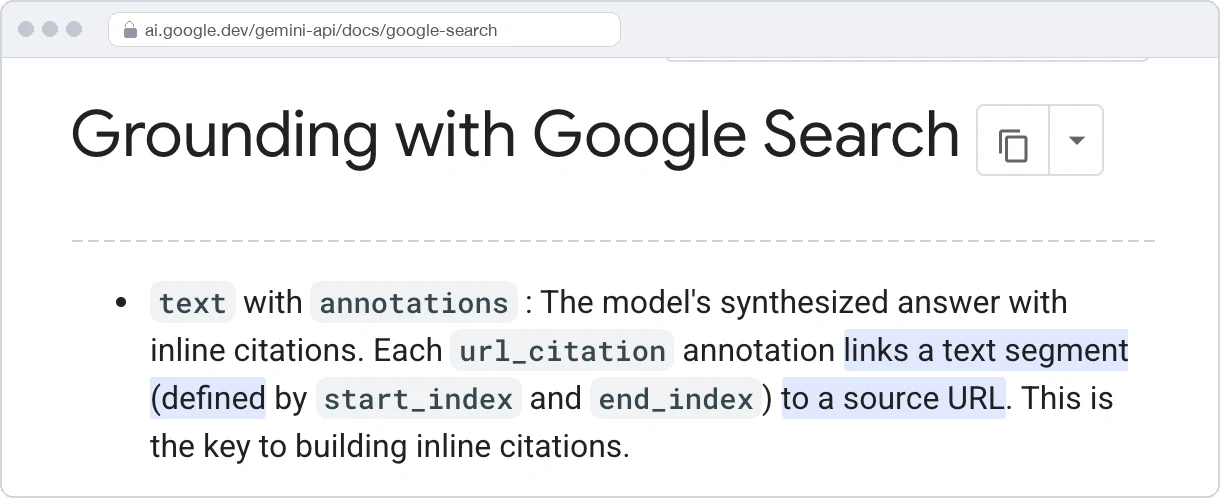
Google adds that its models “identify more supporting web pages” while a response is being generated. Its 2023 patent describes linking a written portion to a document when their similarity clears a threshold, so a link can be added after the sentence is written.
The table sets out what each product documents about links, and the control a website holds over it.
| Product | How the response is linked | The website's control |
|---|---|---|
| Google AI Overviews and AI Mode | Links beside the text | Snippet controls, Search generative AI control |
| Gemini app and Vertex AI grounding | Answer spans linked to URLs (Gemini API) | Google-Extended |
| ChatGPT search and OpenAI API | Answer spans linked to URLs, plus a sources list (API) | OAI-SearchBot |
| Copilot and Bing | Citations beside the text, counted in Bing Webmaster Tools | Bingbot, IndexNow |
| Claude API web search | Answer spans with up to 150 characters of cited text | Claude-SearchBot |
Does grounding stop AI hallucinations?
Grounding reduces AI hallucinations, but it does not stop them, because a model leans on whatever sits in its context. ClashEval, a Stanford evaluation of six 2024 AI models by Kevin Wu, Eric Wu, and James Zou, measured the effect. A model that knew the right answer still repeated a wrong supplied document 31% to 63% of the time.
Models that had answered wrongly followed a right document even more often, so grounding pulls a response toward its source in both directions. Adding four more documents weakened the pull in the two models retested, but also lowered their overall accuracy.

Google's AI Overviews show a second weak spot, citation accuracy. Only 41.9% of the overviews in a 2026 audit by Haofei Xu, Umar Iqbal, and Jacob Montgomery had every claim backed by a page they cited. Most claims passed, but one unsupported claim was enough to fail an overview. The usual failure was a claim no cited page mentioned at all, which is hard to spot, since the link looks like support.
Sourcing caused the most trouble in a 2025 audit led by the European Broadcasting Union (EBU) and the BBC, the UK's public broadcaster. Its reviewers from 22 broadcasters rated 2,709 news answers from ChatGPT, Copilot, Gemini, and Perplexity. A claim with unclear sourcing cannot be checked, as SRF, the Swiss public broadcaster, said of one ChatGPT answer: “it's totally unclear where the information comes from.”
Declining is the safe response to weak support, and Bing's search team sets the goal that “abstention is a valid outcome when support is missing, stale, or conflicting.” Most assistants in the two 2025 news audits answered anyway, even when their answers lacked adequate support. The Tow Center found chatbots “generally bad at declining to answer questions” in its February 2025 test of eight AI search tools, with Copilot the one exception, and the EBU audit saw only 17 of 3,113 questions refused.

- Gemini, OpenAI, and Claude link spans of a response to sources.
- 2025 and 2026 audits found many unsupported claims, and most assistants rarely refused.
- That a complete sentence is repeated more accurately than a partial one.
- That conflicting extracts raise the error rate in consumer answers.
What makes a page's facts groundable for AI engines?
A response leans on what it lifts, so the goal is Bing's groundable information, “discrete, supportable facts with clear provenance.” Four page habits produce it.
1. The sentence supports the whole claim. In the practitioner's annotated Gemini example, extraction picked single sentences, and Stanford researchers found in 2023 that answer engines “often copy or closely paraphrase” their sources. Google Cloud's checker requires support for the whole claim, including the conditions that decide how a limit applies.
What to do: Rewrite key facts on pricing, plan, limit, and compliance pages as single sentences holding the subject, number, unit, and condition, as in this line built from Mercury's own facts.
- ❌ Coverage goes up to $5M. (hypothetical)
- ✔ Mercury checking and savings deposits are eligible for up to $5M in FDIC insurance through its partner banks' sweep networks, when the conditions for pass-through insurance are met.
2. The answer sits where extraction reaches. On the practitioner's annotated page, extracts favored the opening paragraphs. Snippet controls such as nosnippet and data-nosnippet also limit what Google shows, and Google wants important content “available in textual form,” which the chunking guide covers for images and PDFs.
What to do: Put the answer to each key question in the first sentence of its section, and keep snippet controls off text meant to be quoted.
- ❌ A coverage limit shown only in a badge image and a footnote. (hypothetical)
- ✔ A help article that states the coverage limit in its first paragraph, as Mercury's does.
3. The same fact appears everywhere the engine reads. Bing warns that an engine silently arbitrating contradictory sources “may confidently assert the wrong thing.” Third-party pages count: in a second practitioner's five Gemini runs on one Search Console question, a YouTube video was linked to 12 of the 40 claims kept, more than any other page.

What to do: List every place a key fact appears, from the website and docs to third-party listings. Correct the copies the company controls, ask other owners to update theirs, and date the current version.
- ❌ A pricing page, help center, and partner listing that give three different limits. (hypothetical)
- ✔ Every page and listing that states the limit gives the same figure, condition, and date.
4. The fact is current in the copy the engine reads. Moz reads the years in its grounding queries as Gemini looking past its training data for current facts. Those facts come from Google's Search index, so Gemini reads a pricing edit only after a recrawl, while OpenAI's API fetches live pages by default. Bing says that in grounding “a stale fact produces a misleading response.”
What to do: Date the facts that change and keep last-modified dates honest. After an edit, request indexing in Search Console's URL Inspection and ping IndexNow, which Bing says helps answers use “the most current version of a page.”
- ❌ Bookkeeping is free for now. (hypothetical)
- ✔ Mercury Books costs $35 a month, waived until December 31, 2026, as Mercury's pricing page showed on October 27, 2026.
What happens when Google AI Mode grounds a question about Mercury?
On October 27, 2026, we asked Google AI Mode is mercury fdic insured and up to how much, twice.

Neither run showed the searches behind it. In the first, AI Mode linked four statements to Mercury's pages and put the general $250,000 limit on an explainer by Quiltt, a fintech software company. Half an hour later, the run shown above gave the same facts but linked that limit to Mercury plus one other source and added Mercury's Safety & Security page.
Both runs kept what Mercury states plainly: it is a fintech company and not a bank, coverage runs through partner banks' sweep networks, and Treasury funds fall under the Securities Investor Protection Corporation (SIPC). Both also kept “eligible” from Mercury's $5M sentence. Neither said that conditions apply, a point the help article makes twice, each time in a sentence of its own: “Certain conditions must be satisfied for pass-through insurance to apply.” The Treasury line lost its condition too, since SIPC applies if Mercury's broker fails and securities cannot be transferred.
How to optimize content for AI grounding
Grounding AI answers in a company's facts takes a short routine. Google says there is no need to write “just for generative AI search,” and the rewrites also serve human readers.
- Check that each engine may use the key pages. Confirm indexing, snippet eligibility, the Search generative AI setting, Google-Extended, OAI-SearchBot, Bingbot, and Claude-SearchBot.
- List the questions where a wrong answer costs money. Pricing, coverage, limits, and compliance come first, each with its answer sentence.
- Rewrite those sentences as complete claims. Put the subject, number, condition, and date in one sentence near the top of its section.
- Align every copy of the fact. Update the website, structured data, docs, help center, and controlled listings, and date each change.
- Measure what the responses repeat. Use Search Console's generative AI performance and Bing's AI Performance reports, and the same prompts on a schedule. Neither report shows correctness, so record which page supports each statement and whether it is right.
Developers can inspect grounding queries and linked answer spans through the Gemini API. The map below records the second Mercury run.

Repeat each prompt several times, since citations shift between runs: the second practitioner saw a page cited in three of five Gemini runs, then one of five an hour later.
Retrieval comes first, because rewrites cannot help a page an engine never retrieves.
How we keep AI responses grounded in the right facts at Omnius
Because AI models often repeat the extracts they read, the work is making sure every passage a company puts on the web states the right fact. Our technology page notes that AI search changes by “model, context, wording, conversation history, location, retrieval, reranking, entities, and other variables.”
So Omnius, an SEO and AI search agency, works on the probability that any passage an engine lifts is correct and current. People write the pages, and data processing maps each statement to its sentence.
- Map answer statements to their source sentences.
- Rewrite claims about pricing, coverage, limits, and compliance.
- Align each fact's copies across the web.
- Re-check the responses on a dated schedule.

Our entity SEO work keeps a company's facts consistent across the pages engines read.
FAQ
What is the difference between grounding and RAG?
Grounding and RAG name the same technique in Google's guide, which calls RAG “a technique (also known as grounding).” RAG names the setup, and grounding the tie to evidence.
What is the difference between grounded and ungrounded AI?
A grounded AI response rests on sources retrieved at answer time, which gives it traceability, while an ungrounded one rests on training data alone.
What is grounding in Copilot?
Grounding in Copilot is retrieval of Bing index content, plus work data in Microsoft 365 Copilot, as Copilot answers; Bing Webmaster Tools reports the web citations.
What are grounding queries?
Grounding queries are the searches a model writes for itself before it answers, such as BaaS pricing models subscription transaction hybrid in Moz's Gemini sample, which averaged 6.56 words.
Does blocking Google-Extended remove a website from AI Overviews?
Blocking Google-Extended does not remove a website from AI Overviews, because Google says it does not affect inclusion in Search. Search Console's Search generative AI control governs AI Overviews and AI Mode.

Methodology
This guide rests on platform documentation, five independent studies, Moz's public dataset, and two Google AI Mode answers read on October 27, 2026.
- Sources. The documentation and screenshots were read and captured on October 27, 2026, and the studies are listed under Sources below. The Tow Center ran its test in February 2025 and published it in March 2025, and the Washington University study verified claims with a language model checked by people.
- Grounding queries chart. Our count of Moz's public sheet of 5,333 Gemini queries, with words split on spaces, matches Moz's published mean of 6.56 words. Moz prompted Gemini to write four to six queries per prompt, so the sample does not show AI Mode's own fan-out.
- AI Mode answers. Two Mercury runs, signed out on Google US, serve as examples, never as a test.
- Practitioner analyses. Posts by two practitioners on Gemini API data are cited without the publishers' names. Their datasets are unpublished or small and have no controls.
- Limits. No engine publishes its extraction rules or a support threshold for consumer answers. Google Cloud's checker is a developer tool, and Bing's essay states design goals. The AI Overviews study used trending searches, and its checker excluded social and video sources. The EBU and BBC audit rated news answers, Tow tested identifying news articles from excerpts, and ClashEval used 2024 models with one document per question.
- Examples. The weak lines are hypothetical, and Mercury's facts come from its own pages, read on October 27, 2026.
- Publishers' interests. Google, Microsoft, OpenAI, and Anthropic describe their own products, and Moz sells SEO and AI visibility software.
Sources. The sources below are grouped by publisher.
- Google: Google's common crawlers, Guide to optimizing for generative AI features, AI features, Search generative AI control, Generative AI performance report, URL Inspection tool, New opportunities, control and insights for website owners, Gemini API grounding with Google Search, Check grounding, Grounding overview, US 11,769,017 B1
- Microsoft and Bing: Copilot overview, Evolving role of the index, Announcing Microsoft Web IQ, Microsoft's grounding engineering post, AI Performance in Bing Webmaster Tools, Topics Portfolio
- OpenAI: Web search tool, OpenAI crawlers
- Anthropic: Web search tool, Anthropic's crawlers
- Mercury: Understanding FDIC insurance, Pricing
- Research and reports: Xu, Iqbal, and Montgomery on AI Overviews, Liu, Zhang, and Liang on verifiability, ClashEval, EBU and BBC, News Integrity in AI Assistants, Tow Center on AI search citations, Moz on grounding queries