
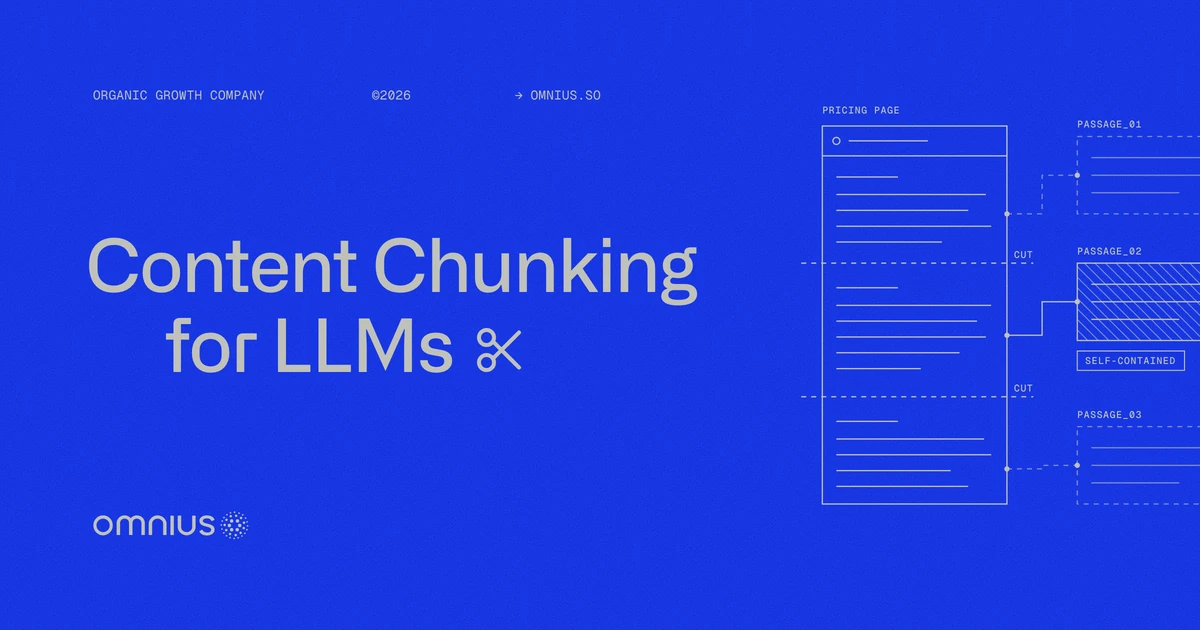
ChatGPT search links its answers to their sources, and Claude's web search also returns the text it cites from each page. Getting from a long page to that short cited piece is the work of content chunking for LLMs, which cuts pages into passages before a model writes the answer.
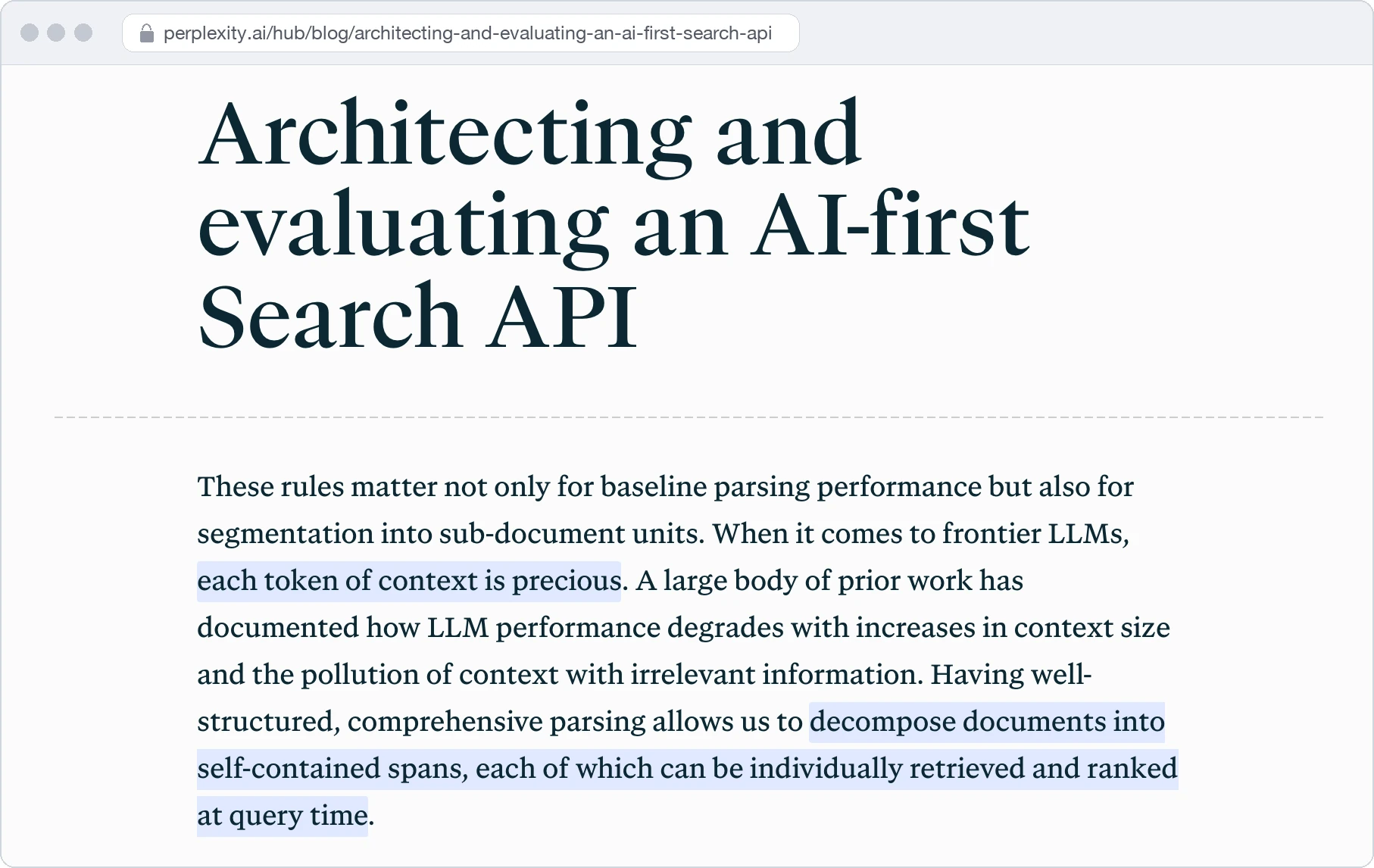
The cut decides what the model reads, because each piece is retrieved and ranked on its own. Perplexity's architecture post describes splitting documents into such “self-contained spans,” in search infrastructure that processed 200 million queries a day in September 2025.
For SaaS, fintech, and AI companies, those pieces carry the answers on pricing, plans, and security. Suppose an IT manager asks ChatGPT whether Notion's Plus plan includes SAML single sign-on (SSO). If the sentence that answers says it and higher tiers in place of the feature and plan names, the quoted piece names neither, and the answer turns vague. This guide shows how to keep key answers complete when the page is cut: how engines split pages, what makes a passage self-contained, and which pages to fix first.
Key takeaways
- AI search engines cut pages into pieces by rules none of them publishes.
- A sentence that leans on a pronoun can lose its subject once its piece is read alone.
- Write every key answer to stand alone, with product, plan, and condition in one sentence.
- Ignore fixed word counts, since Google advises against fragmenting and research finds no chunking method that wins everywhere.
What is content chunking for LLMs, and why does it matter for AI search?
Content chunking for LLMs is the step in which a retrieval engine splits documents into pieces that it can index, score, and pass to large language models. Perplexity's engineers give the reason: “When it comes to frontier LLMs, each token of context is precious,” and a model does worse as irrelevant text fills its context.
In retrieval-augmented generation (RAG), a builder sets the chunk size and chunking strategy. For semantic search, each chunk is stored with an embedding, numbers that capture meaning, in a vector database.
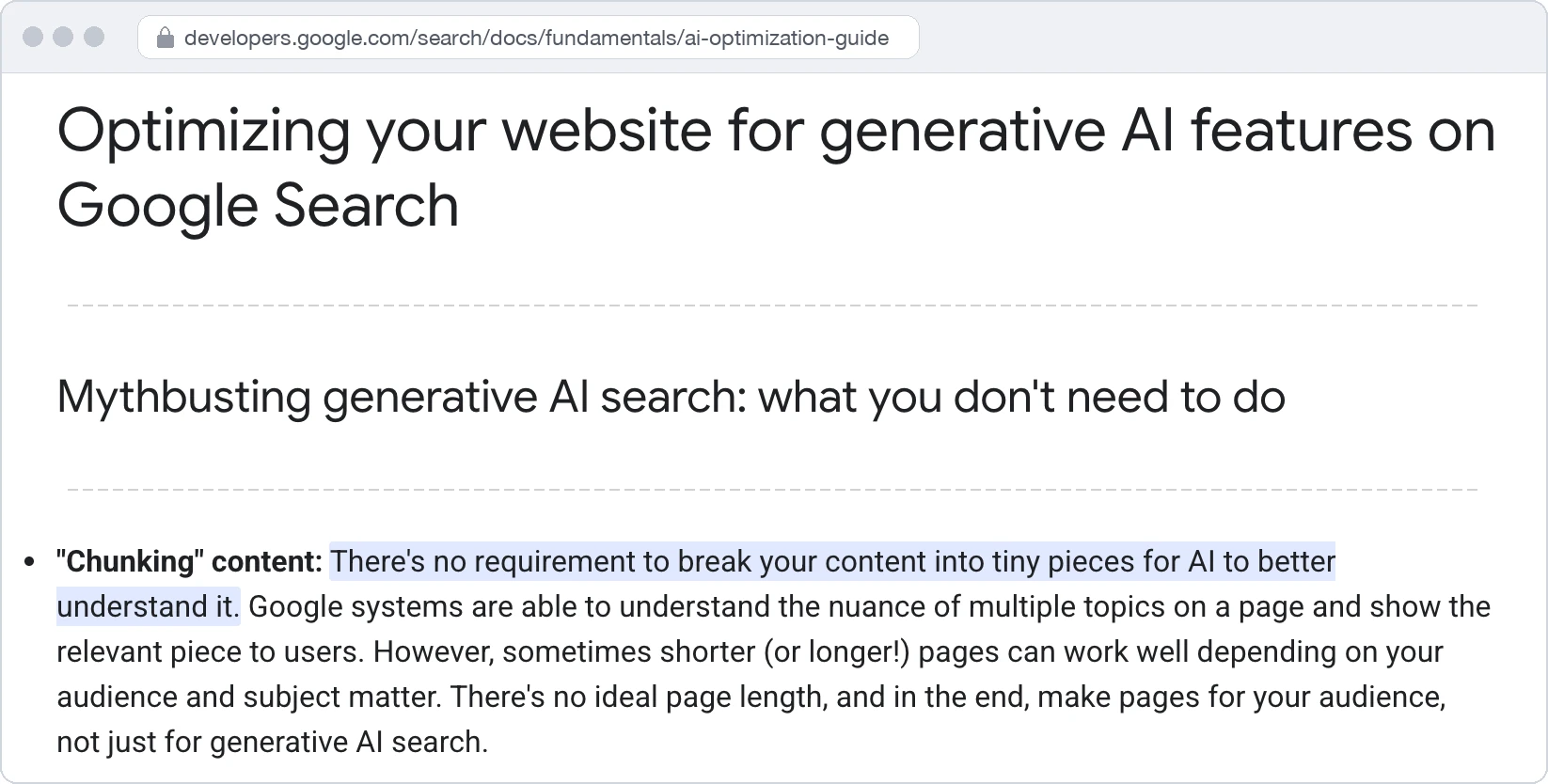
SEO and answer engine optimization (AEO) took the idea over as chunk optimization. Despina Gavoyannis, a senior SEO specialist at Ahrefs, proposes self-contained sections that “can stand on their own,” and other SEO guides give sections a set length. Yet Google's guide to AI features says breaking content into tiny pieces is not required.
On 19 October 2026, we asked Google AI Mode whether content chunking for LLMs matters for AI search. It answered “Yes” with builder settings from developer tutorials, such as 500 tokens with a 10% overlap, a token being a word or part of one.
A builder's cut and an engine's cut are easy to confuse, and three dated changes from the past six months show the engine's side:
- 1 June 2026: Perplexity began building a pipeline per request, first in Perplexity Computer and Agent API.
- 2 June 2026: Microsoft launched Web IQ, APIs that return passages, and says Web IQ powers ChatGPT and Copilot.
- 31 July 2026: Brave made a new content extraction pipeline the default in its LLM Context API.
How do AI search engines cut pages into passages?
Pieced together, the providers' documentation covers four stages, from finding a page to crediting a sentence, in a sequence that is our reading.

1. The engine finds the page
ChatGPT search sometimes sends its queries to search partners, among them Microsoft, and Anthropic lists Brave Search among the web search providers behind Claude. Brave's search API runs a page search first and considers up to 20 results by default.
Google's AI features also retrieve pages with core Search ranking, then “review the specific information from those retrieved pages” to write the answer. For Google and Brave's API, a passage reaches the answer only from a page they retrieve.
2. The page is cut into pieces
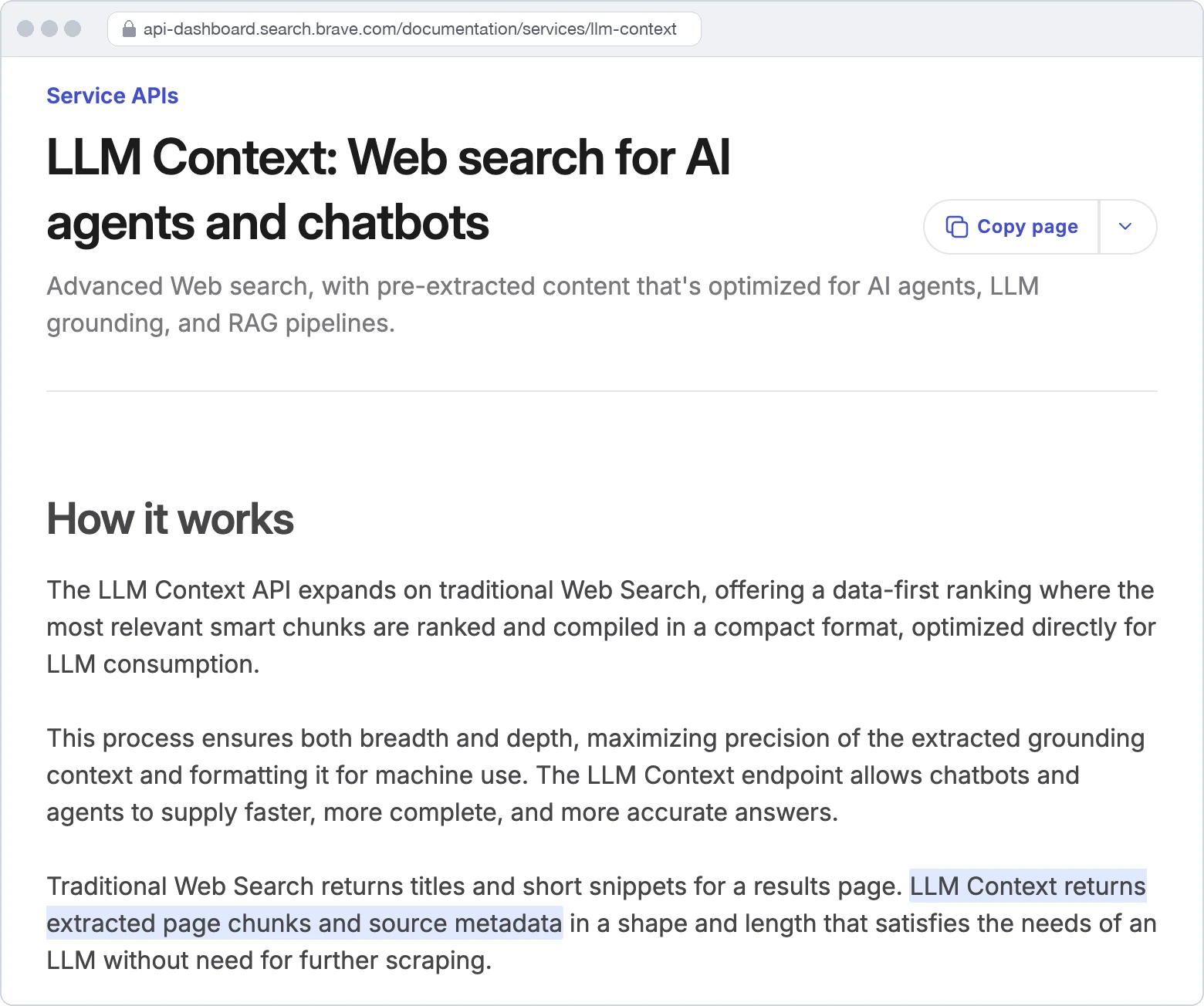
Microsoft says Copilot breaks content into “smaller, structured pieces,” and Brave's search API builds smart chunks from each page as the query arrives. Each system draws its own boundaries, so one page can be chunked into different pieces. A website cannot set the cut but can see one version of it, because Brave's LLM Context API returns the snippets it extracted.
The API's documentation sets a default budget of about 8,192 tokens of context per response and at most 4,096 tokens from any one page. With those defaults, a longer page is returned only in part.
3. Pieces are scored, and the best reach the model
When ChatGPT search uses search partners, it typically rewrites a question into one or more targeted queries. Google says AI Overviews and AI Mode may widen a question with query fan-out, several related searches, which lets one page meet several versions of it.
Perplexity scores chunks with cross-encoder rerankers, models that read the query and the chunk together to judge relevance. So a section that answers one question cleanly matches that question on its own.
Top chunks then enter the model's context window, whose token limits cap what it reads at once. One practitioner analysed the Gemini API's grounding, the source text behind an answer, for 7,060 queries, and the grounding for one query held a median of 1,929 words.
Median grounding fell with source rank, from 531 words for the first source to 266 for the fifth, so lower-ranked sources supplied fewer words.
Average grounding from one page levelled off near 540 words, so the longest pages in that sample had only about 13% of their text used.

4. Credit attaches to statements in the answer
OpenAI's web search records which span of an answer each source supports, and Claude's web search tool returns up to 150 characters of the text it cites. Since 6 May 2026, Google has also placed more links in AI answers next to the text they support. Because credit attaches to a statement, a sentence that names its own subject can be credited without the text around it.
- OpenAI and Anthropic tie each citation to a span of the answer or an excerpt of the source.
- Google and Brave's search API retrieve relevant pages first.
- Perplexity, Microsoft, and Brave's search API cut units smaller than a page.
- The four-stage sequence across engines.
- That a sentence naming its subject keeps it in any piece holding the whole sentence.
- Whether self-contained rewrites raise citations, which no source here tests.
What makes a passage self-contained for AI search?
Because a piece can travel without its neighbours, a passage is self-contained when it still names its subject and conditions on its own. Microsoft's Copilot guidance asks for “sentences that make sense even when pulled out of context.”
Chunking research points to the sentence as well. In a 2024 comparison of fixed-size and semantic chunkers by Qu, Tu, and Bao, the top retrieved chunks “frequently contained the same evidence sentences” whichever method made the cut. The authors say this explains the small differences between chunkers.
1. The sentence names its subject and conditions
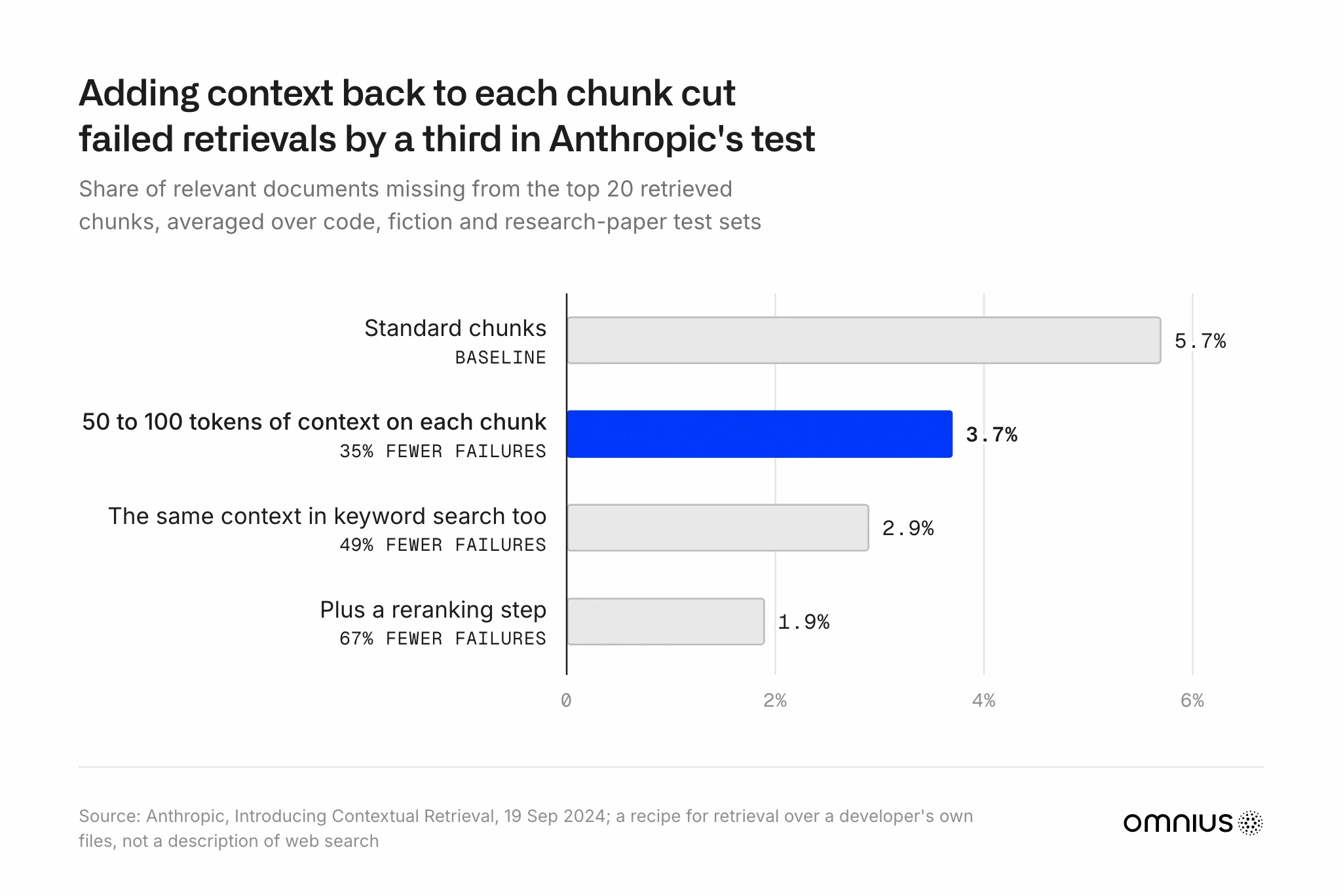
Anthropic's sample chunk, “The company's revenue grew by 3% over the previous quarter,” names neither company nor period once cut out. In Anthropic's developer test, adding model-written context to each chunk cut failed retrievals by 35%.
Microsoft's Bing team warns that chunking “can distort page substance,” and Microsoft says Web IQ can keep local context with a passage without saying how much. So in our view, the sentence itself is the safest place for context.
What to do: Rewrite key pricing, payout, and security sentences so each carries its own subject and conditions. In a hypothetical line about Stripe payouts, the rewrite adds the payout type, currency, and cut-off that Stripe documents.
- ❌ Payouts arrive the same day if submitted before the cut-off.
- ✔ Manual euro payouts on Stripe initiated before 4 pm Copenhagen time are eligible for same-day payout.
2. Each section answers one question first
Peec AI, an AI visibility software company, published a test of 12 open reranker models on one query, what are the best aeo tools. Every model scored a direct answer higher than a product description or rated both near the top of its scale. The post's term breakdown shows the description lacked the query's heaviest terms, and it ties none of the models to an AI search engine.
What to do: Split sections that answer two questions, and open each with its answer. Keep close variants of a question on one page, since Google treats separate pages made mainly to manipulate AI answers as scaled content abuse.
- ❌ A hypothetical Limits section that opens on how an AI platform grows with its customers.
- ✔ Anthropic's Rate limits section, which opens by saying its limits are measured in requests, input tokens, and output tokens per minute.
3. Headings say what the section answers
Krishna Madhavan, a principal product manager at Microsoft Bing, writes in Microsoft's guidance that headings “mark where one idea ends and another begins” and, for AI, “define clear content slices.”
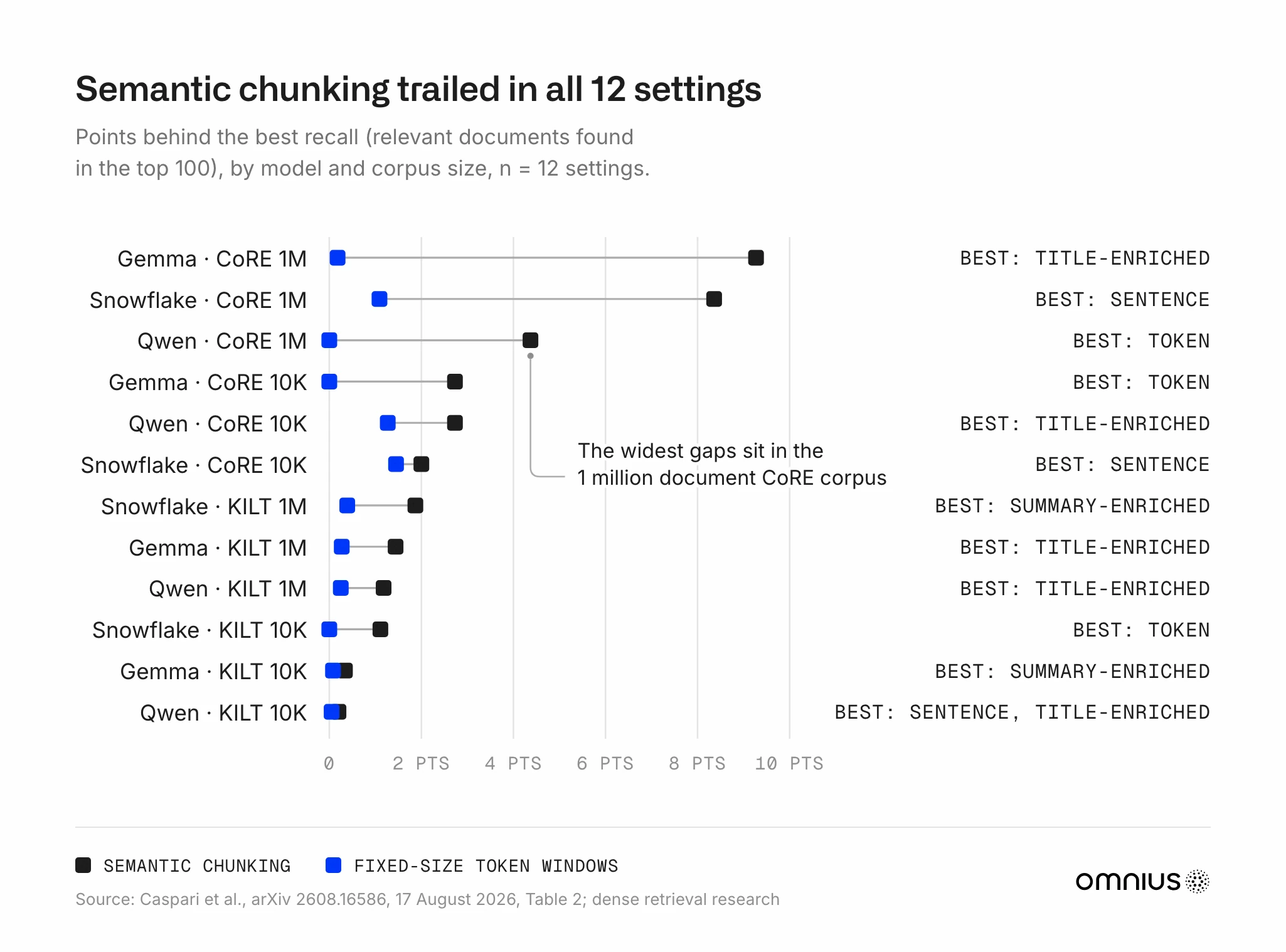
In retrieval research, that kind of context helps when a pipeline adds it to each chunk. Caspari et al. found that title-enriched chunks had the top recall in 5 of their 12 settings, one of them shared, and call the method “a low-cost improvement.”
No consumer engine says headings stay with pieces, so the text below each heading should name the subject too.
What to do: Replace label headings with the question or claim each section answers, as in this FAQ heading for the hypothetical Notion page.
- ❌ Security
- ✔ Which Notion plans include SAML single sign-on?
4. Facts sit in text the engine can read
Tables raise the same problem, since Brave's search API extracts them down to single rows without saying whether a row keeps its column headers. So a cell that names its plan reads correctly either way, and Microsoft adds that text only in images “adds extra complexity and often reduces accuracy.”
What to do: Write table cells as text that names the plan, and move core facts from images, tabs, and PDFs into HTML. Keep data-nosnippet, which hides text from Google's and Bing's AI answers, off text meant to be quoted.
- ❌ An SSO row of check-mark icons, with the plan names only in the column headers.
- ✔ An SSO row whose cell reads SAML SSO: Business and Enterprise.
What happens when an AI answer quotes a SaaS pricing page?
Suppose Notion's pricing page answered the Plus plan question twice, in a plan table and in an FAQ entry about SAML, a standard for single sign-on. The hypothetical entry reads It's available on higher tiers.

In this example, the question and the page stay the same, and the rewrite changes only what the pieces say. The rewritten answer reads Notion includes SAML single sign-on on its Business and Enterprise plans, but not on its Free or Plus plans, as Notion's help center states. Read alone, the old answer names no product, feature, or plan, and the new one names all three. That gives the engine a piece that answers the search on its own, although a review website's plan comparison can still win the citation.
How to optimize content chunking for AEO
To optimize content chunking for AEO, a company applies those four habits to each key answer while the engine keeps deciding where to cut. Google's Danny Sullivan said on Search Off the Record on 8 January 2026, as PPC Land reported, “We don't want people to have to be crafting anything for Search specifically.” A plan name in a pricing sentence passes that test, since readers need it too.
Google Search Central, Search Off the Record, 8 January 2026.
From the writer's side, the same Peec AI post warns that opening every paragraph on a definition gives “robotic text that humans stop reading,” and it leaves landing and conversion pages to persuasion. On a pricing page, the work therefore stays with the sentences that carry a price, plan, limit, or compliance fact.
Two common pieces of chunking advice can go:
- Fixed word counts, because Google specifies no ideal length and a 2026 study of chunking methods found no consistent winner. Four different methods took the top recall across its 12 settings, and semantic chunking, which cuts text where its meaning shifts, scored below plain fixed-size token windows in every one.
- One-sentence paragraphs, because studies of proposition-sized pieces disagree, and models did the cutting. Chen et al. found that propositions beat passages for retrieval over Wikipedia, while Zhou et al. ranked them last of six methods for in-corpus retrieval.
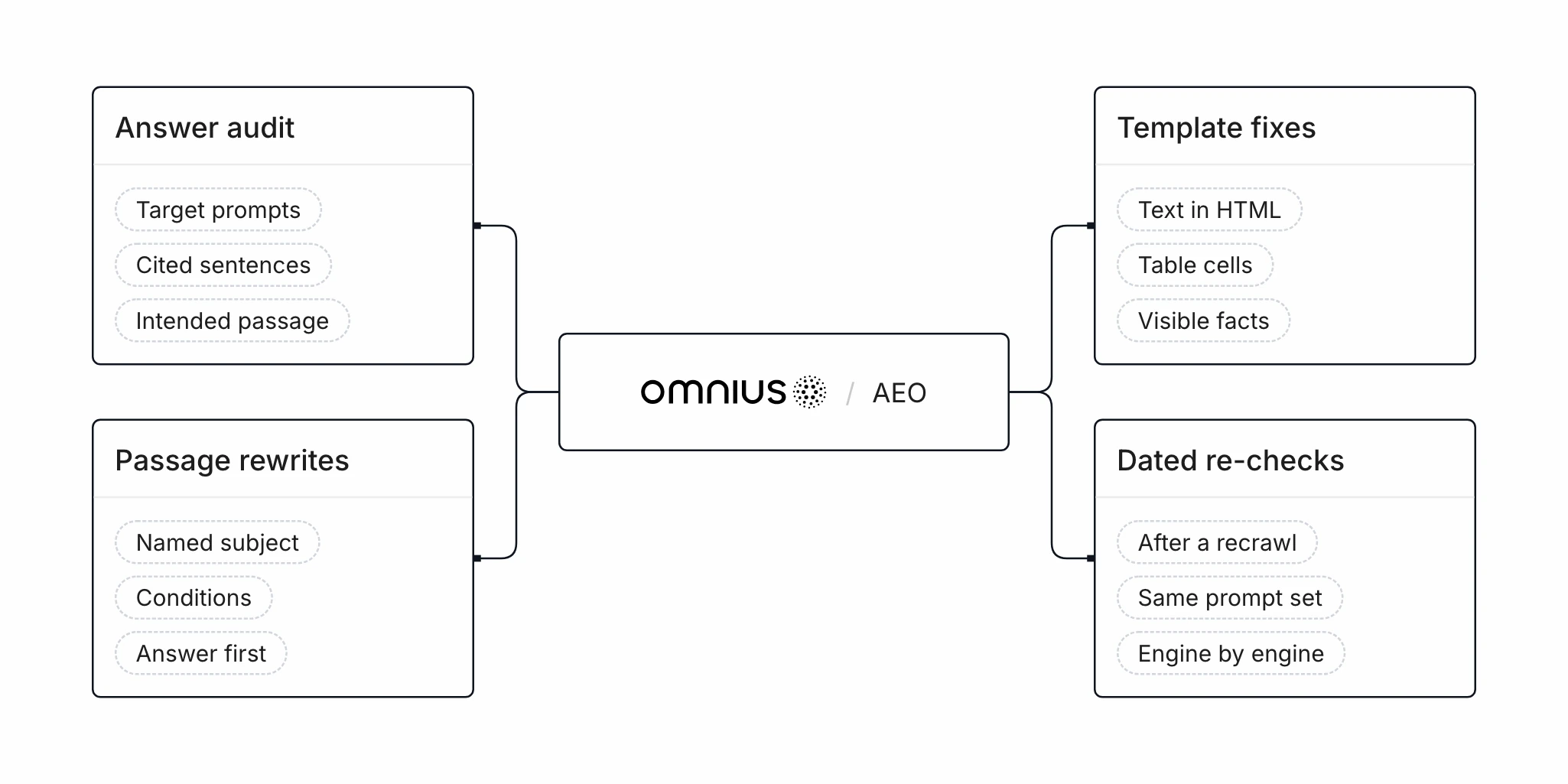
Four steps cover the work, each with a pass test:
- Choose the pages where a wrong fact costs money. Start with pricing, plan, integration, and security pages, and list the questions each one answers.
- Read each key answer alone. Paste it into a blank document, and it passes if it still names the product, plan, and condition.
- Rewrite what fails. Use the four habits above, replacing it and this plan with the nouns they stand for.
- Compare dated answers before and after the rewrite. Before the rewrite, run the same prompts a set number of times in each engine, then again once the updated page is recrawled. Record each answer's date, whether it states the plan and condition correctly, and which page it cites.
For step 4, neither of the two reports below shows which passage an individual answer used:
- Google Search Console's generative AI performance report counts URL appearances in AI features.
- Bing Webmaster Tools' AI Performance report shows citation counts and a sample of the “key phrases the AI used when retrieving content.”
How we write for AI answers at Omnius
AI search changes with “model, context, wording, conversation history, location, retrieval, reranking,” as our technology page puts it. So Omnius, as an SEO and AI search agency, works on the probability that any piece an engine lifts carries a correct, complete answer. People write and edit every answer, while data processing finds the sentences that AI answers cite.
FAQ
How long should a section be for AI search?
A section for AI search should be as long as its question needs, since no engine publishes a piece size and Google sees no ideal page length.
Do headings change how AI search splits a page?
Headings shape chunks in some retrieval pipelines, but no consumer AI search engine says its pieces keep them. Google Cloud's Agent Search appends “title and headings at all levels” to chunks only when a builder turns that option on.
What is semantic chunking, and does it matter for a website?
Semantic chunking cuts text where its meaning shifts, one of several chunking methods next to fixed-size chunking and recursive splits. It matters little for a website, since engines pick their own method. For builders, a 2024 comparison by Qu and colleagues found its cost “not justified by consistent performance gains.”
Does Google recommend chunking content for AI Overviews and AI Mode?
Google does not recommend chunking content for AI Overviews and AI Mode, since its systems can “show the relevant piece to users” of a page with several topics. In a hypothetical, Sullivan allowed that fragmenting may give some websites a small advantage now, but warned that Google's systems may change tomorrow.
Methodology
This guide rests on documentation from six AI and search companies, chunking research, and a Google AI Mode answer read on 19 October 2026.
- Sources. Documentation from OpenAI, Anthropic, Google, Microsoft and Bing, Perplexity, and Brave, read on 19 and 20 October 2026, the chunking papers listed below, and one Google AI Mode answer read on 19 October 2026 in Google US, signed out. The screenshots were captured on 20 October 2026.
- Charts. The Gemini chart is built from the practitioner's averages by page length, and the chunking-method chart from Table 2 of Caspari et al. The second shows each method's Recall@100 points behind the best reported score in its setting; contextual chunking was not run in the three CoRE 1M settings.
- Gemini sample. One practitioner's post of 20 December 2025 analyses 7,060 queries from client projects, each with three or more sources.
- Gemini coverage. Coverage is measured against the full text of 2,275 pages. The dataset is unpublished, it has no controls, and it is cited without the publisher's name.
- Chunking study. Caspari et al.'s Table 2 covers Recall@100 at the 10,000 and 1 million document sizes only, without significance marks, and the paper's own pairwise tests find no single best method.
- Limits. No engine publishes where it cuts pages, so the four stages are our sequence across what each provider documents, never one shared pipeline. No source here tests whether self-contained rewrites raise citation rates, and Anthropic's figures come from its test sets for developer retrieval, not web search.
- Examples. The Notion, Stripe, and Anthropic scenes are hypothetical. Only the plan, payout, and rate-limit facts in the rewritten sentences come from those companies' own pages, read on 20 October 2026.
- Publishers' interests. OpenAI, Anthropic, Google, Microsoft, Perplexity, and Brave describe their own products. Peec AI and Ahrefs sell SEO or AI visibility software, and Vectara sells retrieval products.
Sources
The sources below are grouped by publisher.
- OpenAI: Web search tool, Searching the web with ChatGPT
- Anthropic: Introducing Contextual Retrieval, Web search tool, Rate limits, Subprocessors
- Google: Optimizing for generative AI features, AI features and a website, Links in AI Mode and AI Overviews, Generative AI performance reports, Gemini API grounding with Google Search, Agent Search chunking, Danny Sullivan's author page
- Microsoft and Bing: Optimizing content for inclusion in AI search answers, Evolving role of the index, Announcing Microsoft Web IQ, Web IQ overview, Microsoft on grounding for the agentic web, data-nosnippet in Bing, AI Performance in Bing Webmaster Tools
- Perplexity: Architecting and evaluating an AI-first Search API, Rethinking Search as Code Generation
- Brave: LLM Context API announcement, LLM Context API documentation
- Notion: Pricing, SAML SSO configuration
- Stripe: Payouts
- Research and reports: Qu, Tu, and Bao on semantic chunking, Caspari et al. on chunking strategies, Chen et al. on Dense X Retrieval, Zhou et al. on segmentation methods, Peec AI on rerankers, Ahrefs on chunk optimization, PPC Land on Search Off the Record