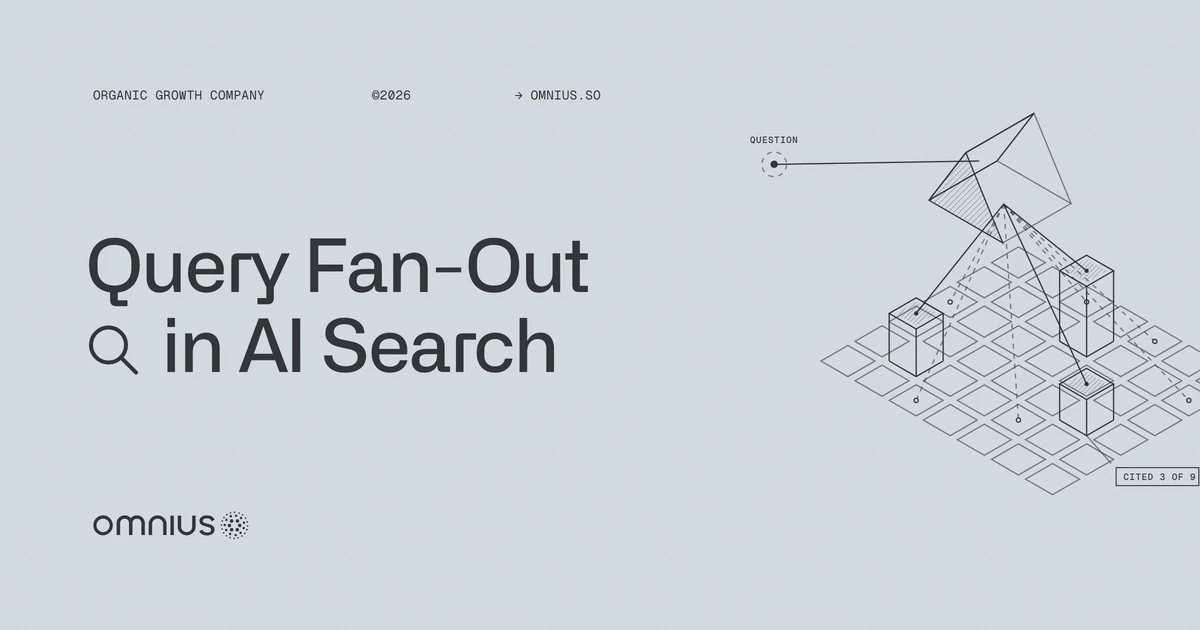
Asked which CRM suits a 50-person B2B SaaS company, ChatGPT's GPT-5.4 Thinking model ran eight web searches before it answered, in a test Writesonic published in April 2026. Three of them checked prices on HubSpot's, Salesforce's, and Attio's own websites. Writing related searches like these, running each one, and combining the results into a single answer is called query fan-out.
Google, OpenAI, Anthropic, and Microsoft all describe this step in their documentation. Because the engine reads the pages that answer its own searches, a page can be cited for a search nobody typed.
For a B2B SaaS, fintech, or AI company, the answer is built from the pages those searches return. In the studies cited below, the searches ask about prices, comparisons, and vendors' own pages, the evaluation questions a content plan built only on the typed keyword can miss. This guide shows how fan-out works, what the searches look like, and how to cover them without a page for every variation.
How AI search algorithms (LLMs) work: the big picture
Before exploring query fan-out specifically, it helps to understand how AI search engines generate answers, in simplified form, since each product implements the steps differently.
When someone submits a query to ChatGPT, Perplexity, or Google's AI Mode, the engine goes through several steps:
Step 1: Query understanding and intent detection
The AI analyzes the query to understand what the person is asking for, whether that's a comparison, a list of options, step-by-step instructions, or general information. The engine may also classify the query type, such as a short fact, a reason, or a comparison, which can shape the answer format.
It also decides whether to search at all. Google's Gemini API documentation says the model "analyzes the prompt and determines if a Google Search can improve the answer."
Step 2: Query fan-out process
For complex or multifaceted queries, the engine may break the input into multiple related subqueries through a process called query fan-out. Using LLM-powered prompt expansion, it generates synthetic sub-queries across different types to build a thorough answer.
The number of searches depends on the question and the mode. Anthropic's documentation for its web search tool says simple factual questions typically take Claude one to three searches, while comparative research "can use 10 or more." Google says Deep Search in AI Mode "can issue hundreds of searches."
The words in those searches show what the engine goes looking for. In about 15 million fan-out queries from free ChatGPT, Ahrefs found the current year in 22.9% of English ones in September 2026, up from 17.6% in August, ahead of "official" and "price".

Step 3: RAG (retrieval-augmented generation)
This is where AI search engines differ from traditional chatbots.
An LLM without retrieval tools answers from its training data and from what the conversation supplies, such as a pasted document. Base ChatGPT without search works this way: it cannot fetch current information or open specific websites on its own.
AI search engines use retrieval-augmented generation (RAG) to bring retrieved information into the answer, usually from a web search index. Search returns indexed pages, and some products also open pages directly while they build an answer, so retrieved facts can still be out of date. The documented search providers include Google for AI Mode, third-party partners for ChatGPT, Bing for Copilot, and Brave Search for Claude.
Read more: Claude SEO
For each sub-query, the engine retrieves content from external websites and can process it with techniques such as these:
- Chunking: Divides documents into smaller, semantically coherent passages.
- Embedding: Transforms each passage into a high-dimensional vector representation.
- Dense retrieval: Uses vector embeddings to perform similarity searches, identifying the most relevant passages.
- Custom corpus construction: Assembles an initial pool of candidate sources to inform the response.
Perplexity's engineers describe the chunking step as splitting pages into "self-contained spans, each of which can be individually retrieved and ranked."
Step 4: Ranking and reranking
This is the filtering stage where the engine decides which sources to use. The techniques below illustrate common approaches, and their use varies by product:
- Reciprocal Rank Fusion (RRF): Can boost sources that appear across multiple sub-queries
- Neural reranking: A model can compare passages head to head (pairwise comparison) to decide which is more relevant
- Quality signals: Factors like freshness, authority, intent alignment, domain credibility, and passage-level answerability
- Diversity constraint: Can favor several perspectives over a single source
- Evidence selection: Can favor passages that support specific claims in the answer
Step 5: Reasoning and answer synthesis
Reasoning models can build the answer in reasoning chains, structured sequences of logical steps, and each product combines functions such as these differently:
- Claim planning: Identifies key points to address based on reasoning steps
- Grounding: Ties claims in the answer to the retrieved passages that support them
- Conflict resolution: Checks where retrieved sources disagree and whether more evidence is needed
- Model selection: Some agent workflows route easier questions to smaller models and harder ones to more capable models
Reasoning can also send the engine back to search. Elizabeth Reid, Google's head of Search, described AI Mode checking its own draft, "and if it detects any gaps, it issues even more searches to fill them in."
Step 6: Citation and response generation
Finally, the engine generates the final response:
- Selective citation: Links selected sources to parts of the answer, so readers can check the supporting material. Most retrieved documents go uncited: across Writesonic's April 2026 test, the answers cited about one in nine of the results their searches returned.
- Multimodal integration: May incorporate text, images, video, audio, and structured data
- Personalization layer: Context such as location, search history, and preferences can shape what is shown. OpenAI says ChatGPT can use approximate location and, when memory is on, saved memories when it rewrites a search.
What is query fan-out?
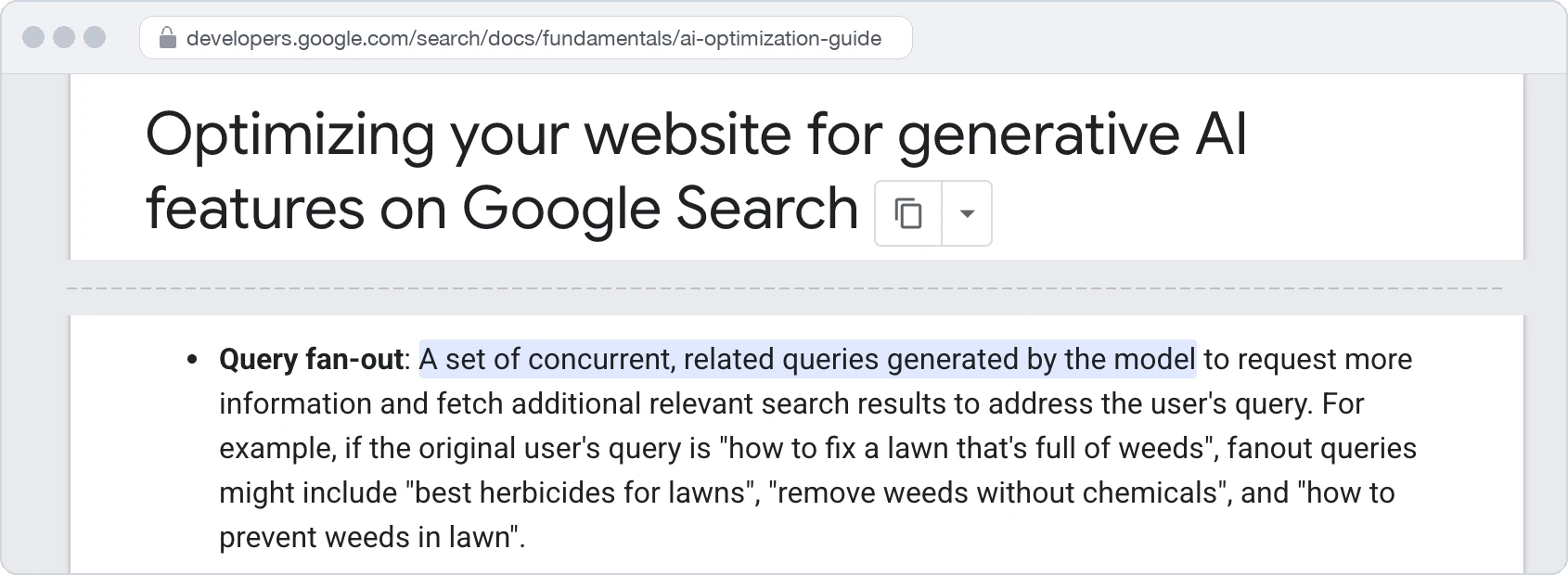
Query fan-out is an approach AI search engines use to break down complex queries into related sub-queries. The engine then takes the relevant information from each result and creates one response for the end user. Google's 2026 guide to its generative AI features defines it as "a set of concurrent, related queries generated by the model."

For example, if someone types "payment gateway for SaaS" into ChatGPT, it could search for smaller related queries such as these:
- "best payment gateway for SaaS 2026"
- "best rated payment gateway for SaaS"
- "payment gateway fees comparison"
- "SaaS payment processing options"
- "subscription payment platform features"
- "Stripe vs Braintree for SaaS"
Then it runs each query, selects the most relevant results for each, and combines them into a single answer that best serves the end user.
OpenAI's own help page shows the same pattern. In its example, a researcher asks about cancer drugs that target the CCR8 protein, and ChatGPT might first search "CCR8 immunotherapy drug development 2025," with a year nobody typed. Microsoft calls these engine-written searches grounding queries, since they tie the answer to web pages.
Since May 2026, the engines and their owners have shown more of how fan-out works:
- 15 May 2026: Google published a dedicated guide to optimizing for its generative AI features, which defines query fan-out and warns against pages made mainly to manipulate rankings for individual fan-out queries.
- 16 June 2026: Bing Webmaster Tools began grouping the grounding queries behind a website's AI citations into topics and showing its share of the citations for each query.
- 3 September 2026: OpenAI introduced GPT-6 Astra for a limited set of organizations. In Writesonic's test of 50 prompts, it ran 6.1 searches per answer against 10.3 for the model before it.
- 7 October 2026: ChatGPT's main chat began moving to GPT-6, which can start answering while it is still searching and add findings without another prompt.
- 13 October 2026: Bing added Topics Portfolio, a beta view that lists a website's citation gaps.
Why do LLMs use query fan-out?
Related searches give the engine evidence across several subtopics, which it combines into one answer to the original question. Google's documentation says AI Overviews and AI Mode may issue "multiple related searches across subtopics and data sources" to develop a response.
For the payment gateway question above, those subtopics include fees, comparisons, and subscription features, each with a search of its own.
Types of query fan-out sub-queries
Beyond the main type of the query, LLMs can search for other types of sub-queries, and these overlapping groups describe the common patterns.
Reformulation query: This type involves rephrasing the main query in different ways to capture related results.
Example: If the main query is "payment gateway for SaaS", reformulation queries could be:
- "SaaS billing platforms"
- "subscription payment solutions for software"
Comparative query: LLMs look for comparisons between options to give a more detailed answer.
Example:
- "Stripe vs PayPal for SaaS"
- "Braintree vs Chargebee pricing comparison"
Why it matters: Comparison searches support a commercial evaluation, although an engine-written comparison does not show that the person is ready to buy.
Related query: These explore topics closely related to the main query to expand context.
Example:
- "Best invoicing software for SaaS companies"
- "Recurring billing automation tools"
Implicit query: Queries that the user might implicitly want to know but didn't explicitly ask.
Example:
- "Payment gateway fees and hidden costs"
- "PCI compliance for SaaS payments"
Entity expansion: LLMs bring in related entities (brands, tools, or services) that might be relevant.
Example:
- Adding "Square," "Recurly," or "Zoho Billing" when the user searches for SaaS payment gateways
Personalized query: A search rewritten with the context an engine has, such as the person's location or, in ChatGPT with memory on, saved memories.
Example:
- If the conversation or saved memory shows the person needs a European provider: "Best EU-friendly SaaS payment gateways"
- If the approximate location is the US: "Top US-based payment processors for SaaS"
Website-specific query: LLMs limit some searches to one brand's own website, such as its pricing, integration, or documentation pages.
Example:
site:stripe.com subscription billing pricingsite:chargebee.com pricing 2026
Why it matters: Searches limited to one website take the engine straight to a vendor's pricing, integration, and documentation pages.
The CRM question from the introduction shows how these types mix in one real run:

GPT-5.5 Thinking ran four searches for the same question, three of them a vendor's name followed by pricing 2026 official. The wording changed with the model, and the searches still went to each vendor's pricing.
How is this different from the way traditional search works?
Conventional Google results list links for the specific query, whether it's complex or simple, while AI Overviews and AI Mode write an answer on top.
AI search engines work differently: they can break the query into multiple sub-queries, search for each, sometimes in several rounds, and synthesize everything into one answer. Some APIs and tracking tools record those searches.
For example, take the query covered above, "payment gateway for SaaS".
Here is one ChatGPT answer and one Google results page for this query:
ChatGPT:
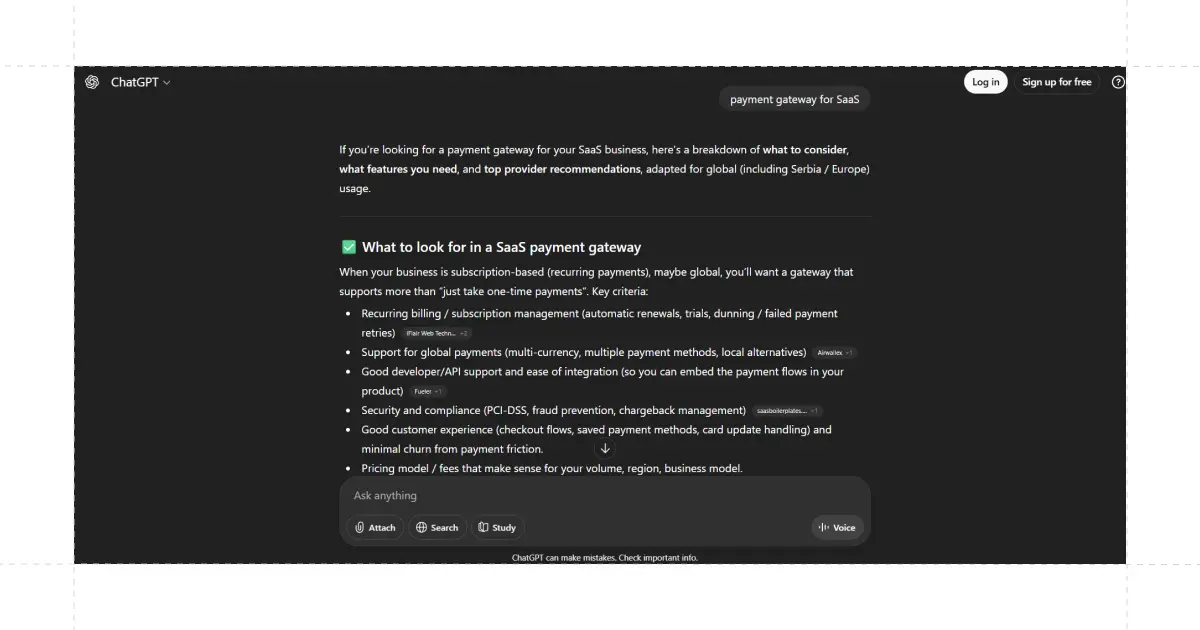
- Provides a synthesized breakdown of key criteria to evaluate (recurring billing, multi-currency support, developer-friendly APIs, fraud protection, flexible pricing models, and local or regional presence)
- Highlights essential features that matter specifically for SaaS businesses (vs. one-off ecommerce)
- Includes top gateway and billing platform recommendations that work especially well for SaaS models
- Offers structured guidance on what to look for in a payment gateway for SaaS
- Presents information in an organized, usable format with clear feature categories and source links beside several of its points
Google SERP:
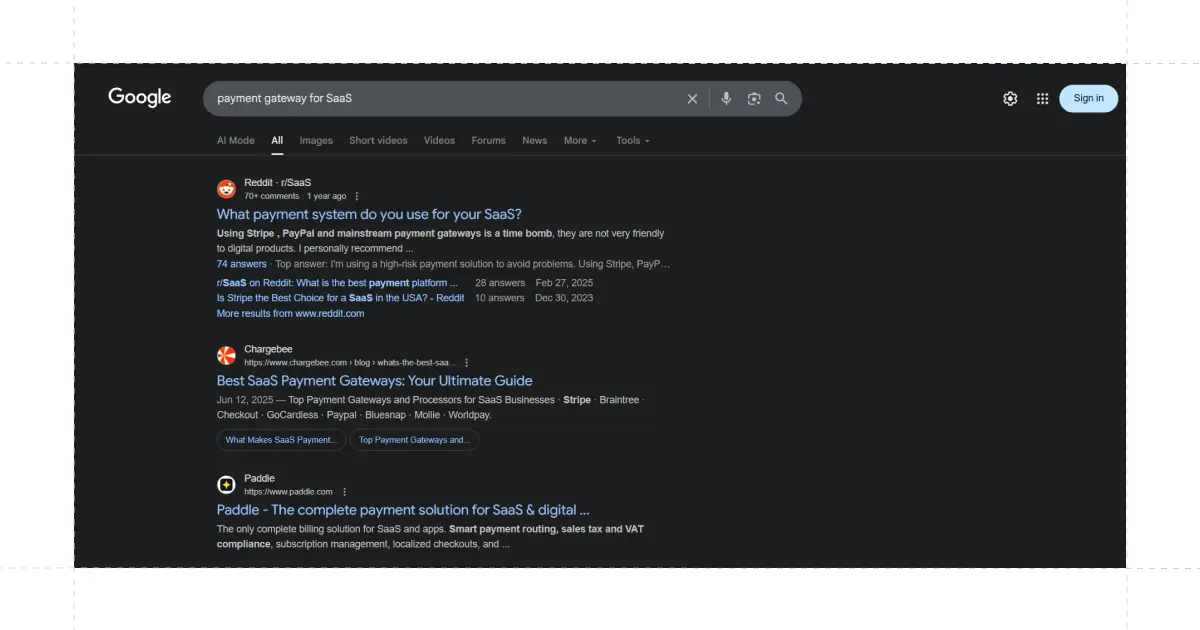
- Shows mostly links to blogs, forums, and product pages (e.g., Reddit, a Chargebee guide, and Paddle).
- Leads to separate pages, which a reader compares to gather the relevant information.
- Information is fragmented and requires manual comparison.
The two results also draw on different pages. In Writesonic's April 2026 test of 30 prompts, 84% to 87% of the domains cited by ChatGPT's thinking models, counted per prompt, were missing from Google's and Bing's first page for the prompt.
What does query fan-out mean for SEO?
Google introduced the query fan-out technique with AI Mode in March 2025 and presented it at Google I/O that May. On stage, Elizabeth Reid explained: "Search recognizes when a question needs advanced reasoning. It calls on our custom version of Gemini to break the question into different subtopics." ChatGPT, Copilot, and Claude also write their own searches from a prompt, as their documentation describes.
Google's Elizabeth Reid explains query fan-out at Google I/O 2025.
AI is now a starting point for software research. G2 surveyed 1,076 people who choose software for their companies in 2026. Of them, 51% start their research in an AI chatbot more often than in Google, up from 29% a year earlier. Understanding how those LLMs work and return results is crucial for every SEO and marketer.
The query fan-out technique is one of those things (such as RAG, neural reranking, and chunking) that SEOs must understand to optimize a website for those results.
Why fan-out changes content planning
Old rule: Ranking high for the target keyword was the main route to visibility.
New rule: AI answers also draw on pages that rank for the engine's own searches, so the main keyword is one route among several.
- Main keyword rankings aren't enough: For example, a page can rank fourth for "best project management software" and still be absent when ChatGPT answers from its search for "Asana vs Trello for remote marketing teams". In Moz's study of nearly 40,000 US and UK queries, 88% of AI Mode citations were not in the organic results for the exact query.
- Authority must extend to sub-queries: Each related question needs content with clear product facts and evidence a reader can check.
- AI influences vendor evaluation: In Semrush's 2026 survey of 519 US B2B professionals who use AI at work, 92% said AI had shaped their vendor shortlist.
- Content depth matters: Clear pricing, feature, and integration details give engines answers to specific evaluation questions, and a page built around one keyword gives the sub-queries little to retrieve.
- ICP analysis sets the priorities: Research on the Ideal Customer Profile (ICP) shows which sub-queries matter to the audience.
While query fan-out presents challenges, it also creates opportunities:
- Long-tail coverage: Narrow sub-queries open a way into the answer for pages that meet one specific need well
- Expertise as evidence: Product documentation, original research, and worked examples give engines specific facts to retrieve and cite
- Comparison content: "X vs Y" pages answer the comparison searches engines run
- Fresh content: The current year was the most common word in Ahrefs' September sample of English ChatGPT fan-out searches, as the chart in Step 2 shows. A year in the title belongs on pages that hold a current evaluation, with the evidence updated whenever product facts change.
LLMs' principles for query fan-out
To use query fan-out well, it's important to understand how LLMs approach sub-queries, explore sources, and personalize results.
1. Include "best" and comparative terms in the title tag
Pages that are lists or comparisons should say so with "best" and comparative terms in the title tag, meta description, headings, and content. This describes the page to people and engines searching for comparisons or top options.
The engines' own searches use these words. In the same CRM run, the first search was "best CRM 50 person B2B SaaS company 2026."
Example optimization:
❌ Generic: "Payment Gateways for Software Companies"
✅ Optimized: "Best Payment Gateways for SaaS To Choose in 2026"
Note: Google shortens titles to fit the display width, so the key terms belong at the start.
2. Transparency in source exploration
Recorded searches show how an engine gathers evidence. Trackers such as Ahrefs' Brand Radar record the fan-out queries of ChatGPT and Perplexity, and Bing provides website-level samples of grounding queries.
Microsoft shows website owners a sample of similar data. Since February 2026, the AI Performance report in Bing Webmaster Tools lists a sample of the grounding queries that Copilot and Bing's AI answers ran before citing a website's pages.
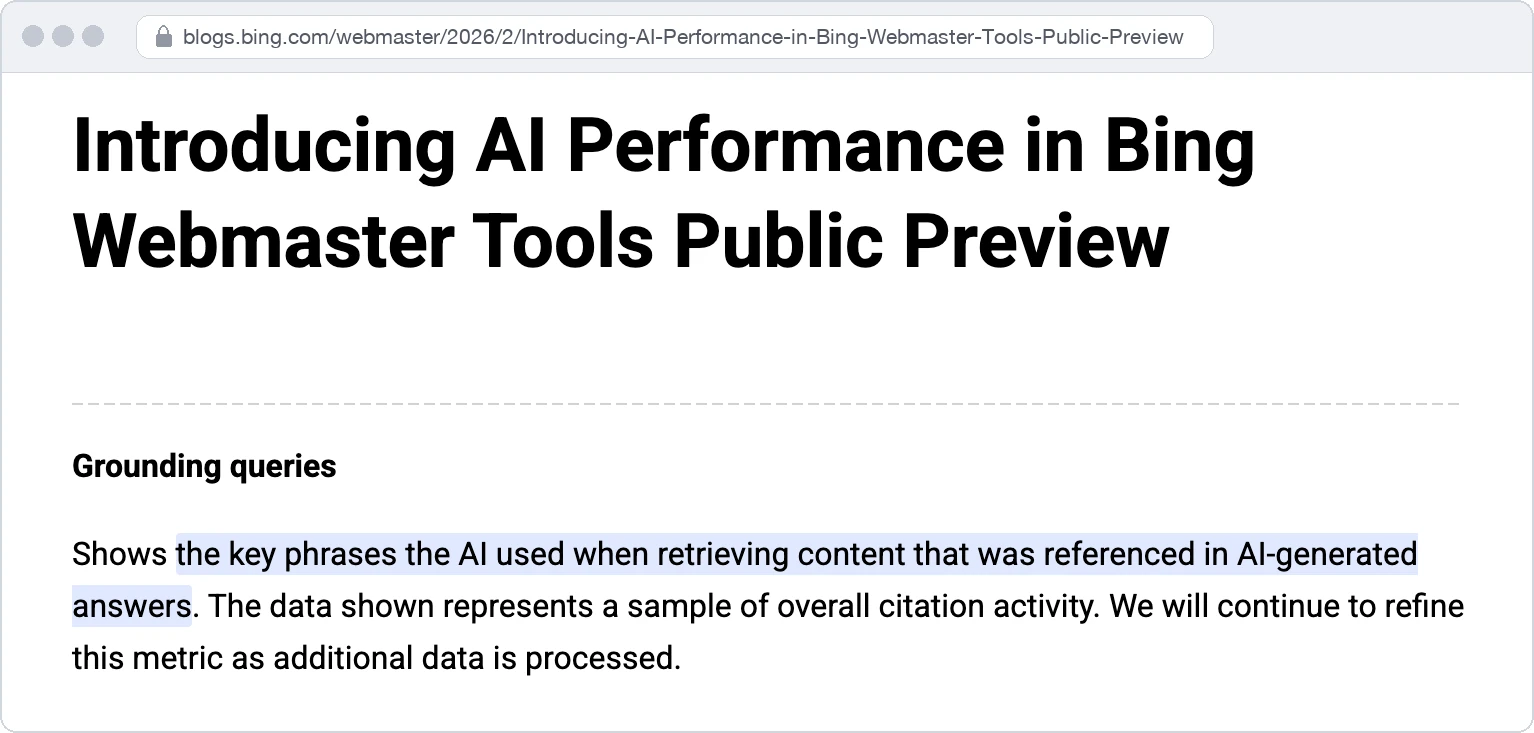
Why this matters: These views show which sub-queries the engines consider relevant, which reduces guesswork in content planning.
Example: Searches related to "payment gateway for SaaS" could include:
- "best payment gateways for SaaS 2026"
- "how to choose a payment gateway for SaaS"
- "payment gateway integration for subscription software"
Action: Group recorded searches and Bing's grounding-query samples into recurring questions, and keep the product, model, date, and locale with each observation.
3. Similarity to autosuggest keywords
Query fan-out resembles autosuggest, since both explore variations of a query around the person's intent.
Strategic insight: Autosuggest shows related questions people ask, and recorded fan-out queries show the searches engines ran. Both point to the variations the content should answer.
The exact wording changes from run to run, so patterns matter more than single phrases. Semrush's Zach Paruch writes that fan-out queries are made "on the fly, they shift from one run to the next, and most carry little or no search volume of their own."
In Surfer's study, which used grounded Gemini as a proxy, only about 27% of fan-out keywords stayed consistent across ten runs of the same prompt.
4. Personalization of results
Search results can vary with context, and the inputs depend on the product:
- Search history, where the product uses it
- Geographic location
- Device type
- Previous interactions, such as saved memories in ChatGPT
- Industry requirements stated in the prompt
Key takeaway: The same query can yield different results for different people. Map the audience's regional, industry, and implementation requirements, then answer the recurring ones with evidence.
How to optimize content for query fan-out?
To succeed in a query fan-out world, publishers must think beyond the primary keyword and create content that satisfies multiple sub-queries and user intents. Here's how:
1. Expand keyword research
Why: Query fan-out adds a second input to keyword research: the questions engines generate while they gather an answer. Those questions spread across a whole topic cluster, so mapping the cluster shows which ones a website already answers.
The cluster approach: Instead of targeting isolated keywords, map out complete topic clusters consisting of:
- Pillar content: The main comprehensive guide
- Sub-topic pages: Comparisons, use cases, and specific aspects
- Supporting content: FAQs, case studies, and related resources
Action steps:
- Map the primary topic into a complete cluster structure
- Group the observed and likely sub-queries in the cluster (reformulation, comparative, related, implicit, website-specific) into recurring questions
- Create interlocking content that references other pieces in the cluster
- Use tools such as Semrush, Ahrefs, AnswerThePublic, and AlsoAsked to explore likely questions, and check recorded searches in Bing Webmaster Tools or a tracker that captures them
Example cluster for "payment gateway for SaaS":
Pillar: "Complete Guide to Payment Gateways for SaaS Companies"
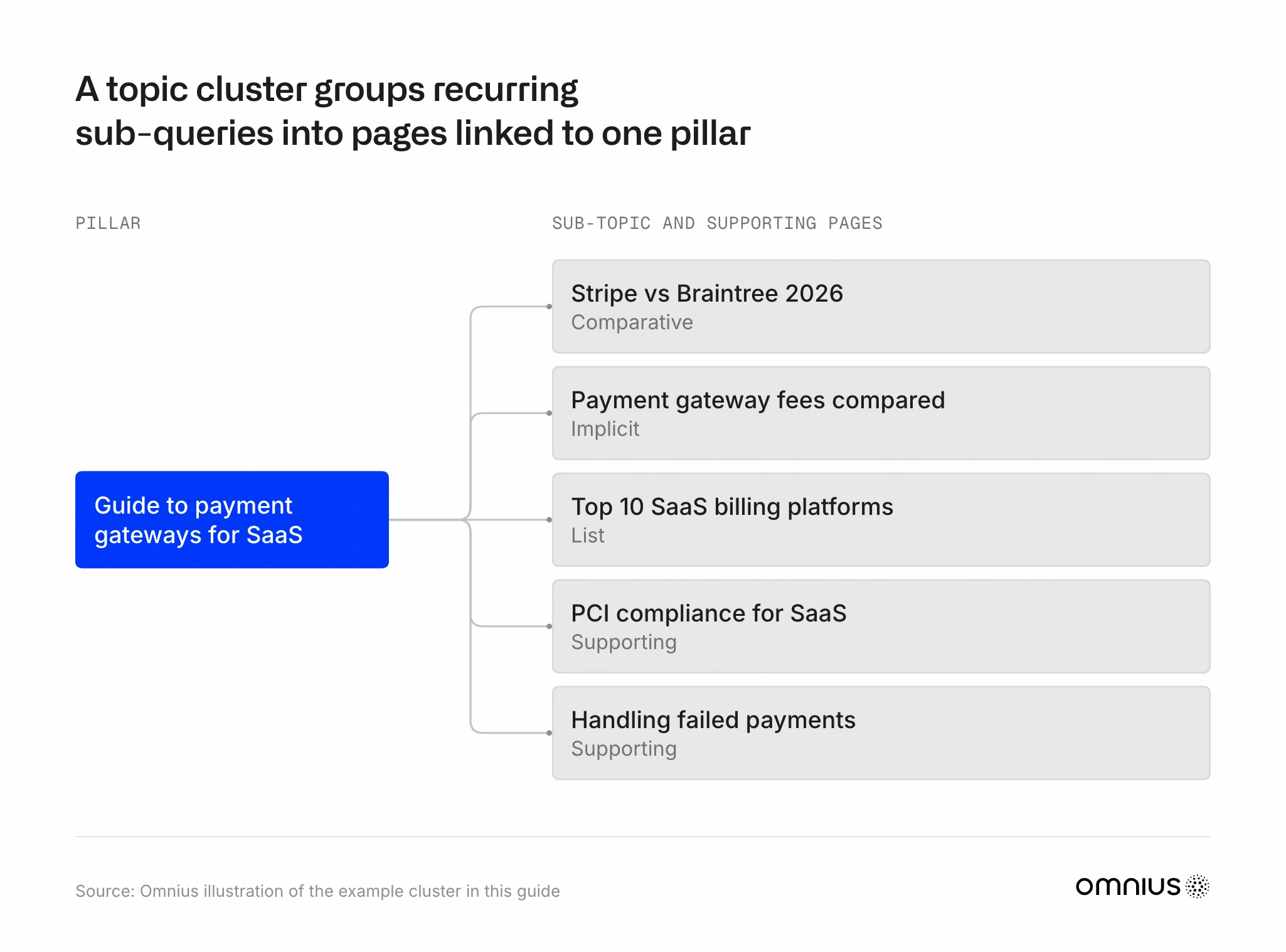
Sub-topics:
- "Stripe vs Braintree 2026: Which is Best for SaaS?"
- "Payment Gateway Fees Comparison for Subscription Businesses"
- "SaaS Recurring Billing Platforms: Top 10 Options"
Supporting:
- "PCI Compliance Requirements for SaaS Companies"
- "Handling Failed Payments in Subscription Businesses"
Pro tip: Audit what the website already covers before commissioning new pages. Then rank the recurring gaps by how much each matters to product evaluation, how weak the current answer is, and whether the company has real evidence to add.
2. Create comparison pages
Why: Substantive comparison pages answer the questions engines write about how products differ.
A ChatGPT answer Omnius recorded on 11 October 2026 shows the pattern. For a request to shortlist three product analytics tools with EU data hosting and a Snowflake integration, its 69 recorded source URLs fell into three reference groups. The first held 11 third-party comparison pages, all comparing the three tools the answer shortlisted, beside vendor and warehouse documentation, and the later groups held only vendors' own pages. A single run shows the mix of source types, and no fixed sequence follows from it.

Action: Build pages or sections specifically comparing top tools, products, or services. Include tables, pros and cons, pricing, and features.
Example: "Asana vs Trello vs Monday.com for remote marketing teams."
3. Optimize title tags and meta descriptions with "best" and comparative terms
Why: Titles and metadata tell people and engines what a page covers, including "best" and comparative intent.
Action: Incorporate terms like "best," "top," "vs," or "comparison" in strategic places:
- Page title
- H1/H2 headings
- Meta description
Examples:
✅ List content: "10 Best Payment Gateways for SaaS in 2026 | Pricing & Features Compared"
✅ Comparison content: "Stripe vs Braintree vs PayPal: Best Payment Gateway for SaaS (2026 Guide)"
✅ How-to content: "How to Choose a Payment Gateway for SaaS | Complete 2026 Guide"
4. Use listing or round-up articles
Why: Lists cover multiple sub-queries in a single content piece. For the same prompt, the AI Mode answer Omnius recorded listed 18 sources, including product lists and comparisons.
Action: Create content that highlights several products, services, or solutions, and include detailed features for each.
Example: "Top 10 Payment Gateways for SaaS Companies in 2026."
5. Regularly refresh content
Why: LLMs value up-to-date and authoritative content for sub-queries. Recent ChatGPT models also check brands' own pages directly. In Writesonic's tests on the same 50 prompts, the share of ChatGPT's searches limited to one website rose from 12.6% under GPT-5.5 in April 2026 to 75.1% under GPT-6 Astra in ChatGPT Work in September. That comparison spans models, months, and surfaces.

Action: Update information, pricing, features, or comparisons regularly, and keep prices, limits, and dates in text on the brand's own pages, outside images and PDFs. Ensure all facts are up to date and accurate.
A study of pricing answers about Cloud 100 companies across six AI engines ran from 29 July to 10 August 2026. Plaid's pricing page was cited first in 42% of answers about Plaid's pricing, against 12% for company pricing pages overall. The authors credit Plaid's billing documentation, without isolating its effect: "Docs are frankly way more information-dense, and AI agents crave details over simplification."
Example: Recheck "Stripe vs Braintree" whenever either product changes its pricing or features, with a scheduled review as a backstop.
6. Cover the full range of sub-queries
Why: Appearing for the main keyword isn't enough; LLMs may surface content for sub-queries instead.
Action: Incorporate content that addresses reformulation, comparative, related, implicit, entity expansion, personalized, and website-specific queries.
Example: Include FAQs like "What is the cheapest SaaS payment gateway?" or "EU-friendly subscription payment platforms."
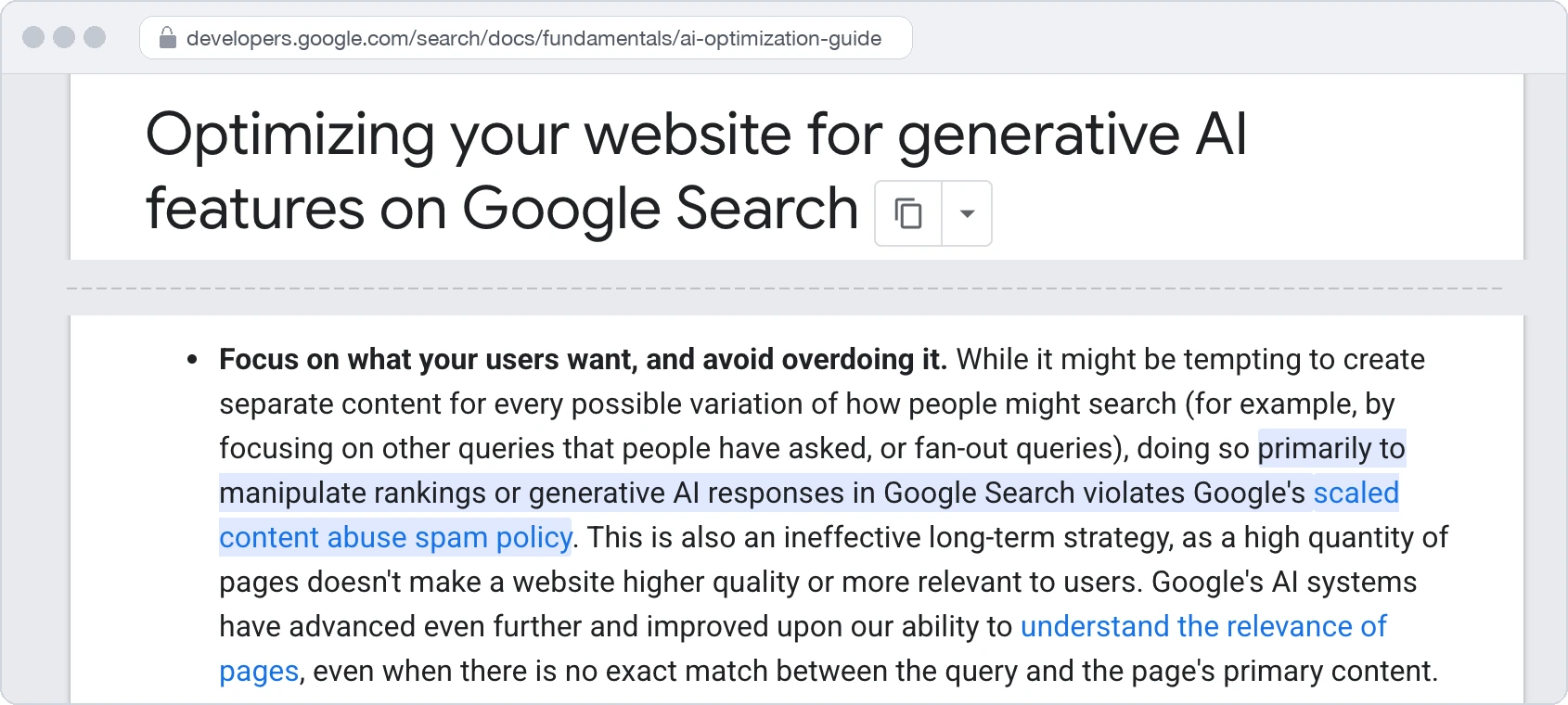
Group related questions where one page can answer them well. Google's 2026 guide treats separate content for every fan-out variation, made mainly to sway its rankings or AI answers, as scaled content abuse.
How to track AI visibility?
Once content is optimized for query fan-out, the next step is measuring AI search performance.
Traditional analytics tools show only part of it. Google Search Console counts AI Overviews and AI Mode traffic inside the regular Web search type. Its generative AI performance reports launched on 3 June 2026 and rolled out worldwide on 31 August for websites with enough impressions. They show impressions by page, country, device, and date, with no query data, and neither report shows how often content appears in ChatGPT or Perplexity.
Why AI search tracking matters
AI-assisted discovery can lead to later direct visits. People discover content through ChatGPT or Perplexity, then visit the website directly, and standard analytics cannot tie those visits to the original answer.
Proper tracking reveals:
- Which AI platforms send referral visits and configured conversions
- The monitored prompts that surface the brand in AI results
- How the brand's visibility compares with competitors across different LLMs
- Which content formats and topics receive citations within the monitored prompts
Answers also change week to week. In SISTRIX's 17-week German sample, as much as 74% of ChatGPT's cited domains each week were new against the week before, so repeated checks give a far better baseline than one.
Three main AI visibility tracking options
1. Google Analytics 4 setup (free)
One starting point is configuring Google Analytics 4 to identify AI traffic sources.
A custom channel group with regex patterns for AI platforms (ChatGPT, Perplexity, Claude, Gemini, etc.) groups visits identified by their referrer or campaign tag. ChatGPT tags its links with a source naming chatgpt.com, and Writesonic found the tag on 82% to 92% of cited links in April 2026, so the referrer check matters for the untagged rest.
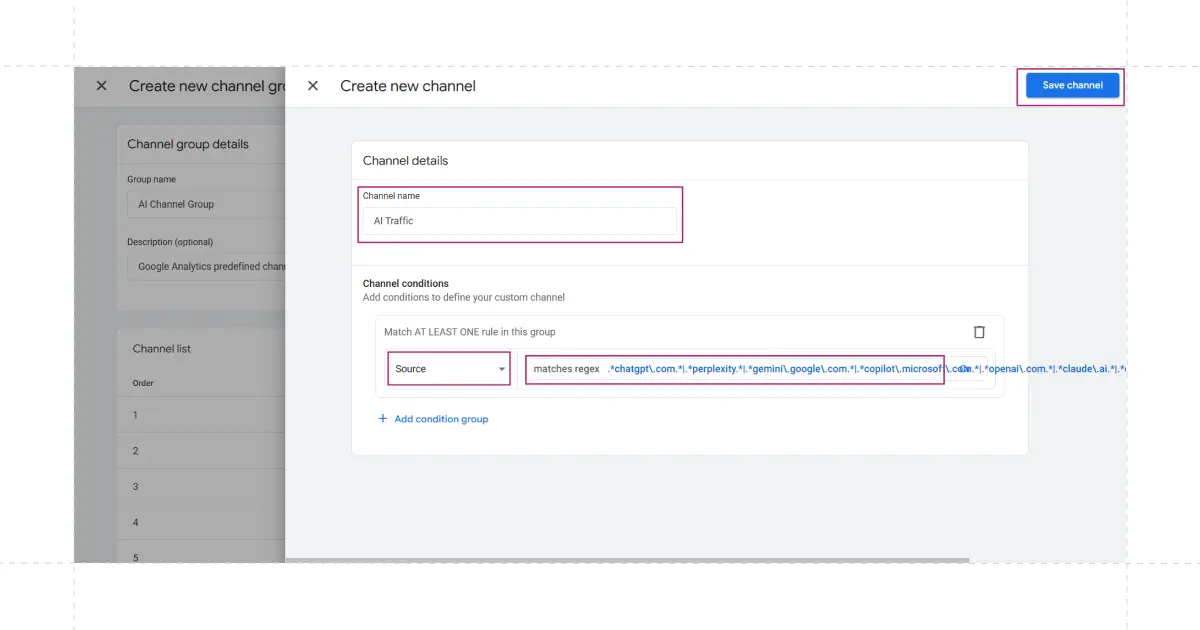
This approach requires some technical setup but provides basic visibility into AI-driven visits.
2. Specialized AI analytics tools (free and paid)
For comprehensive tracking, AI search monitoring tools such as Ahrefs, Semrush, or Atomic AGI offer dedicated AI search analytics.

These tools provide:
- Scheduled checks across the AI platforms each tool supports
- Visibility for a defined set of monitored prompts
- Comparisons of brand mentions, recommendations, and citations with competitors
- The searches and source URLs behind answers, where the tool captures them
3. Bing Webmaster Tools' AI performance report
Bing's report covers Copilot and Bing's AI answers. It shows the grounding queries and cited pages behind a website's citations and, since June 2026, those queries grouped into topics with its share of citations per query. Since 13 October 2026, a Topics Portfolio beta also lists opportunity queries where other websites are cited and the website is not.
Microsoft notes the data is a sample of citation activity, and the beta appears only when a website has enough data. Topic totals are approximate, opportunity queries show citation volumes as ranges, and they can include searches that name another company's brand.
Tracking AI visibility goes beyond vanity metrics: repeated measurements show what changed after a content update.
Coverage analysis compares recorded searches, cited sources, referral visits, and configured conversions, so teams can:
- Compare citation gaps with referral traffic and conversions
- Find content gaps where competitors are cited and the brand is not
- Prioritize topic clusters with citation data from the monitored prompts
- Decide which AI platforms deserve the most work in their niche
Tracking that starts early gives a brand a baseline before the next engine change.
Key takeaways
Here are the seven principles to remember when optimizing for query fan-out and AI search:
- Query fan-out expands retrieval: AI engines can split a query into related sub-queries and combine what they find into one answer.
- Main keyword rankings are no longer sufficient: Coverage of the related sub-queries opens more ways into AI answers.
- Comprehensive content answers the recurring questions: Related questions sit together on one page, and distinct needs get their own pages.
- Comparison content answers comparison searches: Substantive "X vs Y" pages explain the product differences engines look for.
- Freshness matters for time-sensitive questions: Current product facts belong on the brand's own pages.
- Personalization changes results: The same query can yield different results for different people based on context.
- Think like an LLM: Anticipate related questions, implicit queries, and entity expansions when creating content.
Conclusion: cover the questions engines search for
Query fan-out widens the set of searches an engine runs before it writes an answer, such as the pricing and comparison searches in the CRM example. For SEO professionals and content creators, the task is to answer the recurring questions behind those searches with useful, well-supported content.
A practical publishing plan for query fan-out does five things:
- Create comprehensive content
- Maintain fresh, up-to-date information
- Build authority across sub-queries
- Optimize for comparison and "best" queries
- Think holistically about user intent
One question remains: "Does my page rank for this keyword?"
A second question now sits beside it: "Does my content answer the recurring questions my audience has about this topic?"
A brand that answers the second question well gives the engines more to retrieve and cite.
Omnius is a GEO agency that helps B2B SaaS, fintech, and AI companies get mentioned in ChatGPT, Perplexity, and Google's AI Mode, with GEO strategies built on the searches these engines run.
Book a free 30-minute call to see where a brand stands in AI search.
Frequently asked questions
What's the difference between query fan-out and RAG?
Query fan-out writes related searches from one question to cover user intent. RAG brings retrieved information into a generated answer, from web pages or a document collection, and the two often work together. For its AI features, Google describes retrieval as relying on "our core Search ranking systems to retrieve relevant, up-to-date web pages from our Search index."
What is the purpose of a query?
A query starts the search process, in which both traditional and AI search engines identify user intent. In AI search, a single query can trigger query fan-out, spawning sub-queries when the engine needs more information.
Should a website create a page for every fan-out query?
No. Fan-out queries change between runs, so recurring questions make a more useful planning unit than single generated phrases. Google's 2026 guide treats separate content for every fan-out variation, made mainly to sway rankings or AI answers, as scaled content abuse. Related questions belong together where one page answers them well, and a separate page earns its place when it serves a distinct need.
Is there a tool that shows query fan-out?
Yes, in part. Bing Webmaster Tools and Microsoft Clarity show a sample of the grounding queries behind a website's citations in Microsoft's AI answers. Trackers such as Ahrefs' Brand Radar record ChatGPT's and Perplexity's searches, and the Gemini API returns the searches its model ran. Google offers no report of the searches AI Mode or AI Overviews run.
Methodology
This guide states where its evidence comes from and what each source can show:
- Update. This guide was refreshed in October 2026, with its structure and examples kept. Facts were checked against the engines' documentation and the studies listed below, read from 15 to 20 October 2026, and each study's dates and sample are stated where it is cited.
- Recorded run. On 11 October 2026, Omnius recorded one product analytics shortlist prompt in ChatGPT and Google AI Mode with Atomic AGI, the AI search product built inside Omnius. The ChatGPT record groups its 69 source URLs by ChatGPT's reference markers (turn0, turn1, and turn2), which show the groups but not the order of the searches, and the AI Mode record lists 18 sources. A single run is one example, and answers change between runs.
- Named sources. Ahrefs, Semrush, Moz, and Surfer sell SEO software, Writesonic sells an AI visibility tracker, and SISTRIX sells search data. The Cloud 100 pricing study was published by an AI visibility tracker with an outside pricing adviser, and it is cited here without their names.
The documentation and studies behind this guide:
- Google: optimizing for generative AI features on Search
- Google: AI features and a website
- Google: Gemini API grounding with Google Search
- Google: generative AI performance reports in Search Console
- OpenAI: searching the web with ChatGPT
- OpenAI: ChatGPT release notes
- Anthropic: Claude's web search tool
- Perplexity: architecting an AI-first search API
- Microsoft: Topics Portfolio in Bing Webmaster Tools
- Writesonic: GPT-5.5 against GPT-5.4 citation study
- Writesonic: GPT-5.6 Sol citation study
- Writesonic: GPT-6 Astra citation study
- Ahrefs: how ChatGPT does query fan-out
- Moz: AI Mode citations study
- Semrush: how AI shapes B2B buying
- Semrush: query fan-out
- Surfer: query fan-out research
- SISTRIX: AI citation drift
- G2: the answer economy
Keep learning. More Omnius guides on AI search visibility:
- ChatGPT Is Using Google Search: Here's How to Win with Snippet Optimization
- How ChatGPT Ranking Algorithm Works [Retrieval, Reasoning, Citing]
- How to Rank on ChatGPT: 6 Tips to Boost AI Visibility
- How to Rank on Perplexity [Comprehensive Perplexity SEO Guide]
- How to Rank in AI Search Results in 2026
- How to Audit a Website for AI Search Visibility
- Agentic SEO guide