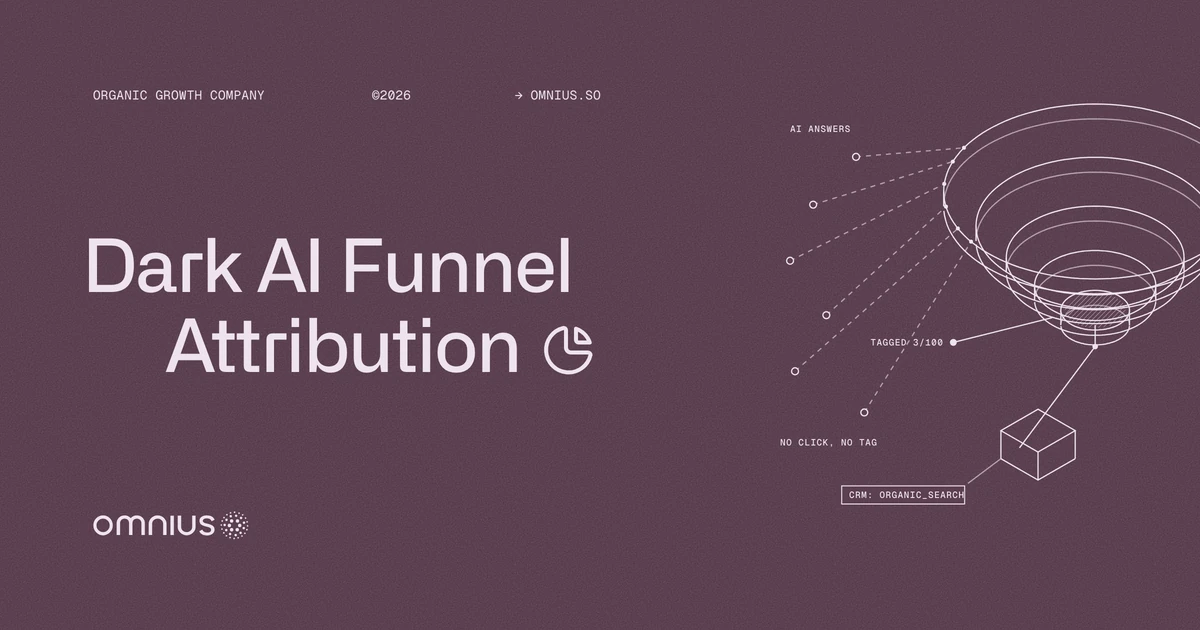
A prospect tells the account executive that ChatGPT put the company on its shortlist. The CRM still files the deal under organic search, and analytics shows almost no AI traffic. That gap is the dark AI funnel: AI search shapes the decision while the records credit something else. AI search attribution is the work of finding that influence and tying it to pipeline and revenue.
The gap is large. In Profound's US consumer panel from January to June 2026, more than 97% of first visits to a brand's website after a ChatGPT mention carried no ChatGPT tag. Without that tag or a ChatGPT referrer, analytics cannot credit the visit to ChatGPT.
For a B2B SaaS, fintech, or AI company, that means a report that undercounts AI search, and a leadership team that can cut the very channel prospects name on sales calls. This guide shows how to measure it anyway: the four signals that reveal AI influence, how to set them up across the CRM, PostHog, and Stripe, and a monthly report a CFO can check.
Key takeaways
- Count AI-connected opportunities instead of AI sessions, flagging each opportunity whose contacts had a tracked AI visit.
- Look for AI influence behind organic and direct leads by asking how the prospect found the company on the form and in the first call, before any question about AI.
- Treat the prospect's own answer as evidence, since the published company comparisons found several times the AI share analytics showed.
- Identify AI agents by their documented user agents, and join installs, signups, and payments on one account ID.
- Read branded demand and AI impressions against a baseline and an annotation log, so a funding round or a tagging outage never passes for AI search.
- Keep both evidence totals apart from incremental revenue, and let a phased comparison decide whether to raise, hold, or reduce the investment.
What is AI search attribution, and why does the dark AI funnel matter?
AI search attribution connects pipeline and revenue to what ChatGPT, Google AI Mode, AI Overviews, Gemini, Perplexity, Claude, and Copilot say about a company. The dark AI funnel is the part of that influence the CRM files under another source. The prospect came back later through a search, a typed URL, or a colleague. The name borrows from the B2B dark funnel, the anonymous research that happens before a prospect contacts a vendor.
Prospects do part of their vendor research in these answers. In G2's March 2026 survey of 1,076 people who buy B2B software, 51% start research with an AI chatbot more often than with Google, and 69% chose a different vendor than planned because a chatbot recommended it.

Four changes since May 2026 moved the AI numbers in analytics and Search Console, so a trend line that crosses one needs a note:
- 7 May 2026: ChatGPT started linking brand names inline to their homepages far more often, and OpenAI referrals to the brand websites Profound monitors rose about 60 to 65%.
- 13 May 2026: Google Analytics added an AI Assistant channel.
- 31 August 2026: Search Console's AI reports for AI Overviews and AI Mode reached all websites.
- 8 October 2026: As GPT-6 rolled out, many ChatGPT links lost their tracking tag until 15 and 16 October.
Cedric Huesler, who works on product for Adobe's brand visibility tools, first guessed that GPT-6 showed fewer links. He then compared about 500 pages where ChatGPT drove at least 5% of visits, from 9 to 13 October 2026 against the week before. Tracked ChatGPT visits fell by about 31,000 a day, while direct visits to the same pages rose by about 26,000.
His recap two days later says “the visits weren’t lost, they were hidden.” After OpenAI confirmed a bug on 14 October, his advice was to annotate 8 to 15 October: “It’s one event, not a trend.”

Why is AI search a black box for B2B attribution?
Each of those changes moved only the AI activity that analytics and Search Console can record. The black box paradox of AI search is how little that record shows: AI referrals made up 1.08% of website traffic across 10 industries in Conductor's 2026 benchmarks, yet 92% of the 519 AI-using B2B professionals Semrush surveyed say AI has shaped their vendor shortlist. The two figures measure different things, since Conductor counts visits and Semrush counts people. Together they show AI shaping decisions that analytics barely records.
AI influence goes unrecorded along several routes, and a deal can take any of them. The research can stay inside the answer, the prospect can return by name through Google, a click can arrive without a referrer, and a colleague's research can stay out of the CRM. In this worked example, Vendor A, an accounts payable software company, follows one deal through five stages of the customer journey until its CRM credits the first source it recorded.

1. The answer builds the shortlist
The CFO of a 300-person company asks ChatGPT which accounts payable tools fit its size and connect to its accounting system. She reads four names, each with a reason, and clicks nothing, so the influence stays invisible to Vendor A's analytics. In Similarweb's data, AI sits in the middle of 76.1% of the sessions that include it, during research and comparison.
The answer can also rely on a company without naming it. Omnius's entity SEO page notes: “Being retrieved is not the same as being recommended: a company’s page can be used as a source while the company itself is never named.”
2. The prospect comes back later, by name, through Google
The CFO forwards the list to the controller, who searches Vendor A's name on Google six days later. In Profound's US consumer panel, 20.5% of first brand visits after an AI mention came within an hour, and only 42% came within 24 hours.
Many returns come through search, as Similarweb's US desktop panel showed from July to December 2025. ChatGPT recommended one of two rival brands to people who had not named it in their prompt or visited its website for four weeks. The recommended brand won the later visit in all six cases, and 55.9% of those visits arrived through search, against 40.4% of other visits.

Similarweb's June write-up puts it plainly: “When AI-influenced users do visit a brand, over half arrive via a branded search query.” The two tools overlap, since more than 9 in 10 ChatGPT users also use Google, and 63% of Semrush's respondents say they search the company on Google when AI mentions it.
Visits after a ChatGPT recommendation averaged 12.0 pageviews and 11.8 minutes in Similarweb's panel, against 6.5 and 5.6 for other visits. In its June 2026 shopper data, sessions that combined AI and traditional search converted at 23.0%, against 17.3% for search alone. Both panels follow US consumers, so they show a mechanism, never a B2B rate.
Our self-attribution forms after first sales meetings point the same way: in the weeks before 13 August 2026, 59% of high-intent companies said they found us through an LLM. All AI engines together sent our website 21% of the traffic Google did. People ask an LLM, get a brand name, and type it into Google, so the conversion is credited to Google. In our data, the AI line therefore understates AI's share of high-intent demand.
Our self-attribution results, posted on LinkedIn, 13 August 2026.
3. The clicks that do happen land in Direct
Clicks lose their trail too. Huesler's October 2026 telemetry shows most ChatGPT clicks arriving without a referrer, the note a browser passes on about the page a visitor came from, so ChatGPT's tracking tag is the remaining signal. Without the tag or a referrer, analytics files the visit under Direct by one of four routes:
- A link that withholds the referrer. A noreferrer link tells the browser to omit the Referer header. During the October bug, Huesler found GPT-6 opening links that way without a tag, as Google's AI Mode did in May 2025 until Google fixed it.
- An app or in-app browser. AI mobile apps and in-app browsers can send visits with no referrer.
- A copied link or a typed URL. GA4 files a typed address, or a link in a PDF or Word file, as (direct) / (none).
- A redirect that drops the tag. Redirects and URL shorteners can strip tags and referral details.
Direct hides less than it seems. On 6 October 2026, before the bug, Huesler tested across about 600 brands whether direct traffic hides AI visits: “It was real but rare, and showed up mostly on docs and help pages.”
More of it returns through search, as one firm that sells SEO and AI search services found. Of 189 leads that named an AI tool in an optional free-text field over two years, its CRM's first-touch source credited only 28 (15%) to AI referrals, 95 to organic search, and 59 to direct.
Omnius's memo describes the same outcome when an answer mentions a brand without citing or linking to it. In that case, it says, “this conversion, in a formal way, is getting attributed to either Google or the direct channel source, which is incorrect.”

4. The CRM credits the touch it could see
When the controller books a demo, the new contact gets a source, because HubSpot's Original Traffic Source keeps “the first known web source”. Associated deals mirror it, so Vendor A's new opportunity reads Organic Search.
Google's own AI answers add a second blind spot. GA4's AI Assistant channel “excludes Google’s AI Overviews and AI Mode”, whose clicks count as Google organic search.
A different attribution model cannot fix this, because Google Analytics defines a model as a rule or algorithm that assigns credit “to touchpoints along a user's path”. Two gaps are recording choices the setup below fixes, an AI visit the source fields never credit and a Perplexity visit filed as Referral. A click with no tag or referrer, or an answer with no click, leaves nothing for a model to read, so it needs a new record on the opportunity.
The untagged share in Profound's panel counts visits, never deals, so it is no multiplier for the CRM floor.

5. The CFO, the controller, and a long sales cycle hide the rest
In Vendor A's deal, the CFO asked ChatGPT and the controller filled in the form, so the person who asked the AI is not the contact the CRM records. Software purchases involve more people than those two. The CMOs Wynter surveyed in January 2026 said 5.1 people take part on average, from the CMO to finance, IT and security, revenue operations, and end users. Most of those CMOs, 68%, start the vendor search in AI tools.
Time widens the gap too, since buying cycles averaged about 10 months in 6sense's 2025 survey of more than 4,000 B2B purchasers. In the same survey, 94% had ranked preferred vendors before first contact. By then the choice has narrowed, since 62% of Wynter's CMOs look at three vendors and no more. Most of them, 80%, arrive at the first sales call moderately or very familiar with the vendor. The first discovery call is therefore a likely place for the AI touch to surface.

Which four signals track AI search revenue, and what does each miss?
Each stage leaves a different mark, so four signals trace AI search toward revenue, and none of them is the total. Two count opportunities, and two read whole-website trends.
1. AI-connected opportunities: the tracked floor
The first signal counts AI-connected opportunities, where at least one contact on the deal had a tracked AI visit in a set window. The window can be the 90 days before the opportunity was created, and each opportunity counts once, however many of its contacts had an AI visit.
It records the AI connection end to end, from the session to the deal, so a CFO can audit it, though a touch never proves that AI won the deal. It misses no-click influence, Google's AI features, and Perplexity visits when it reads only GA4's AI Assistant channel. Read alone, that floor misleads, and switching attribution models leaves it in place. A CEO or chief financial officer (CFO) who sees only the floor concludes that AI search adds little, while prospects say the opposite on sales calls.

What to do: Report AI-connected opportunities as their own line, and never judge AI search on this line alone. Before comparing months, check the annotation log, a dated record of releases, campaigns, and incidents.
❌ AI search sourced 2 opportunities in September, by Original Traffic Source, so the channel adds little.
✔ Vendor A (example): 5 of 40 September opportunities have an AI-referred session on an associated contact in the 90 days before creation, reported as the floor.
Read more: ChatGPT's referral crash
2. Self-reported attribution: the prospect's own account
Self-reported attribution is what the prospect says about how they found the company, on forms, on the first call, and in deal notes. It records the prospect's account of no-click influence, which no tracker can. Coding separates AI discovery, where an answer introduced the company, from AI assistance, where the prospect used AI to compare a known vendor.
Asking finds what the click records miss. At n8n, a workflow automation company, answer engines drew about 1% of signups in GA4's last-touch data and about 9% in its post-signup survey, while search showed a smaller, fourfold gap. Each such comparison covers one company, so neither ratio transfers to another company.
Published survey shares point the same way. Tally, a form builder, says 43% of its new users find it through AI assistants, as its onboarding survey confirms, after noting in 2025 that its tracked AI signups were “just the ones we could track.” In October 2026, Ahrefs reported that its signup survey credits Claude and ChatGPT with 21.7% of its signups.

Collecting the answer costs one form field. PostHog's onboarding asks anyone who heard about it through AI which prompt they used, and it collected 6,814 prompts in three months.
The answer carries its own errors. HockeyStack's 2024 report on demo-form answers from dozens of B2B companies found about 20% of all answers it pulled unusable. Memory errs both ways, naming ChatGPT when a partner referred the prospect first and missing it when a controller fills in the form for a CFO who asked ChatGPT. Question order adds a third error, since Pew Research Center finds that closed questions asked first steer the answers to an open one.
Rand Fishkin, co-founder and CEO of the audience research company SparkToro, names three limits of the question itself. Memory fails, the question never says which time it means, and people who never heard of the company cannot answer at all. He still calls such surveys useful beside interviews and passively collected data.
What to do: Read AI discovery only from open answers, and the AI share only beside its response rate. Treat one month's swing as noise until the next cohort confirms it.
SparkToro's Rand Fishkin on three limits of asking people how they heard about a company (October 2023).
❌ A drop-down that lists ChatGPT first reports a 34% AI share with no response rate.
✔ Vendor A (example) asks the open question first, then the AI follow-up, and 10 of 40 opportunities name AI out of 32 that answer.
Read more: How to measure GEO success
3. Branded search and direct traffic: the demand trend
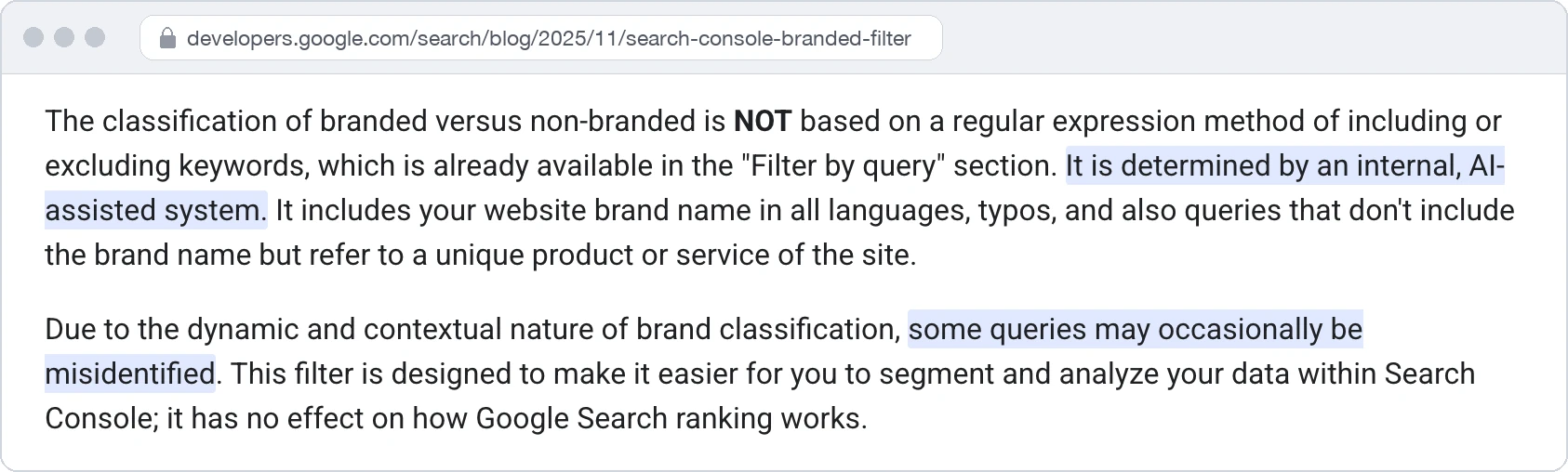
Because many prospects return through search, the third signal is branded demand. It covers branded impressions and clicks from Search Console's branded queries filter and direct visits to key pages, read monthly against a baseline. Google's own system decides which queries the filter counts as branded, and Google warns that some queries “may occasionally be misidentified”.
Ahrefs treats a rise in direct traffic after publishing content for AI search as AI traffic when nothing else explains it, such as a campaign, PR, or seasonality. This guide counts such a rise as a directional sign only when AI visibility also rose on the same timeline and the annotation log shows nothing else that explains it.
What to do: Record branded impressions, clicks, and direct visits before the work starts, then count a later lift as direction, never size.
❌ Branded impressions rose 31% since the AI search work began, so AI search drove the rise.
✔ Vendor A (example): branded impressions rose 31% against the April to June average, in a month with a funding announcement, so the rise does not count for AI search.
4. AI visibility: impressions and tracked answers
The fourth signal records the first stage, where the shortlist forms. Search Console's AI reports show impressions in AI Overviews and AI Mode without the searches behind them. Bing Webmaster Tools reports grounding queries, the searches behind Copilot answers, with the pages cited for each.
ChatGPT and Claude publish no such reports, so exposure there comes from a tracker's sampled answers, which are only as good as their questions. PostHog's signup prompts showed Natalia Amorim, who leads answer engine optimization (AEO) there, that many AI-generated prompts she tracked barely overlapped with real ones, so she rebuilt the set: six months of data had “aged like milk”.
Omnius's technology page states the same limit: “Synthetic prompt tracking is useful, but it samples a non-deterministic system and can turn noise into apparently precise visibility scores.”
What to do: Treat tracked answers as one input beside search, attribution, and conversion data, and build the tracked questions from what prospects write and say. Read exposure per engine as the leading line, never as revenue on its own.
❌ Share of voice in ChatGPT rose 6 points, so AI search added pipeline.
✔ Vendor A (example) is named in 18% of tracked ChatGPT answers to 25 shortlist questions, read next to the other three signals.

How to attribute signups from AI agents such as Claude Code and Codex
The four signals assume a person reads the answer, yet coding agents now pick many developer tools themselves. Asked to add payments to an app, Claude Code or Codex can choose a provider, read its docs, and install its package or command-line tool (CLI) before anyone visits the website. In June 2026, Stripe reported that agents made up nearly 40% of its docs traffic and sent 70% of its CLI requests for API resources.
Each step of that path leaves a different record:
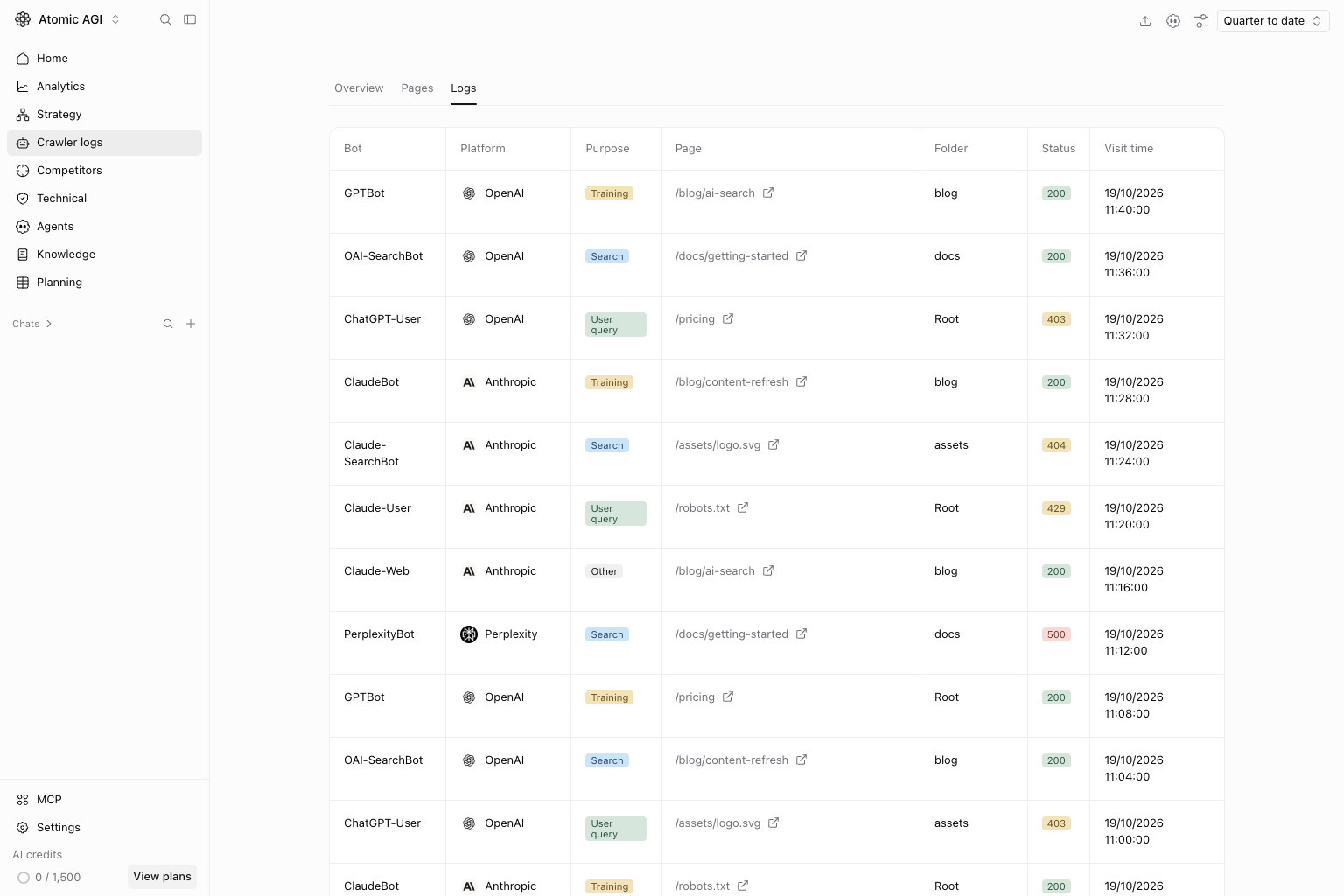
- Server and crawler logs. OpenAI, Anthropic, and Perplexity document the user agents their assistants send when a question makes them fetch a page (ChatGPT-User, Claude-User, and Perplexity-User) and list their IP addresses. Claude Code's WebFetch sends a user agent beginning with Claude-User, and Google documents Google-Agent.
- Docs and llms.txt fetches. On Mintlify-hosted docs, agents made 257 million requests in August 2026 against 131 million human page loads, 83% of them through Markdown pages, llms.txt files, and agent skills.
- Install and CLI telemetry. Claude Code sets CLAUDECODE to 1 in the commands it spawns, and its IDE extensions set it in their integrated terminals too. CLAUDE_CODE_CHILD_SESSION, which Claude Code alone sets in the commands it launches, lets an install script or a CLI record that Claude Code ran it.
- Signup questions. The form asks which assistant, coding agent, or prompt led there, as PostHog's onboarding does.
- Payments joined to accounts. Stripe metadata holds the company's own user ID on the Customer object, so a payment joins the account the signup created.

Each record has a blind spot. Any client can send a user-agent header, so the IP lists matter, and ChatGPT's Cloud browser signs its requests for verification with Web Bot Auth. In Mintlify's April 2026 count, Codex sent no identifiable user agent, so its traffic “can't be distinguished from generic HTTP clients in this analysis”.
Crawler log tools such as Atomic AGI, which our team built, connect to a website through Cloudflare, Vercel, or WordPress. They sort bot requests into training, search, and user-query purposes, with ChatGPT-User, Claude-User, and Perplexity-User among the user-query bots. Its docs add, for user-query requests: “This is not a human browser session or a conversion count.”
What to do: Tag each request by its documented user agent, check it against the vendor's IP list, and record the agent at install and in the signup form. Store the account ID in Stripe metadata so revenue joins the signup.
❌ Vendor A (example) counts 40,000 Claude-User requests to its docs in September as 40,000 AI visits.
✔ Vendor A (example) reports 40,000 agent requests to its docs, 35 signups whose form names Claude Code, and their Stripe revenue, on three lines.
Read more: Agent experience for developer tools
How to set up AI search attribution across the CRM, PostHog, and Stripe
Which records see what, and how they join
The signals and the agent records sit in different tools, so the report joins them, as Natalia Amorim does at PostHog with a prompt tracker, Search Console, PostHog data, and the self-attribution survey:
| Record | What it sees | What it misses |
|---|---|---|
| Form or call answer | The prospect's account of no-click influence | Memory errors and the colleague who asked the AI |
| PostHog or similar | Signup and product events, first-touch tags, survey answers | Research that never reaches the website |
| Stripe | Payments, joined to the account through metadata | How the account found the product |
| Crawler logs | Agent requests per page, by user agent | The person and prompt behind each request |
| CRM | Contacts, deals, call notes, first-touch source | Untracked visits; first and latest source fields alone omit the touches between |
The account ID is the join key. PostHog's docs connect Stripe revenue to a person through a posthog_person_distinct_id field in the customer's metadata, and PostHog backfills first-touch tags such as $initial_utm_source once a visitor is identified. A crawler log line holds a page, a time, and a user agent but no account, so the report reads agent requests per page beside signups.
Omnius's own data layer draws on the same kinds of records: Search Console, GA4, server logs, the CRM, attribution, conversions, pipeline, and revenue, with AI crawler monitoring alongside.

Seven steps to set it up in a B2B CRM
The CRM stays the main record for sales-led deals, so the four signals and the monthly report start there, in seven steps:
- Define the AI-connected flag in the CRM report. Set the lookback window from the company's own time between a first visit and a new opportunity, and report expansion deals apart.
- Add the open question to demo and contact forms. Put the AI follow-up second, and copy both answers to the opportunity.
- Ask the same questions in the first discovery call. Log the answer in an opportunity field, which also covers sales-sourced deals.
- Connect AI-referred sessions to the opportunity. Keep each contact's session history with every visit's tag, and associate every contact who joins the deal (in Salesforce, every opportunity contact role), because HubSpot's attribution reports credit revenue only through associated contacts.
- Record the baseline and keep the annotation log. Record branded, direct, and AI impressions before the work starts, and log every release, campaign, funding announcement, and incident.
- Code, roll up, and deduplicate in the monthly report. Take the union of tracked and self-reported AI opportunities, counting each once.
- Read the deal notes every quarter. Search closed-won and closed-lost notes for AI mentions, and quote the prospects' own words in the board report.
A self-serve product runs the same method in its signup flow, as PostHog does. Its handbook takes the deduplicated union of signup answers and surviving referrer tags, “knowing that’s likely a gross underrepresentation of reality, but it’s the best proxy we have.”

In the worked example, Vendor A's wording adapts HockeyStack's advice to use a multi-step form that progressively asks for more details:
| Where | Vendor A's wording (example) | Coded into |
|---|---|---|
| Demo and contact forms, first question | How did the team first hear about Vendor A? (free text, required) | AI discovery, AI assistance, search, peer, social, events, outbound, other |
| Demo and contact forms, second question | Did an AI assistant such as ChatGPT, Gemini, Perplexity, Claude, or Copilot help find or compare vendors? Which one? | AI assistance, unless the first answer names AI |
| First discovery call | How did the team first hear about Vendor A? Then, did anyone use an AI assistant to shortlist vendors, and which one? | Confirms or corrects the form code for the whole opportunity |
Steps 2 and 3 need no new tools, so they can start first.
What does a monthly AI search attribution report look like?
Once the steps run, Vendor A's September 2026 report in the worked example shows the tracked floor, the deduplicated total, and the demand trend.
The cohort is the 40 new-business opportunities Vendor A creates in September. Original Traffic Source credits AI on 2 of them. The AI-connected flag finds 5, because 3 had a tracked AI visit after the first recorded source.
The discovery calls change two codes. One ChatGPT answer becomes AI assistance because a partner referred the team first, and one Google answer becomes AI discovery because the search followed a Perplexity answer. Vendor A reports its 3 assistance deals on their own line, so finance can read the total without them.
Deduplication gives a total of 12, not 15, because 3 appear in both lists.

The report keeps each figure next to what it proves:
| Measure | Vendor A, September 2026 (example) | What it proves |
|---|---|---|
| Opportunities created (new business) | 40, worth $1,280,000 | The cohort |
| AI Referrals as Original Traffic Source | 2 | First touch only |
| Tracked AI-connected (any associated contact, 90-day lookback) | 5, worth $150,000 | Recorded connection, the floor |
| Self-reported AI (7 discovery, 3 assistance) | 10, worth $312,000, with 32 of 40 answered (80%) | The prospect's account |
| Deduplicated total, tracked or self-reported (3 in both, worth $90,000) | 12, worth $372,000 | Both, counted once |
| Branded impressions against the April to June average | +31%, funding announcement on 9 September | Not counted, explained by the announcement |
| Q2 cohort closed, tracked floor | $48,000 | Mature cohort, floor |
| Q2 cohort closed, deduplicated total | $138,000, with 4 deals still open | Mature cohort, with self-report |
Vendor A's Google AI impressions start only with the 31 August 2026 rollout, so they have no baseline yet. Its median sales cycle runs 90 days from opportunity to close, shorter than the buying cycle because most research comes before the opportunity. Closed business is therefore judged on the Q2 cohort, created April to June, with open deals disclosed.
The summary for the CEO:
For Vendor A, the worked example, September's deduplicated AI total is 12 of 40 opportunities, 5 tracked end to end, and branded search rose in a month with a funding announcement. The mature Q2 cohort closed $48,000 tracked and $138,000 with the prospects' answers, and neither shows what AI search added on its own.
How to show AI search ROI to a CEO, CFO, or board
AI search ROI goes to the board as the summary's two evidence totals, with their definitions, apart from any claim of incremental revenue. Blending them into one figure hides which part is an estimate.
Our memo states the aim: “We optimize for financial outcomes, not nice-looking reports that shake a stationary train to make it appear to be moving.”
Louise Linehan's ROI guide at Ahrefs also reports tracked and self-reported revenue side by side, and divides AI revenue minus AI cost by AI cost. In the worked example, Vendor A's own Q2 programme costs $60,000 for the people, content, and tools behind the work. Shared costs are split by share of effort, and revenue is the first-year contract value the Q2 cohort closed by 30 September:
- Tracked floor: $48,000 closed, a revenue-based return of −20%, or −36% on gross profit at an 80% margin.
- Deduplicated total: $138,000 closed, a revenue-based return of 130%, or 84% on gross profit.
- Incremental return: not measured until a comparison runs.
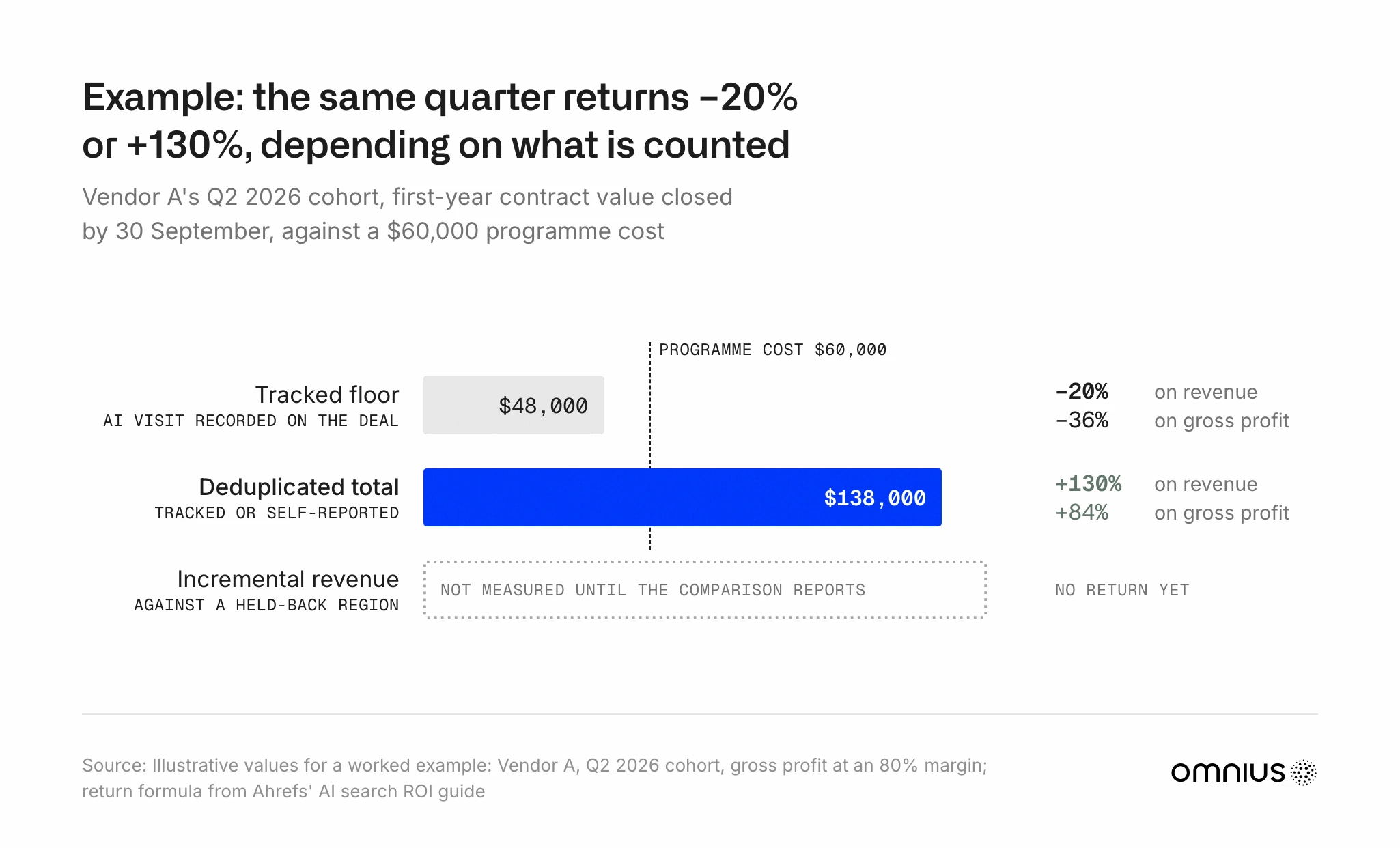
Neither total is a ceiling on AI search's influence. Work from earlier quarters also fed the Q2 cohort, so the report states which costs it matched to which deals.
How to test whether AI search added revenue
Both totals record connections, so a claim about added revenue needs a comparison. In Growth Memo, Kevin Indig separates attribution, which assigns credit, from incrementality, which compares results with the work against results without it.
For a B2B company, the practical version is a phased rollout by market or product line, where markets still waiting for the work serve as controls. In the worked example, Vendor A starts the work in one region and holds a similar region back for two quarters. It picks which goes first at random, as Google Research does in geo experiments.
The comparison holds only while the work stays separate between regions; a website or brand change that also reaches the control region makes the result inconclusive. Over a fixed period, with other campaigns equal in both regions, the report compares their pipeline and gross profit against the gap before the work began, with a margin of error. That comparison feeds a decision rule with three outcomes:
- Keep or raise the investment when AI-connected opportunities rise across mature cohorts, the other signals agree, and the treated region pulls ahead.
- Hold it when exposure rises while both totals stay flat across two mature cohorts, or when the floor sits below cost and the comparison has not reported.
- Reduce it when exposure, branded demand, and both totals stay flat for two mature cohorts, or when a finished comparison rules out a return worth the cost.

Vendor A's Q2 cohort lands on hold, since its floor closed below cost and its comparison has not reported. George Bonaci, vice president of growth at Ramp, explains why no branch rests on the attribution line alone: “Just looking at attribution alone would have led us to cancel all the brand marketing we do, all our stunts, all our direct mail, all our events.”
How we attribute AI search revenue at Omnius
At Omnius, measurement begins before the AI search work does, because a result means something only against a baseline. Our methodology opens every engagement with company context, the market model, a baseline, the diagnosis, and priorities.
On omnius.so, we tracked AI search as a distinct acquisition channel with its own clicks and conversions. We also ask each company in our ideal customer profile how it found us. We judge the work by sales-qualified leads (SQLs), and our memo explains why, weighing traffic volume against its quality: “The number of SQLs is the objective metric that reconciles both sides.”
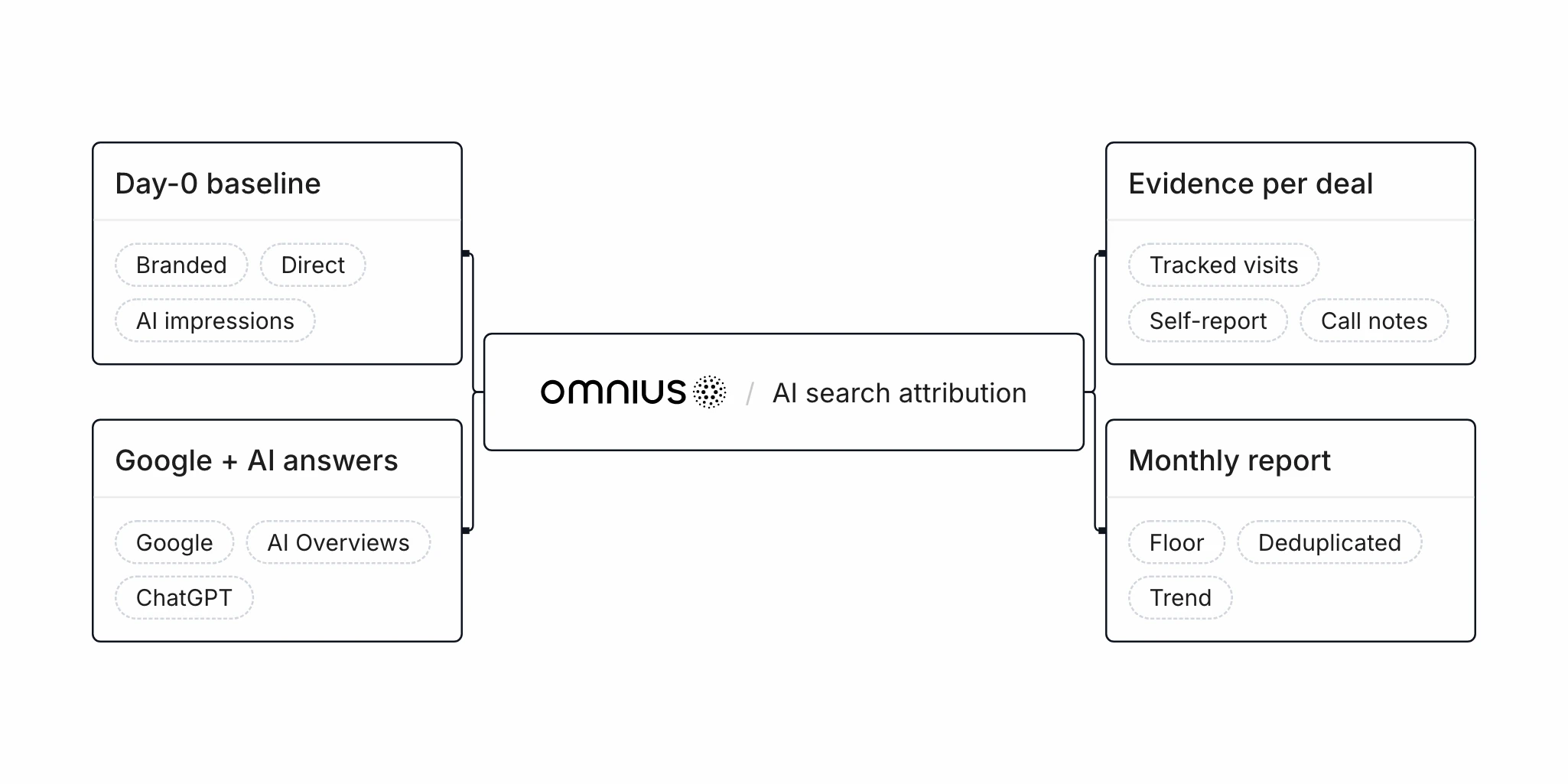
For tracking and attribution built around a company's own sales motion, see data tracking and analytics.
FAQ
What is the best attribution model for AI search?
The best attribution model for AI search is the one finance already trusts, with the AI-connected flag and the prospect's answer beside it. Bonaci calls every model wrong and treats it as a tool to align incentives. Ramp still runs a multi-touch model and discusses its limits daily.
Does AI search traffic convert better than organic search?
AI search traffic can convert better on one website, as at Ahrefs, where it sent 0.5% of visitors and 12.1% of signups over 30 days in mid-2025. Across 118 B2B accounts, though, HockeyStack found such signals “rarely make it to the finish line”, from visit to pipeline to revenue.
Does a rise in branded search prove AI search is working?
A rise in branded search does not prove AI search is working, even when it follows a rise in AI visibility. Proof needs a comparison such as a phased rollout, since Google's CausalImpact documentation warns that “valid conclusions require strong assumptions”.
Methodology
The evidence, its limits, and the publishers' interests:
- How the guide was built. It rests on platform documentation from Google, HubSpot, Bing, OpenAI, Anthropic, Perplexity, Stripe, and PostHog, two visit panels (Profound's and Similarweb's), published company comparisons of self-report against click-based records, practitioners' published accounts, and surveys from G2, Wynter, Semrush, and 6sense, read from 18 to 20 October 2026. The screenshots were captured on 20 October 2026, and Omnius's own figures come from its self-attribution data (LinkedIn post, 13 August 2026). Searches for AI attribution also return AI-powered attribution software and the AI attribution statement, which explains how someone used AI in a piece of work, and this guide leaves both aside.
- Limits. The panels measure the visits of US consumers, and neither measures pipeline. The company comparisons each cover one company, and two are cited without their publishers' names. The firm that published n8n's comparison worked with n8n on it and gives neither a sample size nor a survey response rate. Tally publishes neither its survey wording nor how it calculates its share, and Stripe does not say how it identifies agent requests. The Ahrefs figures come from different periods. Mintlify's March 2026 analysis, published in April, classifies requests by user-agent headers and could not identify Codex traffic, and its August count does not say how it classifies them. Omnius's self-attribution data covers the weeks before 13 August 2026 and one company's leads. The surveys are self-reported. Vendor A and its figures are a worked example, not a company's data.
- Interests. Profound, Similarweb, Semrush, Conductor, and Ahrefs sell AI visibility or SEO software, HockeyStack sells attribution software, PostHog sells product analytics, G2 runs a software review marketplace, Wynter sells audience research, 6sense sells revenue software, Webflow sells AEO tools, Adobe sells a brand visibility product, Mintlify sells documentation hosting, Stripe sells payments, Tally sells form software, SparkToro sells audience research software, and both unnamed publishers sell SEO and AI search services. Omnius sells SEO and AI search services, and its team built Atomic AGI.
Sources
The documentation, studies, and reports behind this guide:
- Platforms: HubSpot attribution reports, GA4 default channel group, GA4 attribution models, GA4 traffic-source scopes, Google AI features and websites, Search Console branded filter, Bing AI Performance, Google CausalImpact, Google Research geo experiments, Google Ads on ROI
- Agents and logs: OpenAI crawlers, ChatGPT Cloud browser signing, Anthropic crawlers, Claude Code tools reference, Claude Code environment variables, Perplexity crawlers, Google user-triggered fetchers, Atomic AGI crawler logs, Stripe metadata, PostHog, connect revenue to customers, PostHog UTM segmentation, MDN on noreferrer
- Studies and surveys: Similarweb, after AI recommends a brand, Similarweb, downstream impact, Conductor 2026 benchmarks, Semrush, AI in B2B buying, Wynter, how SaaS CMOs buy, 6sense 2025 experience report, 6sense glossary, Dark Funnel, HockeyStack, self-reported attribution, HockeyStack, LLM traffic, Ahrefs, AI search ROI, Ahrefs, AI search conversions, Ahrefs, seven signals, IBM Research, AI attribution toolkit, Pew, writing survey questions, AAPOR best practices, PostHog AEO guide, PostHog AEO advice, Growth Memo with Ramp's George Bonaci, SparkToro on asking how people heard
- Company reports: Stripe on agent traffic, Mintlify, August 2026 traffic, Mintlify, coding agents by user agent, Tally, September 2026 update, Tally, June 2025 update, Omnius's self-attribution data (LinkedIn post, 13 August 2026)
- Reports on referrer and tag gaps: Webflow, Profound, Cedric Huesler's check, Cedric Huesler's recap, Search Engine Roundtable, Profound, branded links, Search Engine Journal on the AI Mode referrer bug