.png)

.webp)
A scalable AEO strategy is a repeatable system, not a one-time audit. It combines a recurring citation baseline, a prioritized list of the prompts your buyers actually type within LLM platforms, content built to be extracted rather than just read, targeted off-page signals, and a measurement cadence that reports back to the business every month.
Most B2B SaaS companies that try AEO do one round of it. They test a handful of prompts, publish a few "AI-optimized" blog posts, and move on.
Three months later, nobody can say whether it worked, because nothing was set up to keep measuring it.
This guide walks through the five steps of how to build one, in order, with the exact process we run for our own clients.
Key Takeaways
- A one-time AI search audit gives you a snapshot. A scalable B2B SaaS AEO strategy gives you a compounding asset that keeps earning citations as engines update.
- The system has five parts: citation audit baseline, ICP prompt mapping, content architecture built for extraction, off-page citation signals, and a measurement cadence that reports to leadership.
- Content length matters less than most teams think. Pages between roughly 600 and 2,000 words with one tight focus tend to outperform 3,000-word "ultimate guides."
- Third-party validation carries real weight. In our Q2 2026 dataset, Reddit alone accounted for over 16% of AI citation share across 11,000+ B2B domains, ahead of most brands' own websites.
- Buyer research puts AI-influenced B2B vendor discovery somewhere between roughly a third and half of all buyers, depending on the study. That range alone is reason enough to treat this as infrastructure, not a side project.
Why Most AEO Efforts Don't Scale
Three patterns show up again and again when we audit B2B SaaS sites that "tried AEO" and stopped:
- It was treated as an audit, not a system - Someone ran 20 prompts through ChatGPT once, made a slide, and never tested again. AI answers change weekly. A single snapshot tells you almost nothing about a moving target.
- The content was built only for humans reading, not models extracting - Long, narrative blog posts read well but bury the answer three paragraphs deep. AI engines quote extractable paragraphs, not entire pages.
- SEO and AEO ran as separate initiatives - Different owners, different reporting, no shared prompt list. Since AI engines still lean heavily on well-structured, well-ranking content, splitting the two teams means neither one compounds the other's work.
The table below shows how the two disciplines actually relate. They are not competitors for budget. They are two layers of the same growth system.
| Dimension | Traditional SEO | AEO (Answer Engine Optimization) |
|---|---|---|
| Primary goal | Rank on Google's results page | Get cited as the answer inside AI-generated responses |
| Optimization target | Keywords and search queries | Entities: your brand, product, and expertise, made unambiguous |
| Content focus | Comprehensive pages that satisfy a searcher on-site | Extractable, structured answers a model can lift and cite |
| Success signal | Rankings, organic traffic, click-through rate | Citation rate, share of voice inside AI answers, AI-referred sessions |
| Typical timeline | 6 to 12 months for compounding returns | First citations often within 2 to 4 months on AEO-optimized content |
Neither replaces the other. AI engines still pull heavily from content that already ranks well and is technically sound. AEO is the layer you build on top, not instead.
The Five-Part Framework for a Scalable AEO Strategy
Everything below maps to one system: audit where you stand, find out what your buyers actually ask, build content that gets lifted into answers, earn the third-party signals that back it up, then measure all of it on a fixed schedule. Let’s go through those more in detail.
Step 1: Run an AI Citation Audit Baseline
You can't improve a number you've never measured. Start by finding out exactly where your brand stands across the engines your buyers actually use.
How to do it:
Step 1. Build a fixed list of 20 to 50 buyer-intent prompts, phrased the way a real prospect would type them, not as keywords.
Step 2. Run every prompt across ChatGPT, Claude, Perplexity, Gemini, or any other LLM platform.
Step 3. For each result, log whether you're cited, whether it's a linked citation or just a name-check, the sentiment, and which competitors show up alongside you.
Do this manually in a spreadsheet to start. A DIY setup that queries the ChatGPT, Perplexity, and Gemini APIs on a schedule typically runs somewhere in the range of $15 to $30 a month in API fees once you're ready to automate it.
ChatGPT still carries the largest share of both traffic and citations, but that share is softening quarter over quarter, while Claude and Gemini are both gaining ground fast. A single-engine audit would completely miss that shift.
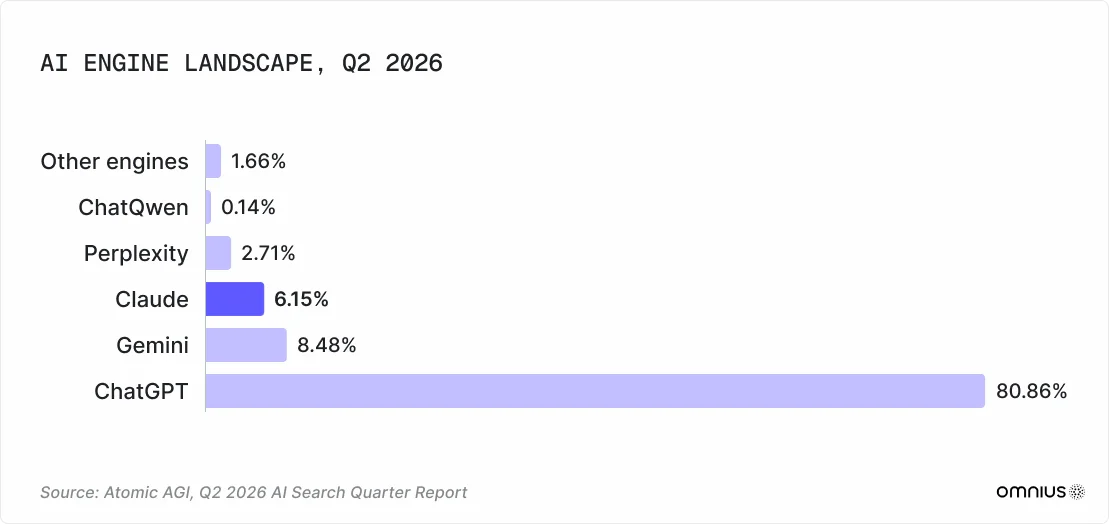
Pro tip: This is exactly the kind of baseline most teams can't maintain manually past the first month. Atomic AGI runs your full prompt set against every major engine on a recurring schedule and tracks the trend automatically, so you catch a share shift like Claude's the moment it happens instead of three months later.
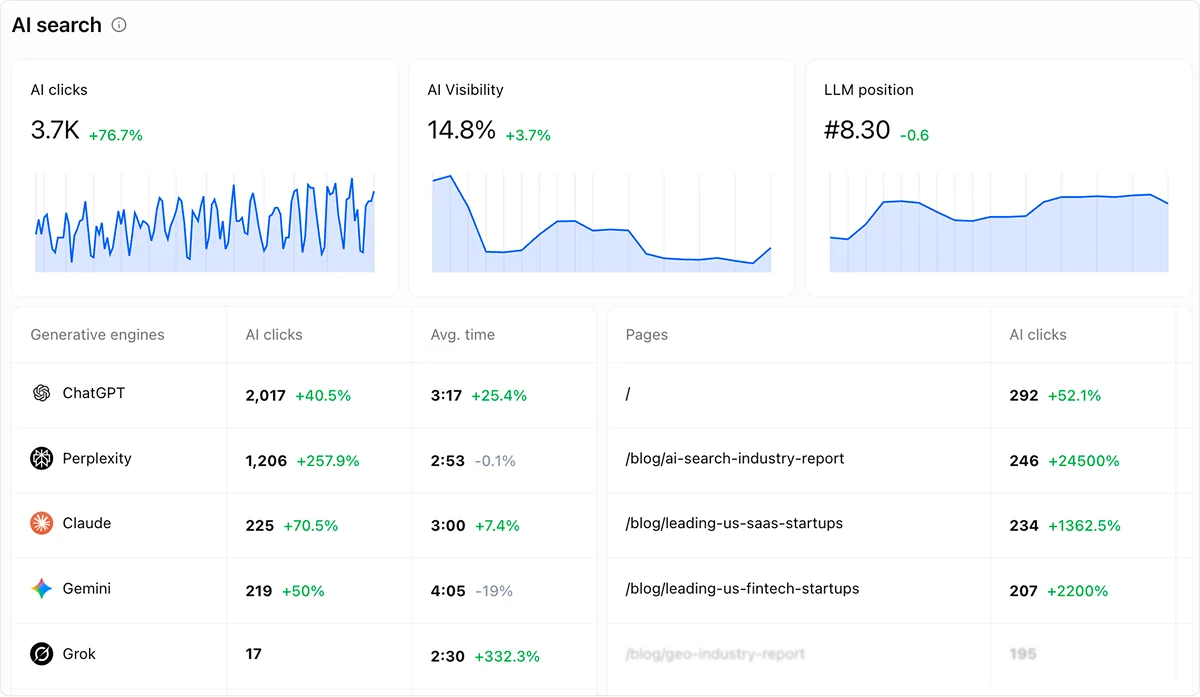
Step 2: Map What Your ICP Actually Asks AI
For inexperienced B2B SaaS companies, the prompt list is usually the entire AEO strategy. Plus, you can easily optimize for the wrong prompts and build visibility for questions your ICP is actually not asking at all.
How to solve this?
Split your prompts into two buckets:
- Competitor prompts ("best alternative to [competitor]") - catch someone who's already unhappy with what they have.
- Category prompts ("best [category] tool for [use case]") - catch someone earlier in the funnel who's still shopping. Both matter, but they need different content.
A useful way to organize the full list:
| Prompt type | What the buyer is doing | Example |
|---|---|---|
| Research | Learning the category exists and how it works | "What is [category] and why do teams use it" |
| Comparison | Weighing your brand against named competitors | "[Your brand] vs [competitor]" |
| Implementation | Figuring out how something works in practice | "How to migrate from [old tool] to [new tool] without downtime" |
| Brand | Asking about you specifically | "Does [brand] support SOC 2 compliance" |
| Evaluation | Judging whether a shortlist option is good enough | "Is [brand] good for enterprise teams" |
Where to actually find these prompts, in rough order of leverage:
- Pull your converting paid search terms and the organic queries already driving signups, then rephrase them as natural questions
- Dive into Reddit, Quora, and niche community threads in your category for the exact language buyers use
- Turn technical documentation headers into buyer-facing problem statements
- Reverse-engineer competitor content to find the prompts they're already winning, and the gaps they've left open
- Interview sales and customer success for the objections and comparison questions that come up right before a deal closes
You won't win every prompt, and you shouldn't try. Prioritize using two dimensions: business value (how close this prompt sits to a purchase decision) and content effort (how much of the answer you already have). Quick wins are high value, low effort, so make sure to cover those first. Everything high value but high effort becomes a planned sprint. Low-value prompts, regardless of effort, should wait.
Our Q2 2026 dataset shows educational prompts still make up the majority of AI search volume, but that share is shrinking while commercial and transactional intent both grow quarter over quarter. If your prompt list is still 90% definitional content, you're underweighting where buyer intent is actually heading.
Step 3: Create Content Architecture AI Can Extract
Once you know what to target, the content itself needs to be built for a model to lift and cite, not just for a human to scroll through.
These are the page types that carry the most AEO weight: comparison pages, alternative pages, use-case pages, and category or definition pages. These signal real buying intent and give AI engines something authoritative to reference.
The elements we check on every page during an AI search audit:
1. Answer in the first two or three sentences. State the direct answer before any setup or context. This is the paragraph engines quote most often.
2. Subheadings phrased as real questions, each answered directly in the sentence right beneath it.
3. Named entities, not vague language. Name your product, your competitors, and specific features. "Leading solutions" types of statements get skipped. "Linear, Notion, and Asana" gets cited.
4. Every statistic sourced and dated. Unsourced numbers are one of the strongest negative signals we see when auditing pages that fail to get cited.
5. Comparison tables and numbered lists wherever you're comparing more than two things. Tables get pulled into answers far more often than equivalent text.
6. An FAQ section where the visible text matches the schema exactly. Mismatches between what a visitor reads and what your FAQPage JSON-LD says are treated as a trust problem by some engines.
7. Visible freshness signals. A "last updated" date on the page, matched to a current “dateModified” in your schema.
Here are the additional details that are also important for building the proper content architecture:
- On length: across the pages we've audited, the sweet spot sits between roughly 600 and 2,000 words with one tight topical focus. Pages that stretch past 2,500 words chasing "ultimate guide" status tend to underperform compared to shorter, sharper pages built around a single clear question. AI engines quote paragraphs, not entire documents, so padding a page rarely helps and often actively hurts.
- Schema that matters: Organization and Product (or SoftwareApplication) for entity clarity, FAQPage for question content, HowTo for process content, BreadcrumbList for site structure, and ItemList for ranked comparisons. Validate every JSON-LD block before it gets published, because invalid markup can cost a page its Google rich results. Our guide to schema markup for AI search covers how to check that crawlers receive the markup and that it matches the page.
Pro tip: Atomic AGI's technical health scoring flags exactly which of your pages are being crawled but never actually pulled into an AI answer, which is usually a structure problem, not a content quality problem. That's a much faster fix to find with data than by guessing.

Step 4: Build Off-Page Citation Signals
Content on your own site is only half the equation. AI engines weight third-party validation heavily when deciding what to trust and cite.
In our Q2 2026 dataset, Reddit alone captured more than 16% of citation share across the tracked domains, ahead of YouTube, Medium, and most brands' own websites combined.

If your AEO plan only touches pages you own, you're optimizing for a shrinking share of what actually gets cited.
The approach that works is targeted, not a spray of random backlinks:
- Audit which domains are already being cited for your target prompts. This tells you exactly where to focus instead of guessing.
- Pursue placement in the industry roundups, comparison sites, and review platforms that show up repeatedly in your citation audit.
- Participate authentically in the communities already shaping answers. Reddit threads, niche forums, and platforms like G2 or Capterra carry real weight in how engines frame your category.
- Earn mentions in expert roundups and press that AI models are likely to have been trained on or continue to crawl.
This isn't classic link building for ranking power. It's about earning presence in the specific sources models already trust for your category, which is a narrower and more deliberate target than a typical backlink campaign.
Step 5: Build the Measurement System
The first four parts only compound if you're actually tracking them. This is the part that turns AEO from a project into infrastructure.
Cadence: test your core prompt set weekly. Run a deeper monthly audit for AI search visibility that reviews sentiment, checks for outdated information, and re-scores citation rate and share of voice. Reset your competitive baseline every quarter, since engine share shifts fast enough that a stale baseline gives you false confidence.
What each discipline actually proves to the business:
| Strategy | Primary KPIs | Secondary KPIs | What it proves |
|---|---|---|---|
| Traditional SEO | Organic traffic, organic conversions | Keyword rankings, share of voice on Google | Drives top-of-funnel awareness and qualified website traffic |
| AEO / GEO | Citation rate, share of voice in AI answers | AI-referred sessions, branded search uplift, featured snippet ownership | Builds pre-website authority and captures high-intent buyers before they ever visit |
On timelines: foundational SEO is still the long game, where you should expect 6 to 12 months for compounding returns. AEO moves faster at the edges. The first AI citations on retrofitted, well-structured content often show up within 2 to 4 months, though building a durable, category-wide system of authority takes longer. Different engines pick up new citations at different speeds too.
Perplexity tends to pick up and cite new content fastest, since it leans heavily on live web search. ChatGPT's training-data citations, the ones that don't rely on live browsing, update far more slowly since they only shift when the underlying model retrains.

Reporting approach: lead with the trend line, not the raw numbers. A citation rate moving from 8% to 22% to 34% over 90 days tells a clearer story than any single snapshot. Pair it with AI-referred sessions month over month and, where you can connect it, pipeline value attributed to AI-sourced discovery. Save the platform-by-platform breakdown for more context.
How Omnius Runs This for Clients
The five steps above map directly onto the process we use with our own B2B SaaS and fintech clients, condensed into seven operational phases:
| Phase | What happens |
|---|---|
| 1. Market research and analysis | Understand the product, business model, and how both Google and AI engines currently interpret it |
| 2. Keyword and prompt mapping | Cluster keywords and buyer prompts by funnel stage, intent, and difficulty, then map them to site structure |
| 3. Data tracking and technical fixes | Set up tracking, fix crawlability and indexing issues, and prepare the site to convert the traffic it earns |
| 4. Strategy development | Build a 12-month roadmap with defined KPIs, a content calendar, and a reversed funnel that prioritizes bottom-of-funnel pages first |
| 5. Process-efficient execution | Ship content, technical fixes, and backlinks on a managed weekly cadence |
| 6. LLM and GEO optimization | Structure content for ChatGPT, Claude, Gemini, Perplexity, AI Overviews, and LLM-driven answers, including schema and an llms.txt file |
| 7. Continuous analysis and reporting | Monthly technical audits and GEO performance reports, tracked month over month, quarter over quarter, and year over year |
This is the same system behind the five-step framework above. It just gets run continuously, for every client, rather than as a one-time project.
Common Mistakes That Break Scalability
A few patterns show up repeatedly in teams whose AEO results plateau after an initial burst:
- Treating it as a one-time audit - Without a weekly and monthly cadence, you lose visibility into shifts like the Claude momentum shown above until they've already cost you ground.
- Trying to win every prompt - Spreading content thin across a huge prompt list produces weak coverage everywhere instead of strong coverage where it actually matters.
- Writing longer content to seem more thorough - Shorter, tightly focused pages consistently get cited more often than sprawling guides.
- Shipping FAQ sections where the visible copy doesn't match the schema - This mismatch is treated as an integrity problem by several engines, not a minor technical detail.
- Chasing backlinks for ranking power instead of targeting the sources AI engines already cite - A generic digital PR campaign and a targeted citation-source campaign look similar on paper and produce very different results.
- Running SEO and AEO as separate initiatives - Since AI engines still lean on well-ranking, well-structured content, splitting ownership means neither team's work compounds the other's.
Proof This Compounds
The AI search optimization results aren't theoretical. Across our B2B SaaS and fintech client base, the organic growth we helped build accounts for more than 188 million registered users, with an average year-over-year organic traffic increase of 426.7%.
When we compared SEO's return against other B2B acquisition channels across the same client base, SEO came out well ahead.
Unlike paid channels, which stop producing the moment budget stops, a well-built SEO and AEO foundation keeps generating both traffic and citations long after a given piece of content shipped. That compounding effect is the entire argument for treating this as a system instead of a campaign.
Ready to build an SEO and AEO system that keeps driving traffic, citations, and qualified signups long after publishing?
See how Omnius can turn AI search into your most compounding acquisition channel.
Frequently Asked Questions
What's the difference between AEO, GEO, and SEO?
AEO (Answer Engine Optimization) and GEO (Generative Engine Optimization) are used largely interchangeably to describe optimizing content so AI assistants cite and recommend your brand. SEO targets traditional search-results pages. The signals overlap heavily, but AEO weights extractability, named entities, and structured data more than classic SEO does.
How long does a scalable AEO strategy take to show results?
Foundational SEO is a 6 to 12 month game for compounding returns. AEO can move faster at the edges: retrofitting existing high-authority content with the structure described in Step 3 often produces first citations within 2 to 4 months. Building a durable, category-wide system takes longer and never really finishes, since it's infrastructure, not a project with an end date.
Should we build this in-house or bring in outside help?
Running a fully integrated strategy in-house is possible but needs a fairly rare combination of skills under one roof: technical SEO, entity and schema work, AI-native content strategy, and authority-driven outreach. Most internal teams cover two or three of those well. A hybrid model, where a specialist handles strategy and a partial in-house team executes, is the most common path that actually sustains a weekly and monthly cadence.
How many pages do we actually need?
For an early-stage B2B SaaS company, 10 to 20 well-built pillar pages typically cover the core query space your ICP cares about. Each page should target 3 to 5 closely related prompts. Adding many more pages beyond that dilutes focus. Depth on the prompts that matter beats breadth across ones that don't.
Does AEO work for a small company with low domain authority?
Often better than you'd expect. Citation rate correlates inversely with domain size more often than people assume. A small, focused B2B SaaS site with tightly structured pages routinely gets cited ahead of much larger, more generic domains, because the content answers the specific question more precisely.
What's the single biggest mistake to avoid?
Treating AEO as a separate tactic that replaces SEO. It's the evolution of SEO, built on the same foundation of technical health, authoritative content, and earned third-party trust. Split it into a separate team with separate goals and you lose most of the compounding effect.


.png)

.svg)
















.svg)



























.svg)