
It's 11 p.m., and a COO at a seed-stage SaaS company types a question into Perplexity: "What's the best subscription billing tool for an early-stage startup?" Four names come back, each with a small numbered source beside it. Your company isn't one of them. Or maybe it is, but the answer quotes a price you dropped last spring.
That's the gap this guide closes. You'll learn how to get your brand visible on Perplexity with a young domain, a team of one to three people, and a budget that doesn't stretch far. Some folks call this generative engine optimization (GEO), others say answer engine optimization (AEO), and the label matters less than the goal: Perplexity should mention you, cite you, and get your facts right. This is the playbook we run for SaaS and fintech teams who want Perplexity citations, stripped down to what a small team can do alone.
Key Takeaways
- A young domain isn't locked out of Perplexity because the engine rewards precise, fresh, quotable pages over domain age.
- Perplexity uses retrieval-augmented generation (RAG) to read the live web before answering, and a citation (your URL) and a mention (your name) are separate wins that shift from run to run.
- Start with an audit of 15–20 buyer prompts and consistent company facts, then publish answer-first docs and price pages and check that Cloudflare or WAF rules aren't blocking PerplexityBot.
- When Perplexity gets your facts wrong, fix the cited source and publish a dated fact page, then track mention rate and share of voice monthly in a spreadsheet.
- Omnius' Atomic and AI search audit are what let startups track Perplexity citations, catch wrong answers, and find the gaps worth fixing first.
How Perplexity Decides Which Brands to Cite
Ask Perplexity a question and you get one written answer with a handful of numbered sources under it. It reads the live web first, writes the answer second, then points at the pages it used. The technical term is retrieval-augmented generation (RAG).
This is where two words start to matter:
- A citation means your URL shows up as a source.
- A mention means your brand name appears in the answer text. You want both, but they don't always come together.
- A G2 page can get the citation while your name gets the mention.
Perplexity also leans on sources it trusts. Well-known publications, review sites, and clean, focused brand sites tend to win. Thin pages and anything that smells like manipulation tend to lose.
Pro Search and Deep Research add another layer. Both split one question into several smaller searches, a process people call query fan-out. So "best billing tool for startups" might quietly turn into "billing tools with usage-based prices," "Chargebee alternatives," and "billing software reviews." Each sub-search is a new chance for your pages to get pulled in.
One more catch. The same prompt can return different sources on Monday and Thursday, or for two different users, or with a different model selected. A single screenshot proves almost nothing
Run the same prompt twice, once signed in and once in a private window, and the source list often shifts.
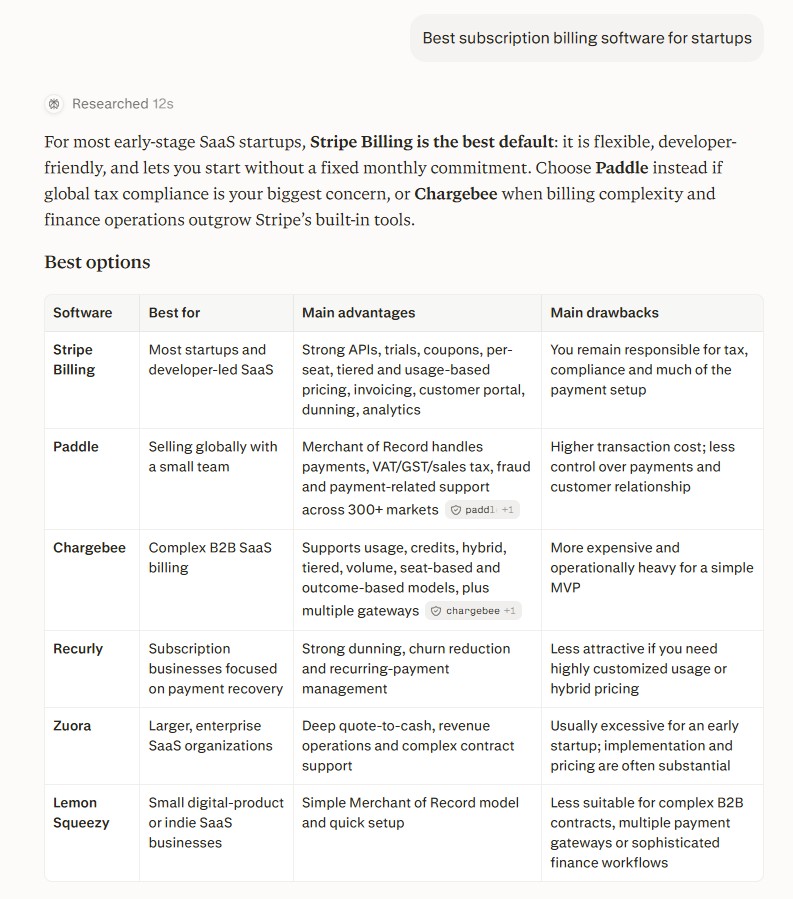
The same prompt, one minute apart. Two different source sets, and one brand that shows up only once.
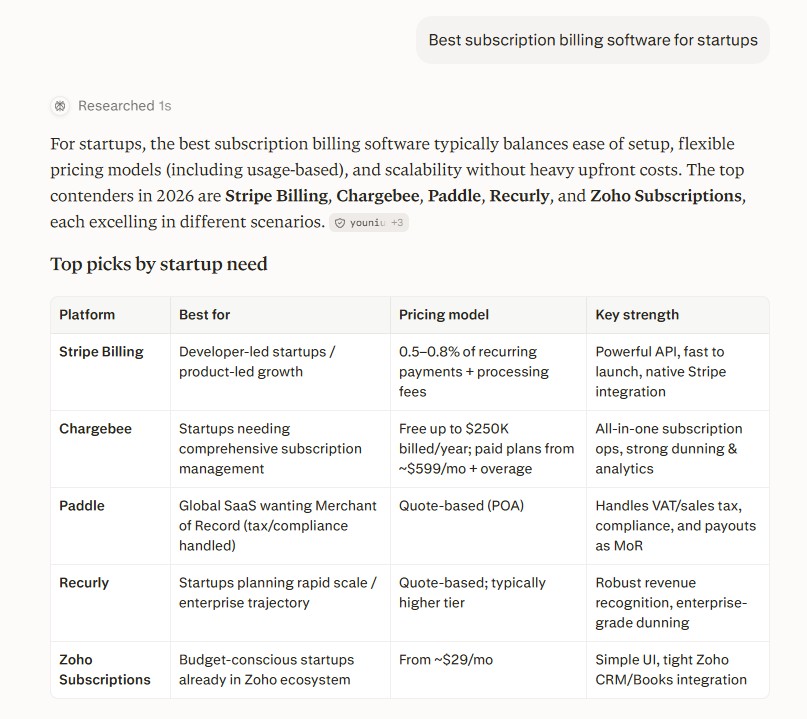
So here's the real picture: you want one of maybe four to eight source slots, not a spot on page one.
The 6-Step Plan to Get Your Brand Visible on Perplexity
Small teams can't do everything at once, and they shouldn't try. The table below splits the work by stage, so you know what to start this week and what can wait.
Each step below lists who owns it and roughly how long it takes.
Step 1: Run a Visibility Audit
Owner: founder or first marketer. Time: about 2 hours, then 20 minutes a week.
Competitors tend to leave the audit for the end. That's backward. You can't fix what you haven't seen, and the audit tells you which pages to touch first.
Write 15–20 prompts that a real buyer would type. Mix the four types below.
Run each prompt three times over a week, in a private window. Log four columns in a spreadsheet: brand mentioned (yes/no), your URL cited (yes/no), which sources Perplexity used instead, and whether the facts were right.
That last column is the one most teams forget. It's also the one that bites.
Step 2: Make Your Brand Entity Consistent Everywhere
Owner: founder. Time: one afternoon.
AI engines cross-check facts across sites. Picture this: your website says "founded 2023," LinkedIn says "2022," and Crunchbase still lists your old name. Perplexity has to guess. And it guesses wrong more often than you'd like.
Pick one version of each fact, then copy it word for word into every profile. Check these first:
- Company name, spelled and capitalized one way
- One-line description, the same sentence everywhere
- Product category (say "subscription billing software," not three different phrases)
- Year founded, founders, and HQ city
- Profiles on your site, LinkedIn, Crunchbase, G2, and Product Hunt
- Wikidata, only if you're notable enough to qualify
Next, add Organization schema to your homepage. It's a small block of JavaScript Object Notation for Linked Data (JSON-LD), and the sameAs field is where you list the URLs of those profiles.
{
  "@context": "https://schema.org",
  "@type": "Organization",
  "name": "Tallybase",
  "url": "https://tallybase.com",
  "logo": "https://tallybase.com/logo.png",
  "description": "Usage-based billing software for early-stage SaaS companies.",
  "foundingDate": "2023",
  "founder": [
    { "@type": "Person", "name": "Maya Okafor" },
    { "@type": "Person", "name": "Daniel Reiss" }
  ],
  "sameAs": [
    "https://www.linkedin.com/company/tallybase",
    "https://www.crunchbase.com/organization/tallybase",
    "https://www.g2.com/products/tallybase",
    "https://www.producthunt.com/products/tallybase",
    "https://x.com/tallybase"
  ]
}
That tells machines, in their own language, that all these pages describe the same company. The Schema.org Organization type lists every field you can use.
Step 3: Create Content Perplexity Wants to Cite
Owner: whoever writes. Time: two or three pages a week, over 60 days.
Young domains can't win on age or backlink count. They win on precision. So own a narrow topic first. Tallybase shouldn't try to rank for "SaaS finance." It should become the clearest source on usage-based billing for early-stage startups, then grow from there.
Answer-First Paragraphs
Perplexity pulls short, clear statements it can lift into an answer. Put the answer in the first sentence or two, then add the detail. Here's the difference.
Before: "In today's fast-paced SaaS world, prices are a hot topic, and there are many models to consider as your company grows."
After: "Usage-based billing charges customers for what they use, like API calls or seats per month. It suits SaaS products where customer value grows with volume."
The second one can be quoted as-is. The first can't. Mirror the exact questions buyers ask, use them as H2s or FAQ entries, and keep a clean order (H2, then H3) so the structure is easy to scan.
SaaS Pages That Get Cited
Some pages are citation magnets for SaaS, and most startups either hide them or leave them half-done. Build these four properly, and you give Perplexity something concrete to quote instead of a competitor's roundup.
Each of these answers one narrow question completely, which is the exact shape Perplexity looks for.
Publish Numbers Nobody Else Has
Perplexity gets used heavily as a stats machine. Founders and analysts ask it for market sizes, benchmarks, and adoption rates, and it pulls those numbers from reports, industry studies, and data-heavy posts. Every one of those answers needs a source, and that's a slot you can fill.
Your product already generates data nobody else can publish. Tallybase knows the median time from signup to first invoice across 400 accounts, the share of customers who switch from flat to usage-based prices in year one, and how often teams change their price model. Those numbers cost nothing to pull and no competitor can copy them.
A few rules keep the data citable:
- Put the number in the sentence, not in a chart image. Perplexity reads text.
- Say your sample size and date range out loud ("across 412 accounts, Jan–Dec 2025").
- Give each stat its own short heading or line, so it can be lifted cleanly.
- Refresh the numbers on a set schedule, quarterly or twice a year, and date the update.
A single benchmark report, published once a year and updated on time, earns more citations than a dozen opinion posts
Honest "Vs." and "Alternatives" Pages
Founders search "[competitor] alternatives" all the time, and Perplexity often cites listicles for those prompts, even ones your competitors wrote. So write your own. Use a comparison table, admit where the other tool is better, and keep it fair. A page that only praises you reads as an ad, and ads rarely get cited.
Keep It Fresh
Add a visible "Last updated" date to key pages. Refresh your top 10 pages every quarter, with real changes (new numbers, new screenshots, a removed feature), not a date swap. Stale pages lose their citations over time.
Step 4: Fix the Technical Foundations
Owner: a developer, or a founder with CDN access. Time: 2–4 hours.
Perplexity uses two main agents. PerplexityBot crawls the web to surface and link sites in search results. Perplexity-User fetches a page when a user's request calls for it. Block the first, and your pages may drop out of results altogether. Perplexity explains both in its official crawler documentation, along with steps to allow them through a firewall.
Here's the sneaky part. Your robots.txt may look fine while a Cloudflare bot rule or WAF rule blocks AI crawlers in the background. Check both. Nobody ever does, and it costs startups citations every day.
Schema markup comes next. It tells crawlers what each page is, in a format they parse reliably, and four types cover almost everything a startup publishes.
Keep the rest basic. Use HTTPS, short clean URLs, and fast load times. Render key text on the server so crawlers don't have to run JavaScript to see it. Keep your XML sitemap current, and use IndexNow to ping search engines the moment a page changes.
Step 5: Build Authority Beyond Your Website
Owner: founder. Time: 2–3 hours a week, every week.
Perplexity trusts what other people say about you more than what you say about yourself. That's tough on a new brand, but it's also where small teams can move fast.
Start with reviews. Ask happy customers for a review on G2, Capterra, or Trustpilot about two weeks after setup, when they've seen value but still remember the switch. Ten honest reviews beat a hundred vague five-star ones.
Then go where buyers already talk. Perplexity often cites Reddit and Quora threads as a kind of human consensus. A founder who answers questions in r/SaaS with real detail, and says "I run Tallybase" up front, earns trust. Fake accounts and planted praise do the opposite, and moderators spot them fast.
Last, pitch your way into third-party "best X tools" roundups and industry podcasts. A guest spot on a niche SaaS podcast often comes with a transcript, and transcripts are text that Perplexity can read and cite.
Step 6: Monitor and Improve
Owner: founder or marketer. Time: 30 minutes a month.
Visibility work has no finish line, because the answers keep moving. Set a testing rhythm and stick to it.
Test at the prompt level, not the keyword level. A keyword like "billing software" tells you nothing here. A prompt like "best billing software for a pre-seed SaaS company with 200 customers" tells you whether you show up for the buyer you actually want. Keep 15–20 prompts in rotation, run each one three times, and run them on the same week every month so the comparison holds.
Track three things and let the rest go: whether your brand appears, whether your URL is cited, and whether the facts are right. Everything else is detail you can add once the basics move.
Manual checks work until your prompt list passes 50 or so, and then the arithmetic stops being worth your Saturday. Atomic, built inside Omnius, runs the prompts for you across Perplexity and the other engines, logs every citation, and flags when an answer describes you wrong.
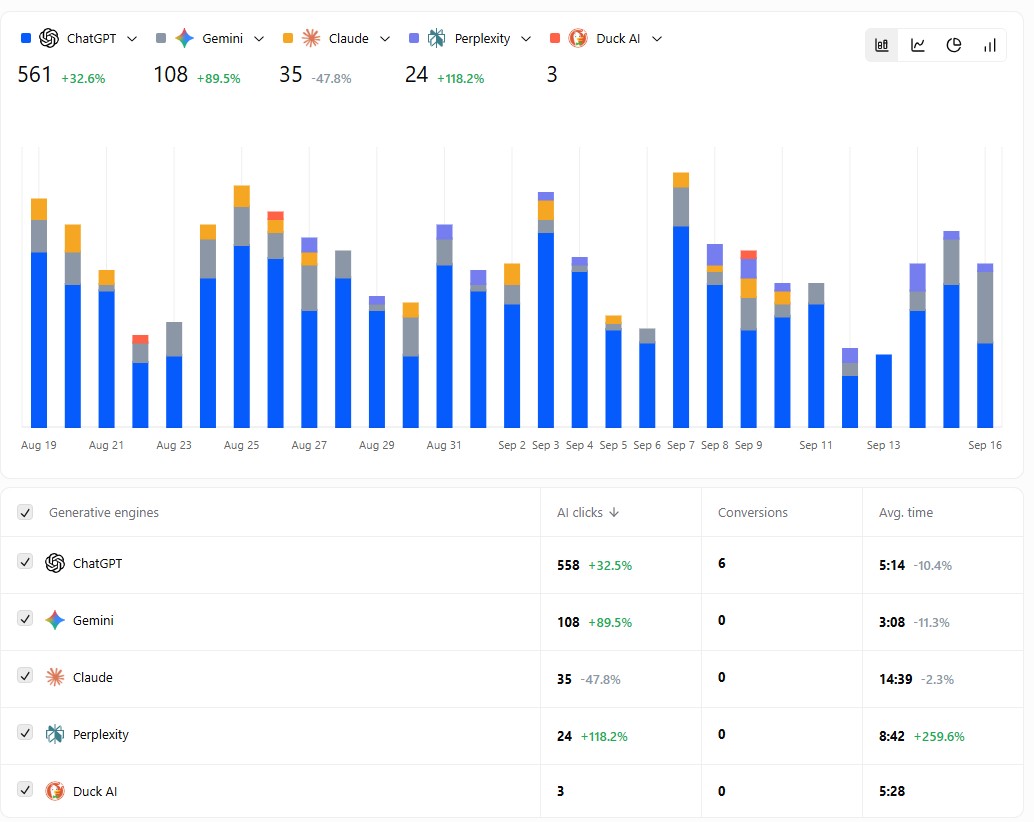
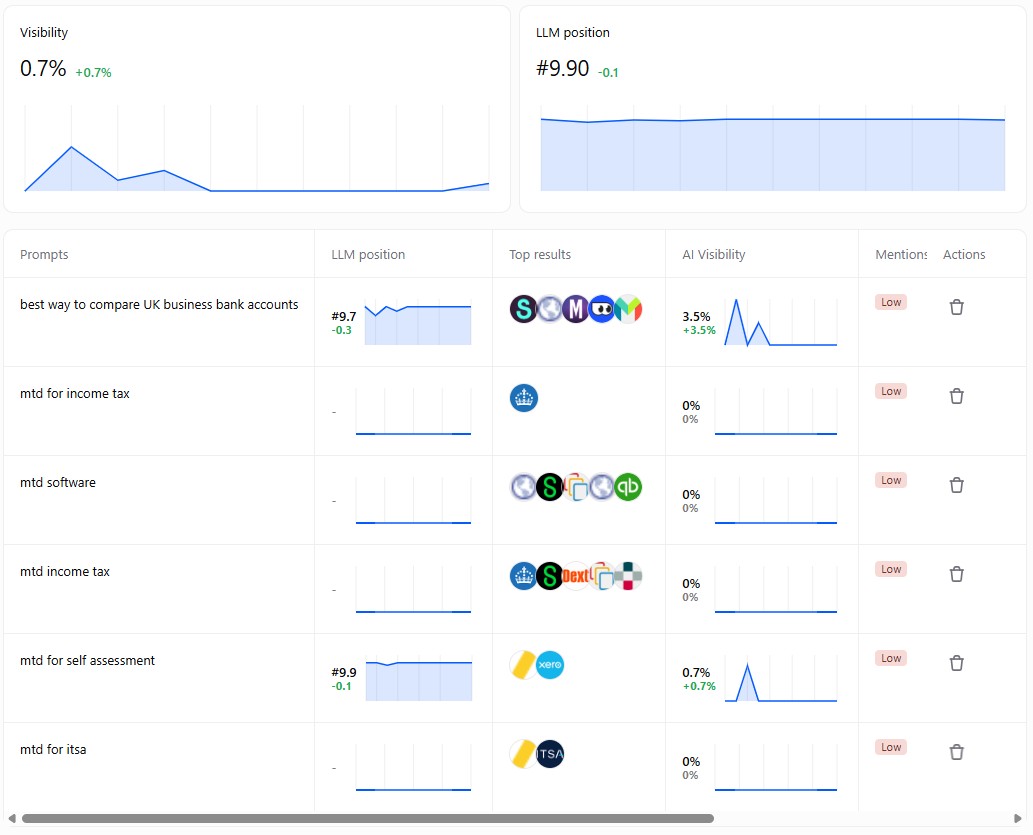
What to Do When Perplexity Gets Your Brand Wrong
Visibility is worthless if the answer is wrong. A confident, wrong answer about your prices or features can lose a deal before you ever hear about it. Say Perplexity tells a buyer Tallybase costs $99 a month when it's $49. Here's the fix, in order.
- Find the source. Click the citation numbers next to the wrong claim. Nine times out of ten, it's an old review, an outdated directory profile, or a similarly named company.
- Fix or update that source. Edit your own old pages, ask the directory to update its profile, or reply to the review with current facts.
- Publish a canonical fact page. One page on your site with prices, core features, year founded, and founders, all in plain HTML with a visible date.
- Report the answer. Use Perplexity's feedback option on the response to flag the error.
- Check again in 2–4 weeks. Rerun the same prompts from your audit and note what changed.
Name confusion deserves its own mention. Another company with a similar name is a common culprit, and your one-line description and sameAs links do most of the work to separate you.
How to Measure Your Perplexity Visibility
Clicks alone won't tell you much-many Perplexity users read the answer and never visit a site. You need a few metrics that reflect the answer itself. Four cover most of it:
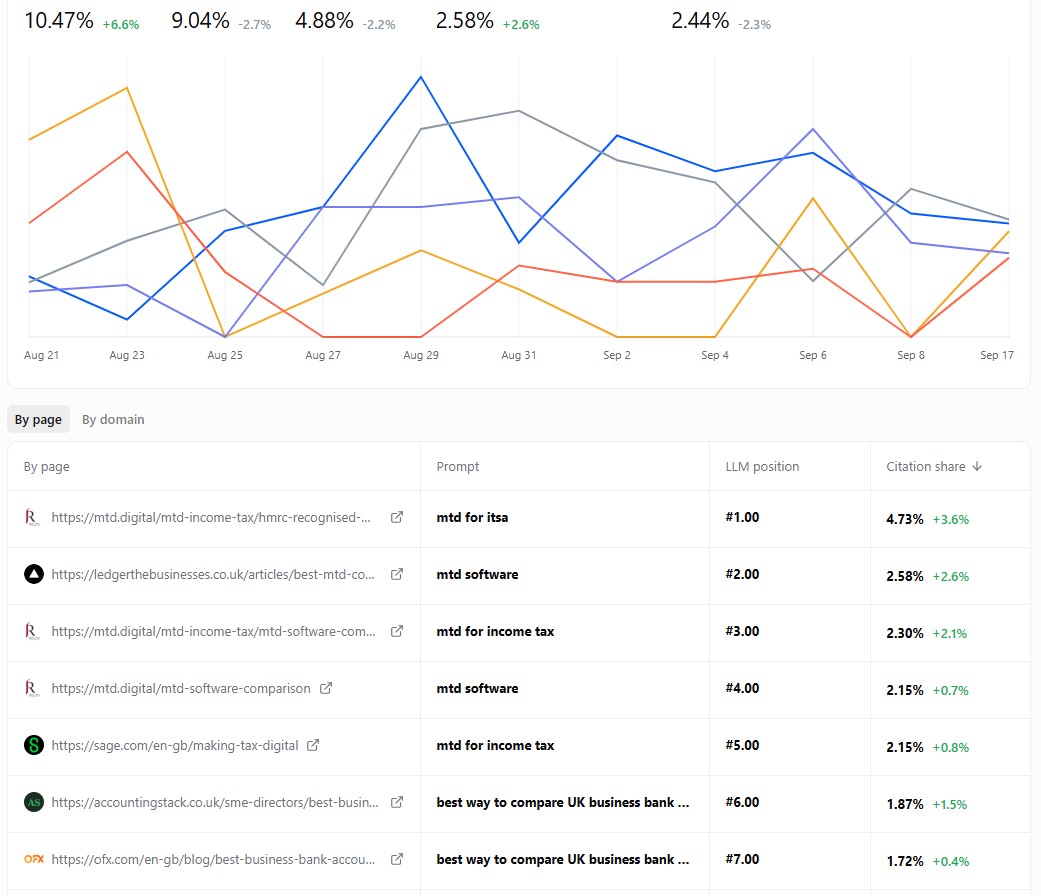
Start with a spreadsheet before you pay for a tool. Use the same 15–20 prompts from your audit, run them monthly, and log results in the same columns. Since answers vary, watch the trend across many runs, not one result. A move from 2 of 18 prompts to 7 of 18 over a quarter is a real signal. One good screenshot isn't.
Three runs a month, three months, one row per prompt. The shape of the total row is the number that matters.
The bottom row moved from 6 of 18 to 11 of 18 in a quarter. The Stripe integrations row moved nowhere, which tells you exactly which page to write next.
Paid visibility tools exist, and they help once your prompt list grows past 50 or so. A spreadsheet does the job until then. For a deeper look at where you stand across Perplexity and other AI engines, the Atomic AI search audit maps your citations, gaps, and wrong answers in one pass.
A Quick Note for Fintech Startups
Finance falls under what Google calls Your Money or Your Life (YMYL) topics, and AI engines treat it with the same caution. Trust signals carry extra weight here. Put named authors with real credentials on your content, and have compliance review any claim about rates, fees, or returns. List your licenses and regulators on-site, and date every disclosure. Never promise returns or state a number you can't source. Those claims won't get cited, and they can land you in a much worse conversation than an SEO one. The team behind Omnius' fintech SEO work sees this pattern constantly
Final Thoughts
Not sure where your brand stands in Perplexity answers right now?
Omnius can help. We run AI search optimization for SaaS and fintech companies, from the first visibility audit through the content and technical work behind it.
Book a free 30-minute call with our team, and we'll walk through which prompts you're missing and what to fix first.
FAQ
How Long Does It Take to Appear in Perplexity?
Crawler and technical fixes can show results within days, since Perplexity reads the live web. Content and review work usually takes 4–12 weeks to show up in answers. Your audit spreadsheet will tell you when it lands.
Should I Block Perplexity's Crawlers?
Not if you want to show up in Perplexity. Block PerplexityBot, and your pages can drop out of its results. Keep private areas like app dashboards blocked, and leave public pages open.
Is Perplexity SEO Different From Google SEO?
It overlaps a lot, since clean sites and strong content help both. The difference is that Perplexity rewards short, quotable answers, fresh pages, and what others say about you, more than domain age. The Omnius Perplexity SEO page covers where the two split in more detail.
Can a New Startup Get Cited Without Backlinks?
Yes, and it happens often. Narrow topics, original data, clean price and docs pages, and a few honest reviews can earn citations long before you have a big backlink profile. Precision beats size here.