

Revolut is now a banking infrastructure company, not a "money transfer app". In March 2026, it received a full UK banking license (Revolut press release), filed for a U.S. national bank charter, and reported $6B in 2025 revenue (+46% YoY) and $2.3B in pre-tax profit. It crossed 70 million customers in May 2026, adding 16M in 2025 alone, with a stated goal of 100M by mid-2027.
A few key numbers:
- 15.7M - AVG. MONTHLY ORGANIC VISITS (MAY 2026)
- 686K+ - ORGANIC KEYWORDS (GLOBAL)
- 90K - RANKING PAGES
- DR 84 - DOMAIN AUTHORITY
That kind of growth normally requires huge paid acquisition budgets. Revolut runs paid, but the bulk of its discovery is organic. Per Similarweb (April 2026), 89.5% of its search traffic is organic, only 10.5% paid, with organic search the #1 channel overall (28.79% of all desktop visits).
That's the question this report unpacks: how does a fintech compound 15.7M monthly organic visits across 173 country locations without running a content marketing blog the way most agencies prescribe?
The short answer is that Revolut treats SEO as a product surface, not a publishing function. Its highest-traffic pages are not blog posts. They are currency converters, crypto price pages, country homepages, and product landing pages — utility pages that are the answer the user came to find. That distinction is what makes this case study practical for any fintech, SaaS, or financial brand sitting on a product that does something the market is already Googling.
Why this matters for your strategy
Revolut's model is replicable. The lessons translate cleanly to any SaaS that has a calculator, converter, lookup, comparison, or status engine inside the product. We've broken down a similar framework in our programmatic SEO playbook for fintech and our product-led SEO guide.
Executive Summary
Five patterns explain why Revolut's organic visibility keeps compounding. Each is supported by the data in the rest of this report:
Sources: Ahrefs (May 2026), Similarweb (April 2026), Revolut public reporting.
Revolut's Organic Growth Overview
Two trends in the Ahrefs data tell the story. First, organic traffic is in a long, controlled compounding pattern — not a viral spike. Second, the keyword position distribution is the shape of a mature, technically healthy domain: a wide base of top-10 rankings, a healthy 4–10 layer providing optionality, and a smaller but stable top-3 cohort.
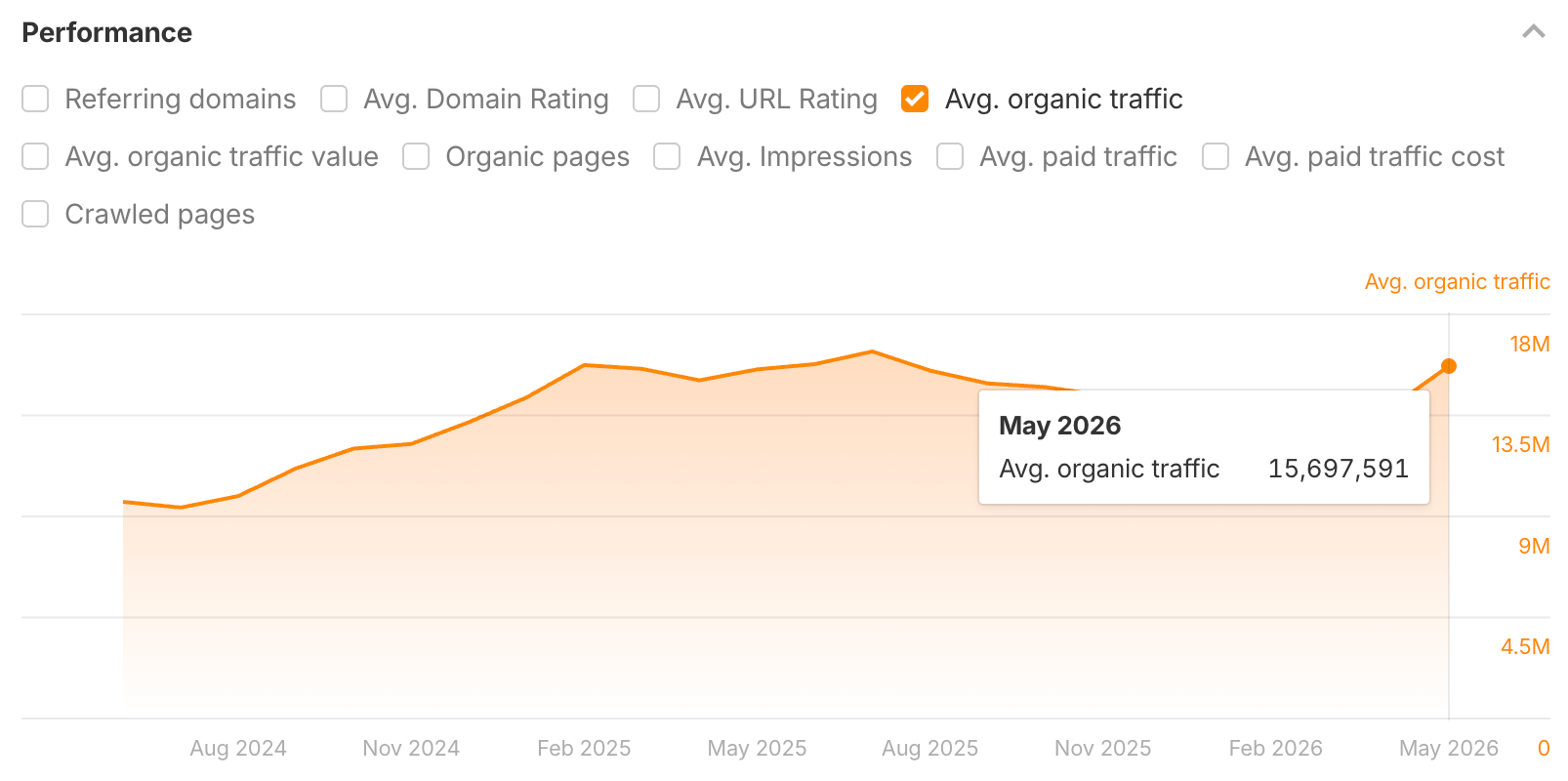
Ahrefs · Avg. organic traffic to revolut.com, Aug 2024 → May 2026. ~15.7M visits/month, with the curve showing classic compounding visibility: a steady climb from ~10M in mid-2024 to a 17–18M peak in mid-2025, then a managed plateau through the November 2025 SERP volatility, recovering back toward the trend line.
What the trend reveals
Growth is not driven by a single hit. It's distributed across thousands of pages, which is why the curve flattens during SERP turbulence (mid-to-late 2025) but doesn't collapse. The post-November dip is consistent with Google's late-2025 core update cycle hitting a number of finance domains — Revolut's recovery to ~15.7M by May 2026 indicates the core asset base (utility pages + localized homepages) absorbed the volatility well.
SEO MATURITY SIGNAL
The shape of this curve — gradual climb, controlled plateau, recovery — is the signature of a domain with diversified template-driven traffic. It's the opposite shape of a blog-led growth strategy, which tends to be spikier and more dependent on individual posts.
Where the traffic comes from geographically
Revolut's top five organic markets (May 2026) show how internationalization is the moat. The UK and US each drive ~1.4M monthly visits, but the more telling numbers are the +146K monthly gain in India, +373K in Spain, and +142K in the US — markets where Revolut is still adding ground.
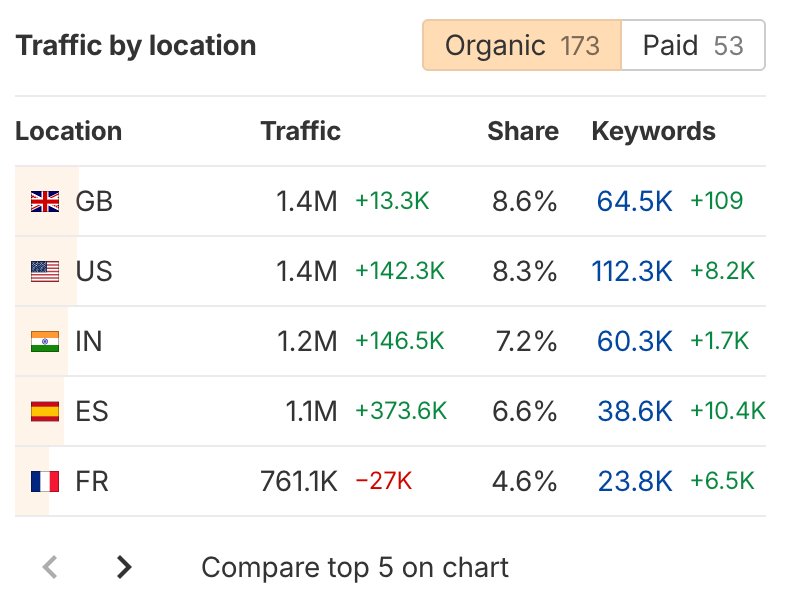
Ahrefs · Top 5 organic markets by traffic. Notice the velocity of change (green numbers) is higher in non-English markets — that's the localization investment compounding.
The Similarweb desktop data confirms the same pattern from a different angle: in April 2026, the UK was 13.09% of traffic, France 10.3%, Spain 9.28%, Italy 7.81%, Germany 5.53%.
Note that no single market — including the UK — exceeds 14% of traffic. That distribution is the protection. A core update that punishes one country SERP doesn't take down the domain.
Position distribution: the shape of a healthy SEO portfolio
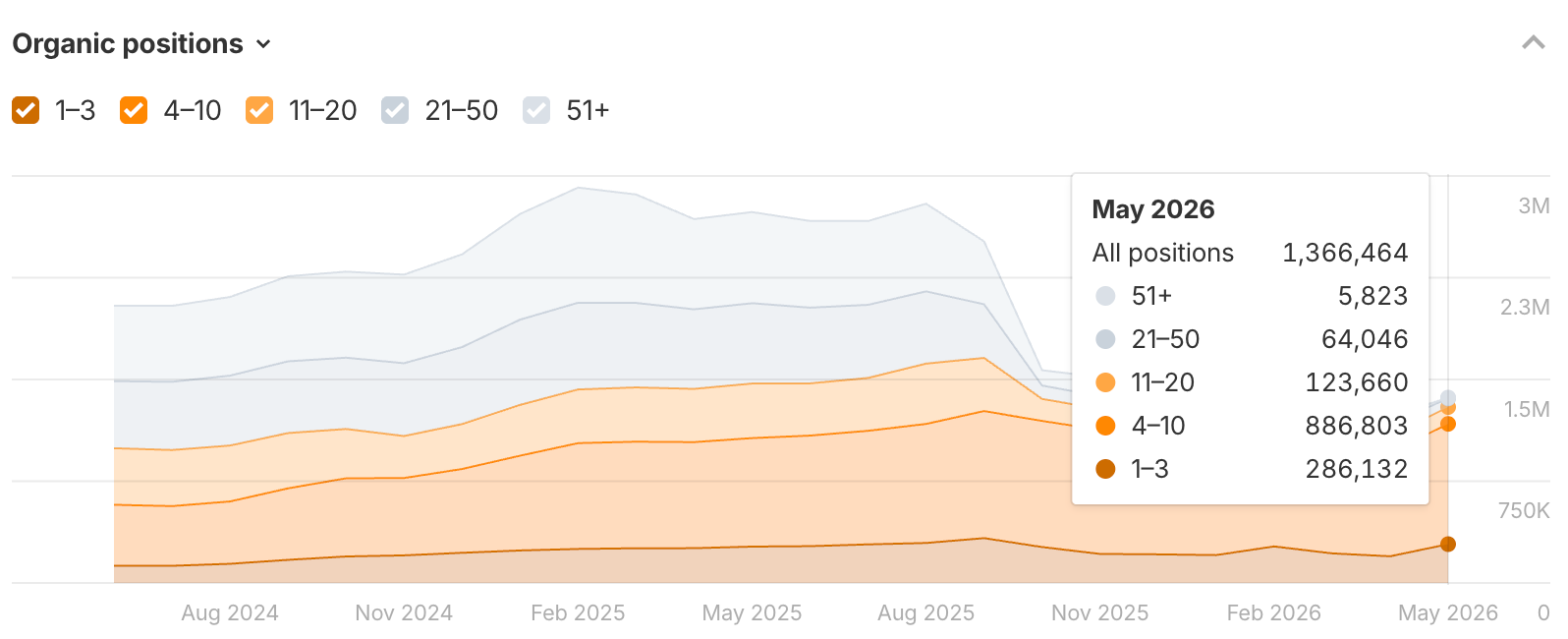
Ahrefs · Keyword positions over time. 286K keywords in positions 1–3 and 886K in 4–10 — meaning ~85% of all ranking keywords are within striking distance of the first page.
1.37M total ranking keywords with 886,803 in positions 4–10 is the most important number on this chart. Those are the keywords one optimization push away from the top 3. For an SEO team, that's the inventory of opportunity. The 64K keywords in positions 21–50 is also notable — that's the long tail that future content refreshes can pull up.
Takeaway:
Mature SEO portfolios have more keywords in positions 4–10 than positions 1–3. If yours doesn't, you're probably writing fewer pages than the search demand requires, or you're not refreshing pages systematically. We cover this in our SEO refresh framework.
Top-Performing Pages Analysis
The top pages report is where Revolut's strategy becomes obvious. Of 90,005 ranking pages, the top traffic generators are not blog posts. They are utility, localized homepage, and product pages.
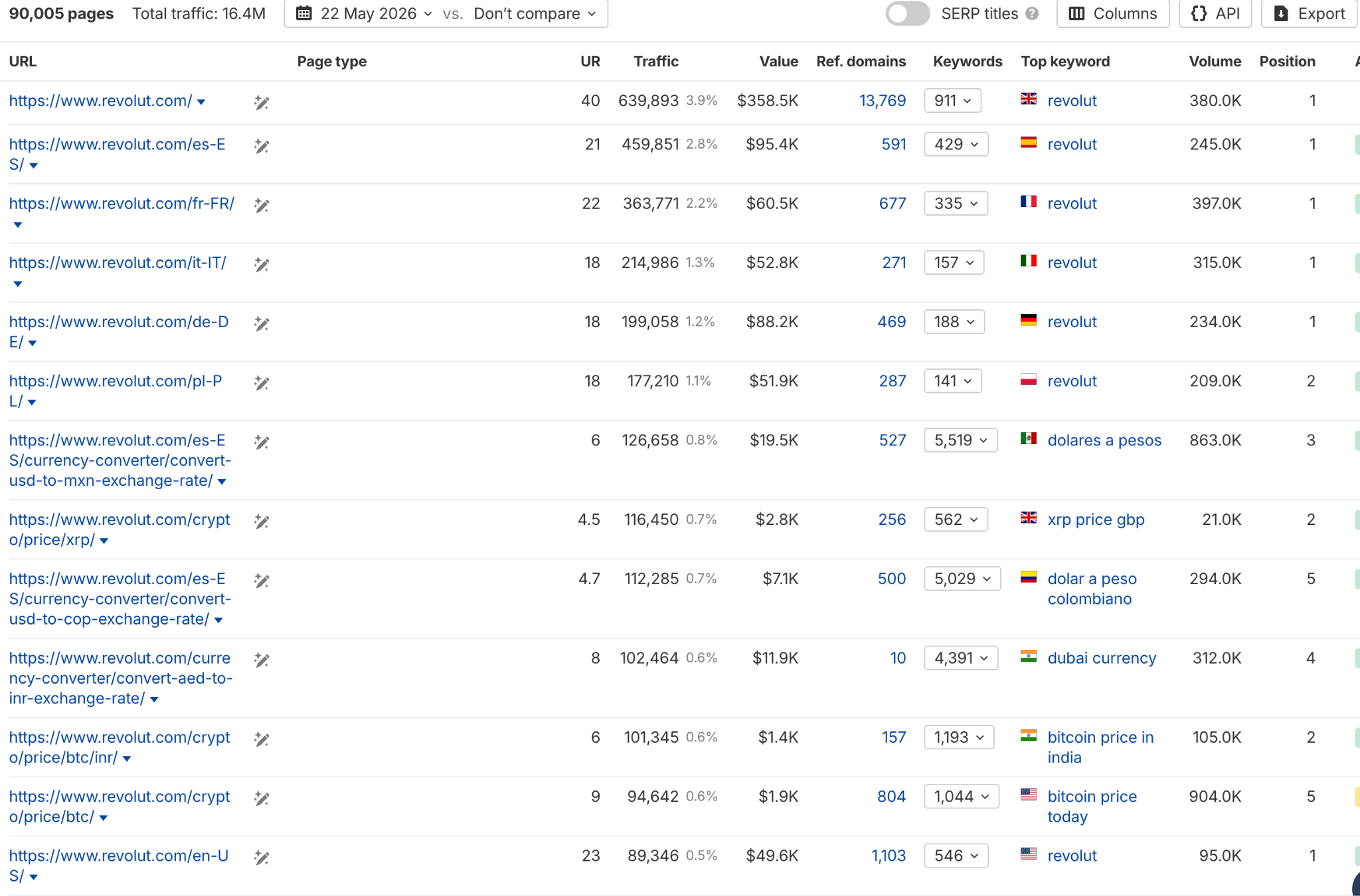
Ahrefs · Top revolut.com pages by traffic (1/2). The pattern: homepage variants by country (en, es-ES, fr-FR, it-IT, de-DE, pl PL) and high-volume currency-converter URLs.
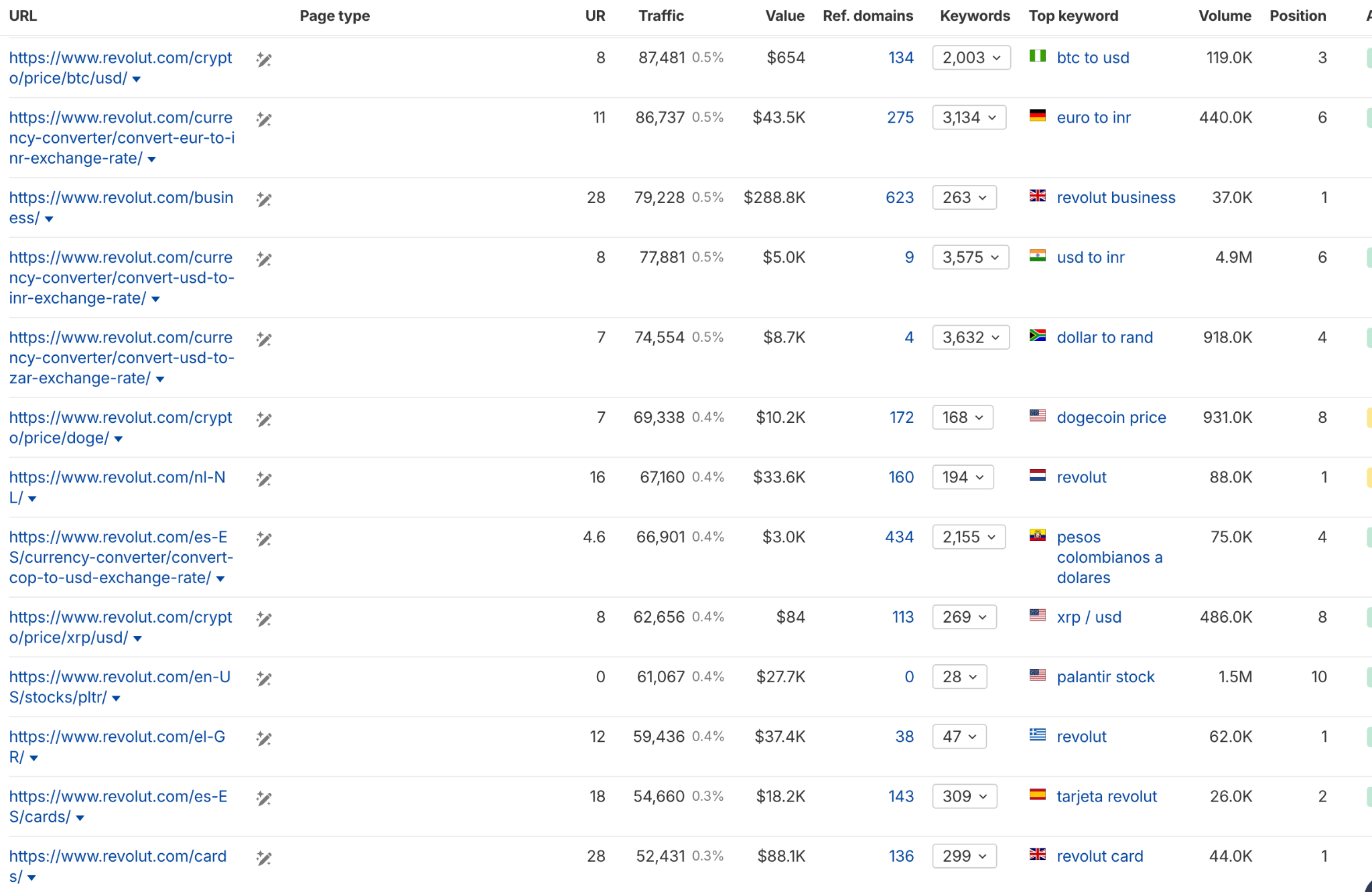
Ahrefs · Top revolut.com pages by traffic (2/2). Notable: /business/ ranks #1 for 'revolut business' (79K visits/mo at $288K traffic value), and crypto price pages (/crypto/price/btc/, /crypto/price/doge/, /crypto/price/xrp/usd/) each drive 60K–90K monthly visits.
Grouping the top pages by template
Revolut's #1 most-trafficked URL after its homepages is a currency converter for USD→MXN, in Spanish, with 6 backlinks. That single page outperforms entire content marketing operations at other fintechs. The lesson is not "build more pages" — it's "match the page format to the intent of the query."
Page type
Example URL
Search intent
captured
Search value
Practical takeaway
Localized
homepage
/es-ES/, /fr-FR/, /it-IT/,
/de-DE/, /pl-PL/, /nl-
NL/, /el-GR/
Branded
"revolut" query
in-market
175K–460K
visits/page · #1
for branded
term
One template, one product story, deployed to every market with translated copy and proper hreflang. Don't write 30
different "about us"
stories.
Currency
converter
/currency-
converter/convert-usd-
to-mxn-exchange-rate/
"dolares a
pesos" —
transactional
FX lookup
126K visits/mo
5,519 ranking
keywords on a
single URL ·
$19.5K traffic
value
One template, one
ISO currency pair
logic, scales to
thousands of
pages. The page is
the answer.
Crypto price page
/crypto/price/btc/,
/crypto/price/xrp/,
/crypto/price/doge/
"bitcoin price
today",
"ethereum
price", "xrp
price gbp"
94K–116K
visits/mo each
· ranks for
562–1,193
keywords
Real-time price
data + minimal
copy + clear CTA =
a page Google
trusts to answer the
query. Don't blog
about Bitcoin; show
its price.
Product hub
/business/, /cards/, /es-
ES/cards/
"revolut
business",
"revolut card",
"tarjeta revolut"
79K visits/mo
(business) · #1
for branded
product
queries
Product pages
compete with their
own brand queries
— and convert
better than any
blog.
Stock/asset price
page
/en-US/stocks/pltr/
"palantir stock"
— informational
financial
61K visits/mo
at position #10
Even at #10, a
high-volume
keyword (1.5M
monthly searches)
delivers 61K visits.
Page-template
scale matters more than page-by-page
rank.
Stablecoin/crypto pair
/crypto/price/btc/inr/,
/crypto/price/btc/usd/
"bitcoin price in
india", "btc to
usd"
87K–101K
visits/mo
Pair-level pages
capture geo-
specific intent that
the parent token
page can't.
Why these page types work:
- Intent match is exact. Someone searching "dolares a pesos" wants the rate. The page provides the rate. Zero friction between query and answer.
- Page templates scale linearly with search demand. One template (currency-converter) produces hundreds of ranking URLs from a database of currency pairs and real-time FX data.
- Trust signals are baked in. Live data, a recognizable brand, structured layout, fast load — Google reads "this is a primary source", not "this is content marketing".
- The CTA is the natural next step. "Want a better rate? Open a Revolut account." The page converts because the user is already in transactional headspace.
Keyword Cluster Breakdown
Ahrefs's intent classification shows Revolut's ranking portfolio splits into nine functional clusters. Understanding which clusters drive volume vs. which drive conversion is how you read this data correctly.
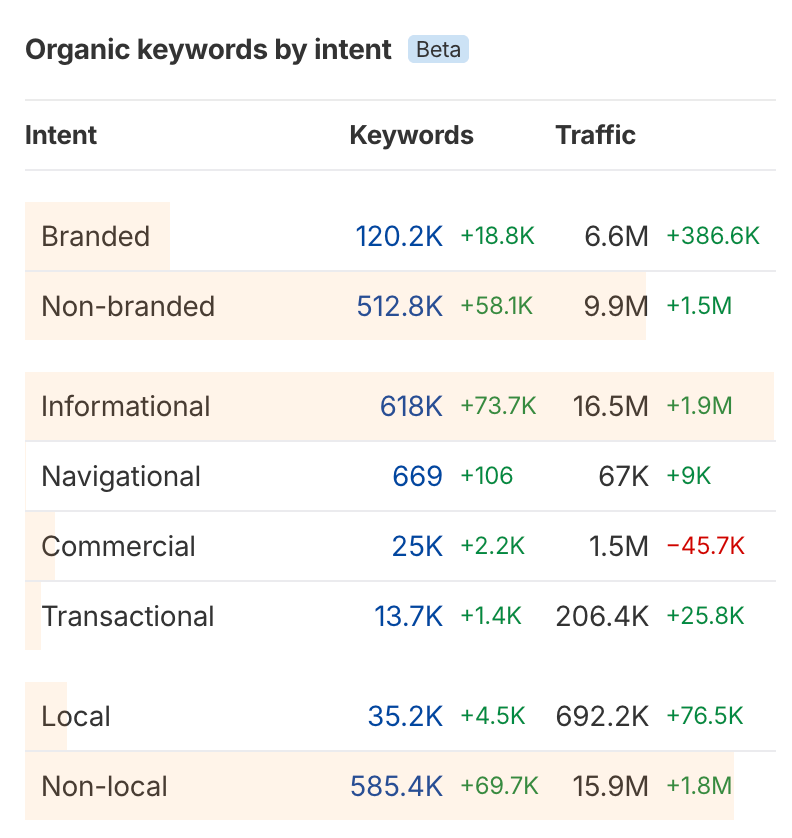
Ahrefs · Organic keywords by intent (May 2026). Informational is by far the biggest cluster at 618K keywords / 16.5M visits — but commercial and transactional, while smaller, are the conversion drivers.
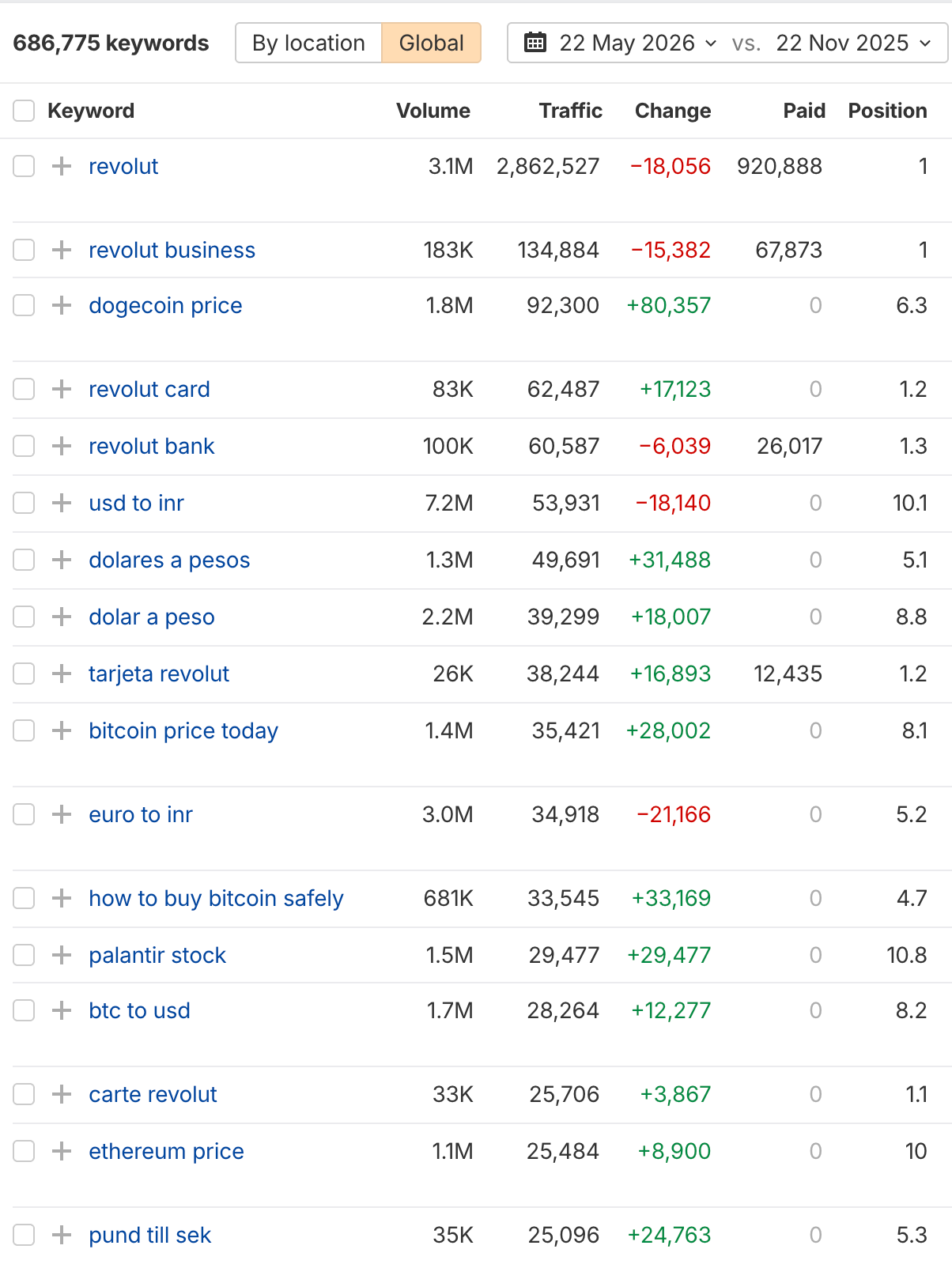
Ahrefs · Top global keywords driving traffic to revolut.com. Note the mix: branded ('revolut', 'revolut business', 'revolut card'), high-volume FX ('usd to inr', 'dolares a pesos', 'euro to inr'), and crypto ('dogecoin price', 'bitcoin price today', 'btc to usd').
Cluster 1: Branded keywords
120.2K branded keywords drive 6.6M visits (+386K MoM). "revolut" alone gets 2.86M monthly visits at position #1. This is captured demand — users who already know the brand and search for it directly. Branded growth tracks brand campaign spend: Revolut's "Money Possibilities" campaign across 20+ countries (Netflix, YouTube, OOH) in early 2025 explains the persistent positive branded delta.
Why it matters: Branded traffic is the cheapest, highest-converting traffic on the internet. It's also where most fintechs underinvest in conversion optimization, because they assume the user "will figure it out".
Cluster 2: Product-led keywords
"revolut business" (134K visits), "revolut card" (62K), "revolut bank" (60K), "tarjeta revolut" (38K), "carte revolut" (25K). Notice the same product word translated across markets. Every product line has its own branded page in every language. This is what makes branded-product traffic compound rather than cannibalize.
Cluster 3: International money transfer keywords
"usd to inr" (53K visits at pos 10), "euro to inr" (35K), "dolares a pesos" (49K), "dolar a peso" (39K), "pund till sek" (25K). Crucially, the position on these high-volume keywords is mid-page (5–10), not #1 — Revolut isn't beating Google's own currency converter at the very top, but it's claiming the next-most-trusted answer slot.
Cluster 4: Business banking keywords
The /business/ page ranks #1 for "revolut business" (37K monthly searches) and pulls 79K monthly visits with $288K of traffic value — likely the highest-converting URL on the domain. Business banking is where the LTV per acquired customer dwarfs retail, which is why this page deserves heavy resource allocation. B2B fintech SEO follows different rules than retail.
Cluster 5: Currency exchange keywords (high-volume FX)
"dollar to rand" (918K search volume, position 4), "euro to inr" (440K volume, position 6), "USD to INR" (4.9M volume, position 6). The play here is to be the #2–6 trusted answer behind Google's own widget. Even at position 6 with a 4.9M-volume keyword, you still capture tens of thousands of visits.
Cluster 6: Card and payment keywords
Localized: "tarjeta revolut" (#1 in ES), "carte revolut" (#1 in FR), "revolut card" (#1 in EN). This is the easiest cluster for any fintech to replicate — one product, one branded keyword per market — and is criminally underused.
Cluster 7: Crypto price keywords
"dogecoin price" (931K volume, position 8 with 80K traffic gain), "bitcoin price today" (904K volume, pos 5), "ethereum price" (1.1M volume, pos 10), "btc to usd" (1.7M volume, pos 8). Revolut hosts crypto trading, so the price page is product-adjacent. The pattern: 1 page per token + locale variations, all running off the same template.
Cluster 8: Comparison and alternative keywords
This is the smallest visible cluster in Revolut's data, which is itself instructive — Revolut doesn't optimize aggressively for "Revolut vs Wise" or "Wise alternatives". Wise, by contrast, has a 24.7% keyword overlap with Revolut (per the competitor chart), suggesting Wise is more aggressive in this space. There's an opportunity here Revolut hasn't fully claimed.
Cluster 9: AEO/GEO-friendly question keywords
"how to buy bitcoin safely" (681K volume, pos 4.7, 33K visits +33K MoM, all new traffic). "How much is one bitcoin" (~21K visits/month per the Concurate analysis). These are the question-form, definition-style queries that LLMs and AI Overviews pull from. We address this in detail in Section 8.
PRACTICAL TAKEAWAY FOR FINTECH / SAAS:
Map your own keyword universe to these nine clusters before you write a single page. Most fintechs over-invest in cluster 1 (branded) and cluster 8 (comparison) and dramatically under-invest in clusters 3, 5, and 7 — the high-volume utility queries that compound. Our keyword cluster mapping template walks through this exercise.
Product-Led SEO: When the Product Page Is the Content
The most important strategic decision visible in Revolut's data is that they don't separate "SEO pages" from "product pages". Their highest-ranking utility pages are functional product surfaces. The currency converter is a real converter — it computes a real rate. The crypto price page shows a real, live price. The /cards/ page sells real cards.
This is what makes the SEO output compound: every page exists to do a job for the user and to capture a query. The two functions reinforce each other instead of fighting for screen real estate.
Six product-led SEO design principles visible in Revolut's pages
Principle
How Revolut applies it
Clear product positioning
Each /currency-converter/ page leads with the converter widget itself, then a short “Convert X to Y with Revolut” CTA. No long preamble. Search intent, meaning rate lookup, is satisfied in 3 seconds.
Search-intent alignment
URL structure matches query shape: /convert-usd-to-mxn-exchange-rate/ corresponds exactly to “USD to MXN exchange rate”. Hreflang variants do the same in target languages.
Internal linking
Currency pages link to /cards/, /business/, /transfer/ and laterally to related currency pairs. This is how a single converter page can rank for 5,519 different queries, as the topical neighborhood signals breadth.
Market-specific pages
/es-ES/currency-converter/convert-usd-to-mxn-exchange-rate/ is not just a translated US page. The page logic prioritizes the MXN side, references local payment context, and links to /es-ES/cards/. Different URL, different intent, same template.
Conversion-focused CTAs
Every utility page ends in “Get the Revolut rate” or “Open an account”. The page solves the query and moves the user one step down the funnel.
Trust signals
Live data, regulator badges, UK PRA banking license, FSCS protection for UK customers as of March 2026, DR 84 domain authority, and 3.6M backlinks. Google reads these as primary-source signals.
THE STRATEGIC INSIGHT
Treat the SEO page and the product page as the same surface. The single most consequential change most SaaS and fintech sites can make is to delete their "/learn/" subfolder and rebuild those queries as feature pages on the product itself. Our product-led SEO breakdown covers when and how to do this.
Content Strategy Behind Revolut's Growth
Revolut doesn't run a content marketing factory in the traditional sense — there's no Concurate-style "we publish 4 thought leadership posts a week" operation. The Concurate analysis (Aug 2025) noted that Revolut "doesn't publish thought leadership, doesn't do SEO blogs, doesn't build backlinks" — yet still pulls 15M+ monthly visits. The provocation is correct, but the conclusion has nuance worth drawing out.
What Revolut does is build content as utility infrastructure. Every content format is functional, fast to render, and built into the product experience.
Content format
Funnel role
Example URL
Why it works
How to apply it
Currency converters
Awareness → Acquisition
/currency-converter/convert-usd-to-mxn-exchange-rate/
Solves a recurring daily problem instantly and ranks for thousands of long-tail FX queries from a single template.
Build it once, deploy per currency pair from a JSON config. Add hreflang for each major language.
Crypto price pages
Awareness → Account signup
/crypto/price/btc/, /crypto/price/eth/, /crypto/price/doge/
Real-time price data creates an evergreen freshness signal. Token-by-token URL structure scales with crypto demand.
Use a token API such as CoinGecko or Coinbase to populate price and historical chart data server-side. Use one template per asset class.
Stock price pages
Awareness → Investing product
/en-US/stocks/pltr/
Stock query volume is huge and evergreen. Even at position 10, the page captures 61K visits.
Use the same pattern as crypto: one template, one asset feed, and automated generation.
Localized homepages
Branded capture
/es-ES/, /fr-FR/, /it-IT/, /de-DE/, /pl-PL/
One #1 ranking per market for “Revolut”. Drives around 1.5M visits across 5 EU markets.
Do not just translate the English page. Rebuild copy around local payment habits, regulators, and currency context.
Product hub pages
Consideration → Conversion
/business/, /cards/, /transfer/, /metal/
Ranks for branded-product queries with high commercial intent, such as “revolut business”, which drives 134K visits and $288K in traffic value.
Create one page per product. Use strong on-page CTAs and FinancialProduct schema markup.
Country/market pages
Localization
/en-AU/, /en-US/, /en-GB/
Captures regulatory, language-specific, and market-specific search demand. Critical for any fintech with a real local entity.
Do not fake localization. Build pages around local regulations, currencies, product availability, and customer context. Google can detect machine translation.
Help center articles
Retention & AEO
/help/ subdomain pattern
Question-form and definition-style content is exactly what LLMs and AI Overviews pull from. It also captures variations of branded support queries.
Structure each article as Q&A. Each article should answer one specific question with a definitive answer. Add FAQ schema markup.
Topical authority through utility, not through volume
The conventional content-marketing logic is: write 200 articles on a topic to signal topical authority. Revolut's logic is: build the canonical tool for that topic and let the tool signal authority. The crypto price pages collectively cover every major token with a real-time data feed. Google reads that as "this domain is a credible source on crypto pricing" — without a single 2,000-word "what is Bitcoin" article.
APPLY TO YOUR STACK
Audit your top 10 highest-volume target queries. For each one, ask: "Is the best answer a piece of content, or a tool?" If it's a tool, build the tool. If it's content, write the content. Most SaaS teams default to content because content is easier to spec — that's the wrong tiebreaker.
AEO & GEO Performance Analysis
The most forward-looking data point in this audit is the growth of Revolut's keywords that trigger AI-powered SERP features. From December 2025 to May 2026, the number of Revolut's ranking keywords with a current AI/SGE/AI Overview SERP feature grew from approximately 52,000 to 88,032 — a ~70% increase in five months.
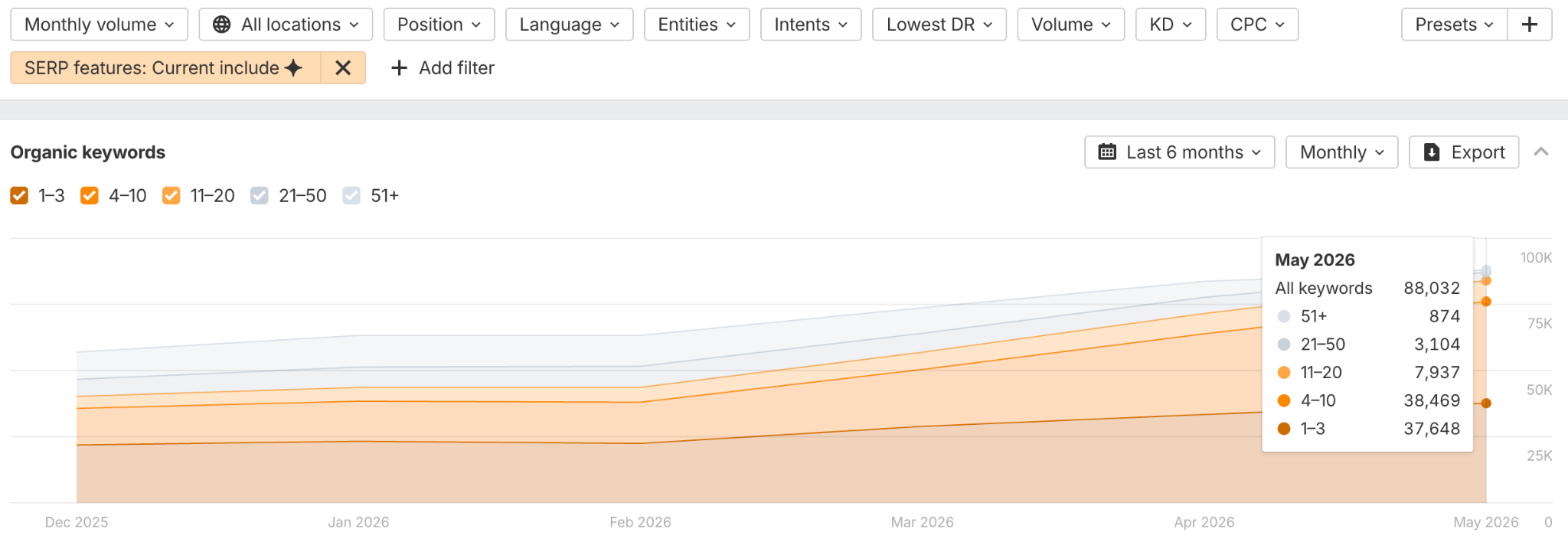
Ahrefs · Keywords where revolut.com ranks AND the SERP currently includes AI features (AI Overview, AI Mode, etc.). 37,648 are in positions 1–3, 38,469 in positions 4–10 — meaning Revolut is well-positioned to be cited in AI-generated answers.
What the AEO data tells us:
- Volume + position match. 37,648 keywords in positions 1–3 with active AI features is the ideal AEO position — high enough rank that Google/Bing/AI engines pull from your page, on queries the AI is actively responding to.
- Growth velocity is the headline. +35K AI-feature keywords in 5 months means Revolut's existing content base is being progressively absorbed into AI search surfaces as those features expand. The pages didn't change — Google's surface area did.
- Where it's likely concentrated. Currency converters ("how much is X in Y?"), crypto prices ("what is the price of Z today?"), and definition-style help articles ("what is a Revolut Metal card?") are exactly the question shapes AI Overviews trigger on.
Why Revolut is structurally well-positioned for AEO
Three structural properties of Revolut's content make it AEO-friendly even though they weren't designed for AEO:
1. Direct answers in the first 100 words. Currency and price pages lead with the data point. LLMs prefer pages that state the answer cleanly and early.
2. Entity-rich pages. Live currency pairs, named tokens, recognizable financial entities (PRA, FSCS, regulator names) saturate the page with the kind of structured data LLMs use to verify reliability.
3. Brand authority signals. DR 84, 3.6M backlinks, links from Apple, Google, Wikipedia, TikTok per the Concurate analysis — these signals are weighed heavily by retrieval-augmented LLMs (ChatGPT Search, Perplexity, Gemini).
THE AEO/GEO INSIGHT
Revolut's AEO performance is a byproduct, not a strategy. They got it because they built clean utility pages with direct answers and strong brand signals. Most fintechs trying to "optimize for AEO" by adding FAQ schema and Q&A blocks to a thin page are solving the symptom. The cause is page substance + entity authority. We dig into this in AEO for fintech.
What this means for your AEO/GEO strategy
If your pages already rank in positions 1–10 for genuinely informational queries, you are already partially AEO-optimized. The remaining work is:
- Add direct, fact-style answers in the first paragraph of every page.
- Mark up structured data (FAQ, Article, FinancialProduct, ItemList) so LLMs can parse the page.
- Strengthen entity authority via Wikipedia presence, brand mentions in trusted publications, and consistent NAP across the web.
- Monitor citation rates in ChatGPT/Perplexity/Gemini (not just SERP rankings) as a new KPI.
What Revolut Does Especially Well
Stepping back from individual tactics, Revolut's strategic SEO edge comes down to seven advantages that compound.
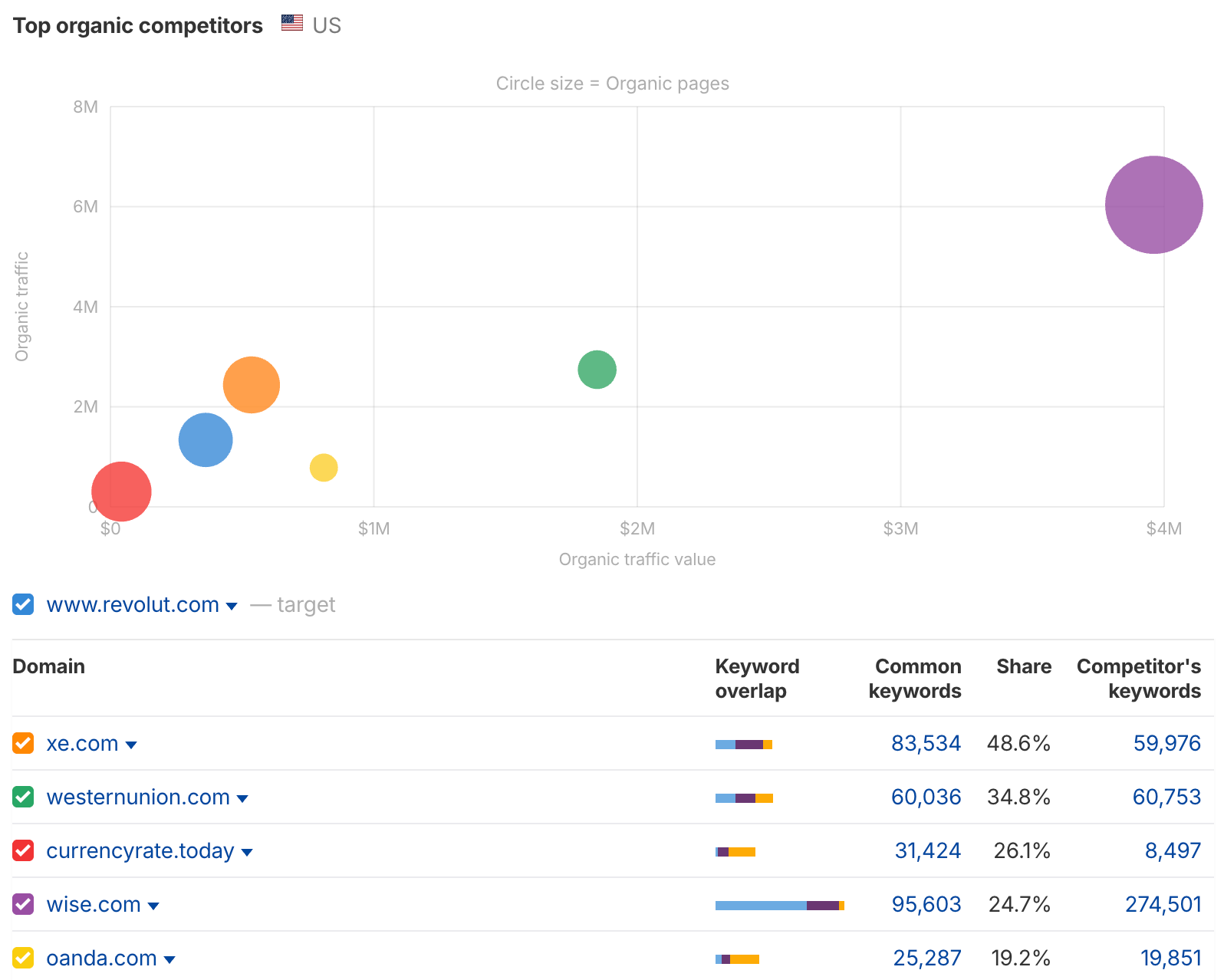
Ahrefs · Revolut vs top organic competitors (US market). Wise (purple, top right) has 274K competitor keywords and high organic traffic value, suggesting Wise is the more dedicated content-marketing operation. xe.com (orange) is the high-overlap competitor for FX queries. Western Union (green) and OANDA (yellow) are also in the FX cluster.
1. Strong branded demand from product-led growth
Branded queries drive 6.6M monthly visits. That demand was built through referral mechanics (the famous 5- minute first-payment loop documented by Growthcurve), the "Money Possibilities" campaign, and product virality — not through SEO content. But SEO captures and converts that branded demand at near-zero marginal cost.
2. Broad topical coverage without bloat
90,005 ranking pages, all variations on a handful of templates. Compare to Wise's 274K competitor keywords (mostly content-blog driven) — Revolut covers similar query volume with a fraction of the page count. That's higher SEO efficiency per unit of effort.
3. Product-led landing pages
The /business/ page generating $288K of traffic value is the model. Every product line has a dedicated, well optimized landing page that competes for its own branded query and for related commercial intent.
4. International SEO coverage
173 organic locations. Localized homepages ranking #1 for "revolut" in ES, FR, IT, DE, PL, NL, GR. Localized currency converters in Spanish for LATAM markets (USD→MXN, USD→COP). This is the moat that protects against any single-market SERP volatility.
5. High-authority backlink profile
3.6M backlinks, 20.7K referring domains, links from Apple, Google, Wikipedia, TikTok. This authority is what allows minimal-content utility pages to outrank content-heavy competitors. You can't out-write someone with DR 90; you can build the better tool.
6. Clear alignment between SEO and product acquisition
Every high-traffic page has a clear path to an account signup. The converter page sells transfers. The price page sells crypto trading. The /business/ page sells a business account. There's no orphaned "thought leadership" eating budget without driving conversion.
7. Content that supports both Google Search and AI search
The same direct-answer structure that ranks well in Google's blue links is what LLMs cite in their generated answers. Revolut isn't running two strategies; it's running one strategy that works in both surfaces.
THE STRATEGIC MOAT
The combination of brand authority + product utility + international depth + template scale is what's hard for any competitor to replicate. A competitor can copy any single tactic. They can't easily copy all four at once.
Practical Lessons for Fintech and SaaS Companies
The translation of Revolut's strategy to other fintech and SaaS contexts is more direct than it might appear. The model works for any company whose product performs a high-frequency, data-driven action that customers are already Googling.
Lesson 1: Build topic clusters around product use cases, not topics
"Currency conversion" is a topic. "USD→MXN exchange rate" is a use case. Revolut indexed thousands of use cases, not topics. Audit your product: every distinct user action is potentially its own URL.
Lesson 2: Create pages for high-intent comparison keywords
Revolut is light here, which is actually a missed opportunity in their playbook. Don't replicate that gap. "X vs Y" and "alternatives to X" pages convert at multiples above generic informational content. We cover the structure in our comparison page guide.
Lesson 3: Use market-specific landing pages
Don't translate. Localize. Pricing in local currency. Local regulators referenced. Local payment habits (UPI in India, Pix in Brazil, Bizum in Spain). Hreflang correctly implemented. This is a non-trivial engineering investment that compounds for years.
Lesson 4: Build educational content that supports commercial pages
If you have a /transfer/ page targeting "international money transfer", you also need /what-is-iban/, /how swift-works/, and /comparing-transfer-fees/. The educational content captures earlier-funnel queries and feeds the commercial page through internal linking.
Lesson 5: Optimize for AEO with direct answers, definitions, FAQs, and structured sections
The first 100 words of every page should answer the query in plain prose. Add FAQ schema. Use structured headers (H2 = question, H3 = sub-question). LLMs index the structure, not just the words.
Lesson 6: Use internal linking to connect awareness content to product pages
Every educational page should have a contextual link to the relevant product page. Not a sidebar CTA — a contextual, in-paragraph link that helps the user when they're ready. Internal linking architecture is the most under-leveraged SEO lever.
Lesson 7: Create visual assets, calculators, and data-led resources
A real-time calculator beats a 2,000-word article for the same query. Build tools, not blog posts, when the query is computational. This is the single biggest takeaway from the Revolut case.
Lesson 8: Track SEO and GEO performance together
Add LLM citation rates to your weekly SEO report. Tools like Profound, Otterly, and similar will tell you how often your domain is cited in ChatGPT and Perplexity answers — that's the new KPI alongside organic clicks.
How to Apply This Strategy in Practice: A 9-Step Framework
This is the operational version. Run this end-to-end, in order, and you'll have a Revolut-style SEO/GEO foundation within 90–120 days.
Map product features to search intent
List every action your product performs. For each action, write the query a user would type to find that action. Group by intent: lookup, comparison, calculation, learn, buy. This is your URL inventory.
Identify commercial and informational keyword clusters
Use Ahrefs/Semrush/SE Ranking to pull search volume for each query in step 1. Cluster by parent topic. Score each cluster on volume × commercial intent × competition. Prioritize high volume / high-intent / mid-difficulty clusters first.
Build product-led landing pages first
Before any blog content, build the page for each cluster's primary commercial query. Page format = utility-first (tool or calculator), then short explanation, then CTA. Treat this as a product sprint, not a content sprint.
Create supporting educational content
For each commercial page, write 3–8 supporting educational pages targeting upstream informational queries. Internal-link from the educational page to the commercial page using exact-match anchor text.
Build comparison and alternative pages
For every direct competitor, build a "[Competitor] vs [You]" page and a "[Competitor] alternatives" page. These are high-converting, mid-funnel pages most fintechs underbuild.
Add AEO-ready sections and FAQs
Every page gets: a 50-word direct answer in the opening paragraph, an FAQ block with 4–6 questions in FAQ schema, and a "Key Facts" structured block. This is the difference between being indexed and being cited.
Strengthen internal linking
Map the internal link graph: every page should have 5–10 contextual internal links to relevant pages. Build a topic-cluster hub-and-spoke structure. Audit quarterly.
Track organic traffic, conversions, AND AI visibility
Weekly dashboard: organic clicks (GSC), rankings (Ahrefs), conversion rate by page (GA4), AI citation rate (Profound/Otterly). Separate views by market.
Refresh pages based on rankings and search behavior
Monthly refresh cycle: any page that dropped >3 positions gets reviewed. Any page in positions 4–10 with high CTR gets a content depth push. Any page with high impressions but low CTR gets a title/meta rewrite. This is where the Revolut-style "long flat plateau" comes from — not from new content, but from systematic refreshing.
Final Takeaway
Revolut's 15.7M monthly organic visits aren't a content marketing win. They're a product-as-content win.
The currency converter is the content. The price page is the content. The localized homepage is the content. The /business/ page is the content. Every URL is a product surface that solves a real query and a conversion path that takes the user one step toward an account.
The lesson is not "do programmatic SEO". Programmatic SEO done badly is the easiest way to get penalized by Google. The lesson is build the canonical answer to a high-frequency query, do it once, deploy it at scale through smart templates, localize properly, link internally, and let the brand authority compound over years.
For any fintech, SaaS, or financial brand sitting on a product that performs a high-frequency, data-driven action — currency conversion, tax calculation, salary comparison, mortgage estimation, crypto pricing, stock quotes, regulatory lookups — the Revolut model is directly transferable. The question is not whether the template works. The question is whether your team is willing to treat SEO pages as product surfaces with the same engineering, design, and analytics rigor as the rest of your product.
The teams that make that shift will compound for the next five years. The teams that keep treating SEO as "content marketing" will spend more, write more, and convert less.
WHERE TO START
Audit your top 20 highest-volume target keywords. For each one, decide whether the best answer is a piece of content or a tool. If it's a tool, that's your next sprint. If you'd like to walk through this framework together, you can book a strategy session — or read the supporting deep dives on programmatic SEO for fintech, product-led SEO, and AEO/GEO for fintech.