.png)


This article explains how we generate more than 1,000 conversions on a quarterly basis on the Omnius website by implementing what we call a bottom-of-the-funnel SEO strategy - meaning a strategy where the primary optimization variable is conversions and buyer intent, not traffic, impressions, or keyword volume.
For us, conversions are the most important metric, and this comes from our experience being part of the founding and executive teams of SaaS and fintech companies in previous chapters of our careers. We hired agencies ourselves, we saw impressive traffic numbers on dashboards that didn't translate into financial results, and that frustration is effectively one of the reasons Omnius exists today.
Everything we talk about, everything we suggest to clients, everything we implement on client projects - we also do on our own websites. For the sake of this case study, we are talking specifically about the Omnius website.
The data referenced here comes from Atomic AGI, our own AI search analytics platform, which we actually developed to better understand the (newly-founded) space of multi-engine search.
We understood that post-2022 SEO - with ChatGPT now part of the ecosystem - would demand owning the data layer behind it. When ChatGPT launched, and other LLMs followed, search stopped being a single-engine environment, and we suddenly had multiple places where people search for information - that were interconnected but also individually very important: Google,Bing, AI engines like ChatGPT, Claude, Perplexity, Gemini, and others.
That introduced several problems at once. First, attribution became more complex because users interact with multiple engines before converting.
Second, discrepancies between tools increased, meaning traditional analytics stacks were no longer sufficient to understand performance accurately. Third, the speed of change increased significantly compared to pre-2022 SEO, which created the need for much more real-time analysis and feedback loops.
That's why we built Atomic.
One of the modules inside Atomic is attribution tracking, where we monitor conversions across the website to better understand user intent.
Based on that data, Omnius currently generates over 1,000 conversions per quarter - meaning meetings booked, and forms filled. The number itself is interesting, but the more important part is how we got there and what strategic decisions led to it.
Understanding the business model before touching SEO
One of the biggest differences between how we approach SEO and how most agencies approach it is the starting point. We start with the business model rather than with keyword tools.
Most classical SEO workflows begin with keyword research, search volume analysis, and keyword difficulty filtering. Those variables are useful, but they do not include the most important variable, which is intent.

Intent is what determines whether traffic converts into revenue, and this becomes particularly important in B2B markets, where traffic volume is not the primary constraint. The constraint is acquiring the right visitors - the ones who are realistically capable of becoming customers.
What you'll typically see taught in courses and implemented by most generic SEO agencies is to find keywords with a difficulty low enough and a search volume high enough, and start ranking for those.
But this doesn't actually mean much, because the intent level of those keywords is not part of the equation. You can end up with a lot of clicks and a lot of traffic, but a relatively small number of conversions, and a low conversion rate is one of the biggest problems we see when clients come to us dissatisfied with their previous engagements with other agencies. The most common reason is that a lot of things were happening, but not many conversions and very little financial impact came from those activities.
This is what we specialize in reversing, and again something that came to us, as Omnius has been founded based on our negative experience with other marketing agencies once we were part of the marketing teams and executive teams of SaaS companies in the past.
We've seen this a lot. What agencies tend to do is implement one templatized strategy for every client, and this is not only their fault - the industry is kind of set like that through the education, through something that's now the common knowledge, which is effectively wrong.
SEO should not only care about clicks and impressions, but also the conversion rate, and that's what we do. We tend to care for both sides of the story, because at the intersection, you'll find the number of conversions / SQLs coming from the collaboration - and this is kind of the whole point of it.
In the end, the agency model is mission-critical to the client's success, as that's where the retention rate comes from, that's where the new growth loops can be opened:
When companies are happy, they are happy to refer, happy for you to turn their project into a case study, and happy to give testimonials, and this is how you effectively grow.
We have a lot of case studies, a lot of testimonials, and effectively a lot of successful projects, which were simply one of the most important factors of our growth.
The Economic principle behind the strategy
The way we think about this strategy comes down to one economic principle that marketers - and more importantly, economy-aware marketers - are familiar with: Pareto's rule.
20% of inputs will bring 80% of the outputs (end results), whether we're talking about customer cohorts, product features, SEO, or anything else - you can extend this across most systems.
- 20% group of customers tend to bring 80% revenue.
- 20% of product features tend to account for 80% of revenue
- 20% of keywords tend to bring 80% of paying users.
That last one is the one this article is about - and it's the one most SEO strategies get wrong. The typical approach optimizes for volume: find keywords with enough search traffic, rank for them, and report impressions and clicks.
The problem is that the keywords with the highest volume are rarely the ones that bring paying users. They bring visitors, and visitors are not the same thing as customers.
What we prioritize instead is intent level - how likely a visitor arriving through a specific keyword is to convert into a paying customer. That includes two layers:
- How likely they are to convert on the website itself, and
- How likely they are to convert from trial or freemium to paid inside the product.
Both matter, and optimizing only one of them is one of the most common reasons SEO produces traffic without revenue.
By understanding the business model, the product, the competitors, and the ICP deeply enough, you can identify the 20% of high-intent keywords that will predictably bring paying users rather than just visitors.
That identification is not something a keyword tool does automatically - it requires understanding what a buyer looks like at the moment they're closest to a decision, what language they use, and what they're actually searching for when they're ready to act.
Once you can see it, the strategic direction becomes clear: Go narrow, deep, and fast on that 20% rather than wide, shallow, and slow across everything.
For Omnius, that meant centering the entire strategy around a small group of keywords where the person arriving through them is already close to a purchase decision - not someone who needs to be educated about the category, but someone actively evaluating options.
That's what bottom-of-funnel means in practice.
What the BOFU approach actually means
By the definition, bottom-of-the-funnel visitors are people who already understand the market and the problem and do not need additional education on the product or use cases.
They often already use competitor products or are actively evaluating alternatives. They don't need to be convinced that the category matters - they need confidence that your product or, in our case, services, is the right fit.
Timing is what makes this fundamentally different from every other type of traffic. When someone searches a bottom-of-the-funnel query, they are usually close to making a decision.
- They are not researching whether SEO is worth investing in.
- They are not trying to understand what a B2B content strategy looks like.
They are searching for the best SEO agency for SaaS companies, comparing GEO agencies, or looking for someone who has done exactly what they need done. That specificity of intent - at the timing of their demand reaching purchase-readiness - is the signal that separates BOFU from everything above it in the funnel.
To make this concrete:
- A TOFU keyword for Omnius looks like "what is GEO"
- A MOFU keyword looks like "Best GEO strategies"
- A BOFU keyword looks like "GEO agency for SaaS"
The search volume on BOFU keywords is almost always lower, but the intent is incomparably higher. Someone arriving through the third type of keyword is not browsing - they are evaluating.
That difference in visitor state is what drives the conversion rate gap between BOFU-focused strategies and everything else.
Because these visitors arrive ready, the entire nature of the sales process changes. You spend:
- Less time on education,
- Less time on nurturing sequences,
- Less time on objection handling.
They are faster to convert to revenue because they come prepared. The sales conversation starts further along. And that efficiency compounds - every resource you would have spent on nurturing a low-intent visitor gets redirected toward closing a high-intent one.
What most companies and agencies don't do - and what made the biggest structural difference for us - is reverse the funnel entirely.
The classical approach builds from the top down: start with awareness content, build TOFU traffic, nurture it toward MOFU, and eventually convert some portion at the bottom. It feels logical because it mirrors the buyer journey.
But it has a critical flaw: it delays revenue.
You spend months building traffic that has no near-term conversion potential, and by the time your BOFU content is in place, you've already invested a significant amount of time and budget into traffic that isn't paying back.
We did the opposite. We built BOFU first - identified the highest-intent keywords for our specific market, built the pages and clusters around them, and established conversion infrastructure before expanding upward.
The immediate result was that early traffic, even when relatively low in volume, converted at a significantly higher rate than what most agencies report. The result was that by the time we expanded into MOFU and TOFU content, the domain already had authority built around commercial intent.
This sequencing also changes what success looks like in the early months of implementing the SEO strategy. Instead of watching traffic grow slowly with no conversion signal, you see conversion signals early, which tells you whether the strategy is working before you've committed fully to it. Sort of a proof-of-concept strategy applied to SEO.
That feedback loop is one of the most underrated advantages of the BOFU-first approach, and it's something we now build into every client engagement from day one.
How we identified high-intent focus points
Identifying high-intent opportunities is manual work. It cannot be automated — and this is worth stating directly, because a lot of people right now are saying that Claude Code, Cursor, or whatever new AI product replaced their marketing stack.
But they don't get that marketing is a non-probabilistic discipline. Successful strategies need to come from context, and context comes from understanding the customers you are trying to acquire. You can automate (parts of) execution; understanding - not so much.
The starting point is always the market and competitive landscape. We go deep on understanding how SaaS, fintech, and AI companies specifically think about their problems - what they search for when they are evaluating solutions, how their buying decisions are made, what triggers them to look for a new vendor, and where the gaps are in how competitors are currently positioning themselves.
Because we work exclusively with companies in these verticals, this understanding compounds over time. Every client project adds to a broader picture of how these buyers behave, what language they use, and what intent signals reliably predict a purchase decision.
That accumulated knowledge is one of the things that makes identifying high-intent opportunities faster and more accurate for us than it would be for a generalist agency starting from scratch on each project.
From there, we go into the data - but with a specific question already formed.
We are not browsing dashboards looking for interesting patterns. We are looking for evidence of what is already working and why.
In Atomic, we track which sources & keywords are driving engagement & conversions, not just traffic - a direct signal of intent rather than an indirect one. We tend to do this on a weekly basis.
In Clarity recordings, we watch how visitors arriving from specific keywords actually behave on the website - whether they read, scroll, click toward conversion points, or leave immediately.
In PostHog, we track behavioral sequences: which pages high-converting visitors move through, where they spend time, and where they drop off. Together, these three data sources tell a story about intent that search volume alone never could.
But the most reliable source of high-intent keyword intelligence is one that almost no agency systematically uses: sales conversations. We sit down with our existing and potential clients every week, and we listen.
We document everything - conversations, objections, expectations, and decision triggers. The connection between what someone says in a sales conversation and what they typed into Google to find you in the first place is closer than most companies assume.
The exact phrasing, semantics someone uses to describe their problem, the way they frame what they are looking for, the comparisons they are already making before they even speak to you - that language surfaces keyword opportunities that tools alone would never find, because it reflects real buyer psychology rather than aggregated search behavior.
A practical example: when prospects consistently arrive in sales conversations already familiar with GEO, already using that wordchoice rather than just AI SEO or other variations, that tells us something important. It tells us those terms, and that framing belongs at the center of our keyword strategy - because the people using that language are already close to a purchase decision.
What this process produces, when done consistently, is a map of the 20% of keywords that will drive the majority of high-intent traffic.
Not a list generated by a tool, but a picture of how your specific buyers think, search, and decide - built from real conversations, real behavioral data, and real intent signals observed over time.
This is, obviously, not a one-time research exercise.
The market changes, competitors adjust their positioning, and new intent signals start being important as AI search changes how people behave.
So this process runs continuously - we are always going through new data, always talking to new potential clients, always updating our understanding of what high-intent looks like in our specific market.
Patterns become obvious when you do this consistently, and those patterns are what the entire keyword strategy is built on. The strategy at month twenty-four looks significantly different from month one - not because the principle changed, but because the understanding of the market deepened.
That depth is one of the things that is genuinely difficult for a newer competitor to replicate quickly, regardless of budget.
The Implementation (a harder part)
When it comes to implementation, we thought about it as a two-layer system. The first layer is traffic. The second layer is conversion rate. You need both, and optimizing only one of them is one of the most common reasons SEO engagements don't produce the financial results they should.
The traffic layer
Everything in the traffic layer was built around two things: SEO clusters & technical optimization.
Technical is the smaller part of this equation. It's about making sure our website is properly crawlable and readable by both Googlebot and AI search crawlers. We do weekly checks to keep technical health in order.
It's important, but it's table stakes - not what moves the needle.
What actually moves the needle is the cluster approach, and this is probably one of the most profitable strategies anyone can implement in B2B SEO.
The idea is simple. Instead of publishing isolated articles around loosely related topics, you build everything around a small number of high-intent commercial keywords - and every piece of content, every backlink, every social post, every video reinforces authority around those core keywords.
Here's what this looks like in practice.
One pillar page targeting the Generative engine optimization (GEO) agency keyword is supported by:
- YouTube video about GEO strategies
- Thought leadership piece about SEO vs GEO
- Industry report about the GEO industry
- Listicle about the best GEO agencies
- Listicle about the best GEO tools
- Recycled content into several posts/articles on LinkedIn, X, and other platforms
- High-quality backlinks from niche-specific websites with GEO-related anchor text
Everything reinforces authority around that one commercial keyword. This is how you compound visibility over time - on Google and inside AI search engines simultaneously.
When it comes to content itself, everything is manually written, reviewed, formatted, and designed. We don't use AI to generate blog posts, and it's been like that since day one. The quality bar has to be high enough that it builds genuine authority, not just fills pages.
Backlinks are the third component, and this is where the multi-engine environment changes the approach significantly compared to traditional link building.
In classical SEO, backlinks were evaluated almost entirely by domain authority and Google ranking impact. That still matters, but it's now only part of the picture.
AI search engines, including ChatGPT, Perplexity, Gemini, and others, have their own citation patterns. The correlation between sources Google ranks highly and sources AI engines cite is only 8-12%. That means the majority of your link-building effort, if aimed purely at Google, is almost invisible to AI search.
So we build authority deliberately across both.
We identify which publications, directories, and industry resources tend to get cited inside AI-generated answers for our specific category - and we make sure Omnius has a presence there.
A single mention in the right environment can have more impact on AI search visibility than dozens of links from sources that engines never reference. Getting that mapping right is one of the more leveraged things you can do in the current multi-engine environment.
The Conversion Layer
Traffic acquisition cannot compensate for a poor conversion environment. If the website looks like purple-buttoned-AI-generated-Tailwind-slop & doesn't communicate trust, clarity, and value effectively, all the SEO effort is wasted - and this is something most companies underinvest in significantly.
Our website was one of the best investments we've made. We spent six months building it, which is longer than it should have taken, but the ROI has been higher than anything else we've done.
It converts a significant volume of visitors because it was built with a very specific philosophy:
- Memorable but not distracting,
- Conversion-friendly but not salesy,
- Simple enough that visitors understand what, how, and why within the first few seconds.
Practically, this means pages aren't too long. Social proof, case studies, client logos, and testimonials are placed where it matters most in the decision process, not at the bottom where nobody reads them.
Conversion points are obvious and low-friction.
Messaging speaks directly to the problems our ICP is actively trying to solve, not to generic benefits that could apply to any agency.
We iterate on it every month. Small changes - adjusting a section, adding a new case study, tightening the messaging on a key page, individually move conversion rate by small amounts.
But those small amounts compound against every future visitor. A website that converts 2% better after six months of iteration is permanently more efficient for everything that comes after it.
When both layers are working together, high-intent traffic from well-structured clusters landing on a website genuinely built to convert, this is where the compounding effect starts to turn into financial results.
Understanding this concept is very important in business generally, and in SEO especially.
The Compounding effect of self-scaling content
This is probably the most underestimated part of the entire strategy - and the part that, once it starts working, becomes the hardest thing for a competitor to replicate.
Here's what we observed happening over time.
- When people write content for their blogs or publications, the majority of them now use LLMs during the research process.
- The LLM recommends a product or company - in our case Omnius - because we rank strongly on Google for high-intent keywords, and because we have citations across the sources AI engines pull from.
- Wrteirs finds us on both Google and inside AI-generated answers, which increases the probability they include us in whatever they're writing.
- They publish that content on their own website.
- That publication becomes a new citation on the web.
- More citations increase the probability of LLMs mentioning our brand again.
- More LLM mentions increase the probability of future citations, as more writers encounter our brand during their own research.
LLMs influence writers > Writers create content > Content influences LLMs.
Each turn of the loop builds on the previous one - marginally increasing the benefit and decreasing the effort required, because the system is feeding itself.
We see this concretely in Omnius being referenced as one of the best SEO, GEO, AEO, AI search agencies on websites we've never heard of, by people we've never spoken to, with no relationship to us whatsoever. That didn't happen because we reached out - but because of the compounding effect.
The reason early adoption matters here is the same reason it mattered in early SEO. The companies that understood Google's authority model in the early 2000s and built for it deliberately didn't just get a head start - they got a compounding advantage that proved very difficult for later entrants to close, regardless of how much they spent.
We believe the same thing is happening now in multi-engine search, probably faster. Early adopters will have compounding benefits for years, probably decades, to come, and we are already seeing early signals of this.
Getting in early doesn't just mean being visible sooner. It means the gap between you and later entrants grows automatically over time, because every turn of the loop increases citations, which increases AI visibility, which increases citations further.
Understanding the Attribution Picture
One important thing to understand when looking at the 1,000+ quarterly conversions is that attribution in a multi-engine search environment is fundamentally different from what it was 4 to 5 years ago - and interpreting it the way you would have interpreted it then will give you a distorted picture of what's actually driving results.
What actually happens:
- Someone searches for something on ChatGPT or Perplexity.
- They find a brand name because LLMs don't display links the way Google does
- They go to Google to validate - they search the brand name, visit the website, and convert.
The recorded source is Google or direct. The LLM that drove the original discovery gets no credit. Our data shows there are now over 3 billion queries done on AI engines each day, and almost none of that shows up accurately in standard attribution models.
On top of that, the rising adoption of privacy-friendly and GDPR-compliant cookie policies is pushing more conversions into the direct bucket regardless of how many touchpoints were actually involved.
So when you see Google and direct dominating your attribution report, it doesn't mean other channels aren't working. It often means the attribution chain is incomplete.
But the more important strategic point here is not about attribution accuracy. It's about how these two systems, Google and AI search, actually relate to each other.
They are not competing channels, but mutually-feeding ones.
- Strong Google rankings increase the probability of being cited in AI-generated answers, because reasoning models frequently pull from Google's index when retrieving data.
- AI mentions increase the probability of branded searches on Google, because people validate what LLMs tell them by searching directly. Each system feeds the other.
This is exactly why we treat SEO and GEO as one process rather than two separate workstreams. Optimizing for Google improves AI visibility, while optimizing for AI citation patterns drives branded searches back to Google.
The compounding effect happens precisely because both sides of this loop are being maintained simultaneously - and the attribution picture, imperfect as it is, is simply a reflection of how interconnected these two environments have become.
Continuous iteration
One of the things that is often underestimated is how much continuous iteration contributes to outcomes over time.
We update our website regularly, analyze behavior data, and refine messaging and structure based on what we observe. Over multiple years, these incremental improvements accumulate into significant results.
In practice, iteration means different things at different stages.
In the early months it means structural changes - refining page layouts based on what Clarity recordings show about how visitors navigate, adjusting conversion points based on where PostHog data shows people dropping off, tightening messaging based on what objections keep coming up in sales conversations, and adapting the product or service offerings based on financially positive experiments.
As content clusters mature, iteration shifts toward strengthening them - identifying which supporting articles are driving the most internal link value, which cluster pages are closest to ranking for their target keywords and need another push, which core pages need updated data to stay competitive.
A cluster that has been actively maintained for two years looks completely different from one built and left alone, and the ranking stability and citation authority that comes from that kind of maintenance is very difficult for newer competitors to replicate quickly.
At the same time, as we deliver successful projects, we accumulate more case studies, testimonials, and recognizable client logos - which strengthen trust signals and increase conversion rates further.
Happy clients generate referrals.
Referrals generate more successful projects.
More successful projects generate more credibility.
And credibility improves conversion efficiency.
That chain of iterations is a major part of how we grew.
What This Strategy Has Produced for Omnius
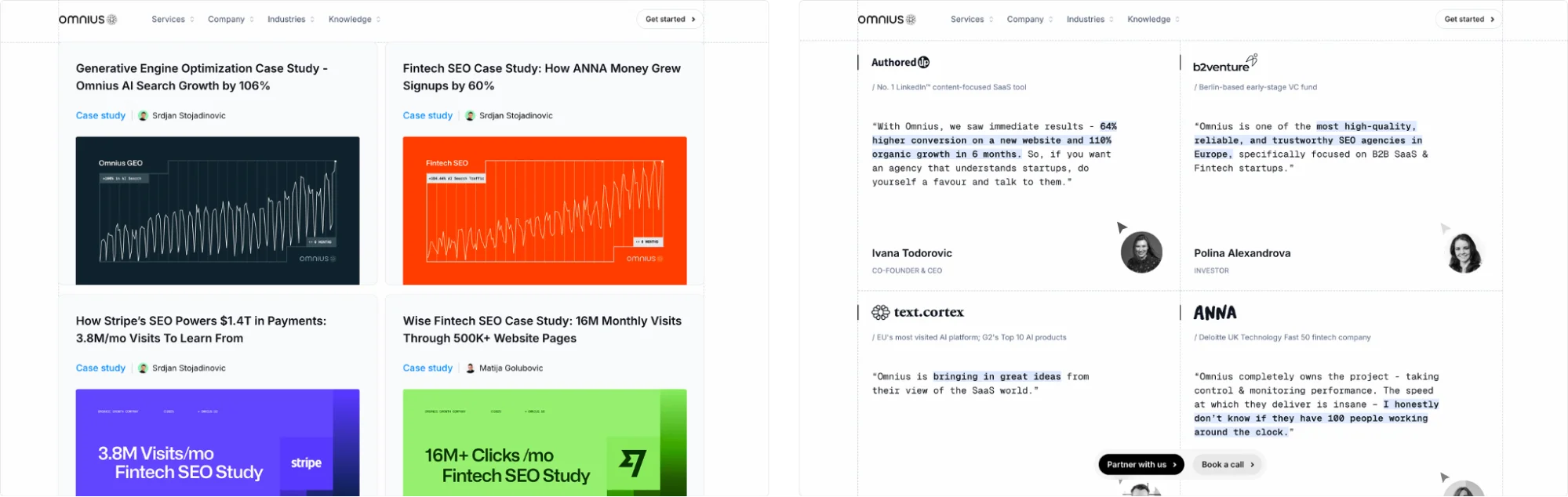
Everything we've achieved as a company has come through organic search. No paid ads, no paid acquisition channel, no ad spend to attribute results to - since day one. That makes our own website one of the clearest possible proofs of what this strategy actually produces, because there is nothing else it could be.
Financially, we've been growing 150 to 180% year over year for the last 5 years. That growth funded building the agency, developing Atomic, and contributing to the ecosystem through starthere - all simultaneously, all from organic alone.
But the number that matters most to us is not the growth rate.
It's the quality of the companies that found us through search, evaluated us, and decided to partner with us. You can't fake organic search - if a company with real standards found you by typing something into Google or an AI engine, read what you've published, and decided you were the right partner - that is the most direct validation a strategy can produce.
The companies that have done that include some of the most credible names in their respective categories:
WorldFirst, part of Ant International, the world's largest fintech group, serving over a million businesses globally with cross-border payments and FX.
Meniga, a Series D digital banking fintech and one of CNBC's Top UK FinTechs 2025.
ANNA Money, a UK neobank that raised $88M+, a Deloitte UK Fast 50 company.
ApexAnalytix, positioned highest for Ability to Execute in the 2025 Gartner Magic Quadrant for Supplier Risk Management, protecting $9.5 trillion in annual spend for over 320 of the world's largest companies.
TextCortex, one of G2's 10 Best AI Software Products of 2025.
Solflare, one of the largest non-custodial Solana wallets globally, with 4M+ users and $20B+ in assets secured.
Onetrace, one of the UK's Top 200 fastest-growing businesses in 2025 in its category.
These are not companies that respond to cold outreach or make decisions based on impressive pitch decks. They are companies with high standards that do their own research before engaging anyone. The fact that they found us through organic search for the exact keywords their teams were searching when evaluating options, is the whole point of the strategy this article describes.
For us, being found on both Google and AI search engines for the keywords our ideal clients are actually searching is the ultimate proof that we know what we're doing.
You can't buy that. And you can't fake it.
Why this works especially well for B2B
B2B markets have smaller audiences but higher deal values and clearer intent signals. That combination is exactly why intent-focused SEO is disproportionately powerful here compared to almost any other context.
In B2C, traffic volume is the primary lever because deal values are low and conversion rates are modest - the math requires scale. In B2B, and particularly in SaaS and fintech, a single converted visitor can represent tens of thousands of dollars in annual contract value.
A page generating fifty visitors a month that converts three of them into qualified leads is worth significantly more than a page generating five thousand visitors converting a fraction of a percent into low-intent signups. The math works completely differently, and most SEO strategies don't account for that difference.
The cost of getting it wrong is also higher.
Traffic that looks good on a dashboard but attracts the wrong visitors doesn't just fail to produce revenue - it wastes sales capacity, inflates the pipeline with leads that don't close, and creates a distorted picture of what's actually working. We see this constantly with companies that come to us after previous agency engagements.
The traffic was there, the conversions weren't, leading us to a logical conclusion that the strategy was optimized for the wrong variable.
What makes B2B buyers specifically well-suited to the cluster approach is how they actually research and make decisions, because they don't convert on the first visit.
They read multiple pieces of content, evaluate competitors, talk to peers, and return to your website several times before they reach out. Every touchpoint either builds or erodes confidence.
A well-structured cluster creates multiple touchpoints across that research journey - each one reinforcing the same authority signal, each one moving the buyer slightly further toward a decision.
We see this in our own data consistently.
The companies that reach out to Omnius have almost always encountered us more than once before they book a meeting. They found a case study, saw us referenced in an AI-generated answer, and read a piece of content that answered a specific question they had.
By the time they reach out, the trust is already largely built.
The meeting is confirmation, not discovery.
That's what this entire strategy produces when it runs long enough in a B2B market. Not traffic, not impressions, but buyers who already know who you are, already trust what you do, and reach out because they've decided you're the right fit before the conversation even starts.


.png)

.svg)
















.svg)



























.svg)