.png)

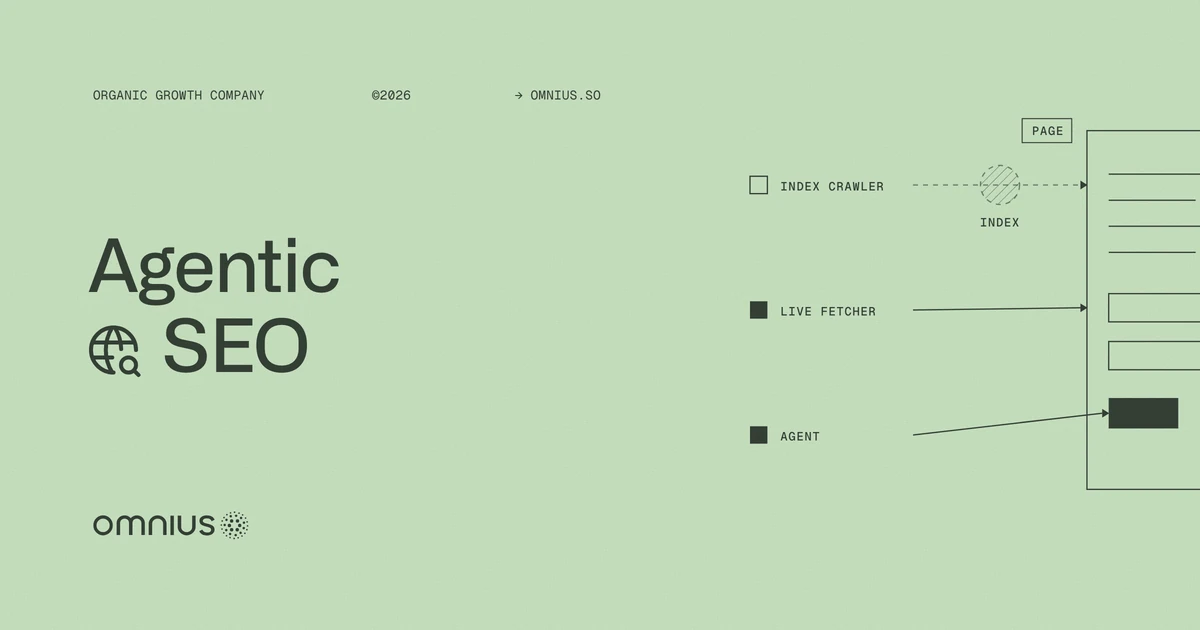
Agentic SEO is the work of making a company findable, understood and usable for the AI agents that research and compare software for people. When a finance lead asks ChatGPT or Claude for three spend management platforms that work with Xero and hold ISO 27001, the agent builds the shortlist from what it can confirm on the web, before anyone opens a vendor's site.
One example shows how much that check changes the list. Asked for the best spend management software for mid-sized companies, four of five AI engines named Ramp first. Asked for three platforms for a 200-person company in Germany with several legal entities, none of the five included Ramp, and Payhawk, which only two had named the first time, was on all five.
| Engine | Ranked first for the plain question | Shortlist with the three requirements |
|---|---|---|
| ChatGPT | Ramp | Payhawk, Pleo, Moss |
| Claude | Ramp | Spendesk, Payhawk, Mobilexpense |
| Gemini | Ramp | Spendesk, Moss, Payhawk |
| Google AI Mode | Ramp | Moss, Payhawk, Spendesk |
| Google AI Overviews | Airbase (Ramp fourth) | Payhawk, Moss, Spendesk |
Category rankings decide which products an agent considers, and the facts it confirms against each requirement decide which ones it recommends. This guide explains how agents run that check, the seven factors of agentic SEO behind it and how to optimize for each, drawing on shortlisting examples, 111,337 tracked AI citations and platform documentation.
Key takeaways
- Agentic SEO builds on GEO. Category visibility puts a product on an agent's candidate list, and facts it can confirm put it on the shortlist.
- The website now has two jobs. It is the source an agent reads to compare products and the interface it operates to book a demo or start a trial.
- Hard requirements decide the list. In 25 answers across five SaaS categories, the product ranked first for a plain category question was left off 8 once three hard requirements were added.
- Unconfirmed facts get flagged or filled in. Agents mark a requirement they cannot confirm or take the fact from another source, such as a third-party price where the vendor's own is missing or different.
- The fixes start with access. After a baseline, fix bot access by role, then publish a fact block for every hard requirement and use one category line on the site and every profile.
- Selection share is the headline measure. It counts how often the product makes the shortlist on a fixed set of tasks, tracked monthly.
What is agentic SEO, and why does the agentic web matter?
An AI agent is software that carries out a person's goal in steps. Asked to compare spend management platforms, it plans searches, reads vendor and review pages and checks each option against the request's hard requirements, the conditions a product must meet to stay on the list. When allowed, it fills in a form or starts a trial. Agentic SEO covers each of those steps.
The agentic web is everything these agents read and operate, including the tools a site declares to them through MCP or WebMCP. ChatGPT Work uses a cloud browser of its own, and Claude in Chrome clicks through pages for its user.
OpenAI's DevDay 2026 keynote, where it launched Dots.
Since June 2026, agents have gained new ways to act and pay:
- 9 June 2026: Chrome opened a WebMCP origin trial, so a site can declare what its buttons and fields do instead of leaving agents to guess.
- 10 June 2026: Visa announced Agent Score, which rates whether AI agents can navigate, understand and complete tasks on a merchant's website.
- 11 June 2026: Stripe reported that agents send 70% of CLI requests for API resources, and its Projects tool connected them to 49 software providers.
- 20 July 2026: Natural, which builds payments infrastructure for AI agents, raised $30 million when the company was 193 days old.
- 29 September 2026: OpenAI launched Dots, always-on agents in ChatGPT that each work from a cloud computer of their own.
More than half of internet traffic is now non-human, by Cloudflare's count. In some heavily crawled site categories, human visits fell by as much as 40% in less than a year. Cloudflare names software and finance among the affected industries.

For a company that sells software, that shift moves the comparison off its own website. In G2's 2026 survey of 1,076 B2B software decision-makers, 51% start research with an AI chatbot more often than with Google, and 69% chose a different vendor than they had planned because a chatbot recommended it.
The list that research produces is close to the decision. In 6sense's survey of nearly 4,000 people behind recent B2B purchases, the vendor a buying group preferred before it talked to sales won four out of five deals. An agent that cannot confirm a product's facts flags it or leaves it off that list.
Agents now pay as well as research. Visa Intelligent Commerce and Mastercard Agent Pay process agent purchases made with their users' cards, and Gartner predicts that by 2028, 90% of B2B buying will be intermediated by AI agents. The more of a purchase an agent completes, the more its shortlist decides the sale.
The same phrase also names AI agents that do SEO work, which our guide to AI-powered SEO agents covers.
How is agentic SEO different from GEO?
Agentic SEO builds on GEO, generative engine optimization, which is the work of being cited and recommended in AI answers. Agents still pull results from search indexes, so indexing, content quality and authority still decide whether a page is found at all, and Google says optimizing for its AI features is still SEO. The difference starts after the search. An agent runs a search for every requirement, compares the results and can act on them.
| Traditional SEO | GEO | Agentic SEO | |
|---|---|---|---|
| Who runs the search | A person, on Google | A person, in ChatGPT, Gemini, Perplexity or AI Overviews | An AI agent, for a person |
| Searches per need | One query, refined by hand | Several, fanned out by the engine | Many, at least one per requirement |
| Who decides | The person, after clicking | The person, after reading the answer | The person, from a shortlist the agent built against their requirements |
| What wins | Rankings and a persuasive page | Being cited or recommended | Making the shortlist: found, confirmed on every requirement, and easy to act on |
| What the page must do | Persuade a person | Be quotable and trusted | State checkable facts and offer a next step an agent can use |
| Core metric | Organic leads | Share of voice in AI answers | Selection share |
The website ends up with two jobs. It is the source an agent reads while someone waits for the answer, and the interface it operates to book a demo or start a trial. Most of those reads, however, never become a visit. In Pew Research Center browsing data from 900 US adults, people shown a Google AI summary clicked a traditional result in 8% of visits, against 15% without one.
How does an AI agent shortlist B2B SaaS products?
Behind every one of those reads, an agent works through five stages: planning, retrieval, reading, evaluation and action. Four kinds of agent differ in where they stop:
- Answer engines such as ChatGPT search end with a cited answer.
- Research agents such as Claude Research loop through retrieval, reading and evaluation until they have enough.
- Browser agents such as Claude in Chrome act on a page.
- Tool-calling agents call functions a site declares.

The stages below follow one request throughout. A VP Finance asks an agent to find month-end close software that works with NetSuite, keeps data in the EU and has SOC 2 Type II, then to pick three with prices and book demos.
1. Planning: turning the request into requirements
The agent first breaks the request into requirements and writes a search for each, a technique known as query fan-out. ChatGPT search rewrites a question into targeted queries. Google's AI Mode splits it into subtopics, and its Deep Search can issue hundreds of searches for one question. Claude Research hands each aspect to a subagent.
The requirements do not weigh the same. NetSuite, EU data residency and SOC 2 Type II decide whether a product stays on the list, and the five-day close and the price only order the products that pass.
An agent confirms a requirement only where it finds it stated. A product that meets a requirement and leaves it unstated on pages an agent can read is flagged as unconfirmed, ranked lower or described from other sources.
Google's Search keynote at I/O 2025, where it introduced AI Mode and Deep Search.
2. Retrieval: searching the indexes agents use
With the requirements set, each search goes to a search index, and the platforms use different ones:
- AI Mode searches Google's index.
- Copilot searches Bing's index.
- Claude searches Brave's index and pages from Anthropic's own crawler.
- ChatGPT searches OpenAI's own crawl and partner search providers.
A page has to be indexed and open to that platform's crawler before an agent's search can find it. Brave skips any page Googlebot cannot crawl.
Within each index the agent opens the results that rank, and our guide to Claude SEO follows one such path from Brave's index to Claude's answer.
The platforms also separate their bots into three roles, for search, model training and visits a user asks for. A site allows or blocks each role separately, and one that mixes them up drops out before any comparison starts.
| Role | User agents | Allowing it | Blocking it |
|---|---|---|---|
| Search crawlers | OAI-SearchBot, Claude-SearchBot, Googlebot, Bingbot | Pages can be retrieved and cited in ChatGPT search, Claude, Google's AI features and Copilot | OpenAI: the site is not shown in ChatGPT search answers. Anthropic: may reduce visibility and accuracy. Brave skips any page Googlebot cannot crawl |
| Training crawlers and tokens | GPTBot, Google-Extended | Content can be used to train models (Google-Extended also covers grounding in Gemini) | Content stays out of training; Google-Extended does not affect Google Search |
| User-triggered fetchers and agents | ChatGPT-User, Claude-User, Google-Agent, ChatGPT Work's cloud browser | The agent can read and use the page for the person who asked | Google's user-triggered fetchers generally ignore robots.txt; OpenAI says it may not apply to ChatGPT-User; Claude-User honours it |
| Verification | Web Bot Auth signatures (ChatGPT's cloud browser), Google's published IP ranges for Google-Agent, Cloudflare's signed agents | A site can confirm an agent is genuine before deciding | A user agent string alone can be spoofed |
3. Reading: fetching the chosen pages
The agent then fetches the pages it picked. A crawler reads the HTML the server sends, and a browser agent reads the page as a screenshot, raw HTML and an accessibility tree, the structure a browser exposes to screen readers. Not all bots run JavaScript, so a price that appears only after a script runs, such as inside a pricing tab, may never reach the agent.
4. Evaluation: building the candidate list and checking each requirement
Once it has read those pages, the agent builds its candidate list from three places: what the model already knows, products named on review and comparison pages, and vendor pages that ranked. It then checks each candidate against each requirement. Anthropic grades its research agent on whether every requested aspect is covered and whether it used primary sources, and for a vendor's own facts the primary source is the vendor's page.

To see which pages feed that list, we counted every source cited in the AI answers we track over 91 days. Pages with "best-" in the URL made up 17.7% of them, and the tracked companies' own websites 5.3%.
Vendors publish roundups of their own category, and answers use them. Two of the three sources Claude cited for the spend management answer were roundups by Spendesk and Mobilexpense, and both vendors made its list. So roundups decide which products get considered, and the vendor's own pages decide whether each requirement can be confirmed.
Requirements then reshape that list. We compared the two kinds of question in five categories, 25 answers with requirements in all. The product ranked first without requirements kept first place in 9 of them, fell to a lower place in 8 and was left out entirely in 8. Five of those 8 were the spend management answers above, and the other three were in help desk, product analytics and contract management.

In Ramp's case the absence is fair, since its Europe page still offers a waitlist. The products that replaced it were chosen requirement by requirement. Claude, for example, ended its answer with a table that ticked ISO 27001:2022 for Spendesk and Mobilexpense and marked Payhawk's as "Confirm with vendor".
Yet when we checked on 12 October 2026, Payhawk held ISO 27001, and its trust portal listed the certification. Claude cited no Payhawk page at all, so its flag shows what the answer could confirm from the pages it read. A requirement an agent cannot find stated stays unconfirmed, however well the product meets it.
5. Action: booking the demo or starting the trial
Once the comparison is done, browser agents can go on to act inside the website. ChatGPT Work's browser completes tasks, surfaces a login screen for the user to sign in and asks for confirmation before consequential actions. If the demo form or trial fails for the agent, ChatGPT's cloud browser asks the user to take over.
Tool-calling agents skip the clicking and call functions a product declares. They do it through an MCP server, built on the open standard that connects an AI assistant to a product's tools and data, or through WebMCP, a proposed web standard in a Chrome origin trial.
What are the seven factors of agentic SEO?
A product can drop out at any of those five stages. Seven factors decide whether an agent can find it, read its pages, list it, confirm it and act on its site. The first two, access and readable pages, are gates that decide whether the agent can use the company's own pages at all.
1. Access: crawlers and agents can reach the site
Access is the first gate, because a page the search crawler cannot reach stays out of the index an agent searches. CDN settings can close it at the network edge.
Cloudflare's setup screen for new domains has separate Search, Agent and Training settings. Since September 2026 its Block option also stops Googlebot and Bingbot, while Disallow AI Training stops training alone. Few B2B companies set these roles on purpose. MKT1 found that only 12% of 100 high-growth B2B startups had written rules for AI bots in robots.txt.
What to do:
- Audit robots.txt and CDN or firewall rules by bot role.
- Allow search crawlers and user-triggered agents, and decide on training crawlers separately.
- Verify agents by their request signatures or published IP ranges before blocking anything.
- Return status codes an agent can act on, such as a real 404 with a short text body that links the sitemap for a missing page, and a 429 with a Retry-After header when throttling. Vercel and Ora's tests found that agents could not read an answer behind a 403.
2. Readable pages: requirement facts sit in the HTML
Agents can only use what they receive, so facts written as plain text on a page engines already read are the passages they quote. In Vercel and Ora's study of 1,033 agent runs, agents that reached the homepage opened it first in 92% of those runs. An agent that only fetches HTML could not read an answer loaded by JavaScript.
Gemini's citation links end in a text fragment (#:~:text=) that highlights the quoted passage, so the Omnius datasets show which sentences it used. They include a certifications line (GDPR, SOC 2) on a homepage, the sync direction on an integration page and a yes-or-no answer in a comparison FAQ. For one company with a flat fee on its homepage, 9 of 28 homepage passages Gemini linked to came from the pricing section.

Most SaaS companies write for the broad category question and stop there, so the product's facts sit on pages that AI answers rarely cite. That is why we tell them first to put each hard requirement in plain text on the homepage and comparison pages, which answers already quote.
Markup is a second channel for the same facts. It names the company, the product and its offers in a form machines read without guessing, and it has to match what the visible page says.
What to do:
- Serve pricing, plan limits, certifications and integration details in server-rendered HTML.
- Put plan matrices and specs in HTML tables.
- Add Organization and SoftwareApplication markup that matches the page, and keep the same facts in visible text.
- Once the HTML works, offer a Markdown version of each fact page, either returned to requests that ask for it (Accept: text/markdown) or linked as a .md copy from the page head. Agents asked for Markdown in 65.1% of their fetches in the same study.
- ❌ Plans shown as an image, or loaded by JavaScript after a toggle is clicked
- ✔ An HTML table served with the page, listing plan, price basis, entity limit and included integrations
3. Entity clarity: agents know what the company does and for whom
Agents start with a view of the company already formed, since what the model already knows is one source of the candidate list. A company described as three different things across its homepage, review profiles and LinkedIn is easy to miss for its category and easy to describe wrongly. Our article on entities and knowledge graphs explains why a relationship confirmed from several directions outweighs one a company asserts alone.
Category wording decides who gets named. In our data, a services firm was named in 92 of 152 answers when the question used its own category name. When the question called the same service a software platform, it was named in none of 454. The category line, the sentence that says what the company is and for whom, has to use the words customers type.

What to do:
- Write one category line and use it on the homepage, the about page and every profile.
- List those profiles under sameAs in the Organization markup on the homepage, so the line and the profiles point to one company.
- ❌ Homepage: the finance operating system; review profile category: accounting software; LinkedIn: fintech platform
- ✔ [Company] is month-end close software for mid-market finance teams on NetSuite and Sage Intacct, used on the homepage, the about page and every profile
4. Third-party coverage and agreement: other sources confirm the facts
Beyond its own pages, a company depends on what others publish about it. Among the sources AI answers cited in the Omnius datasets, the "best-" pages from stage 4 far outnumber review platforms and forums, with G2 at 1.1% and Reddit at 0.6%.
Other people's pages also put their own numbers in the answer. On the same day, Google's AI Overviews cited Payhawk's pricing page and gave about $449 a month for cards and expenses, while AI Mode listed that page among its 19 sources and still quoted $599 to $699, a software directory's figure.

What to do:
- Align pricing, plan names, integrations and certifications across the site, docs, review platforms, software directories, partner marketplaces and LinkedIn.
- Give the writers of independent roundups and comparisons accurate facts, since their pages are cited most.
- Ask customers for reviews that mention the requirements they bought for.
- ❌ A review profile last updated in 2023 that lists a discontinued plan, and no independent comparison that names the company
- ✔ A current review profile that lists the NetSuite integration, the hosting region and the pricing model, and an independent comparison that states the same facts
5. Requirement coverage: every requirement has a specific fact
For every requirement customers screen on, a page on the company's own site should state whether and how the product meets it, with names, numbers, scope and dates. For a SaaS product, the facts fall into eight groups:
| Fact group | What the agent checks | Where it should live | Common gap on SaaS sites |
|---|---|---|---|
| Pricing and packaging | Pricing model, billing unit, minimums, what each plan includes | Pricing page | "Contact sales" with no model, range or starting point |
| Plan limits | Seats, usage caps, API rate limits, storage, overage rules | Pricing page and docs | Limits visible only in the app or the contract |
| Integrations | Which tools, native or connector, what syncs, direction, plan required | One page per key integration | A logo wall with no depth |
| Security and compliance | Certifications and audit dates, DPA, data residency, the plan that includes SSO and SCIM | Security page or trust center | Everything gated behind an NDA request |
| Fit and non-fit | Company size, industry, use case, who the product is not for | Use-case and industry pages | "Built for teams of every size" |
| Implementation and support | Time to go live, migration help, onboarding, SLA | Implementation or support page | Answered only on sales calls |
| Proof | Named customers, case studies with numbers, review ratings | Case studies, review profiles | Unattributed logos and vague outcomes |
| Next step | Trial, demo booking, API docs, sales contact | Conversion pages | Unlabelled fields, script-only forms, five steps before a booking |
The month-end close answers show what that looks like. ChatGPT ranked BlackLine third when we asked without requirements and first when we added them. It said BlackLine's "public documentation provides the clearest evidence of both SOC 2 Type II examination and EU hosting options". It cited BlackLine's security, certifications, subprocessor and NetSuite integration pages.
Even so, AI answers rarely cite fact pages today. In our data, pricing, security and integration pages drew 2.7% of the citations AI answers gave a company's own site, and security pages drew none.

Where a company publishes the fact, answers cite the company for it. Answers comparing one company that publishes its pricing in plain text with named rivals cited its own pricing pages 140 times and third-party listings 27 times. Broad category questions make up most tracked prompts, so the prompt panel in the measurement section adds one per hard requirement.
We check the security page first. When a price is missing, the answer fills it with someone else's estimate and keeps the product. When a certification or hosting region cannot be confirmed, the product is flagged or ranked lower.
What to do: publish enough for an agent to clear each requirement, even where the details stay gated.
- State each certification with its scope and audit date, and keep the report itself behind a request.
- State the pricing model with a starting price or the drivers that set it, and keep the enterprise price list behind a request.
- State each integration with what it syncs, in which direction and on which plans.
- ❌ Integrates with all major ERPs. Enterprise-grade data protection.
- ✔ Native NetSuite integration, with journal entries and subsidiaries synced every 15 minutes. Customer data is hosted in Frankfurt (AWS eu-central-1) and never leaves the EU.
6. Freshness: facts are current and dated
Agents compare current offers, and AI assistants lean toward newer pages. In an Ahrefs analysis of 17 million citations, the pages assistants cited were 25.7% fresher than those in Google's organic results.
Old pages also keep answering after they are replaced. In our data, AI-referred visitors still reached archived pricing pages, one of them from 2021.
What to do:
- Show a last updated date on every fact page.
- Update a fact everywhere in the week it changes.
- Retire old pages that contradict current ones, starting with archived pricing pages.
- ❌ A pricing page with no date that still shows last year's plan names
- ✔ Pricing updated 2 September 2026, current plan names and a link to the changelog
7. Operable next step: an agent can complete the demo or trial
The last factor applies once the agent acts. Browser agents recognise real button and link elements as interactive, and they may miss a styled <div> that only looks like a button. They can also filter out controls smaller than 8 square pixels. Anthropic's demo shows what that looks like from the agent's side.
Anthropic's demo of Claude in Chrome clicking through pages and filling in forms.
What to do:
- Use standard HTML forms with labelled fields and real buttons.
- Keep the booking flow short, and give the user a way to take over wherever a CAPTCHA appears.
- Test embedded schedulers and sign-up flows with a browser agent. Where email verification or a fraud check stops it, keep the check and hand that step back to the user.
- Offer a self-serve trial or sandbox where the product allows it.
- For developer products, keep API documentation public and readable, and offer an MCP server where developers already work through agents.
What happens when an agent compares month-end close software?
The seven factors are easiest to see together, in a single request. This example follows the VP Finance's request through the five stages in seven steps, with invented vendors lettered A to I.
The VP Finance at a 300-person software company types: Find month-end close software for us. We run NetSuite, need EU data residency and SOC 2 Type II, and want to close in five days. Shortlist three with prices.
- Plan. The agent proposes a research plan she can edit and splits the work into category, NetSuite, EU data residency, SOC 2 Type II, close speed and price.
- Search. It runs best month-end close software 2026, close software NetSuite integration, close software EU data residency and similar searches. Vendor F's pages never load, because its CDN blocks AI bots as a class.
- Build the candidate list. Seven vendors come from comparison articles, a review category page and the model's own knowledge. Vendor G calls itself a finance operating system and is never linked to close software. Vendor H appears on no comparison or review page.
- Check each requirement. Vendor C states EU residency nowhere public and drops. Vendor D shows pricing not public, because its prices load in a JavaScript tab. Vendor E's 2023 NetSuite page contradicts its current docs, so the agent flags it.
- Cross-check. It checks the leaders against reviews and forum threads, and notes a NetSuite sync complaint and a third-party price range.
- Report. Vendors A, B and I, with every hard requirement confirmed and cited; close speed stays unconfirmed for Vendor I.
- Book demos. She replies Book demos with the top two. A browser agent fills Vendor A's labelled demo form and asks her to confirm before it submits. Vendor B's form has placeholder-only fields and a CAPTCHA, so the agent hands control back, and she does not finish.

When we put the same three requirements to ChatGPT, BlackLine came first on its documented SOC 2 Type II and EU hosting. By the time the VP Finance visits Vendor A's site, she has already compared it with six others. The vendors the agent ruled out get no visit, so their analytics never record the loss.
What does a fact block an agent can confirm look like?
Each of those losses has a fix, and most of the fixes are facts the vendor could have published. The table maps every fix to its vendor, and the blocks below repair four of them, with values invented for a fictional close-management product.
| Vendor | Where it dropped or stalled | Stage | Factor | The fix |
|---|---|---|---|---|
| F | Its pages never loaded | 2. Retrieval | 1. Access | Allow search crawlers through the CDN |
| G | Never linked to close software | 4. Evaluation | 3. Entity clarity | One category line everywhere: "month-end close software" |
| H | Named on no comparison or review page | 4. Evaluation | 4. Third-party coverage | A complete review profile and independent comparisons |
| D | "Pricing not public" | 3. Reading | 2. Readable pages | Pricing in a server-rendered HTML table |
| C | No public source for EU residency | 4. Evaluation | 5. Requirement coverage | State the hosting region on the security page |
| E | 2023 NetSuite page contradicts current docs | 4. Evaluation | 6. Freshness | Update or retire the old integration page |
| B | Demo form stalled | 5. Action | 7. Operable next step | Labelled fields, a real submit button, no CAPTCHA without a handoff |
- SOC 2 Type II: audit period 1 January to 31 December 2025, report available under NDA
- ISO 27001: certified, renewed March 2026
- GDPR: DPA linked; hosting in Frankfurt (EU) and Virginia (US)
- Access: SSO on Business and above; SCIM on Enterprise
- Starter: $1,500 a month, billed annually; 1 entity and the standard close checklist; no SSO
- Business: $3,000 a month, billed annually; up to 3 entities, the NetSuite integration and approval flows; SSO included
- Enterprise: custom, typically from $60,000 a year; unlimited entities, SCIM, audit logs and EU data residency; dedicated support
- Integration type: native
- Data synced: journal entries, subsidiaries and GL codes
- Direction and frequency: product to NetSuite, every 15 minutes
- Availability: Business and Enterprise plans
- Setup: NetSuite admin permissions; about one day
- Last updated: 2 September 2026
- Category line: [Company] is month-end close software for mid-market finance teams on NetSuite and Sage Intacct
- Best fit when: a 50 to 500-person company on NetSuite or Sage Intacct, with several entities and a finance team that closes the books centrally
- Not a fit when: the company needs on-premise hosting, or runs a single entity on QuickBooks with fewer than 10 employees
How to optimize a SaaS product for AI agents
Fact blocks are one of nine steps in optimizing a product for agents, and the order matters. Measure first, fix access and readable pages, then publish and align the facts that hard requirements test. Each step below names an owner, the output and the factor it serves.
- Record a baseline (measurement). The growth or SEO lead runs tasks like the VP Finance's request in ChatGPT, Claude, Gemini and Google AI Mode. The baseline panel records whether the product appears, which facts are wrong or missing, and who wins instead.
- Fix bot access by role (factor 1). The web or DevOps team sets robots.txt and CDN rules that allow search crawlers and user-triggered agents, decides on training crawlers separately and returns status codes an agent can act on.
- Build the requirement inventory (factor 5). Product marketing builds it with sales from security questionnaires, RFPs, lost-deal reasons, sales-call notes and review-site filters. Each requirement gets one row with the customer's phrasing, the fact, the page that states it, the third-party source that confirms it, the date last verified and the owner.
- Publish a fact block for every requirement (factor 5). Product marketing writes the pricing, plan limits, security, integration and suitability pages together with the security, finance and product teams.
- Put the facts in server-rendered HTML (factor 2). The web team puts plans and specs in HTML tables, adds a Markdown version of each fact page and adds Organization and SoftwareApplication markup that matches them.
- Use one category line everywhere (factor 3). Marketing puts the line on the homepage, the about page and every profile, and links the profiles through sameAs.
- Make third-party facts match and date every fact (factors 4 and 6). Customer marketing aligns the review, directory, marketplace and LinkedIn profiles and keeps a dated changelog.
- Make the next step work for an agent (factor 7). Web and product build a demo or trial flow with labelled fields that a browser agent can complete, with a handover to the user at any CAPTCHA.
- Measure every month (measurement). Growth and marketing operations track selection share and fact accuracy and add an attribution field to the CRM.

The inventory in step 3 is where most of the work starts. For the fictional close product above, its first three rows read:
- Our data must stay in the EU: hosting in Frankfurt (EU), stated on the security page, confirmed on the review profile and verified on 2 September 2026 by the security lead
- We need SOC 2 Type II: audit period 1 January to 31 December 2025, report available under NDA, stated on the security page and the trust center and verified on 2 September 2026 by the security lead
- It has to work with NetSuite: a native sync of journal entries, subsidiaries and GL codes every 15 minutes on the Business and Enterprise plans, stated on the NetSuite integration page and the NetSuite partner listing and verified on 2 September 2026 by product marketing
Where to start: limit the first pass of the inventory to the requirements customers treat as hard, and publish their fact blocks before the rest.
The order shifts with the business model, since agents go further toward the purchase for self-serve and developer products:
| Business model | First | Second | Can wait |
|---|---|---|---|
| Sales-led or sales-assisted | Bot access (step 2) and fact blocks for hard requirements: pricing model, plan gates, security, key integrations (steps 3 and 4) | Category line (step 6), matching third-party profiles (step 7) and a demo form an agent can complete (step 8) | WebMCP and agent payments |
| Self-serve tier | Bot access (step 2), pricing and plan limits in an HTML table (step 5) and a sign-up and trial flow an agent can complete (step 8) | Fact blocks for security and integrations (step 4) and a dated changelog (step 7) | WebMCP until it leaves preview |
| Developer and API products | Documentation readable as HTML, with SDKs, rate limits and regions stated (steps 4 and 5) | An MCP server where developers already work through agents (step 8) | Commerce protocols |
How to check whether a SaaS site is ready for AI agents
Those steps begin and end with a readiness check. A site is ready when an agent can reach, read and operate it, and when it states the facts that hard requirements test. Free scanners now check the first part, and of the more than 117,000 sites Ora has scanned, 5% rate B or better.
Ora scores a site against nine questions an agent asks, from discovering and trusting a company to operating its site, and sends a live agent through a task such as explaining what the company does. Its report for vercel.com, a site built for developers' agents, scored 88 out of 100 when we checked on 12 October.
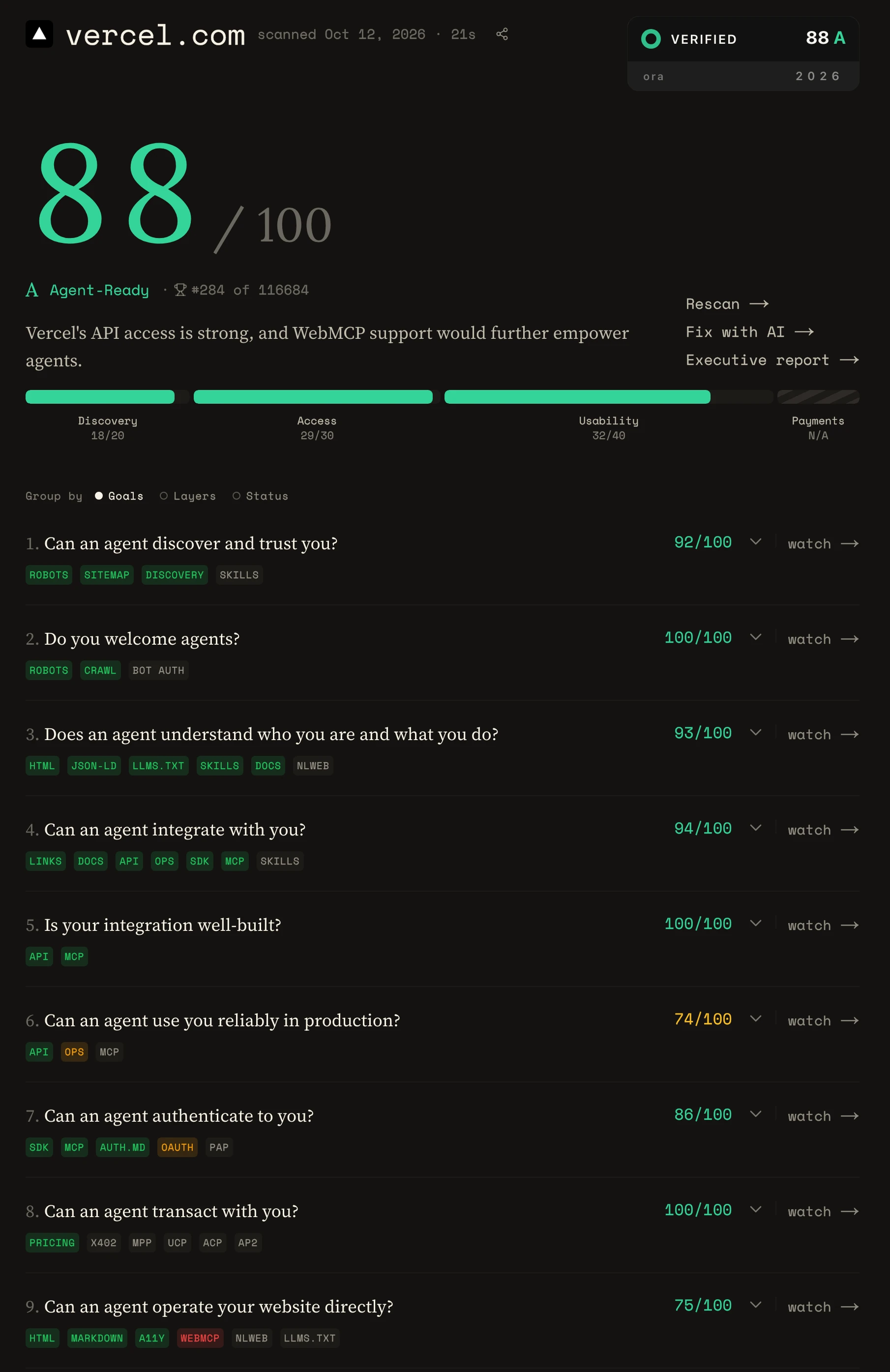
The scanners confirm that a pricing page exists. Whether the site states the security, hosting and integration facts customers require is the second part of the checklist below. Cloudflare's Is It Agent Ready? tests robots.txt, Markdown negotiation, bot authentication and protocols such as MCP and WebMCP, and Vercel's Is Agentic groups similar checks by site type. Both suggest a fix for each failed check, and Cloudflare writes its fixes as instructions to paste into a coding agent such as Claude Code or Cursor.
Run the checklist before the baseline and again after the fixes. The last column names the step that fixes each check. Checks 6 and 7 come last, because in Vercel and Ora's tests Markdown copies and llms.txt did not change whether an agent could retrieve an answer already in the HTML.
| # | Agent needs to | Check | Passes when | Step |
|---|---|---|---|---|
| 1 | Reach the site | Bot access | robots.txt allows OAI-SearchBot, Claude-SearchBot, PerplexityBot, Googlebot, Bingbot and user-triggered agents such as ChatGPT-User and Claude-User when tested per user agent, names the sitemap, and no CDN rule blocks AI bots as a class | 2 |
| 2 | Reach the site | Indexing | The homepage carries no noindex tag or header, and the sitemap lists every fact page | 2 |
| 3 | Reach the site | Crawler visits | Server logs show verified search-crawler and agent visits to pricing, security and integration pages in the past month | 2 |
| 4 | Reach the site | Status codes | Missing pages return a real 404 with a short Markdown or text body that links the sitemap, throttling returns 429 with Retry-After, public pages never answer with a 403 or a login wall, and redirects work without JavaScript or meta refresh | 2 |
| 5 | Read the page | Raw HTML | With JavaScript off, every fact page still shows its key facts, the homepage says what the company does in text under one H1, and each page passes Is Agentic's page token budget | 5 |
| 6 | Read the page | Markdown version (early practice) | A request with Accept: text/markdown gets Markdown back (with Vary: Accept), or each fact page links a .md copy from its head | 5 |
| 7 | Read the page | Linked discovery files (early practice) | llms.txt, and for API products the OpenAPI spec and MCP server card, are linked from the footer, the page head or a Link response header, not only placed at a known path | 5 |
| 8 | Understand the company | Category description | Asked what the company does and who it is for, ChatGPT, Gemini, Claude and Google AI Mode answer the way the category line does, and a search for the company's name returns its own site first | 6 |
| 9 | Understand the company | Identity markup and trust pages | Organization markup has contactPoint, address and sameAs, SoftwareApplication markup names the category and offers, every page sets its canonical URL and language, and About, Contact and Privacy pages are linked site-wide | 5, 6 |
| 10 | Confirm the facts | Pricing model | Model, billing unit and a price, range or starting point are in HTML text | 4 |
| 11 | Confirm the facts | Plans, limits and enterprise gates | Each plan's features, seat caps, usage and API limits are in text, and the plan that unlocks SSO, SCIM, audit logs and data residency is named | 4 |
| 12 | Confirm the facts | Integration depth | Each top integration has a page with type, data, direction, frequency and plan | 4 |
| 13 | Confirm the facts | Compliance and data residency | Each certification is named with its audit period, the DPA is linked and hosting regions are listed | 4 |
| 14 | Confirm the facts | Fit and non-fit | Use-case or industry pages say who the product is and is not for | 4 |
| 15 | Confirm the facts | Proof | Case studies name customers and give measurable outcomes | 4 |
| 16 | Confirm the facts | Agent fact test | A browser agent sent to find the price and each hard requirement on the site finds all of them, in a run watched step by step with a tool such as Ora's Journey | 4 |
| 17 | Confirm the facts | Consistency and coverage | Pricing, plan names and integrations match across the site, docs, review profiles and marketplaces, and independent comparisons name the product | 7 |
| 18 | Confirm the facts | Freshness | Every fact page shows a "last updated" date that matches the last change to its facts | 7 |
| 19 | Act | Labelled forms | Every demo and trial field has a visible label, buttons and inputs are native controls with accessible names, and no hidden text addresses agents | 8 |
| 20 | Act | Usable next step | A browser agent books a demo for a test persona up to the confirmation step, with no one stepping in | 8 |
How to measure agentic SEO
Once the checklist shows a site is ready, measurement shows whether the work pays off. It starts with which products agents pick and what they say about the product, then follows the traffic and pipeline that do arrive.
Track two numbers: Selection share is how often the product makes the shortlist on a fixed set of tasks, and fact accuracy is the share of requirements each engine states correctly. In the spend example, Payhawk's selection share was 5 of 5.
We tell CMOs to lead with selection share on prompts that state their customers' hard requirements, the one number that shows the comparisons the product lost. Prompt tracking gives direction, so we pair it with AI-sourced pipeline from the CRM.
Build a prompt panel from the requirement inventory
Both numbers come from a prompt panel, a fixed set of prompts written from the requirement inventory in step 3:
| Prompt type | Example from the VP Finance's request | Record on every run | Feeds |
|---|---|---|---|
| Category | "Best month-end close software for a 300-person company" | Mentioned? Shortlisted? Sources cited, own or third party | Selection share |
| Category plus requirement | "Month-end close software that integrates with NetSuite" | Shortlisted? The requirement stated right, wrong or missing | Selection share, fact accuracy |
| Comparison | "[Company] vs [alternative] for month-end close" | Each requirement: right, wrong or missing | Fact accuracy |
| Direct check | "Does [company] keep data in the EU?" | Yes, no or unknown, and the source cited | Fact accuracy |
| Price | "What does [company] cost?" | Price model stated? Correct? Source | Fact accuracy |
Start with one prompt per hard requirement plus the category and comparison prompts, a set small enough for a spreadsheet. Pairing each category prompt with a version that adds the hard requirements shows which requirements cost the product its place.
Broad prompts alone understate how often a specialist product is named. In our data, questions naming a segment, region or capability named the company in 10.4% of answers, against 4.4% for broad category questions. The specific questions did better for most companies that tracked both.

The gap can be total. One payments company appeared in 12 of 82 answers to questions that combined a compliance need with a region, and in none of the 1,144 answers to its broader questions.
Three rules keep monthly results comparable:
- Run each prompt three times per engine with memory off where possible, since answers vary between runs and ChatGPT may use saved memories when it rewrites a query.
- Treat a change as real only when it holds across two monthly runs.
- Expect a fix to show only after each index recrawls the page. OpenAI says robots.txt changes take about 24 hours to reach its search results; for a page change, rerun the panel after the logs record the crawler's visit.
Read platform reports and server logs
Beyond the panel, read the platform reports for direction, since each shows only what its own platform exposes. Bing's AI Performance report is the most useful, because it lists a sample of the grounding queries its AI wrote to find cited pages; set them next to the requirement inventory to see which requirements agents search for.
In server logs, trust a bot name only after verifying it, because user agent strings can be spoofed. Verified sessions also show agent-initiated conversions, such as demo or trial requests submitted by a signed agent like ChatGPT's cloud browser.
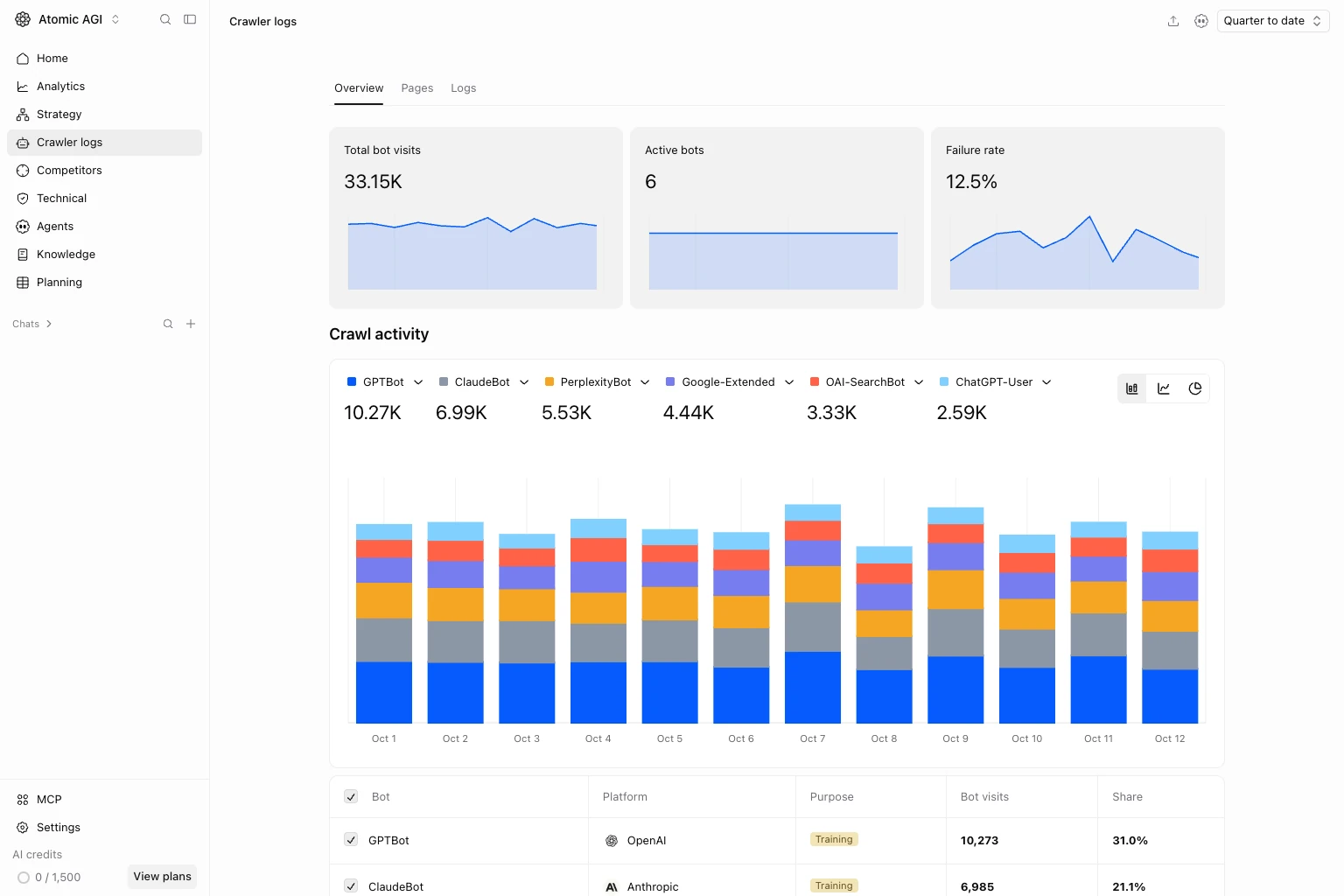
Atomic AGI's crawler logs, for example, break those visits down by platform, bot, page and HTTP status, so a team can see whether crawlers reach its fact pages and what the server returned.
Track AI-sourced pipeline in the CRM
The last measure is pipeline. Visits from AI arrive late, some of them as direct traffic, so analytics cannot show which answer sent them. Similarweb's traffic panel shows about six in ten ChatGPT-referred visits landing on a homepage, which reveals nothing about the question behind them.
Add AI assistant as an option in a required field on demo and trial forms that asks how the lead first heard of the company. Store it on the lead in the CRM and report that pipeline beside every other channel.
Each source answers a different question:
| Measure | What it shows | What it misses | How often |
|---|---|---|---|
| Search Console generative AI report | Impressions of links to the site in Google's AI features | Other platforms; mentions without a link | Weekly |
| Bing AI Performance | Citations across Copilot and Bing's AI summaries, and the grounding queries behind cited pages | Pages never cited; other platforms | Weekly |
| Server logs by verified bot role | Which crawlers and agents read which pages, including agent sessions on demo and trial pages | What the agent concluded | Monthly |
| AI referral sessions | Visits that arrive from AI assistants | Most agent reads, and AI-driven visits that arrive as direct traffic | Monthly |
| Self-reported attribution in the CRM | Pipeline from people who say they first heard of the company through an AI assistant | Precision; it depends on memory | Continuous |
Which agentic SEO mistakes cost SaaS companies the most?
Four mistakes undo much of that work, either keeping SaaS products out of agents' answers or putting someone else's facts in them.
- Contact sales as the only price fact. The agent cannot confirm budget fit from the vendor, so it quotes someone else's figure. In our close and contract-management answers, ChatGPT gave a labelled third-party estimate for every vendor it listed.
- Measuring AI by referral traffic only. Referral sessions miss the comparison that happened before the visit.
- Keeping a hard requirement in a sales deck or a gated PDF. An agent cannot confirm what it cannot read, so a certification stated only in a security questionnaire stays unconfirmed.
- Unsourced claims about competitors on comparison pages. After the blog, comparison and alternatives pages draw the most citations to a vendor's own site, with 26.9% in the Omnius datasets and 14.5% without the largest company. Answers quote these pages directly, so an unsourced claim about a competitor reaches the answer under the vendor's name.
How we approach agentic SEO at Omnius
As an SEO and AI search agency, we treat agentic SEO as infrastructure for how software is discovered, understood, selected and bought. The Omnius memo sets out why. Machines are moving from retrieving information to making decisions and then to completing transactions, and each step leaves less room for a company whose facts an agent cannot confirm.
How we think about agents
An answer engine sends a person to a page that can still persuade them. In an agent's loop the shortlist is the decision, so when the VP Finance's agent leaves a vendor off it, no landing page is left to recover the answer. That is why we start from the request an agent receives and work back to every page, profile and record that must confirm each requirement.
What we see in the data
A company can drop out of an AI answer at three points:
- Before retrieval: pages that are hard to crawl never enter the candidate pool.
- At reranking: pages with no semantic match to the request fall out.
- In the final answer: claims that read as self-promotional, lack corroboration or rest on weak entities are left out.
A page can also be the source of an answer that never names its company, and in 25.1% of the AI appearances we measured, the answer mentioned a brand without citing or linking to it.
How the work runs
One team runs the work from research to measurement, in four parts:
- Machine access: we set crawler and agent rules by role, serve facts in HTML and return status codes an agent can act on.
- Entities: our entity SEO work puts the company's facts into one record, each marked confirmed, inferred or still open, and maps claims that rest only on its own pages to the independent sources best placed to confirm them.
- Requirement facts: with sales and product teams, we list the hard requirements customers state and publish a fact block for each.
- Measurement: we track selection share and fact accuracy every month.

We measure selection share in Atomic AGI, the AI search product built inside Omnius, which tracks more than 11,000 domains across Google and the major AI engines. This guide's Omnius datasets come from the same tracking.
Frequently asked questions
How do AI agents find the websites they read?
Through search, then links. An agent turns a request into many searches, opens pages that rank in its platform's index and follows links within a site. In Vercel and Ora's study, 86-97% of fetches of files such as llms.txt came through a link, so a page no search ranks and no page links to stays unread.
Which AI agents matter for a B2B SaaS company today?
The ones that research and compare software for a person. ChatGPT search and ChatGPT Work, Claude Research and Claude in Chrome, Google's AI Mode with Deep Search, and Microsoft Copilot decide which products reach a shortlist. Always-on agents such as OpenAI's Dots run the same work unattended.
Do AI agents read llms.txt or need special markup?
Some agents read llms.txt; Google Search does not. In Vercel and Ora's study, agents reached llms.txt in about a third of runs, and 36% of those answers drew on it. Google's Search uses no llms.txt or other AI text files, and its AI features need no special structured data, so the facts have to sit in the page. On Google's Search Off the Record podcast, Danny Sullivan advised creators not to rush to break content into bite-sized chunks just to please LLMs.
Search Off the Record: Google's John Mueller and Danny Sullivan on SEO in the age of AI.
Should a SaaS company block AI agents and crawlers?
Block a training crawler only if keeping content out of model training matters more than what models learn about the company before any search runs. Google-Extended also covers grounding in the Gemini app and Vertex AI, leaving Google Search unaffected. Keep search crawlers and user-triggered agents such as ChatGPT-User and Claude-User allowed, since they act for a person, and verify agents instead of blocking them.
Do AI agents buy B2B software on their own?
Some do, inside limits a person sets. Ramp lets an agent buy with a company card under the spend limits and approval rules of the employee who connected it. AWS Marketplace's agent mode ends a software comparison with a purchase or a purchasing proposal. In G2's June 2026 survey, 9% of B2B decision-makers would let agents buy within approved guardrails and 2% without pre-approval. A person still approves most purchases, starting from the agent's shortlist.
Methodology
The evidence behind this guide:
- Omnius datasets. The datasets cover 111,337 citations across 19,832 tracked AI answers and the AI-referred sessions over 91 days to 11 October 2026, anonymised and aggregated. Where one company weighs heavily, the median or the figure without it is given too.
- Shortlisting examples. On 11 October 2026 we asked ChatGPT, Claude, Gemini, Google AI Mode and Google AI Overviews about five SaaS categories (month-end close, spend management, help desk, product analytics and contract management), each once as a plain category question ("What is the best [category] for [segment]?") and once as a request to shortlist three products with three hard requirements, 50 answers in all. Each prompt ran once per engine, and we read the requirement answers in full. Perplexity and Grok are left out because most of their runs returned no answer.
- Analysis. The order of the factors, the nine steps and the checklist are our analysis of this data and of the platforms' documentation.
- Recent developments. Each date is the announcement date on the primary source, checked on 13 October 2026.
- Readiness reports. The Ora and Is Agentic reports shown are stored snapshots from 12 October 2026. A rescan moves them.
- Limits. The examples show AI answers to shortlisting requests, not agents completing delegated tasks. Each prompt ran once and answers vary between runs, so they show the pattern without measuring how often it occurs. The dataset figures describe the companies tracked in them.
- Other sources. Agent behaviour comes from OpenAI, Anthropic, Google and Microsoft documentation. Third-party figures come from Cloudflare, which sells bot management and measures traffic across its network; G2, a software review marketplace; 6sense, which sells revenue intelligence software; MKT1, a marketing newsletter; Vercel, which hosts websites, and Ora, which sells agent-readiness scoring and ran the agent study with Vercel; Ahrefs, which sells SEO tools; Stripe, which sells payments infrastructure; Gartner, which sells research and advisory; Similarweb, which sells traffic intelligence; and Pew Research Center.
Sources
The documentation and studies behind this guide:
- OpenAI: Searching the web with ChatGPT, overview of OpenAI crawlers, ChatGPT release notes, using cloud browser in ChatGPT and cloud browser allowlisting
- Google: AI Mode update, AI features and a website, JavaScript SEO basics, Organization structured data, user-triggered fetchers and agent-friendly site UX on web.dev
- Anthropic: How we built our multi-agent research system and Model Context Protocol
- Other platforms: Brave Search crawler, Bing AI Performance report and Cloudflare on mixed-use AI crawlers
- Recent developments: WebMCP origin trial, Visa Agent Score, Stripe Projects update, Natural's Series A and OpenAI's Dots launch
- Surveys and market data: Cloudflare's agentic internet report, G2's answer economy research, G2's 2026 Buyer Behavior Report, Gartner's 2026 predictions, Pew Research Center on AI summaries, Ahrefs on fresh content, Similarweb's AI traffic data, MKT1's state of marketing report and 6sense's 2025 Buyer Experience Report
- Vendor pages checked: Ramp's Europe page and Payhawk's trust portal
- Agent payments: Visa Intelligent Commerce Connect, Mastercard Agent Pay trust services, Ramp agent payments and AWS Marketplace agent mode
- Studies, tools and evidence pages: Vercel and Ora's agent study, Is It Agent Ready?, Is Agentic, Ora, Ora's report for vercel.com and Atomic AGI's crawler logs


.png)

.svg)
















.svg)



























.svg)