.png)

SEO and PPC work differently, but in SaaS, they end up on the same buyer. Someone reads your comparison post while researching, leaves, sees your ad a week later, comes back through a branded search, and finally books a demo.
The difference is structural: SEO is a compounding investment that can keep paying off after you ease up, while PPC delivers instantly but stops the moment you stop spending.
SaaS acquisition isn't one click. It's a long stretch of research and approvals, and each channel covers a different part of it. So the real question isn't which wins, but how the two fit together for your company, and how much each should get.
This guide breaks down how SEO and PPC compare for SaaS: where each one wins, where it falls short, what they actually cost, and how the right mix shifts as your company grows.
How SaaS buyers actually make decisions
SaaS rarely gets bought on impulse. Committing to a tool means a recurring cost, a migration, and the risk of looking bad if it goes wrong.
So buyers research:
- they compare features,
- read reviews,
- pull in colleagues, and
- quietly rank you against two or three competitors before they ever fill out a form.
Most of that happens before sales is involved. Gartner's B2B buying research found buyers spend only about 17% of their time with potential vendors, doing the bulk of their research on their own and consuming a stack of content along the way. By the time someone books a demo, they've usually already decided whether you're a serious option.
That changes what each channel is for. Early on, buyers search for their problem, not your product: "why our onboarding completion keeps dropping." That's SEO territory, and it's also where you can shape the criteria they'll judge you on later. Closer to the decision, the searches get specific: "[competitor] alternative". Intent is high, and that's where both can help: SEO and PPC.
The same person often passes through both, finding you through a blog post in week one and clicking your ad in week four.
SEO for SaaS
SEO for SaaS isn't about pumping out blog posts or stuffing keywords onto a page. That approach stopped working years ago. What matters now is building real authority around a focused set of topics, so that when a buyer searches, you're the source that answers them.
It's easy to box SEO in as a top-of-funnel research play, but that undersells it. Yes, it captures early problem-aware searches like "why our onboarding completion keeps dropping." It also ranks for the high-intent terms further down the funnel: "[competitor] alternative," "[category] pricing," "best [tool] for [use case]." Those are the searches closest to a purchase, and owning them organically means you're capturing demand without paying for every click.
That's what makes SEO a long-term revenue engine rather than just a traffic source. Once a page ranks across that full range of intent, it keeps pulling in qualified buyers month after month on the same upfront investment. Lower cost per acquisition over time, compounding as your library grows. Organic results also read as earned rather than paid, so buyers tend to trust them more, and that trust is part of why organic traffic usually converts better than paid over the long run.
The catch is time. SEO can take months to gain traction, especially on a newer domain, and it needs steady content and technical upkeep to hold rankings. It's competitive, and nothing is guaranteed. It's a durable growth engine, not a quick source of leads.
PPC for SaaS
PPC gets dismissed as "buying traffic," but for SaaS, it's really a speed-and-precision channel. It puts you in front of high-intent buyers immediately and gives you fast feedback on what's working, which is something SEO can't do in the early months.
It's strongest on high-intent searches where the buyer's intent is obvious: branded terms, competitor searches, product-specific queries, and retargeting. Someone searching "best CRM for startups free trial" isn't researching; they're shopping, and PPC catches them at that moment. For an early-stage company, it's often the fastest way to learn which messages land and which audiences respond, since every campaign doubles as a market test.
The other advantage is control. You can turn campaigns on or off, shift budget, and test new positioning without waiting months for results. That makes PPC useful for launches, repositioning, defending your brand terms against competitors, and testing new markets before committing to them.
The limits are just as clear. Clicks in SaaS are expensive, often $5 to $50 and well above $100 in competitive categories like fintech and HR.
The bad side is that cost scales directly with volume, so the leads stop the day the spend does, with no residual value. PPC works when it's pointed at high-intent searches and backed by landing pages that actually convert. Run it as "switch on Google Ads and scale," and it's mostly a way to burn budget.
SEO vs PPC - Side-by-Side Comparison
The two channels stack up differently across the things that actually matter for SaaS. Here's the short version before we get into cost and timing.
The general difference is speed versus durability. PPC buys you visibility instantly and gives you full control over it, but that visibility lasts only as long as the budget does.
SEO is the reverse: slow to build and harder to control, but once it's working, it keeps producing on the investment you've already made.
PPC is traffic you rent; SEO is traffic you own. That single trade-off sits underneath every row in the table, and it's why the two tend to fit different stages rather than compete head to head.
Cost and ROI: Where the Lines Cross
SEO and PPC don't just cost different amounts; they cost on different schedules, and that's what decides which one is cheaper for you.
PPC's math is simple and immediate. You pay per click; every click has a price, and your cost per lead stays roughly flat no matter how long you run. Spend more, get more; stop, and it's gone. There's no point at which yesterday's spend keeps working for you today.
SEO front-loads the cost instead. You're paying for content, technical work, and authority-building well before the traffic shows up, so early on your cost per lead looks bad compared to PPC. But once pages start ranking, that same work keeps producing leads without the per-click bill, and your cost per lead falls month after month as the library compounds.
PPC clicks in SaaS commonly run $5 to $50, and north of $100 in competitive categories, billed every time, ongoing. SEO programs often run $3,000 to $15,000 a month, but that spend builds an asset instead of renting attention.
On conversion, organic converts at around 2.1% for B2B SaaS, compared with roughly 1.0% for PPC. Across all industries, the gap is narrower, about 2.4% organic to 1.3% paid, so treat the wider SaaS spread as directional rather than exact.
The pattern holds either way: organic tends to convert better compared to paid in the long term.
So where do the lines cross? SaaS analyses put the point at which SEO gets cheaper per lead somewhere between months 3 and 12.
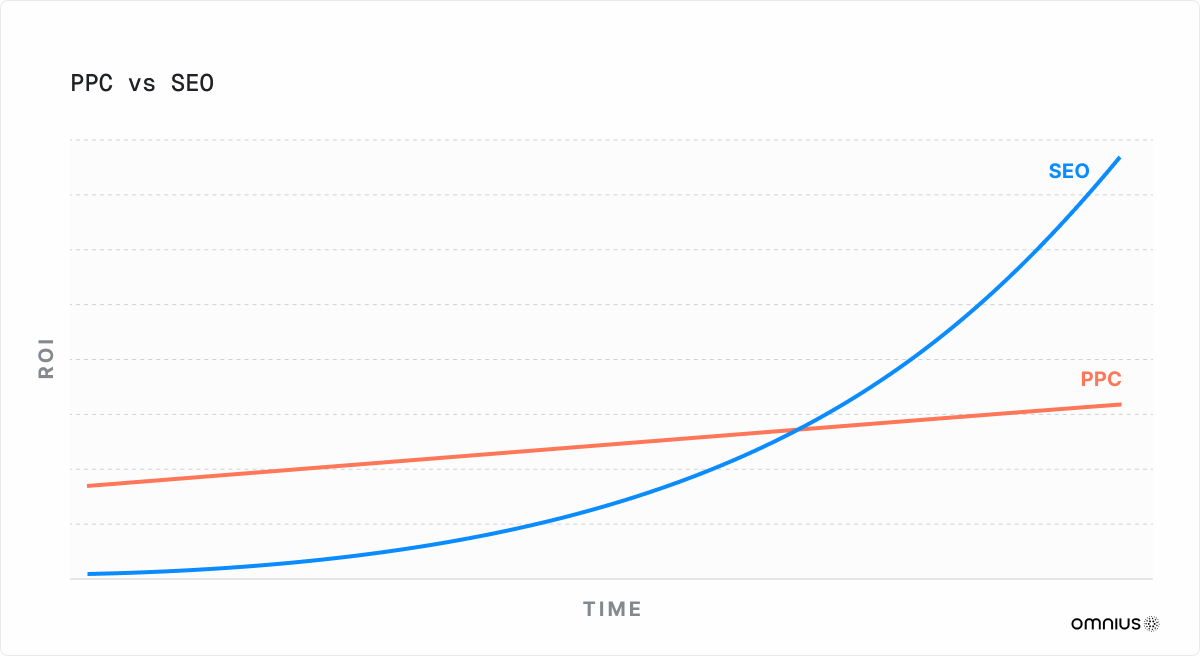
Treat that as a common example, not a rule. There are cases where it can be much faster. A new domain in a crowded category can take far longer; an established site with real authority can cross much sooner.
That's the part worth holding onto: there's no single formula.
How to Choose the Right Channel for Your SaaS?
There's no universal answer, but a few questions narrow it down fast.
How soon do you need pipeline? If you need it this month, PPC is the safer bet - it delivers right away, while SEO usually takes months to build. SEO can move faster on an established domain or low-competition terms, but you can't count on it for immediate pipeline the way you can with PPC.
Are you building for the long term? If you're playing for durable, compounding growth and lower acquisition costs down the line, SEO has to be part of the plan. It's the only one of the two that keeps producing on work you've already paid for. PPC alone means renting your pipeline forever.
How long is your sales cycle, and how big is the contract? Long cycles and high contract values reward SEO, because buyers spend months researching and your content can be there the whole time. Short, low-touch sales lean more on PPC's immediacy.
When to use SEO and PPC combined?
For most SaaS companies, the real answer isn't picking a channel - it's running both and letting each do what the other can't. The questions above tell you where to start and how to weight the budget, but the strongest setups don't treat that weighting as a permanent choice. They use PPC and SEO together, then adjust the balance as the company grows.
The logic is simple. PPC gives you speed and certainty now; SEO builds an asset that lowers your costs later. Run only PPC, and you're renting pipeline forever, paying the same price for every lead with nothing accumulating underneath.
Run only SEO, and you're blind for the first several months, with no way to test messaging or capture ready-to-buy demand while you wait for rankings. Each channel's weakness is the other's strength, which is exactly why they belong together.
They also reinforce each other in the background. The trust you build through organic content makes your ads more likely to get clicked, and showing up in both the paid and organic results for the same search gives you more of the page and crowds out competitors. A buyer who's seen you in a blog post is warmer when they later hit your ad.
The split should shift over time. Early on, lean PPC for speed and learning. As your content compounds, let SEO carry more of the load and keep PPC focused on launches, brand defense, and high-intent capture. The mix is the strategy.
Conclusion
Choosing between SEO and PPC isn't a channel decision; it's a pipeline decision. PPC earns its place when you need speed, but it stops the day you stop paying. SEO is what builds you an asset: organic visibility across the full buyer journey that keeps producing long after the work is done, at a lower cost per customer the longer it compounds.
For most SaaS companies, the smart play is both, weighted to your stage. Lean on PPC early for speed, then let SEO carry more of the load as your content compounds and your acquisition costs fall. The companies that win stop treating the two as rivals and treat the mix as the strategy.
But make no mistake about which one drives durable growth. PPC rents you pipeline; SEO builds it. The longer you wait to start, the more your competitors own the searches that should be yours.
If you're serious about building SEO into a pipeline engine that lowers CAC and keeps producing year after year, book a 30-minute call to map out where the biggest organic opportunities are for your SaaS.


.png)

.svg)
















.svg)



























.svg)
%20for%20B2B%20SaaS%20%5BFull%20Guide%5D.webp)

.webp)