.png)

Generative engine optimization KPIs and metrics are data points brands use to measure how often they’re cited by AI engines and what impact that has on the business.
Linked citations are meaningful indicators of AI visibility, yet they’re overlooked. When an AI engine cites your website as a source, that indicates it finds you credible and prefers you over many others who published for the specific query. According to the Edelman Trust Barometer, 47% of UK B2B buyers trust a Perplexity citation as much as a Reuters or FT mention.
But how do you get there?
No matter the strategies you implement, tracking progress allows you to make meaningful, targeted adjustments. A lot of advice exists online. But you won’t know what actually works for your specific case without ongoing measurement.
This guide breaks down the main generative engine optimization (GEO) metrics and KPIs, along with additional metrics to help you fine-tune your growth strategy.
Key Takeaways
- Standardize before you measure. Build a fixed set of 20-30 prompts, run it monthly per engine, and pull averages from multiple runs to cut through the volatility inherent to AI responses. Stick to AI Overviews, AI Mode, and Perplexity for citation tracking, since they cite by default.
- Check crawlability first - it's the precondition for everything else. If your robots.txt or Cloudflare settings block AI bots, no amount of content or authority work will get you cited, because the engines can't retrieve you in the first place. Audit access before treating low citation numbers as a content problem.
- Interpret citation rate, position, and share together. Rate shows whether you're selected, position shows how prominent you are, and share shows whether you're winning the category or just rising with it. Pair them with mention rate to get a fuller picture of your AI visibility, since GEO and AEO efforts reinforce each other.
- Source page distribution and persistence reveal whether your visibility is durable. Distribution flags fragile single-page reliance and shows which page structures to replicate. Persistence separates lucky one-off citations from compounding visibility.
- Clicks, conversions, and session time connect GEO to revenue. Read these together per platform to decide where to invest. Still, remember that these numbers capture only one aspect of AI’s influence. Being recommended without a link can lead to significant visibility we can’t always measure.
Author’s note: Many sources use the term GEO to describe any effort to improve AI search visibility. Others, including Omnius in this article, consider it a sub-discipline that focuses on landing in AI’s citations and separate it from answer engine optimization (AEO), which focuses on getting mentioned within answers. Check out this guide to learn about AI search visibility metrics in general.
Understanding GEO: A Brief Recap
Queries in the B2B SaaS industry generally trigger retrieval-augmented generation (RAG). In this process, AI crawls a broad pool of online content to generate an answer rather than relying on training data. For complex queries, engines may first perform query fan-out, breaking the prompt down into subqueries before retrieval.
Once it gathers relevant sources, the engine will rank them and form the answer. Only a small number of pages are retrieved, and even fewer get a citation. ChatGPT, for example, surfaces only 15% of the sources it discovers, according to a 2026 AirOps study. Depending on the engine and specific query, the reference may or may not include a link.
How To Get Cited With a Link
Each AI engine has a distinct selection process, but they generally favor content with the following attributes:
- New and updated content, and current metadata
- Deep coverage of the topic and real user queries
- Clear content structure and scannability
- Properly attributed statistics and quotes
- Proprietary data not found elsewhere
Engines also consider third-party brand authority signals when evaluating you as a source.
In our Q1 2026 AI search analysis, we found that Reddit, LinkedIn, and YouTube are the leading AI citation sources. For niche queries, sources may also include G2 or industry publications. Being mentioned across these sources signals to AI that your content is trustworthy and increases your chances of being cited.
Still, for an engine to even consider you for retrieval, its crawlers need to have access to it. Many brands unintentionally block bots in their robots.txt file or Cloudflare settings.
To end up in AI’s citations, it’s essential to manage all of the above, including technical, content-related, and brand-authority factors. According to Google’s latest guide on AI, only pages that are fully optimized and high-quality across the board are considered for selection.
Continuously measuring progress and making targeted improvements allows you to get surfaced faster and stay visible for longer.
The Mention-Source Gap and How To Address It
The terms mention and citation are often used interchangeably, but being mentioned in the answer and being cited as a source are two different things. Landing one without the other can be problematic:
- If an AI engine mentions your data but doesn’t cite you as a source, it doesn’t give you the proper credit.
- If an AI engine cites you as a source but recommends your competitor, that means you inform the answer without winning the buyer.
Tracking both citations and mentions, as well as qualitative metrics like context of mention, is necessary to get a fuller and more accurate picture of your brand’s AI visibility.
Additionally, not all engines produce linked citations, and this can also depend on the type of query.
AI Overviews, AI Mode, and Perplexity produce linked sources by default. Perplexity generally has the highest citation density of all engines, with 8.2 citations per response on average (MarGen, 2026). Models like ChatGPT, Gemini, and Claude occasionally provide citations in browsing mode.
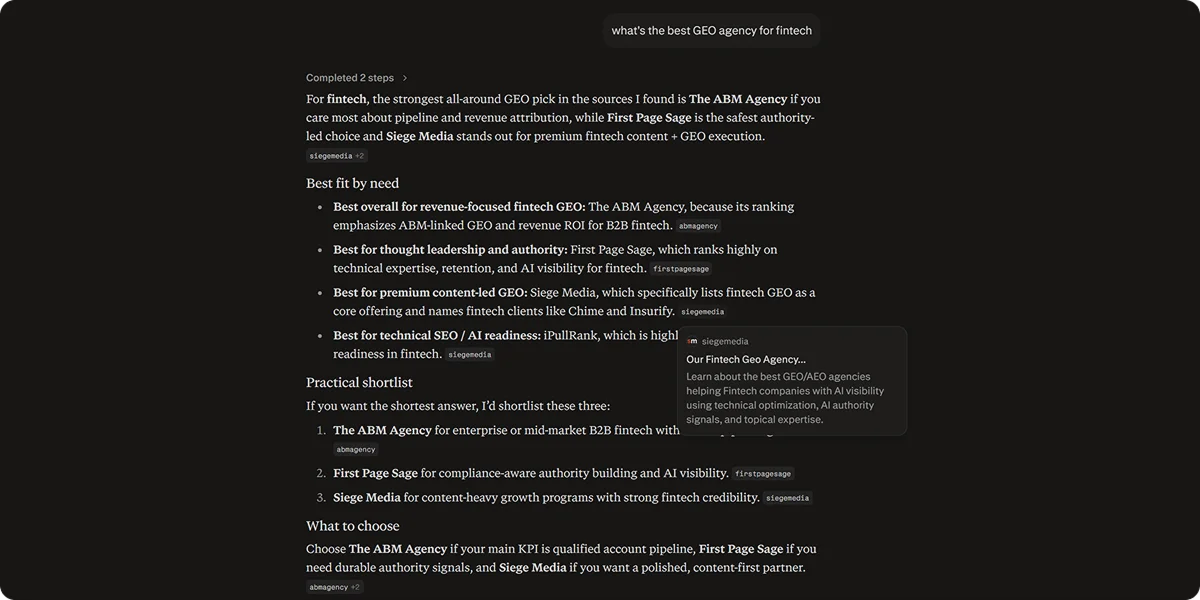
When tracking citations specifically, it’s best to stick with AIO, AI Mode, and Perplexity because they allow your samples to stay consistent and comparable from one measurement to the next.
7 Generative Engine Optimization KPIs and Metrics
You can measure GEO metrics and KPIs manually or automate the process with tracking tools like AtomicAGI, which show you the sources that were used for each prompt.
Regardless of your method, you need to standardize your tracking process. Since there are no industry benchmarks and responses vary with each prompt, you should build a set of 20–30 queries and measure against it each month.
If you decide to measure manually, run the query set multiple times for each engine, as each response is unique, and pull the averages. Compare month-over-month to gauge progress.
Make sure to measure GEO metrics alongside overall AI visibility metrics like mentions, share of voice, and AI-referred traffic and conversions. Citations alone don’t give an accurate picture of GEO success, as GEO and AEO efforts overlap significantly.
Here’s an overview of the KPIs and metrics we’ll cover in the article:
Site Crawlability
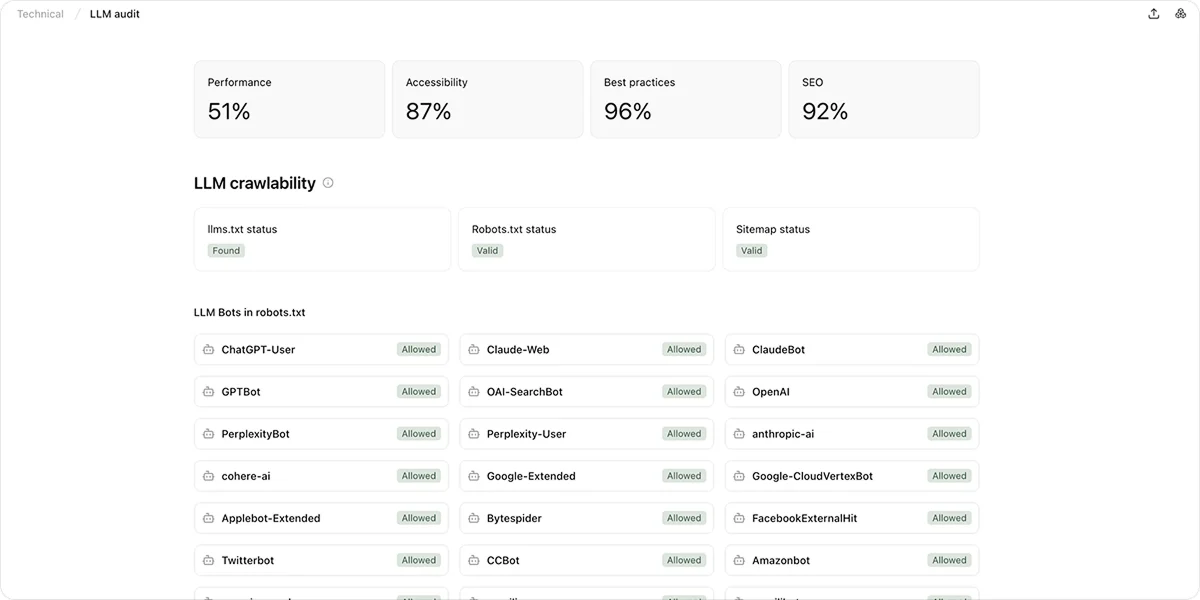
Monitoring crawlability shows you whether AI search engine crawlers can access your website. If your robots.txt file or Cloudflare settings block any AI bots, they won’t be able to retrieve your content.
You can evaluate crawler access by checking your settings, but there are also several tools that let you view specific bot activity.
For example, total crawler requests points to overall access volume, while unique pages crawled evaluates URL coverage. Error responses indicate broken pages and other technical issues that prevent retrieval.
Pro tip: Use AtomicAGI to get an in-depth breakdown of your website’s crawlability, parseability, trust signals, and technical health. The tool crawls your website similar to an LLM bot, evaluates it, and summarizes the information into clear, direct insights to optimize your website for all engines.
Citation Rate
Citation rate is the percentage of relevant prompts where an engine cites your domain as a linked source. This is the core GEO metric, and reveals how often you appear as a source.
The calculation: No. of prompts where you're cited ÷ total tracked prompts × 100
Read citation rate as a trend line. What matters is direction - a rate climbing month-over-month against a frozen query set means your GEO work is landing.
A low but stable rate indicates that your content is not being selected at all, probably due to a content or authority gap. A high but volatile rate indicates inconsistent selection and fragile positioning, which is the cue to look at persistence.
Note that a sudden drop usually isn't your fault. It could occur due to a model update, a retrieval-index shift, or a competitor's new content. Investigate the cause before reacting.
Citation Position
Citation position shows where you appear in the citation list relative to other sources, averaged across tracked prompts over time. It indicates how you’re ranked as opposed to whether you’re ranked at all, offering a more granular insight into your GEO success.
The calculation: Average position per tracked prompt over time (e.g., first or second source)
Position matters because earlier-listed and more prominently surfaced citations generally capture more attention and clicks than the ones buried lower in the source list. Citations are scarce, and AI referral volume is overall low, so early placement could be the difference between meaningful traffic and none.
Here’s what Adam Gnuse, an SEO Content Manager & Analyst, wrote for Search Engine Land:
“The CTR curve shows a steep decay, so that by AI Overview citation 4 or 5, your link basically doesn’t exist.”
If your position is poor for a given prompt, the engine sees you as corroborating evidence rather than the primary authority on that topic. This is usually a signal that a competitor's page is more directly on-point or more thoroughly covers the query than yours.
Citation Share
Citation share is a competitive metric, and it shows how much of the citation real estate your brand occupies in relation to your competitors.
The calculation: Your brand's total citations across all prompts ÷ all brand citations (yours + competitors') across the same set × 100
Share is the metric that keeps citation rate honest. Your rate can rise while your share falls. Read this metric as competitive position:
- A rising share means you're taking source slots from rivals.
- A flat share with a rising rate means a rising tide, not necessarily an edge.
Because engines cite only a few sources per response, share is close to zero-sum. It's the number to put in front of stakeholders who want to know whether you're actually winning the category.
Source Page Distribution
Source page distribution reveals how many citations your individual pages are earning.
A healthy profile has citations spread across multiple pages. A profile where one page carries all your visibility is fragile, because your whole presence drops if that page drifts out. When you know which pages are citation-worthy, you can replicate their structure on pages that should be winning but aren't.
Citation Persistence
Citation persistence shows you how many consecutive measurement periods you stay cited for the same prompt, and whether your visibility compounds or evaporates. This metric addresses the single biggest problem in GEO measurement: volatility. Ahrefs’s data scientist, Xibeijia Guan, found that around 45% of cited sources change from one Google AIO to the next.
A strong one-time citation rate can be misleading. Persistence captures whether visibility is durable rather than a single lucky snapshot.
AI-Referred Traffic
Linked citations directly drive referral traffic, while a mention with no link drives visibility in ways you can't see in analytics. The volume of traffic from AI citations is generally low, accounting for only 1.08% of all website traffic across 10 industries, but the quality of this traffic makes tracking it a top priority.
In the B2B context, 89% of Perplexity users click at least one citation link per session to verify the AI's answer (MarGen, 2026). Those Perplexity-referred sessions yield a 3.1x higher conversion rate and a 4.7x higher session duration than traditional, non-branded Google organic search traffic.
Most importantly, traffic and conversions allow you to connect search metrics with revenue impact and justify GEO investments to non-technical stakeholders.
There are a few caveats here. Clicks from LLM-based systems are meaningful, but they capture only a fraction of the influence AI search has on user decisions and brand consideration. Citations and mentions put you in front of customers, but recommendations help close more deals.
Also, GA4 bundles traffic from all sources by default. You need to segment your GA4 data by referrer (e.g., perplexity.ai) to isolate AI-referred sessions.
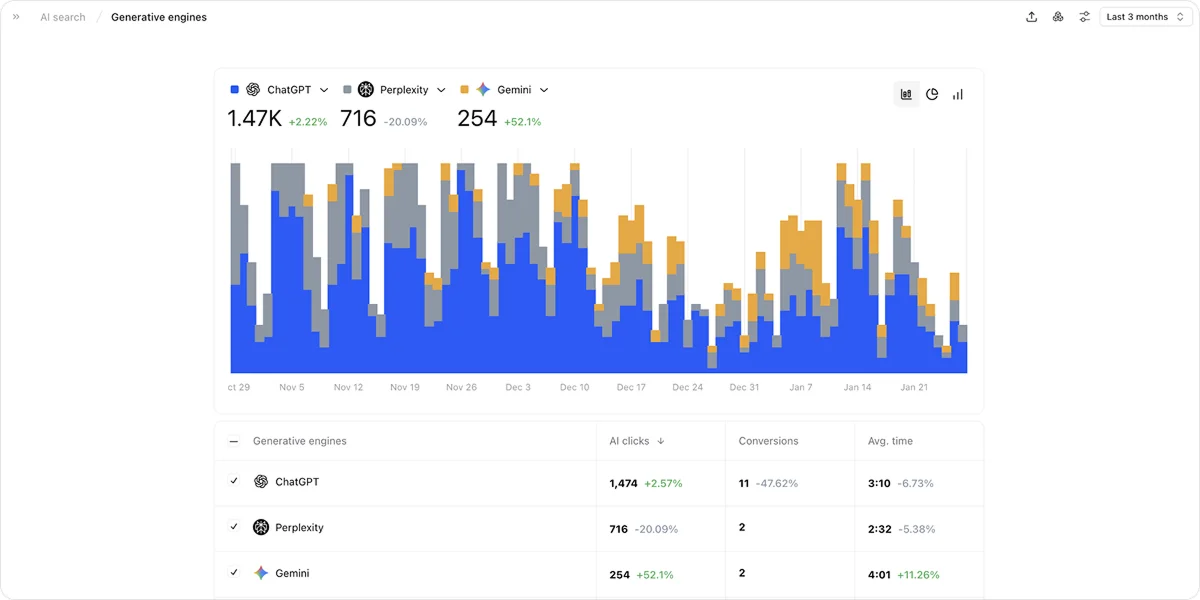
Pro tip: AtomicAGI’s dashboard makes it easy to understand how much each AI platform contributes to your performance. You get a simple breakdown of per-platform clicks, conversions, and average session time, including a graph to gauge progress over time.
Interpreting GEO Traffic Metrics
Read traffic-related numbers together to understand where to invest.
A platform with low traffic but strong conversion is an underexposed good fit, so you should work on lifting your visibility. A platform with high traffic but weak conversion is sending the wrong audience - fix the landing pages and framing before pursuing more of it, or deprioritize. Where you already convert well, doubling down is the lower-risk near-term play.
Remember that these numbers only capture linked-citation traffic. A platform where you earn mentions without links will look weak here while still shaping consideration you can't see, so never base your decisions on clicks alone.
Here’s a quick interpretation guide for individual traffic-related metrics:
Parting Words
GEO success can’t be measured with any one metric in isolation. You need to track several metrics, including citation rate and AI-referred traffic, to get the most realistic picture of your performance. Additionally, none of this will work unless you have a clear query set, track against each engine, perform multiple runs to combat volatility, and repeat each month.
That's a lot of moving parts to stand up and maintain. If you’d prefer to focus on your product and delegate GEO to experts, Omnius can help. We’re a B2B marketing agency that handles SEO and LLMO end-to-end, from the content and authority work that earns citations to the measurement that proves it's working.
Frequently Asked Questions
What is generative engine optimization?
Generative engine optimization (GEO) is the practice of optimizing your website to be cited as a linked source in AI-generated answers from engines like Google AI Overviews and Perplexity.
In this article's framing, it's distinct from answer engine optimization (AEO), which targets being named or recommended within the answer text itself. GEO is about being the source the engine draws from; AEO is about being the brand it recommends.
What are the key GEO KPIs and metrics to track?
The core four GEO metrics and KPIs are:
- Citation rate: How often you're cited
- Citation position: Where you rank among sources
- Citation share: Your slice versus competitors
- Citation persistence: Whether it holds over time
Supplement these with source page distribution, plus mention rate and AI-referred traffic to connect citations to recommendations and revenue. Track everything against a fixed query set, per engine, over multiple runs and periods.
How do GEO, AEO, and SEO metrics differ?
SEO metrics measure ranking and clicks in traditional search. GEO metrics measure whether you're cited as a linked source in AI answers, and AEO metrics measure whether you're mentioned in the answer text.
These metrics overlap in practice. The same content and authority work tends to move all of them. Strong SEO performance lifts GEO and AEO results. Tracking one without the others gives an incomplete picture.


.png)

.svg)
















.svg)



























.svg)

%20for%20B2B%20SaaS%20%5BFull%20Guide%5D.webp)
.webp)