.png)


Stripe is one of the most influential fintech companies of the last decade.
Known for simple APIs and enterprise payment solutions, Stripe quietly built something equally powerful behind the scenes: a world-class SEO engine that attracts millions of high-intent visitors every month.
In this deep dive, you’ll learn:
- How Stripe structures its SEO strategy
- Why their content performs so well
- What real numbers show about their growth
- How to apply Stripe’s SEO strategy to build your traffic, especially non-branded traffic focused on conversions
What is Stripe?
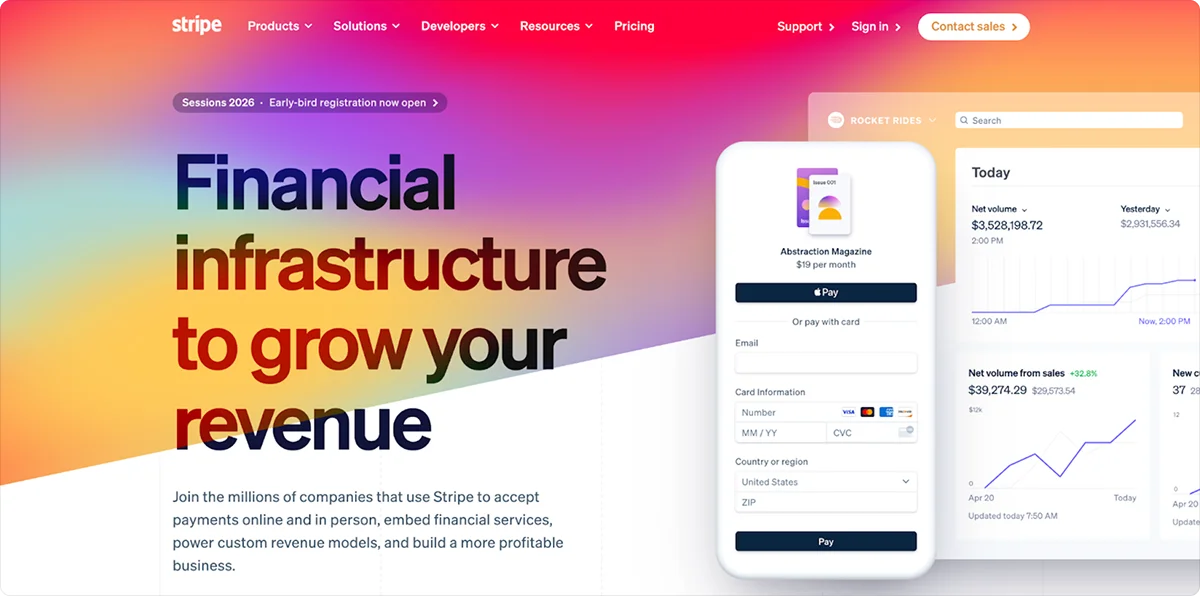
Stripe is a global payments platform that allows businesses to accept online payments, manage subscriptions, handle payouts, and run financial operations. It’s widely used by startups and enterprises because it combines easy‑to‑use APIs with powerful financial infrastructure.
Today, Stripe serves businesses in over 40+ countries and powers payments for more than 1.5 million websites.
Why Stripe’s SEO Strategy Matters
In 2024 alone, the company processed $1.4 trillion in payments - up 38% year-over-year.
And just recently, Stripe had the largest four-day period since its founding, with over $40 billion in volume across 578 million transactions:
But what many don’t see is how much organic search supports this growth.
Stripe ranks for hundreds of thousands of keywords, dominates high-value payments queries, and leverages educational content to attract businesses long before they even consider setting up payments.

As a global fintech infrastructure with many possible services and use cases, SEO gives Stripe a scalable, low-cost, high-leverage marketing channel with over 3.8 million monthly search traffic, according to Ahrefs.
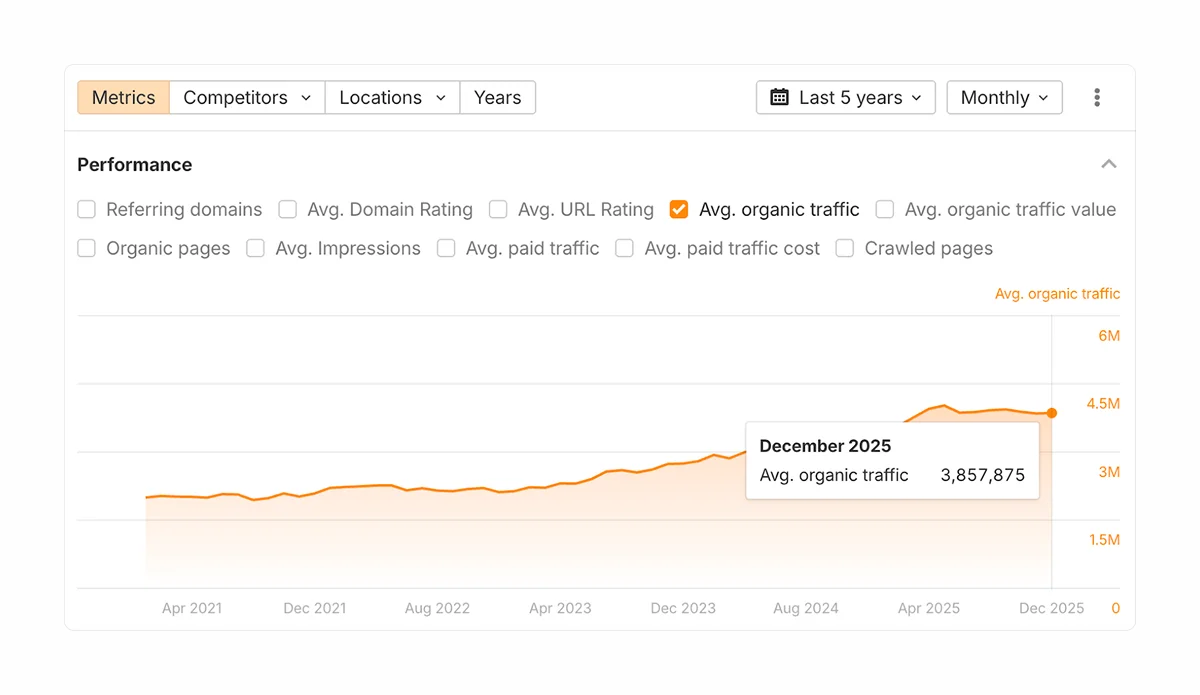
Paid ads alone would be unsustainable at their scale - organic search provides consistent, compounding growth.
According to SimilarWeb, organic traffic is their next-largest source of visits, after direct and referral traffic.
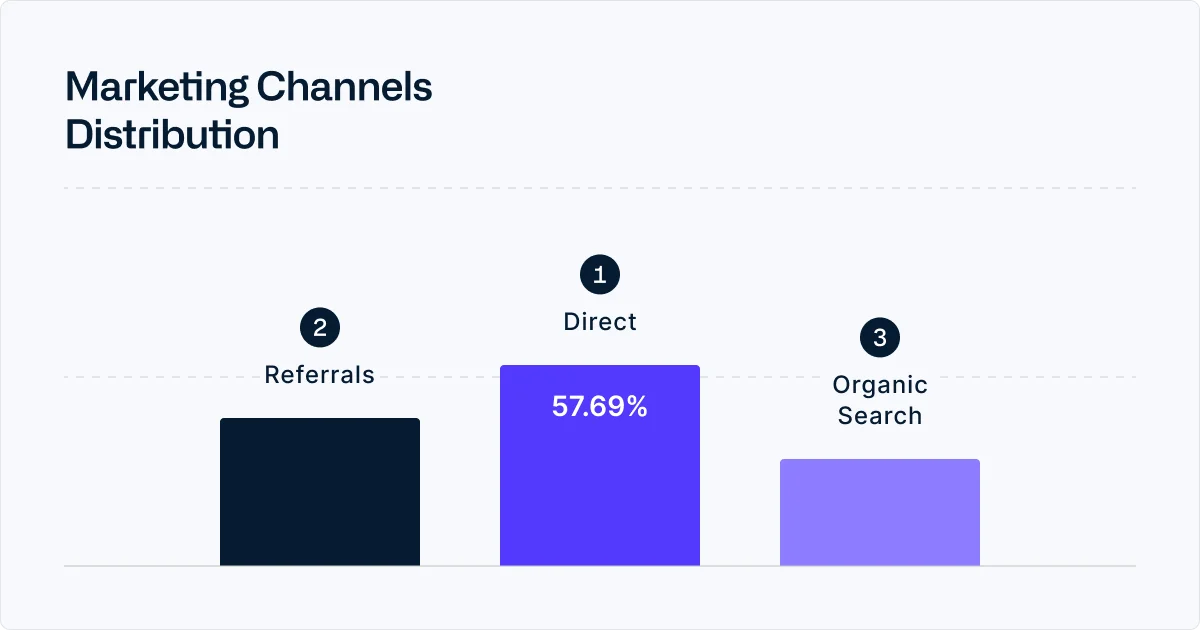
Stripe’s SEO is not accidental - it’s a masterclass in structure, intent, and compounding value.
That’s why we’ll dive deeper into their SEO strategy to help you understand how they attract growth and how you can implement it for your business.
Stripe’s SEO Strategy Foundation: Intent-Driven Site Architecture
Most businesses structure their pages around what their product can do.
Instead of focusing content solely on features, Stripe focused on mapping the high-value, intent-driven keywords across the right pages on its site - ensuring the terms potential customers care about are placed exactly where they belong.
Their Homepage Captures Broad, Category-Defining Keywords
On their homepage, Stripe targets high-level, broad keywords such as “online payment processing”, “accept online payments”, and “financial infrastructure.”
That helps Stripe anchor their core value proposition in search.
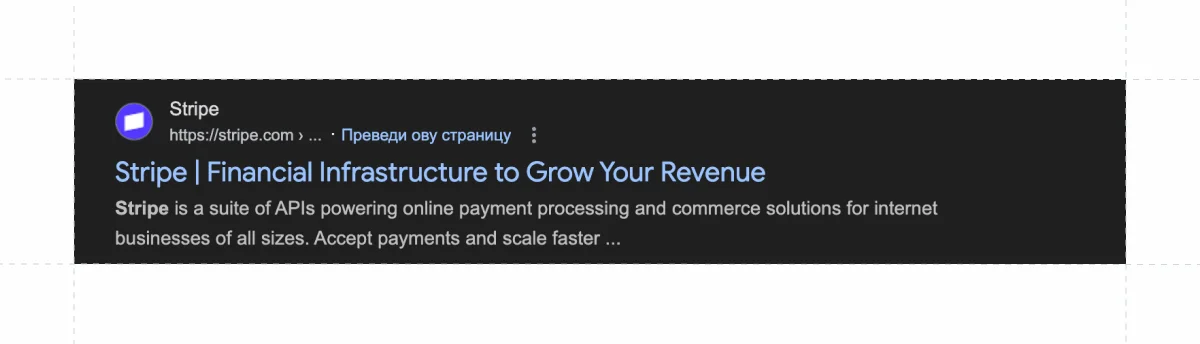
These broad searches signal users who are early in their buying decision. By ranking for these terms, Stripe consistently reaches businesses in the discovery phase.
This gives Stripe a massive, consistent stream of new, high-intent traffic.
Then, based on it, they’re further narrowing the product pages to target specific keywords related to their features.
Product Pages Target Mid-Intent, High-ROI Queries
Stripe avoids dropping multiple unrelated keywords into one page. Instead, each product (or major service) gets its own dedicated page optimized for a relevant keyword, such as:
- Payment processing
- Online credit card payments
- Subscription billing
- Marketplace payments
- Fraud detection
- Invoicing software
Each page targets a primary keyword and a cluster of secondary keywords that match the same user intent.
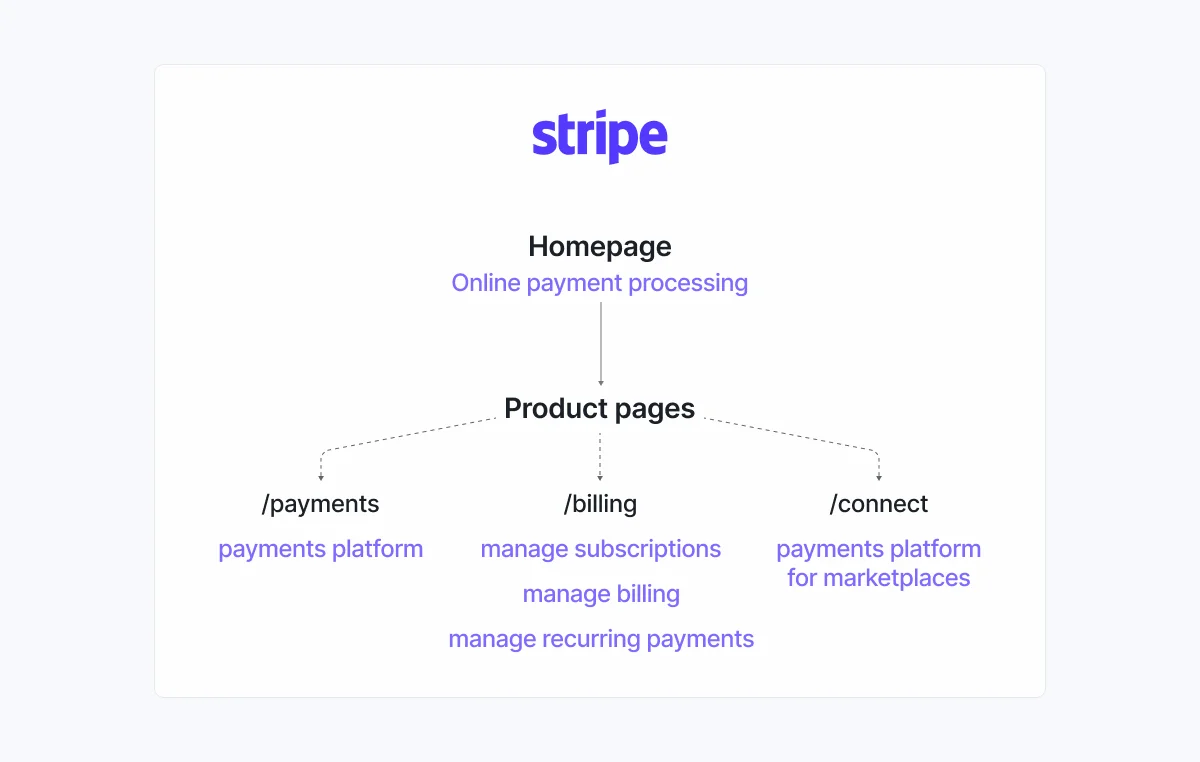
This is why Stripe ranks highly for broad and competitive terms — because each page is laser-focused.

Why is it important that keywords are placed on multiple pages instead of putting them all into a single one? Well, this is because it becomes difficult to optimize for more than two keywords on a single page.
The reason you can’t optimize one page for more than two keywords is because:
- You need to add the keywords to the main SEO sections (e.g., the page title), and it’s difficult to add more than two due to length limitations.
- The content of the page needs to be specific around the topic to rank well. If you try to optimize the page for non-relevant keywords, the content won’t be specific enough for search engines and LLMs to rank you.
Also, Stripe’s product pages convert exceptionally well because they combine:
High-value keyword targeting + strong product storytelling.
Each page has:
- Clear feature breakdowns
- Clean headings with keyword alignment
- Internal links to deeper guides
- Developer documentation for trust
- Case studies for credibility
- Been optimized for target commercial keywords (e.g. “payment API for SaaS”)
- Clear H1s, strong CTAs, schema markup, and internal links
- 2–3 value-oriented case studies or use cases per product page
Stripe’s Secret Weapon: Educational, High-Value Content
Stripe doesn’t rely only on product pages. They expand reach by using content marketing and partner pages, targeting related but often less competitive or more user-education-focused keywords by targeting:
- Informational/education keywords - content that explains payment topics, compliance, integration, best practices, etc. This positions Stripe as a trusted expert rather than just a vendor.
- Solution / “how to” / problem keywords - Their blog and resource-type pages capture searchers looking for guidance (e.g. “how to accept credit card payments,” “how to integrate payments API,” or “how to start a small business website”).
As a result, content becomes a magnet for organic traffic — not just random visitors, but qualified ones who are actively seeking solutions Stripe offers.
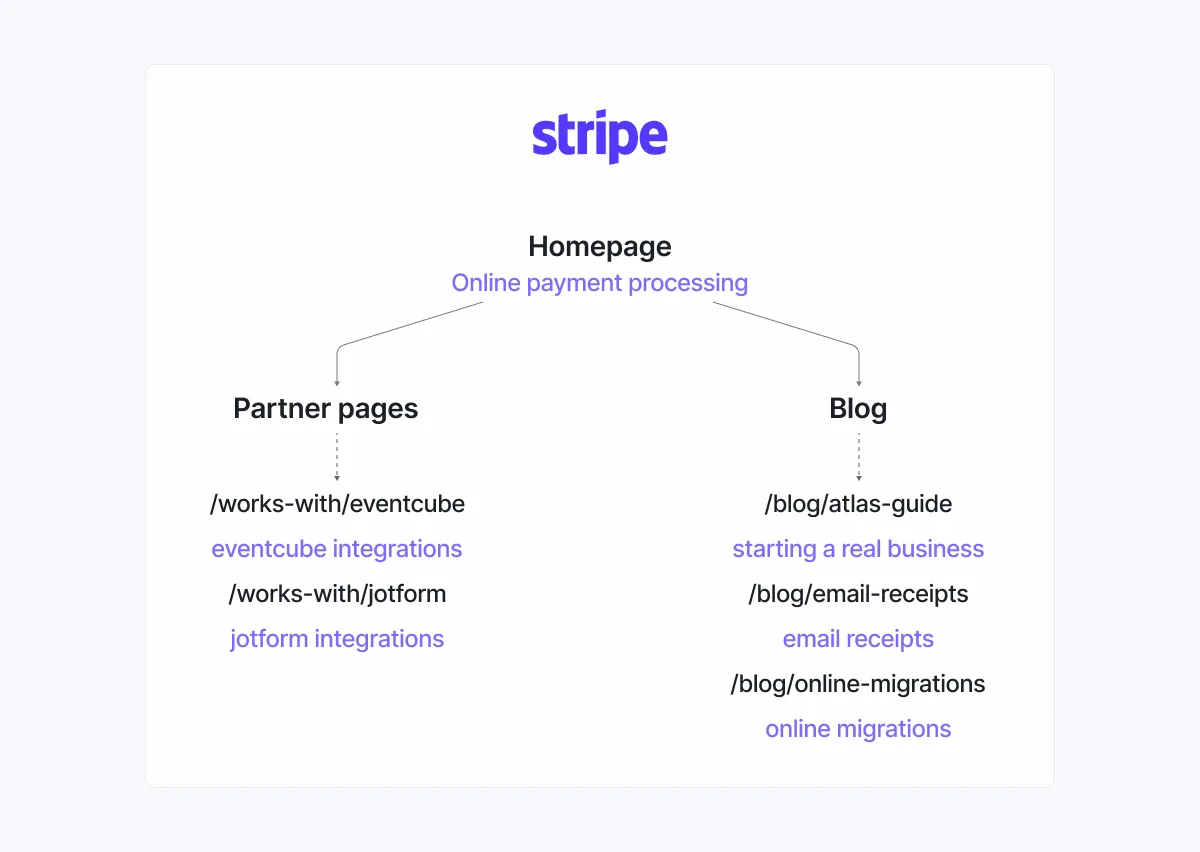
Their guides and blog posts target:
- How to accept credit card payments online
- How to start an online business
- What is a payment gateway
- How to set up subscription billing
Just seeing that one of their articles alone is estimated to generate over $500K per year in value, based on SEO traffic and keyword CPC.
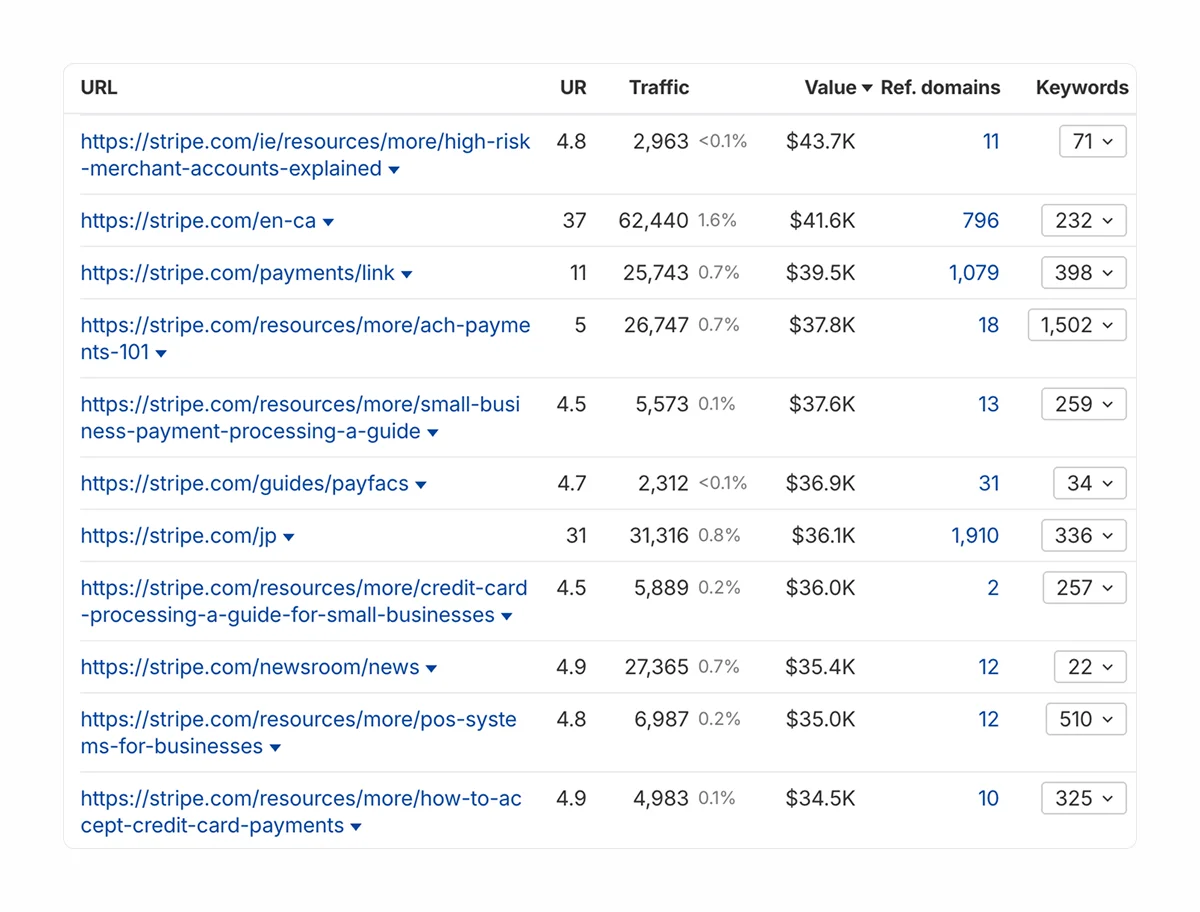
Many of these articles are under 1,000 words — proving that SEO results don’t always require long-form writing.
What matters is intent + quality + clarity.
It is exactly what brings Stripe over 1.5M monthly non-branded traffic visits.
To better understand what works for them, let’s take a look at Stripe’s top-performing pages and non-branded keywords that are generating traffic and value.
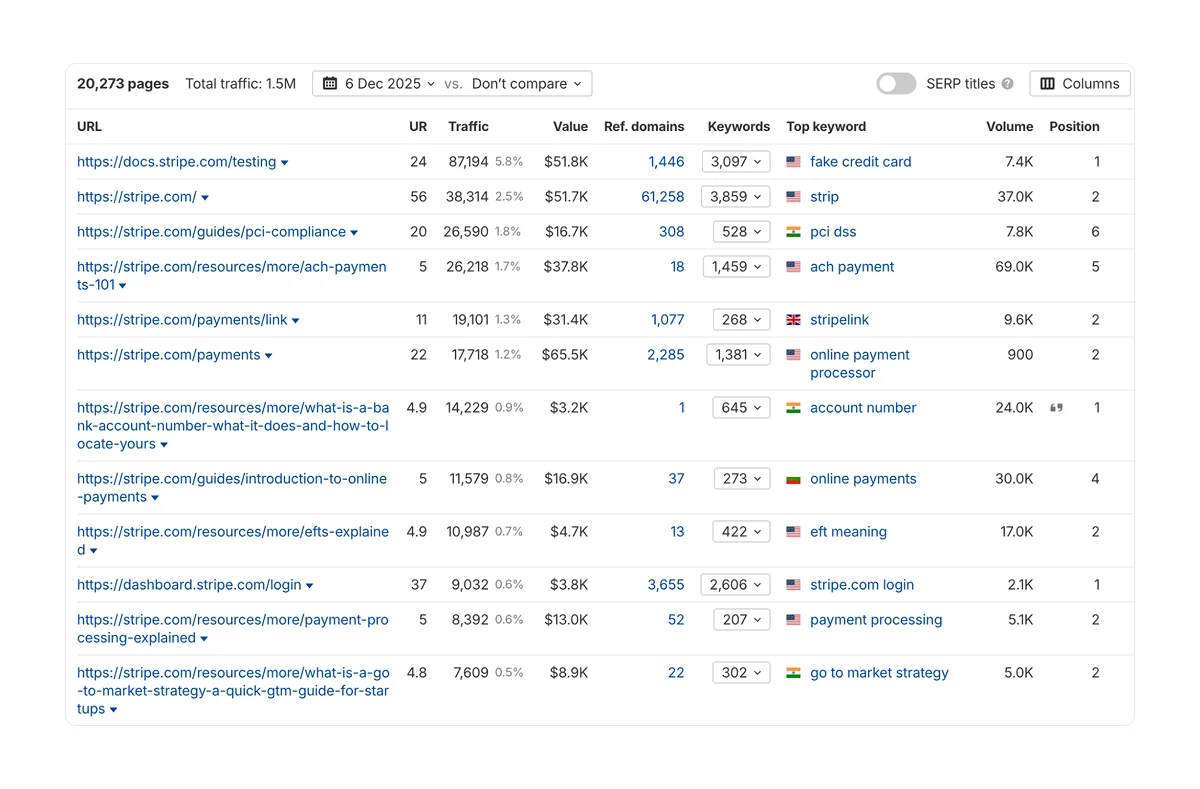
Each category within their content is a topic cluster they cover with different topics, such as:
- Payments cluster: “payment processors 101,” “payment processing explained,” “global payment solutions 101,” “payment trends that are transforming how customers pay,” “payment localization best practices,” “payment operations 101,” etc.
- Business/Startups cluster: “how to form an LLC,” “marketing tactics for startups,” “how to start an ecommerce business,” “how to start a digital marketing company,” “go-to-market strategy,” “market research,” “positioning statements,” etc
These are two really great SEO strategies for startups and new business websites to start with.
To implement it, make sure to build content that aligns with your audience’s problems/questions. Use blogs/resources to attract folks early in their journey — not only when they know your brand.
Stripe Builds Topical Authority With Strategic Supporting Content
The main Stripe site is structured around product hubs (Payments, Billing, Issuing, Tax, etc.) and then sliced further by use case (Ecommerce, SaaS, Platforms, Marketplaces, Embedded finance…) and by industry (AI companies, creator economy, nonprofits, retail, hospitality, insurance, etc.).
1. Industry-specific pages
By targeting the persona/use-case keywords (e.g. “payment software for SaaS,” “payment solution for marketplaces,” or “payment gateway for small business,”) Stripe ensures it captures people at different stages: evaluation, research, or ready-to-buy.

And they do it by covering different industry-specific pages:
- SaaS businesses
- Ecommerce stores
- Marketplaces
- Platforms
- B2B services
Each industry page contains:
- Problem framing specific to that industry
- Customer stories within that vertical
- Product recommendations tuned to that industry
- Links to solutions + guides + docs
For example:
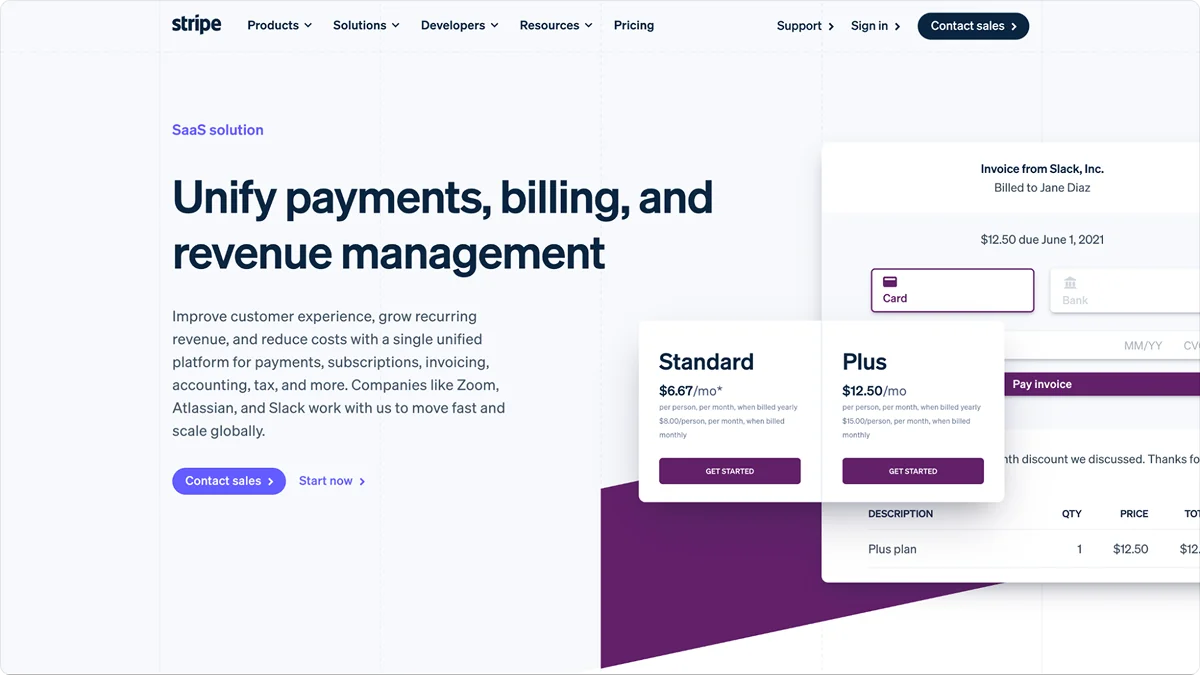
Each of these pages targets niche keywords relevant to those industries. This makes Stripe rank for combinations of keywords, such as:
- “payments for SaaS startups”
- "education payment platform"
- “travel industry payment solutions”
- “marketplace payouts solution”
This is powerful because Stripe covers EVERY quadrant of commercial intent, which dramatically improves search match quality:
Here’s the performance of all top-performing use cases that they cover when it comes to traffic and value.

2. Country-specific pages
Besides that, Stripe has dedicated content for the countries they operate in. These pages capture geo-specific keywords like:
- “payment processing UK”
- “online payments Singapore”
- “accept payments in India”
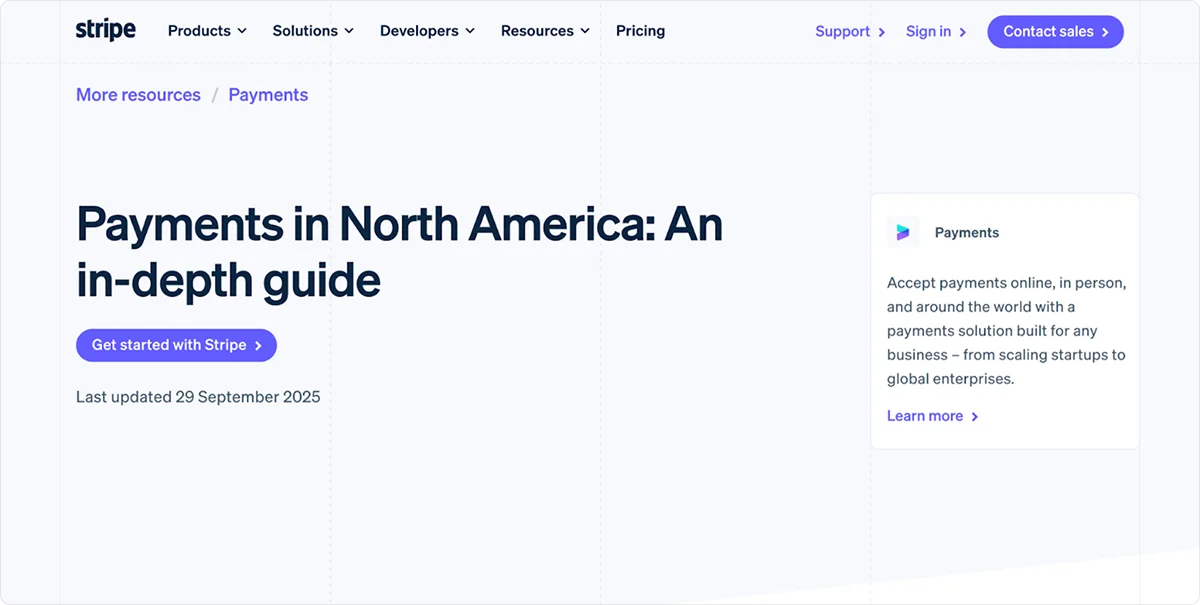
Here are some of the specific country guides they cover:
- “How to set up an online clothing store in Italy”
- “Sales discount regulations in Italy”
- “Payment on invoice in B2B: what companies in Germany need to know”
- “How to take your brick-and-mortar store online in Italy” on a Singapore-localized path (/en-sg/.../italy).
- D2C in Japan guide, tailored to the Japanese market and payment methods.
Their SEO Marketing Manager job spec explicitly mentions devising tailored SEO strategy for each market, building frameworks and systems to operate across regions, and contributing to all pillars of SEO (content, technical, off-site).
Practically, this means they’re using SEO not just to drive traffic, but to support market entry and expansion.
3. Partnerships and integrations piggybacking
Stripe uses customer stories not as “success stories,” but as SEO acquisition assets. Stripe ranks for high-intent keywords through pages like:
- Shopify + Stripe
- WooCommerce + Stripe
- Squarespace + Stripe
Every major customer gets a dedicated, indexable page, for example:
- stripe.com/customers/shopify
- stripe.com/customers/openai
- stripe.com/customers/amazon
- stripe.com/customers/woocommerce
This creates SEO flywheels that run on partner brand authority.
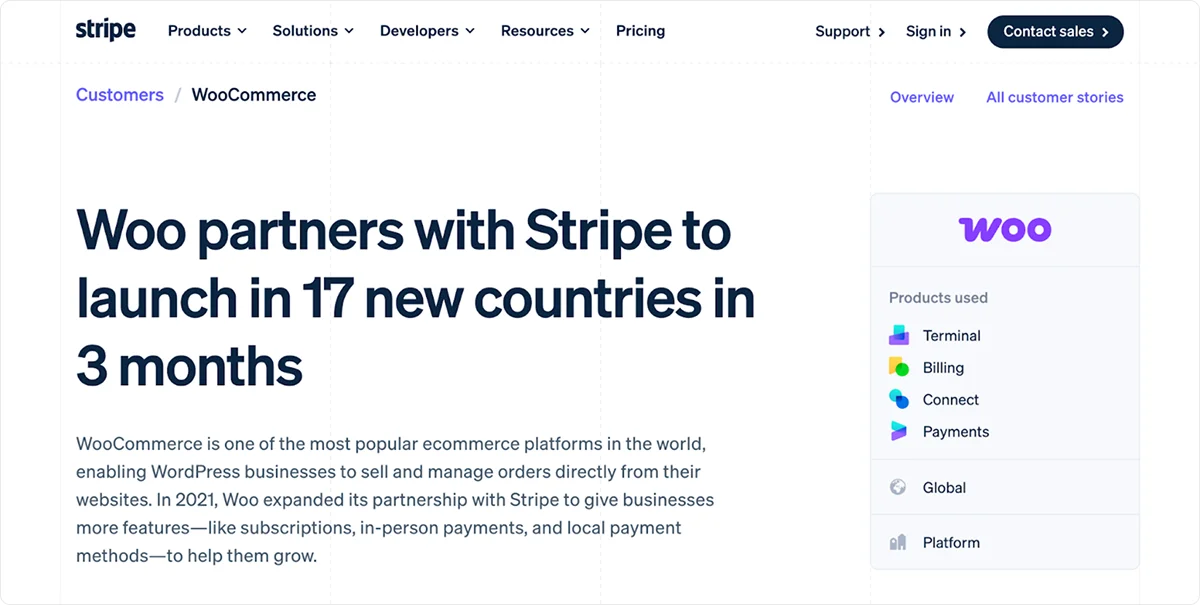
And those are not only a few keywords bringing some slight traffic, but tens and hundreds of keywords generating thousands of searches.
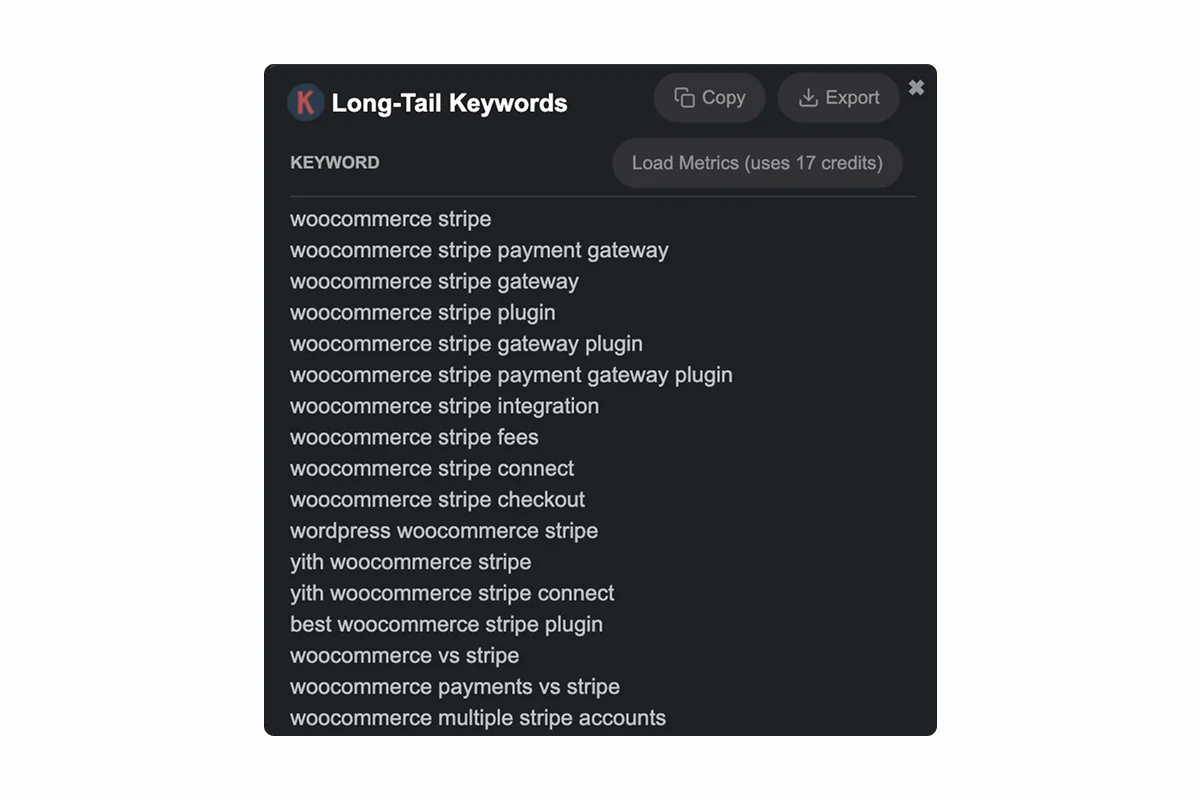
Note: In many cases, ranking for other brands you work with and ranking for blog/content-lead keywords are much less competitive than generic product/service type keywords.
So, when you’re just starting out in SEO, and your authority as a website is low, look at tactics like these to drive traffic whilst you build in strength.
Let’s look at how Stripe ranks for these integration-specific queries.
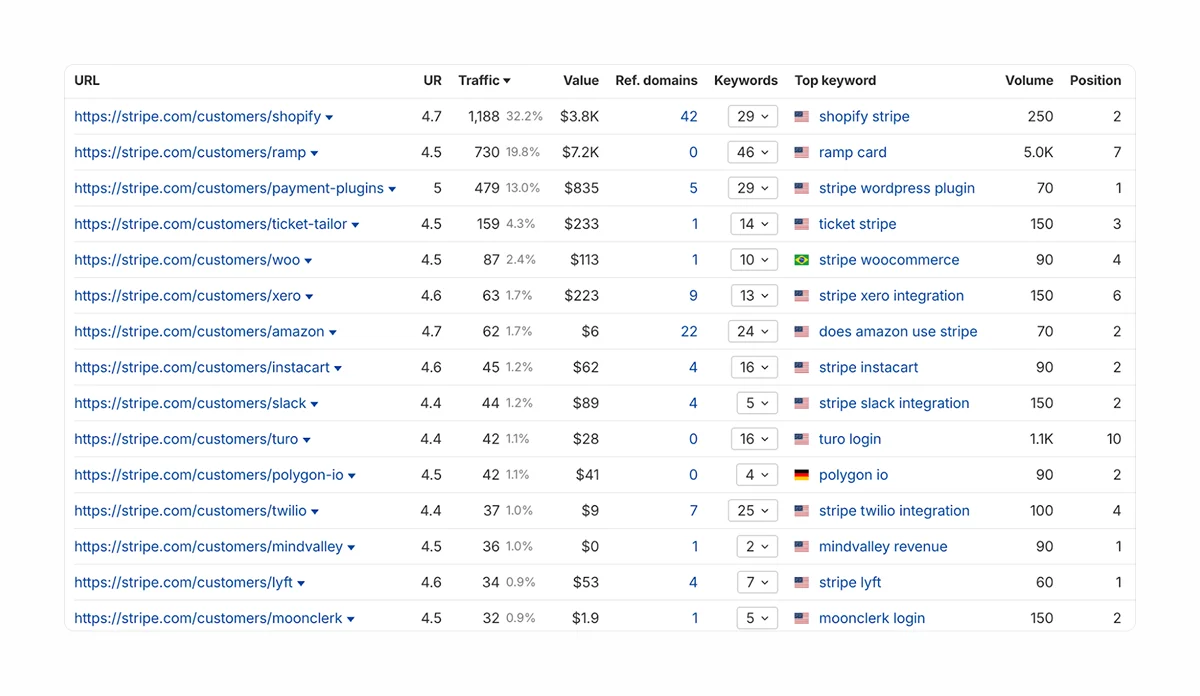
This is not typical SaaS storytelling. It’s an SEO-powered internal linking system.
Stripe’s customers frequently publish:
- Engineering blog posts
- Changelogs
- Press releases
- Case studies
- Funding announcements, and
they mention Stripe as their payments infrastructure provider. These create high-authority natural backlinks.
A single customer like Shopify can pass more link equity than 10,000 low-DA backlinks.
4. Focusing on Technical Documentation vs. Blog Posts
For most marketers, it’s the default to just focus on publishing blog posts. Stripe doesn’t do the expected - they invest in serving their target audience.
As a result, Stripe focuses on creating the technical documentation that developers need to implement their solutions easily.
And they don’t just create plain old boring docs with huge walls of text as most of businesses do.
They make documentation designed to please and rank for searches like “Stripe API error [code]” or “Stripe integration with React”, ensuring developers land on Stripe’s own pages for help.
Just take a look at the beautiful and easy-to-navigate UX.
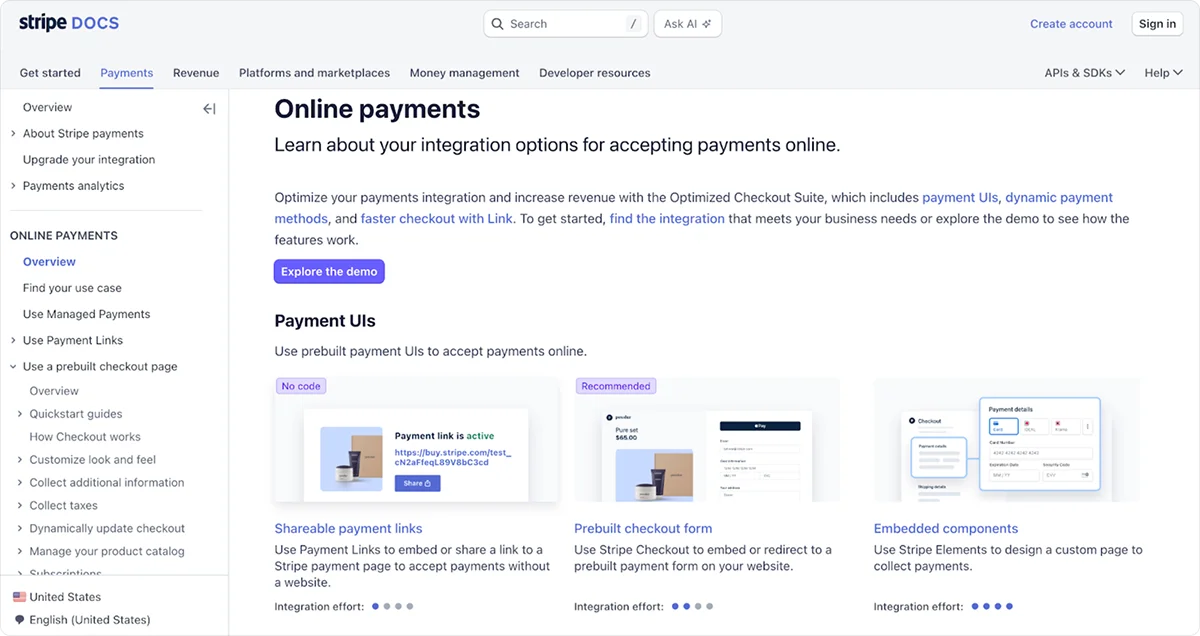
Even an industry analyst report noted that engineers “feel supported by great documentation, error messages, and API logs” when using Stripe-
It’s very unlike most tech documentation, and this difference is a key driver of its close to 290K monthly visits according to Ahrefs data.
Who would say that it makes a huge difference for their content strategy and that documentation guides are dominating that much?
Just look at each top-performing documentation guide’s traffic and the value they’re bringing ($ spent on ads they’re saving).
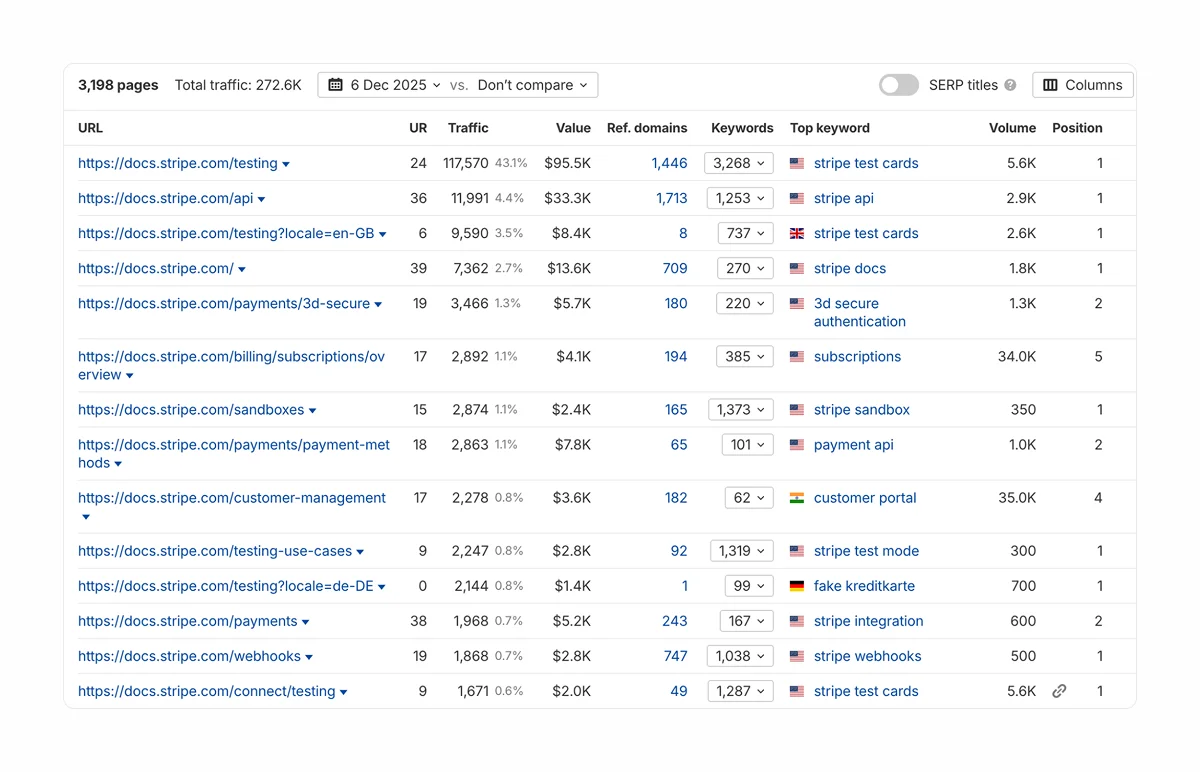
This layered keyword + content taxonomy (homepage → product pages → solution pages → educational content) allows Stipe to cover a broad net of search intents - from top-funnel curiosity to bottom-funnel conversion.
And Stripe’s documentation is not just developer support — it’s designed to win organic search for long-tail queries and now AI SEO/GEO (which we will discuss further in a moment).
Information architecture & internal linking
Stripe’s website is not a collection of isolated landing pages—it's a website of smartly connected pages designed to help both humans and search engines navigate thousands of pages effortlessly.
Stripe uses a dual-layer IA (information architecture) system:
1. Product-focused structure that aligns with how businesses think about payments.
2. Task-focused structure that aligns with how developers think about implementation.
This dual model ensures Stripe ranks for both commercial-intent product keywords and high-volume developer/task queries, and that authority flows smoothly throughout their domain.
On the marketing/resources side:
- Guides consistently embed CTAs and internal links to product hubs (“Explore Payments,” “Learn more about Billing,” etc.).
This creates a connection of links between:
- Top-level products
- Use-case/industry pages
- Guides and long-form resources
- Dev docs and API reference
which is ideal for both crawlability and pushing link equity to deep, high-intent pages.
Stripe’s Strategic Advantage in AI-Powered Search
Stripe isn’t just winning traditional SEO. In the emerging world of AI search via Google SGE, ChatGPT, Gemini, Perplexity, and Microsoft Copilot, Stripe ranks as one of the most frequently cited fintech brands.
Recent AI citation data(December 2025) shows just how deeply Stripe content is integrated into AI-generated answers across multiple platforms:
- Google AI Overview: 28,300 citations across 5,300 indexed pages
- ChatGPT: 2,400 citations from 2,300 pages (+363 in the last month)
- Perplexity: 2,900 mentions across 1,600 pages
- Gemini: 1,100 citations (+110 MoM), now referencing 1,600 pages
- Copilot: 568 citations (+120), with growth across 373 pages
This multi-platform visibility shows how Stripe’s structured, high-authority content is being actively selected and surfaced by LLMs.

Why? Because Stripe's content ecosystem checks every box that AI systems prioritize:
- Topical authority in payments, APIs, compliance, and infrastructure
- Clear and structured documentation with rich technical metadata
- Consistent keyword-to-page alignment with minimal dilution
- High engagement and backlinks, signalling credibility
And it's not limited to longtail content. Stripe currently ranks for 101,496 keywords in AI Overviews - nearly 30,000 of which are in the top 3 positions, creating massive visibility across both search and AI-generated experiences.
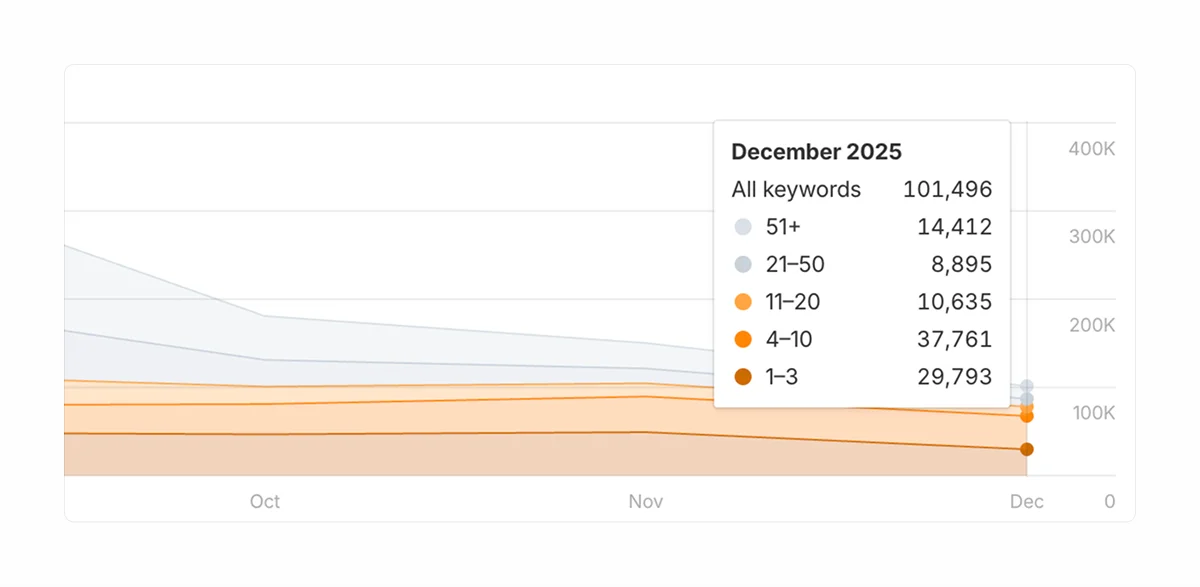
Stripe is showing how to future-proof SEO strategy in an AI-first era:
- Build with structured data
- Write for clarity and precision
- Map each page to one user intent
- Target both traditional and LLM-based discovery flows
If your startup is building domain authority, focus now on AI citation optimization, because AI assistants are becoming an additional search layer besides SEO.
Stripe already plays there. You can too.
What You Can Apply From Stripe’s SEO Success
Stripe’s strategy is replicable - even if you’re early-stage. Here’s what they do, and how you can use it to your business's favor:
1. Build your site around search intent, not product features
Create one page for each topic:
- Homepage → broad category
- Product pages → mid-intent users
- Industry pages → niche problems
- Country pages → geo-intent
- Blog posts → educational intent
2. Use supporting content to capture early-stage audiences
Examples of content you can publish:
- “How to…” guides
- Industry breakdowns
- Comparison pages
- Payment or SaaS tutorials
- Compliance and regulation explainers
This is how you meet customers before your competitors do.
3. Optimize each page for one main keyword
Stripe doesn't dilute a page with 10 unrelated keywords. Follow this rule:
One page → one core search intent.
4. Invest in content that compounds over time
Stripe’s highest-value article is short, simple, and solves a problem.
Your best content doesn’t need:
- giant word count
- complex visuals
- over-optimization
It needs:
- search intent alignment
- clarity
- Authority
- consistency
5. Use SEO as a long-term acquisition channel
Stripe didn’t win SEO overnight — but their effort compounds into:
- Consistent traffic
- Lower CAC
- Higher trust
- Better product awareness
SEO is an asset. One great page can produce revenue every month for years.
Final Thoughts: Stripe Proves SEO Is a Revenue Engine
Stripe’s rise wasn’t powered only by a great API or investor backing. Their SEO is one of the most quietly powerful pieces of their growth machine.
They built:
- Intent-based pages
- High-authority content
- Structured keyword clusters
- Geo-specific content
- Partner integrations
- Educational resources
All of this results in millions of organic visits, lower customer acquisition costs, and unmatched market reach.
Want to develop a comprehensive SEO strategy and grow like Stripe?
If you're building a fintech product and want to get more traffic, more signups, and better leads through search, we can help.
Schedule a free consultation, and we’ll show you how to build a content strategy that actually works.


.png)

.svg)
















.svg)



























.svg)