One switch in January 2026 shows how AI model updates affect visibility. Google made Gemini 3 the default model for AI Overviews, and in one study of 100,000 US keywords, 42.4% of the domains cited before the switch no longer appeared in February.
Switches like this now arrive almost every week. ChatGPT, Claude, and Google's AI Mode changed their models on at least seven dates between 2 September and 8 October 2026, and most changes reached only some plans.
For a B2B software, fintech, or AI company, each switch can change whether its name reaches the shortlist an AI answer gives a CTO or a head of finance, and a visibility report shows the swing without its cause. When a team misreads one, it rewrites its content plan for a change the engine made, or waits out a drop it could have fixed that day. The five checks below weigh the evidence for the update, so the team knows whether to act, wait, or re-test.

Key takeaways
- Model availability varies by plan and mode, so a tracker may not query the version prospects use.
- One update can move retrieval, citations, and mentions apart, so more citations can sit beside fewer mentions.
- Matched prompts, release timing, and re-tests strengthen the link to an update, and competitor movement adds context without proving cause.
- Tracking defects and verified access or factual errors get fixed at once, and content changes wait for the re-tests.
What is an AI model update, and what changed in 2026?
An AI model update is any change to the model behind an engine's answers: a new version, a new default for a plan, an update under the same name, or a new rule for switching to reasoning mode. Every major engine made such changes in 2026, often for only some plans or surfaces:
- 27 January 2026: Gemini 3 became the default model for Google's AI Overviews.
- 30 June 2026: Claude Sonnet 5 became the default for Claude's Free and Pro plans.
- 6 August 2026: OpenAI named GPT-5.6 Luna the default for ChatGPT Free and Go.
- 14 September 2026: ChatGPT Plus and Pro stopped switching automatically to Thinking mode.
- 28 September 2026: Anthropic released Claude Sonnet 5.5.
- 7 and 8 October 2026: GPT-6 began rolling out in ChatGPT, Sol for paid plans and Luna for Free and Go.
A new model is one of three kinds of engine-side change:
| Kind of change | What changes | 2026 example | What it can move |
|---|---|---|---|
| Model | Weights, reasoning, instruction following, knowledge cutoff | GPT-6 rollout announced for Free and Go from 8 October | Whether the answer searches, and how it writes |
| Retrieval | The searches generated, the index read, which sources are picked, and how they rank | Reddit's share of ChatGPT answers, 12.6% to 1.7% from 14 August | Which pages are read and cited |
| Product | Interface, source display, personalisation, citation format | The Sources button sometimes moved into a menu in mid-August | What a tracker sees, with the same model underneath |
Google's documentation says AI Mode and AI Overviews "may use different models and techniques, so the set of responses and links they show will vary". One study found that, for the same prompt, only 17% of the domains cited by either surface appeared in both.
Gemini 3.8 Flash, for example, reached only AI Mode's Pro and Ultra subscribers on 2 September, who could select it from the model menu. The rollout left out logged-out AI Mode sessions, so the announcement alone cannot identify the model behind a tracker's answers.

How do AI model updates affect brand visibility in AI answers?
A release can change what answer engines say about a company at four points. They are whether an answer searches, which pages it retrieves, which links it cites, and which companies it names. These are measurement categories for reading reports, since engines differ in their retrieval tools and answer formats.
1. Whether the answer searches, and what else it draws on
A company's current pages reach an answer when the engine searches the web or opens them directly, and whether it does depends on the model, the question, and the tools it has. OpenAI says ChatGPT may search when a question "would benefit from current information". Ahrefs found fan-out queries, the searches logged behind an answer, in only 14.4% of 66.6 million free, logged-out ChatGPT responses from August and September 2026.
A new version can move that rate in either direction. Anthropic's launch page for Claude Sonnet 5.5 quotes an early-access customer: "Sonnet 5's tendency to reach for web search too often and its high token use are both gone in this new model."
Without a search or a fetched page, an answer draws on training data, the conversation, any supplied documents, and enabled memory. Anthropic lists June 2026 as the knowledge cutoff for its current models, so a company renamed in July can still appear under its old name until newer information reaches the answer.
2. What it retrieves and cites
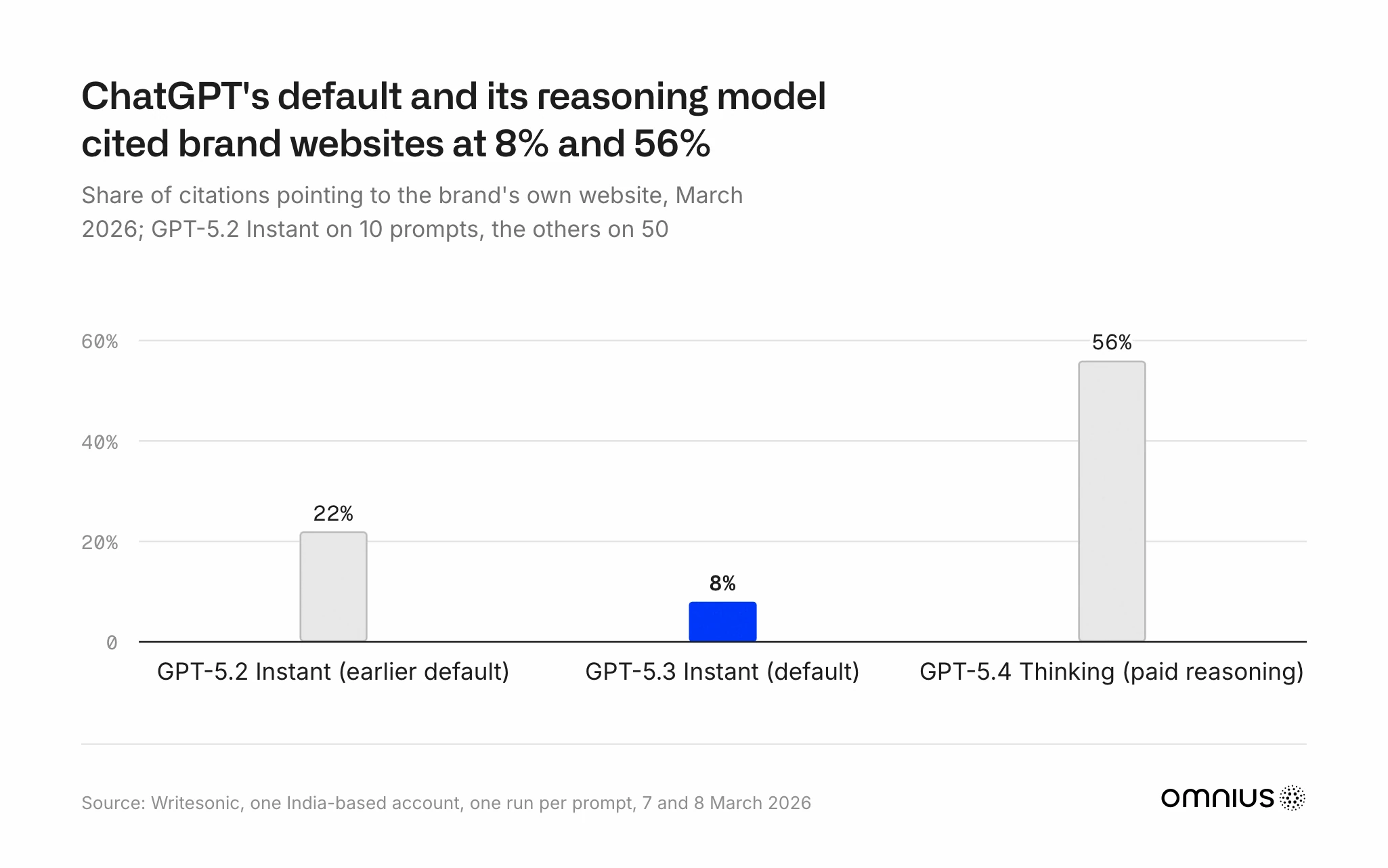
A new model can change the searches behind an answer and the pages it reads to check a company's claims. In a March 2026 test of 50 prompts, ChatGPT's default ran one search per prompt, while the paid reasoning model ran about 8.5 and cited companies' own websites far more often.
A default change can shift the same mix for every user of a plan. On 8 August, the share of ChatGPT's searches that looked inside one named website, a site: search, rose from 0.2% to 18% in one tracker's study. Those counts come from ChatGPT's own disclosure panel, so the study leaves open whether the research grew or only what the panel shows.
The direction differs between releases:
- After Gemini 3 became the default, the same January-to-February comparison found the average AI Overview's source panel about a third larger, with the dropped domains almost all in the long tail.
- After a ChatGPT default change in May, a separate test found own-website citations at 6%, against 13.4% for the previous default.
3. Whether it names and recommends the company
The model then decides whether to link a page, name the company, or both, and a link often arrives without the name. In Semrush's count of 3,981 domain appearances, 61.7% were a source link with no brand name in the answer.
One update can push the two further apart. After 8 August, ChatGPT answers in the same tracker's study carried more inline citations, 0.82 per answer instead of 0.49, while tracked brands were named slightly less often. More citations can sit beside fewer mentions, so recommendations need their own count before either figure supports a conclusion about sales.

How to tell whether an AI visibility change is linked to a model update
A change can also come from the company, its competitors, or the tracker. Five checks strengthen or weaken the link to an update for a rise as much as a drop. The worked example below runs all five.
1. The tracker asks the same plan the same questions
Like-for-like tracking comes first. Questions, engines, location, account state, and schedule must match before and after, and the tracker has to query the plan that got the new model.
| Engine | Where changes are announced | What differs inside it | What to record |
|---|---|---|---|
| ChatGPT | OpenAI's release notes | Plan, tab, and reasoning mode | Account type, tab, and mode |
| Claude | Anthropic's release notes | App or API, reasoning effort, and memory (on by default for Free, Pro, and Max) | App or API, memory, and model name |
| Google AI Mode | Google's Search announcements | Subscription and model menu | Signed-out or subscriber view |
| Perplexity | Perplexity's help center and API changelog | Model picker by plan; API presets that switch models under one name | Plan, chosen model, and preset |
| Microsoft 365 Copilot Chat | Microsoft's Copilot documentation and blog | A model selector and automatic routing by prompt, with phased rollouts | Surface, account type, chosen model, and routing mode |
| API-based tools | The provider's developer notes | The model the developer picks | The model the tool calls |
A logged-out session usually shows a free default, while paid and work accounts run other models. Names can hide a switch too: in September, Perplexity's xhigh API preset moved from GPT-5.6 Sol to Claude Opus 5.5 under the same name.
What to do before reading any change:
- Freeze the questions and the schedule.
- Ask the vendor which plan, mode, and account state each engine runs on.
- Add a paid-account series with memory off where the audience uses paid plans.
❌ Comparing July with August after adding 15 questions and moving to a paid account with memory on.
✔ The same 20 questions on the same logged-out Free session before and after 8 August.
2. The change leaves the normal range, on a matched set of prompts
Every engine reshuffles its answers from week to week, so a change means more when it moves beyond that engine's normal range. In the August tracker study, 57% of the top-five places in its most-cited brand lists had already turned over between 1 to 3 and 5 to 7 August. That churn, often called AI search volatility, came before the 8 August jump.
The normal range differs by engine. In a 17-week study of 82,619 prompts:
- AI Overviews kept about 8 of their 11 cited domains consistently present.
- ChatGPT drew as much as 74% of each week's cited domains from outside the previous week's citations.
A swing that is ordinary on ChatGPT can therefore be unusual on AI Overviews, so each surface needs its own baseline on the same metric and prompts.

Claude sits nearer the stable end. In one vendor's weekly panel of 40 fixed buying questions, 54.5% of Claude's cited domains came back the next run, against 40.0% for Google AI Mode.
An interval, a range of likely values for the before-and-after difference, shows how much of a change could be churn. A prompt's repeated answers are related, so the resampling keeps each prompt's answers together. An interval that includes zero leaves the result compatible with no change at all, and one above zero shows a measured rise whose cause still needs the other checks.
Small samples make the call harder. In one preprint, a ranking of cited websites needed 33 to 94 answers with citations before it was both stable and well separated, and 3 of its 30 tests never reached that point. Those figures concern rankings, so a company's own before-and-after rate still needs its own interval.
What to do: Compare the same prompts before and after the suspected change, and give an interval for the difference, resampled by prompt. An engine with no announced release can serve as a comparison when its earlier trend and collection settings match.
❌ "ChatGPT citations of our website jumped" in a week with 40 answers and no earlier range.
✔ A rise from 10% to 21% on the same 20 prompts, with an interval for the difference that stays above zero.
3. The change starts with a release that reached the tracked plan
A tracker queries one plan, such as ChatGPT's Free plan logged out. Only a release that reached that plan before the change began can explain it. The 8 August case shows the limit of a date match.
- Observed: own-website citation rates rose for 85.9% of 1,665 brands between 1 to 7 and 9 to 13 August 2026.
- Correlated: on 6 August, OpenAI said GPT-5.6 Luna would become the Free and Go default that week.
- Unconfirmed: that the model caused the rise. The study ties the change to no model, and its page counts come from ChatGPT's disclosure panel. "If OpenAI began showing more of a process it had always run", those counts would look the same.
What to do: Match the date against a dated log of releases for that engine and plan, and compare with engines that announced no release.

❌ Crediting GPT-6.1 Sol's Work and Codex rollout for a move in Chat.
✔ Matching a jump on 8 August to OpenAI's 6 August note on the Free and Go default, and calling it correlated until the other checks hold.
4. Competitor movement and other changes add context
Competitor movement adds context, although an update can affect brands unevenly and shared sources can move several together. Other changes often share a release week as well:
- A launch on the company's own website.
- A Google update, such as the September 2026 spam update.
- A product change shipped with the model, such as GPT-6's answer format.
- One source dropping out, such as Reddit in ChatGPT on 14 August 2026, which the August study read as an access problem.
What to do: Read the competitors' lines and the dated log for that week before naming a cause.
❌ Crediting a new comparison page that went live the same week, while every competitor rose too.
✔ Four of five tracked competitors moved in the same week, and the log shows no website release.
5. The change holds in a re-test
A reading from release week may not last, because models change again after launch. OpenAI's second same-name update to GPT-5.5 Instant targeted answers about "researching options, or shopping." A launch-week reading of buying questions therefore described an earlier version.
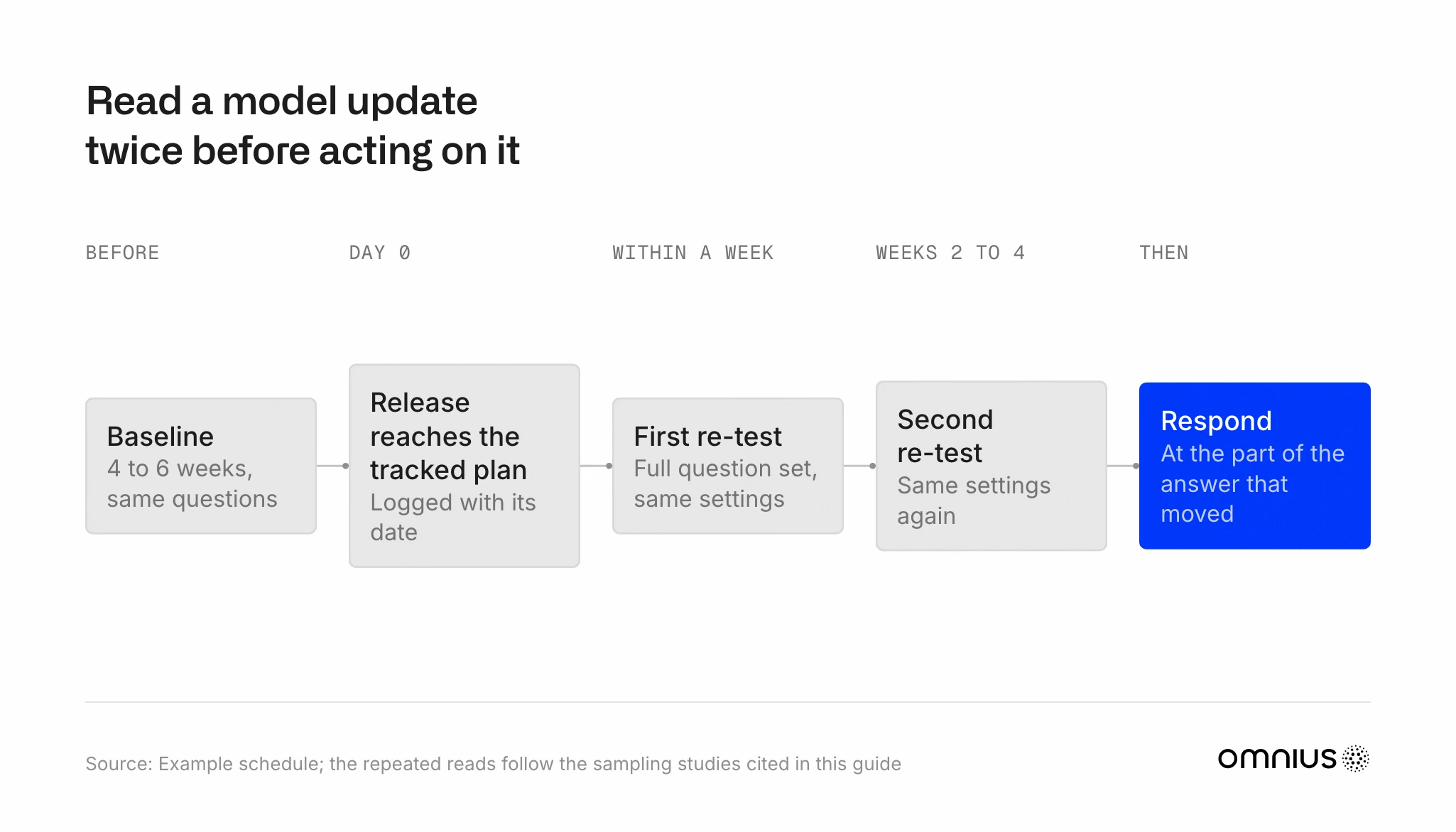
What to do: Re-run the full question set within a week and again a few weeks later, and act on what both show.
❌ Rewriting the content plan after the first week of data.
✔ Acting only after re-tests one and three weeks later both hold.
How to track AI search visibility across model updates
Each engine and plan gets its own chart, marked from one dated log of releases, Google updates, and website changes. Each metric needs a stated denominator, and two of them are standard AI visibility metrics:
| Metric | What it counts | Out of |
|---|---|---|
| Mention rate | Answers that name the company | All tracked answers |
| Recommendation rate | Answers that recommend or shortlist the company | Answers to buying questions |
| First-party citation rate | Answers that cite the company's own website | Answers with citations |
| Citation share | Links to the company's own website | All citation links in the answers |
| Source churn | Cited domains new since the previous week | Cited domains this week |
The denominator changes the reading. Take a week of 140 answers, 70 of them with citations, and 14 citing the company's website:
- Out of all answers, the company is a source in 10%.
- Out of cited answers, it is a source in 20%.
A recommendation needs a written rule, such as named in the answer's list of suggested products.
Google's own data now covers part of this. Since 31 August 2026, Search Console's generative AI report counts impressions of a website's links in AI Overviews and AI Mode, by page, country, device, and date, without clicks, queries, or a split between the two.
How to protect and improve AI visibility after a model update
A tracking defect, or a verified access or factual error, gets fixed the day it is found, and changes that are hard to reverse wait for the two re-tests:
| What the report shows | What to check | Response | When |
|---|---|---|---|
| The setup changed (questions, plan, account, location) | The tracker's settings log | Fix the tracker and rebuild the baseline | At once |
| Citations rose, mentions stayed flat | Whether the cited pages name the company clearly | Keep the plan where they do, and name the company plainly where they do not | Check now, change only where needed |
| Citations fell on one engine only | Answer formats, the pages retrieved, and the sources that engine now cites | Fix verified access problems and test content gaps | Access fixes at once, the rest after the re-tests |
| Mentions or recommendations fell while citations held | The companies the answers now name instead, and the evidence behind them | Correct factual omissions in the lists and comparisons the answers cite | Factual fixes at once, the rest after the re-tests |
| One cited source dropped out | Whether the loss hits other brands too | Improve accurate coverage in the sources the engine still cites, where a gap exists | After the diagnosis |
| Every engine fell in the same week | No shared release, a website change in the log | Check crawler access, indexing, and rendering | At once |
When retrieval changes, the searches behind the answer, its query fan-out, and the pages they return show where to work. In Ahrefs' consumer-heavy data, 75.9% of the most common site: searches pointed at a company's own website, so pricing, limits, and support facts belong there in plain text.
In one AI Overview for a B2B payments question, below, all three visible sources are third-party lists. Where such lists hold inaccurate company details, correcting them is a practical fix.

What does a model update look like in an AI visibility report?
In a report, a suspected update looks like a sustained change on one engine near a release that reached the tracked plan. Vendor A, an invented payments API company, tracks 20 buying questions daily on four engines. In August, its own-website share of ChatGPT citations rose from 10% to 21%.
The collection settings were unchanged, and on the same 20 prompts the interval for the difference stayed above zero. The rise began on 8 August, two days after OpenAI's note.
Four of its five main competitors rose the same week, and the log held no website release. The readings supported an engine-side explanation, not the model's share of it.
The mention and recommendation lines stayed inside their usual range. Re-tests a week and three weeks later held at 20% and 22%.
A note for the CEO. ChatGPT's free plan got a new default model in the week of 6 August. Since then, 21% of its citations in our tracked answers point to our website, against a usual 6% to 11%. Mentions held, so the content plan stays.

How we handle AI model updates at Omnius
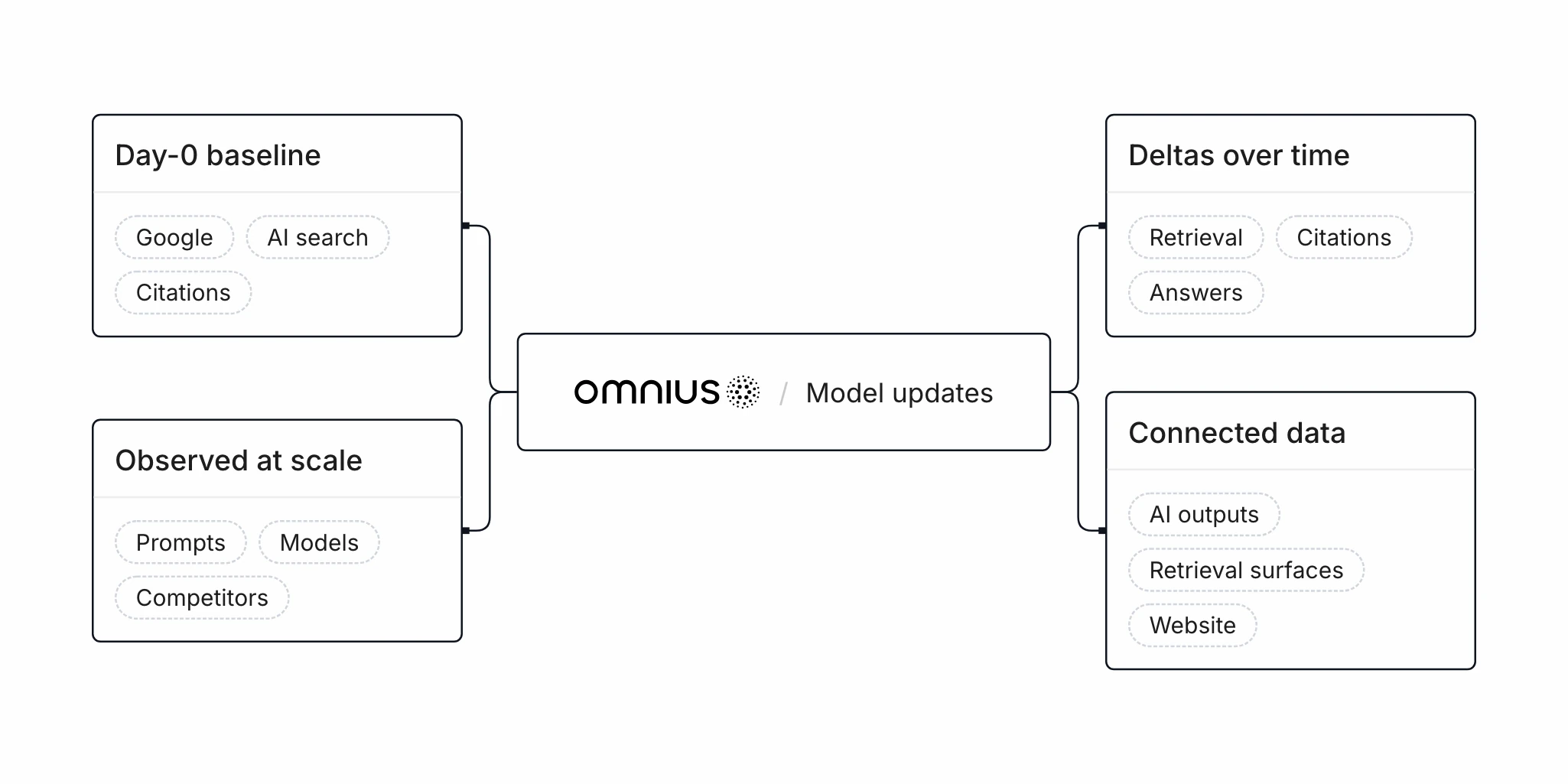
At Omnius, every change in AI visibility is read against the baseline set when the work began, which our methodology measures "as deltas against the Day-0 baseline."
We ran the five checks on our own tracking, 8,332 answers to the same 32 prompts across eight engines from July to October 2026.
After GPT-6, the dashboard showed Omnius named 7.0 points more often. On matched prompts, ChatGPT's own rate barely moved, and the other engines had started rising five days before the release, so the headline gain failed the checks.
After the 6 August default switch, the share of ChatGPT answers citing omnius.so rose 5.0 points, and the interval for the difference stayed above zero, while the other engines' rate fell. By late August the daily count was back near its July level, and the tracker records no plan or model, so the rise did not hold and the link to the model stays unconfirmed.
For an outside read of how AI engines describe a company today, see the AI search audit.
FAQ
Why does ChatGPT give different answers to the same question?
ChatGPT gives different answers to the same question because it writes each answer afresh, and its wording, context, and retrieved pages can change from run to run. SparkToro found, in its experiments, less than a 1 in 100 chance of the same list of brand recommendations appearing in two answers.
How often should AI visibility be checked?
A practical schedule for AI visibility is daily collection, a weekly review for each engine, and a re-test after a relevant release, such as Claude Sonnet 5.5 on 28 September 2026. A single reading can hold too few answers to separate change from noise, so the number of prompts and repeat runs matters more than the number of days.
Methodology
The guide rests on the platforms' release notes and documentation and on outside studies, checked from 17 to 20 October 2026:
- Release dates. From the platforms' release notes, documentation, and status pages, plus trade-press reports of the AI Mode and Sources button changes.
- Our captures. The AI Overview screenshot was captured on 17 October 2026, logged out with US English settings in a headless browser.
- Omnius data. Atomic AGI supplied 8,332 completed answers to 32 established prompts from 20 July to 14 October 2026. Comparisons use matched prompts within each engine where both windows have completed answers. Rates count the answers that name Omnius, or cite at least one omnius.so page, out of the completed answers in each comparison's windows, with failed runs left out. The tracked prompts are not named.
- August and October windows. August compares 20 July to 5 August, excluding 26 July, with 9 to 13 August: 245 and 92 completed ChatGPT answers. October compares 2 to 6 with 9 to 14 October: 96 and 160 completed ChatGPT answers.
- Dashboard comparison. The 7.0-point figure uses all tracked prompts and each window's engine coverage, 21 September to 6 October against 9 to 14 October, and includes prompts added in October.
- Intervals. The 90% intervals come from 10,000 resamples by prompt, each keeping a prompt's before and after answers together. The August citation rise of 5.0 points has a 90% interval of 1.9 to 8.6 points. The intervals are exploratory and not adjusted for multiple comparisons.
- Vendor A. The company and its numbers are invented; the dates it uses are documented.
- Limits. None of the studies isolates one 2026 release's effect on B2B companies, so a release date gives timing, never cause. Writesonic used one account and one run per prompt. The August tracker study compared 1 to 7 with 9 to 13 August, names no plan, and its 85.9% is not adjusted for answers carrying more citations. Semrush gives no fieldwork dates, and the sample-size figures come from a preprint by Ron Sielinski of IQRush. SE Ranking counted the sources in AI Overviews' right-hand panel, not inline links, in January and February 2026, after Google fixed a bug that had left some Overviews without sources. The vendor's retention panel queried each engine through its API.
- Interests. Writesonic, Semrush, Ahrefs, SE Ranking, SISTRIX, Profound, Promvia, IQRush, and the August tracker study's publisher provide AI visibility or SEO software. Both Semrush studies also involved an independent growth consultant. SparkToro sells audience research software and ran its study with an AI tracking company. Omnius sells SEO and AI search services, and its team built Atomic AGI, the AI search product named in this guide.
Sources
The release notes, documentation, and studies behind this guide:
- Platforms: ChatGPT release notes, ChatGPT search help, Claude release notes, Claude models overview, Google AI features documentation, Search Console generative AI reports, Search Console generative AI report help, Google September 2026 spam update, OpenAI web search, Gemini 3 in AI Overviews, Gemini 3.8 Flash announcement, Claude Sonnet 5.5 launch, Perplexity API changelog and Microsoft 365 Copilot model changes, Microsoft Copilot Chat documentation
- Studies: Writesonic, GPT-5.4 and GPT-5.3, Writesonic, GPT-5.5 Instant, Searchable, research depth, Ahrefs, ChatGPT fan-out, Semrush, reasoning modes, Semrush, ghost citations, SISTRIX, citation drift, SparkToro, AI consistency, Profound, entity update, SE Ranking, Gemini 3 in AI Overviews and Promvia, citation retention
- Trade press: Search Engine Land, Search Engine Roundtable and Search Engine Journal