.png)

AI search visibility metrics are indicators of how often and how your brand appears across AI engines, which dominate search today. Businesses that don’t leverage these metrics alongside traditional SEO KPIs risk getting buried by competitors.
37% of people start their searches with AI. And even half of Google searches now feature AI Overviews. You can rank high on Google yet still be absent from AI-generated answers where competitors appear.
Clicks no longer capture the full picture of your search performance. To see how you actually rank, you must add AI search visibility metrics to your toolkit. This guide covers the most important ones, explains what each one reveals, and shows how to act on the data.
Key Takeaways
- AI search visibility metrics indicate the success of your optimization efforts. They reveal whether AI engines mention your brand, how they describe it, and whether mentions translate into traffic. They help you understand where exactly your strategies fall short so you can fine-tune them.
- Visibility rate is the baseline metric. It measures how often your brand appears in AI-generated answers for tracked prompts. A high rate indicates brand recognition, while a low or declining rate signals content gaps, crawlability issues, or weak authority.
- Citation rate reveals whether AI engines trust your content enough to link to it. A high citation rate indicates authority, but low rates don't always signal a content problem, as some query types don't trigger sourced answers.
- Share of voice and citation share add the competitive layer. They reveal how often you get mentioned or cited compared to your competitors for relevant queries that include multiple brand mentions and citations alongside yours.
- No single metric tells the full story. Pair presence metrics with competitive, qualitative, and outcome metrics. This allows you to see the true scale of your presence and whether it moves the needle.
Why You Should Care About AI Search Visibility Metrics
AI search visibility metrics are important because they allow you to make decisions that consistently land you in AI’s answers and citations. Without them, you have no way to confirm whether your optimization efforts are actually improving AI visibility.
Apart from the frequency of mentions, these KPIs reveal how and when engines and LLMs position you, and whether that translates into actual traffic.
This data lets you identify gaps, such as engines and queries where competitors consistently outperform you, address them directly, and track improvement progress.
Ultimately, this helps:
- Bring awareness of your brand to a larger portion of your audience
- Surface your brand during the research phase, before prospects build a shortlist
- Maintain an accurate representation of your brand and products across AI engines
- Establish trust in your brand and position it as an industry leader
Note: SEO is still relevant. People still rely on Google at some points of the buyer journey. AI search engines source information based on traditional search results. SEO and AI search optimization rely on each other. Including both in your audit and strategy is necessary to stay relevant online.
10+ Best AI Search Visibility Metrics To Track in 2026
Here’s an overview of the essential metrics to include in your AI visibility audit:
1. Visibility Rate: Brand Visibility
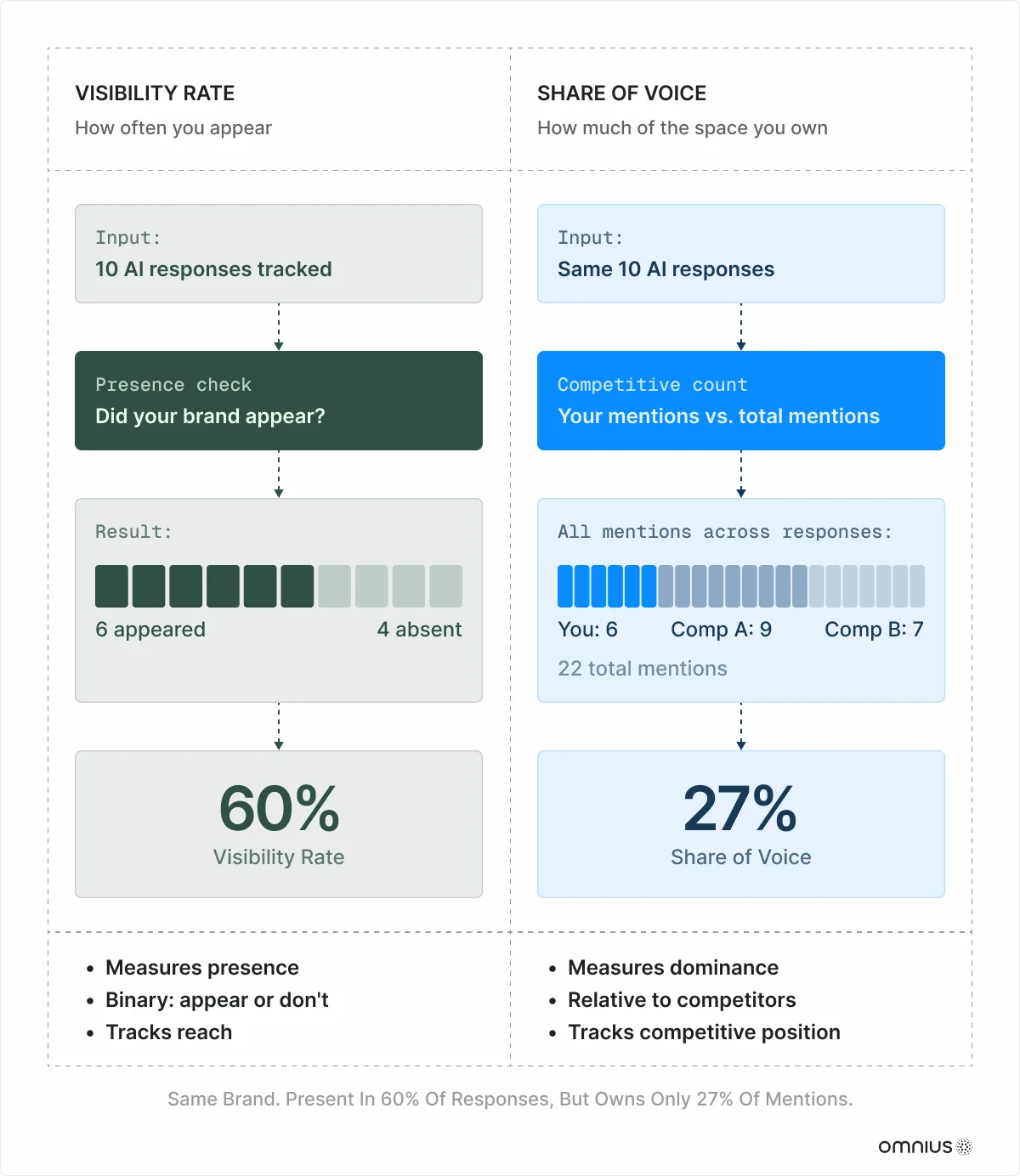
The AI visibility rate measures how often LLMs like Claude and ChatGPT mention your brand in responses to relevant user queries. For example, when a user asks a chatbot about project management tools in their industry, your brand may come up if relevant.
Depending on the tool you use, the brand visibility rate may be presented differently. We usually refer to it as the percentage of the total number of relevant responses that mention your brand.
You should track the rate monthly for baseline monitoring, or weekly if actively testing changes. Measure across platforms, and for different prompt, market, and language segments.
What that tells you: The AI visibility rate reveals how well LLMs recognize your brand. Tracking it continuously lets you notice changes as the models, the audience, and your brand evolve. Segmentation allows us to identify specific bottlenecks, such as low visibility in specific regions or models.
Low visibility could suggest poor content coverage and weak brand authority signals. The cause could also be technical. Check your Cloudflare settings and robots.txt file to ensure they’re not accidentally blocking AI crawlers.
2. Share of Voice: Relative Brand Visibility
Share of voice (SoV) is similar to visibility rate, but it’s used to assess competitive dominance. It represents the frequency of your brand’s mentions across LLM answers in relation to your competitors. We calculate it as the percentage of the total brand mentions that include your brand.
What that tells you: The share of voice correlates with market share and perception. Combining this metric with the visibility rate offers a more accurate picture of your real-life presence in answers.
Let’s say your brand has a high visibility rate but a low SoV. That means AI mentions it frequently for relevant prompts, but also includes many other competitors. In contrast, a high SoV with a low visibility rate indicates your brand sees fewer mentions, but you usually dominate them.
Neither of these contrasting situations is ideal, and they point to distinct problems and solutions. Low SoV indicates you need to develop more original content to differentiate your brand, while low visibility requires expansion and query fan-out.
3. Citation Rate: Content Visibility
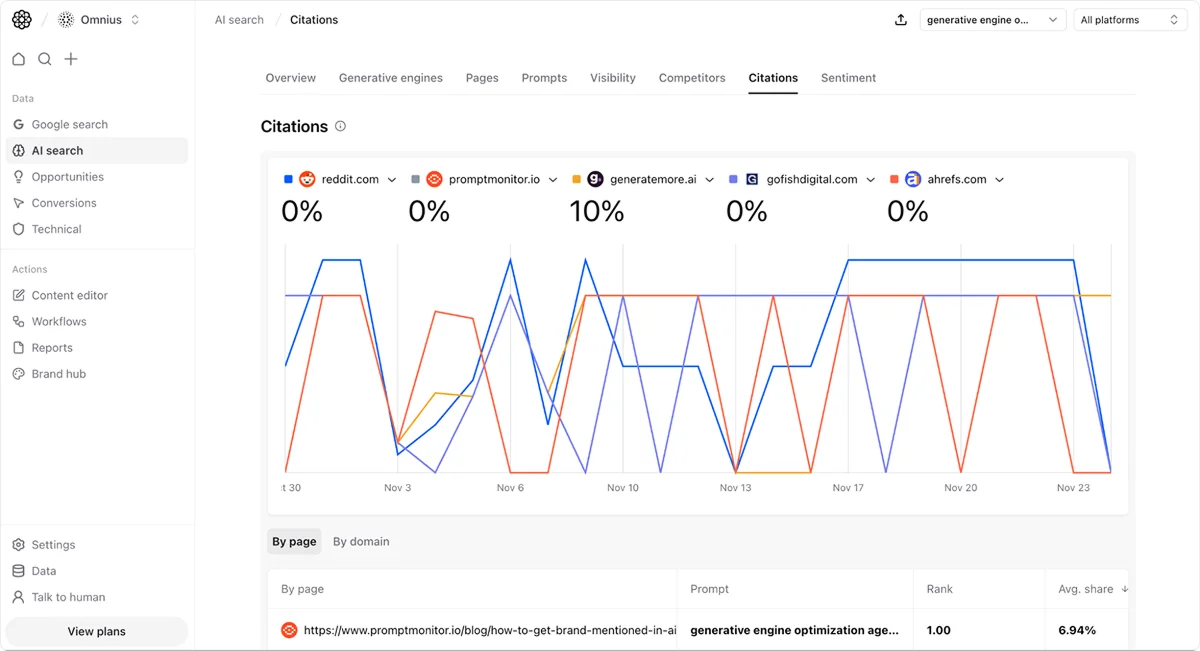
The citation rate shows how often AI cites your brand as a source in relevant answers. It’s the percentage of total AI answers with at least one citation that includes your domain. For example, if a user asks about the benefits of project management tools, it may mention your research data and cite your research paper to support the answer.
You can track the citation rate for specific pages, as well as against specific prompts and models, and over select periods.
What that tells you: A high citation rate correlates with strong domain authority and backlink profile. When an LLM consistently cites a domain or page over time, it might indicate that it considers the brand and its content valuable and relevant to the specific context.
However, low citation rates don’t always signal a content problem. The appearance and maximum number of citations vary across AI answers, and the conditions are unclear. So, if your citation rate is low for some queries, it might be low across the board. In that case, it’s better to switch to other queries where the metric is more useful.
4. Citation Share: Relative Content Visibility
The citation share also measures how often AI cites you, but relative to your competitors. It’s the percentage of total citations across sources that include your domain. Citation share is to citation rate what share of voice is to the visibility rate.
What that tells you: A high citation share indicates that your domain or page takes up a bigger share of citations than competitors for target queries.
Ideally, you want to track and improve upon both your citation rate and share. A healthy citation rate with weak share means you're included but diluted, while a strong share with a weak rate means you dominate niche queries but miss broader ones.
5. Visibility in Google AI Overviews
Google AI Overview (AIO) visibility shows how often your brand appears in AIOs for relevant keywords. We usually calculate it as the percentage of target keywords that result in AIO mentions.
These AI-generated answers top half of the search results pages today. The figure has grown by 58% in only one year.
An even more startling figure: For queries with AIOs, the click-through rate (CTR) can decline by over 60%, according to Seer Interactive. Even if you land at the top of SERPs, that might mean nothing if you don’t get featured in the overviews.
Tracking AIO visibility can help pinpoint content that is getting buried. You can then investigate what featured results for relevant queries offer, optimize your content accordingly, and track progress. If you want to get granular, you can also track the citation rate and share of voice specifically for AIOs.
Pro tip: In the Google Search Console, the AIOs and AI Mode mentions count as clicks and impressions. Still, you should track them with a dedicated tool alongside GSC, as the platform bundles them with other data.
6. Average Position in Responses
Average position is a score that shows how AI engines rank you in responses that feature multiple brands alongside yours.
For example, say a user asks AI to recommend a tool in your niche. The AI lists you first in 50 out of 100 responses, and third in the other half. Your average position will be two in that case.
What that tells you: A higher position means your brand is highly relevant for the target query. But it also reflects your brand’s overall credibility in the AI engine's eyes. Users usually focus on the first few suggestions only, so the position can sometimes be a more valuable indicator of GEO’s effectiveness than the visibility rate.
7. Citation Source Types
Citation source is a KPI that reveals which sources the AI engine used to answer a relevant user query. The sources may include your website, your competitors, or giants like Wikipedia and YouTube. They might also fall under categories such as social and commercial sites.
What that tells you: Citation source reveals the types of websites that the AI considers experts, the content it deems high-quality, and the formats it prefers. These insights can offer valuable insights for your strategy. For example:
- AI prioritizes YouTube for answers. >>> Maybe it’s time to start making videos.
- A competitor is more commonly used as a source. >>> Inspect their content for ideas. If they managed to outperform well-known sources, you can too.
- AI consistently relies on a relevant industry digest. >>> Consider getting a guest post or mention there.
8. Quality, Context, and Sentiment
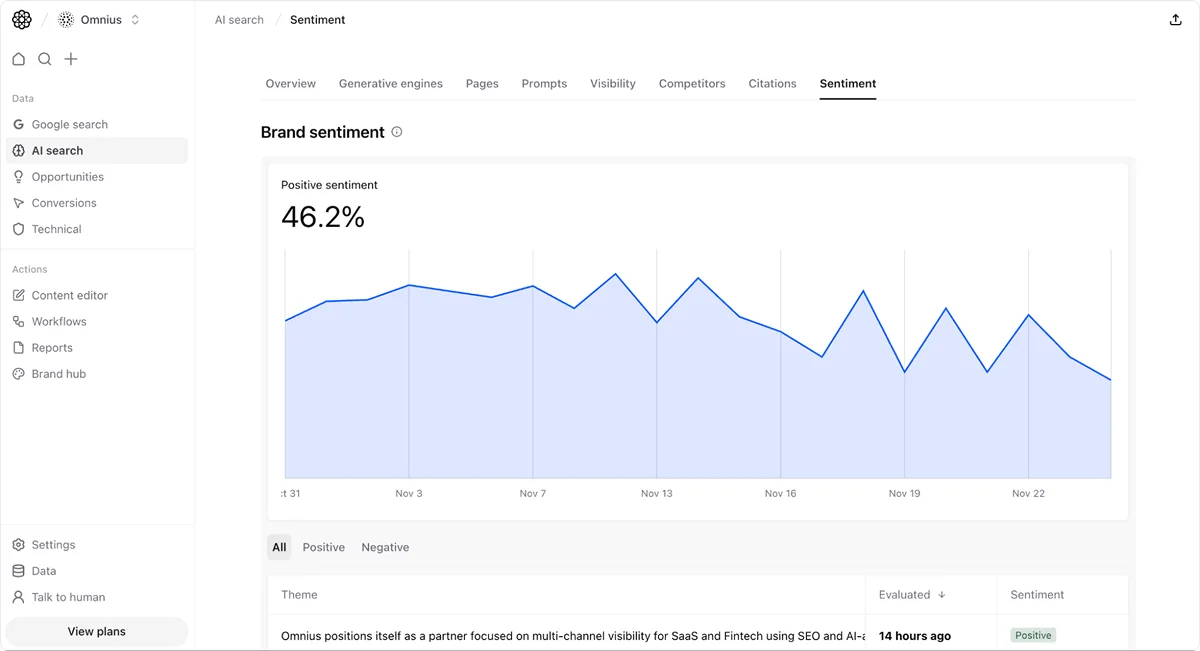
Platforms calculate these metrics differently, but they all reveal the same—how AI engines perceive your brand in the relevant context. Is the information about your brand accurate? Does the AI mention you in a positive or negative light?
Sure, it’s great to have many mentions. But if a significant portion of them represent your brand falsely or criticize you, those mentions may not mean as much.
One or two misrepresentations could be accidents or isolated issues that you can solve by contacting the website owners. However, consistent errors or critiques could point to a more fundamental problem with your website content or product.
9. AI Referral Traffic and Conversions
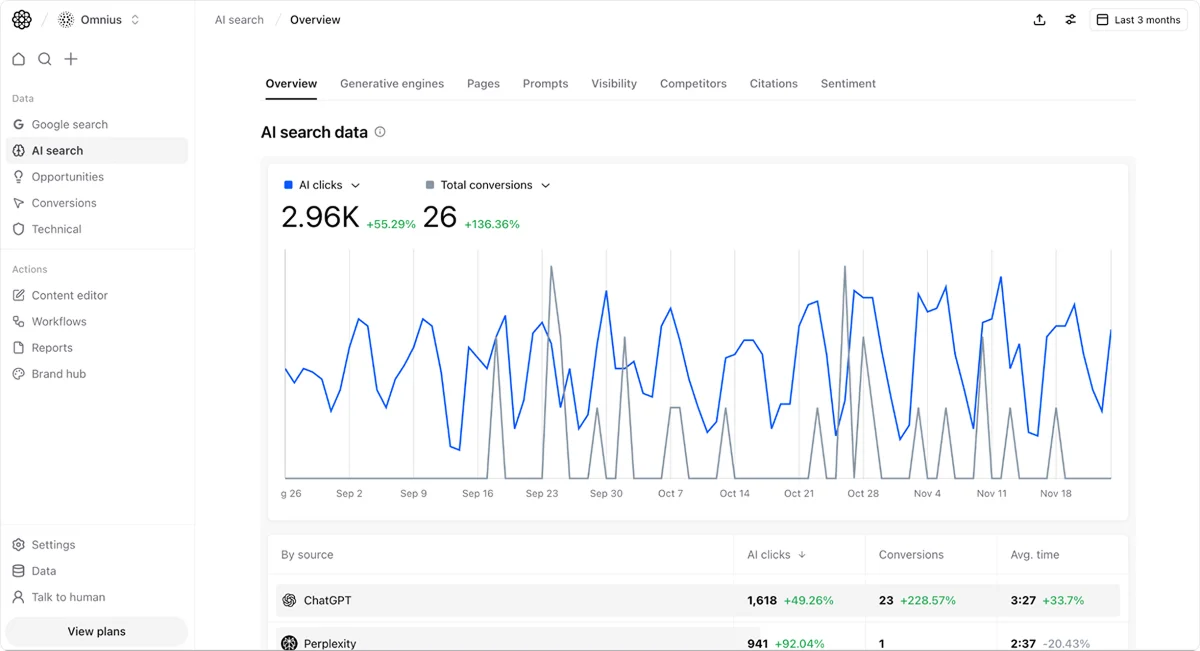
AI referral traffic is the number of visits AI engines bring to your website, while conversions can be any event valuable for your business, such as a purchase. Traffic tells you whether people are coming. Conversions reveal whether those visits result in desired business outcomes.
Tracking both is essential for a comprehensive picture. A mismatch between the two signals a problem:
- High traffic, low conversions: The AI engine is citing you for queries that don't match what your page delivers. Alternatively, users have already got their answer from the AI response and are clicking through without real intent. To fix, improve your query intent mapping and destination pages.
- Low traffic, high conversions: The AI engine sends you fewer visitors, but the ones who do arrive have strong intent and follow through. This tells you your content-to-page alignment is right, but your citation footprint is too narrow, so you need to expand visibility to more prompts.
Still, conversions should take priority when evaluating success across engines. Review conversions weekly to identify the weakest link, make one adjustment per reporting cycle for clean attribution, and revise the effects in the following cycle.
10. Bot Activity: Technical Health Scores
Measuring bot activity allows you to see how AI crawlers engage with your site before indexing it and featuring its content. Several types of crawler bots exist, including:
- Training bots that collect training data
- Search bots, which build indexes
- User bots gathering data to respond to user queries in real time
We can monitor bot activity through various metrics, but the following five are essential:
How To Track AI Search Visibility Metrics
You can measure AI search visibility manually by running relevant queries through LLMs and analyzing the patterns. Here are key tips for this approach:
- Define 20–30 prompts relevant to your business.
- Combine branded, unbranded, informational, and comparison queries.
- Capture whether your brand appears, how and where it appears, whether competitors appear as well, whether the sentiment is positive or negative, and when you are cited.
- Write down your results in a spreadsheet or dashboard.
- Repeat this for all major LLMs over select periods, but use the same prompts for reliable results.
- Analyze changes every month, or weekly if testing or optimizing.
The manual approach is a solid way to track snapshots and establish your baseline in the beginning. But it’s not scalable, and it doesn’t let you take full advantage of AI search visibility metrics. For the most comprehensive and accurate insights, you need to run hundreds of prompts across models.
A specialized AI search visibility tool, such as AtomicAGI, allows you to automate the tracking process and monitor key metrics across 10+ engines in real time. The dashboard makes it easy to understand all sides of your performance:
- Leverage metrics like visibility rate, traffic, citation share, position, and sentiment.
- Filter by prompts, categories, and period, and click on a category to sort by it.
- Assess progress easily with color-coded graphs and variance percentages.
- Get alerts when AI mentions you or drops you from results.
Teams that use Atomic AGI for data analysis and reporting typically save around 30 hours per month.
Final Step: Leveraging Your Data for Growth
Now that you have all the data you need, it’s time to turn it into measurable outcomes. Identify the gaps, make targeted improvements, and compare before-and-after metrics to gauge progress. Don’t be afraid to experiment with different prompts, content formats, messaging, and authority-building methods, but make sure to document every result.
Keep monitoring even if you’re not actively testing. Events such as model updates, new campaigns, and brand-related shifts can quickly disrupt results, so prompt action may be required to remain competitive.
If you lack the bandwidth, hiring a professional marketing agency like Omnius allows you to stay ahead of the curve without putting in the effort. We specialize in growth for B2B SaaS and fintech companies, covering everything from technical optimization to content. Get in touch to see how we can support your business.
Frequently Asked Questions
What’s the difference between AI Search and SEO metrics?
SEO metrics, such as rankings and CTR, rely on deterministic results, which return the same links for a query every time, while AI search metrics use non-deterministic results, which are different for every run.
Because of that, AI search visibility metrics are more complex to track. They tell you whether AI engines mention you, how they describe you, and how often they cite your content. These outcomes require multi-run sampling rather than simple rank tracking.
What are the limitations of AI search visibility metrics?
The biggest limitation is that the same prompt can produce different results across runs, so single snapshots are unreliable.
There's also no standardization. Tools define metrics like visibility rate differently, which makes cross-tool comparison difficult. Attribution is another gap, since many AI-influenced visits register as branded organic traffic rather than AI referrals. Additionally, some metrics depend on AI engine behavior you can't control. For example, citation rate is bounded by whether engines choose to cite sources at all for a given query type.
What are the best tools for tracking AI search visibility?
Many tools for AI search visibility tracking exist today, but our overall top five include:


.png)

.svg)
















.svg)


























.svg)


%20(1)%20(1)%20(1)%20(1)%20(1).png)