.png)

Key Takeaways
- Enterprise SaaS SEO is a long-term, compounding growth channel that drives qualified traffic, lowers CAC, and builds sustainable competitive advantage.
- Success depends on executing all core pillars together: technical SEO, keyword strategy, content, and link building, not treating them as isolated tactics.
- A strong strategy captures demand across the entire buyer journey, from problem-aware searches to high-intent, conversion-focused queries.
- Consistency, internal alignment, and execution at scale are what separate companies that win in search from those that struggle to compete.
Did you know that 55% of enterprise-level companies invest more than $20,000 per month in SEO?
That’s because enterprise SaaS SEO is not just about rankings, it’s about building a scalable growth channel that drives qualified traffic, high-intent leads, and long-term revenue through search.
Unlike traditional SEO, enterprise SaaS SEO operates in complex environments, with large site architectures, multiple stakeholders, and highly competitive markets. It requires a structured, scalable approach that goes beyond basic optimization.
In this guide, we’ll break down how enterprise SaaS SEO works, why it matters, the key challenges companies face, and the strategies needed to build sustainable organic growth.
What is Enterprise SEO for SaaS?
Enterprise SaaS SEO represents the implementation of suitable SaaS SEO strategies that will help your website rank in search results in search engines.
The main goal of enterprise SaaS SEO is not just to rank on the search engine results page; it’s to drive qualified traffic that converts into leads.
The main parts of enterprise SaaS SEO require creating an appropriate SEO strategy, technical SEO, SEO audit, on-page SEO, off-page SEO, content marketing, and doing keyword research.
These SEO aspects enterprise firms typically divide into three ways:
1. Working with an agency
This is the most common approach for enterprise SaaS companies operating at scale. Working with enterprise SaaS SEO agencies brings:
- proven SaaS SEO frameworks (based on the previous successful results),
- technical expertise, and
- resources to handle typical SEO challenges (such as multilingual SEO, programmatic SEO, and large-scale site architecture)
They also provide strategic data-driven direction, faster execution, and access to specialized tools, making them ideal for enterprise SaaS firms aiming for the most suitable long-term growth.
2. In-house SEO specialist
Some enterprise SaaS companies build internal in-house SEO teams, or just one SEO specialist, with the goal of replacing the agency workflow.
For some firms, that can be a good approach if they do not have enough money to invest in an agency or already have stable SEO results and do not want to invest heavily into it.
However, scaling results often depend on the team's experience and available internal resources.
3. Do not invest in SEO
Enterprise SaaS firms that choose not to invest in SEO typically rely on other marketing channels such as paid acquisition, outbound sales, or partnerships.
While this can generate short-term results, it often leads to higher CAC (customer acquisition costs) and missed opportunities to capture long-term, high-intent demand.
In some cases, the decision not to invest in SEO can be influenced by previous negative experiences with SEO agencies or specialists, such as bad execution without results, lack of transparency and communications, or unclear ROI. As a result, companies may become sceptical of SEO as a channel and struggle to see its long-term value.
But, without SEO, enterprise SaaS businesses risk losing visibility during critical stages of the buyer journey, especially as more users rely on search and AI-driven discovery to evaluate solutions.
Note: Because SEO is a long-term channel, companies that invest early build momentum over time, giving them a strong competitive advantage over those who delay.
Importance of Enterprise SaaS SEO
The importance of SEO for enterprise SaaS companies is huge, running far beyond just generating brand visibility and clicks; a well-structured strategy can directly impact revenue, CAC, and long-term growth.
For enterprise SaaS companies, SEO should not be just a marketing channel; it’s a scalable growth long-term infrastructure.
- Growth at scale: Unlike paid channels that scale linearly with budget, SEO is the approach that is generating more and more results over time, without constantly burning money.
- Lower CAC: Enterprise SaaS typically operates in high-CPC industries (often $20–$100+ per click). SEO helps reduce dependency on paid channels and stabilize long-term acquisition costs.
- Covering the full customer journey stage: Enterprise SEO allows companies to rank for:
- Bottom-of-funnel keywords (e.g., “best enterprise CRM software”)
- Comparison queries (e.g., “X vs Y”)
- Problem-aware searches (e.g., “how to automate financial reporting”)
This enables full-funnel demand capture, not just awareness.
- Global and multi-market visibility: Enterprise SaaS companies often operate across multiple regions.
SEO enables scalable acquisition through:- multilingual content
- localized search intent
- international SERPs
- Brand authority: By building deep topical coverage across hundreds of related pages, enterprise SEO strengthens your authority in a niche, making it harder for competitors (especially new ones) to outrank you across entire keyword clusters.
These advantages are not just theoretical; they are reflected in how users search, evaluate, and purchase SaaS products today.
Data consistently shows that organic search plays a dominant role in both traffic acquisition and the B2B buying journey, especially for enterprise-level solutions.
Here are some of the statistics that represent the importance of investing in SEO:
- 68% of all online experiences begin with a search engine, making organic search one of the most consistent acquisition channels.
- Organic search drives over 53% of total website traffic, outperforming paid and social combined.
- 70–80% of users ignore paid ads and focus on organic results, which makes SEO critical for trust and conversion.
- In B2B SaaS specifically, 57%–70% of the buyer journey is completed before a prospect ever talks to sales, meaning discovery via search is often the first touchpoint.
- Companies that invest in SEO see up to 14.6% close rates, compared to ~1.7% for outbound tactics.
Challenges of Enterprise SaaS SEO
Enterprise SaaS SEO comes with a unique set of challenges due to the scale, complexity, and internal structure of large organizations.
1. Large-scale site architecture complexity
Enterprise SaaS websites often include:
- thousands of pages
- multiple product lines
- feature pages, integrations, and use cases
Managing internal linking, crawlability, and indexation at this scale becomes a technical SEO challenge, not just a content task.
2. Slow implementation due to internal processes
Unlike startups, enterprise companies rely on:
- multiple stakeholders (marketing, product, engineering)
- long approval cycles
- strict development workflows
This slows down SEO execution and makes agility a major limitation.
3. Alignment between SEO, product, and engineering teams
SEO success at the enterprise level depends heavily on:
- engineering resources
- product prioritization
- data integration
Without alignment, even the best SEO strategy fails at execution.
4. Managing international and multilingual SEO
Enterprise SaaS companies operate globally, which introduces:
- hreflang complexity
- localization vs translation challenges
- region-specific search intent differences
Scaling SEO across markets requires structured international strategies.
5. Competing in highly saturated SERPs
Enterprise SaaS niches are extremely competitive, often dominated by:
- established brands
- aggregators
- review platforms (e.g., G2, Capterra)
Ranking requires authority, backlinks, and deep content coverage, not just basic optimization.
6. Difficulty measuring ROI across long sales cycles
Enterprise SaaS sales cycles can take:
- weeks or months
- multiple touchpoints
This makes it harder to:
- attribute conversions to SEO
- prove short-term ROI
SEO becomes a long-term revenue driver, not a quick-win channel.
7. Scaling content without sacrificing quality
Enterprise SEO often involves:
- programmatic content
- large content clusters
The challenge is balancing:
- scale (volume)
- quality (E-E-A-T, depth, expertise)
Many teams now use AI to help hit that scale, then run the output through an AI humanizer to keep it reading naturally before it goes live. Poor execution leads to thin or duplicate content issues.
Poor execution leads to thin or duplicate content issues.
8. Legacy technical issues and SEO debt
Enterprise websites often carry:
- outdated CMS systems
- broken internal structures
- historical SEO mistakes
Fixing these requires deep technical audits and long-term investment.
9. Trust issues from previous SEO failures
Many enterprise companies:
- had bad experiences with agencies
- saw unclear ROI
- faced poor execution
This creates internal resistance, making it harder to secure buy-in for SEO initiatives.
Enterprise SaaS SEO vs Regular SEO
While the main SEO principles remain the same between enterprise SaaS SEO and regular SEO, the key difference lies in the level of business complexity, scale of operations, and execution constraints, not in fundamentally different SEO strategies.
Enterprise SaaS SEO operates in environments where:
- websites are significantly larger and more complex
- multiple teams are involved in execution
- decisions require prioritization and alignment across the organization
In contrast, regular SEO is typically executed in more agile environments, where changes can be implemented faster and with fewer dependencies.
Here are the 4 more differences between enterprise SaaS SEO and regular SEO:
1. Execution complexity
Regular SEO can often be fast-approved and implemented directly by a small team or individual.
Enterprise SaaS SEO requires coordination across:
- engineering
- product
- marketing
This makes execution slower and more dependent on internal business processes.
2. Scale of impact
In regular SEO, changes are typically applied to a smaller set of pages, making testing and iteration relatively low-risk and fast.
In enterprise SaaS SEO, many changes are implemented through templates, systems, or site-wide logic, meaning a single update can affect a large portion of the website.
Because of this, testing, validation, and prioritization become critical, as mistakes can scale just as quickly as improvements.
3. Technical depth
Enterprise SaaS SEO involves:
- complex site architecture
- indexing and crawl budget management
- handling large datasets and dynamic pages
Regular SEO rarely reaches this level of technical complexity.
4. Resource allocation and prioritization
In regular SEO, priorities are often defined within the marketing team.
In enterprise environments, SEO competes with broader business priorities such as product development, engineering capacity, and revenue initiatives.
This makes prioritization, stakeholder alignment, and internal advocacy essential for successful execution.
How to do Enterprise SaaS SEO? 6 Best Strategies to Implement
Understanding why enterprise SaaS SEO matters is one thing; knowing how to execute it correctly is another.
The strategies below cover every core pillar of a well-structured enterprise SaaS SEO program.
Each strategy is interconnected. For enterprise SaaS companies, success comes from executing all of these pillars consistently and in the right order, not treating them as isolated tactics.
1. Technical SEO
Technical SEO is the foundation and should be an unskippable part of any enterprise SaaS SEO strategy.
Without doing it, even the best content and link-building efforts will underperform and be invisible because search engines need to be able to crawl, index, and understand your website correctly.
For enterprise SaaS companies, technical SEO goes far beyond basic optimizations. Typically, enterprise SaaS websites have large-scale site architectures, dynamic pages, multiple product lines, and often complex CMS or custom websites that can cause issues and mistakes.
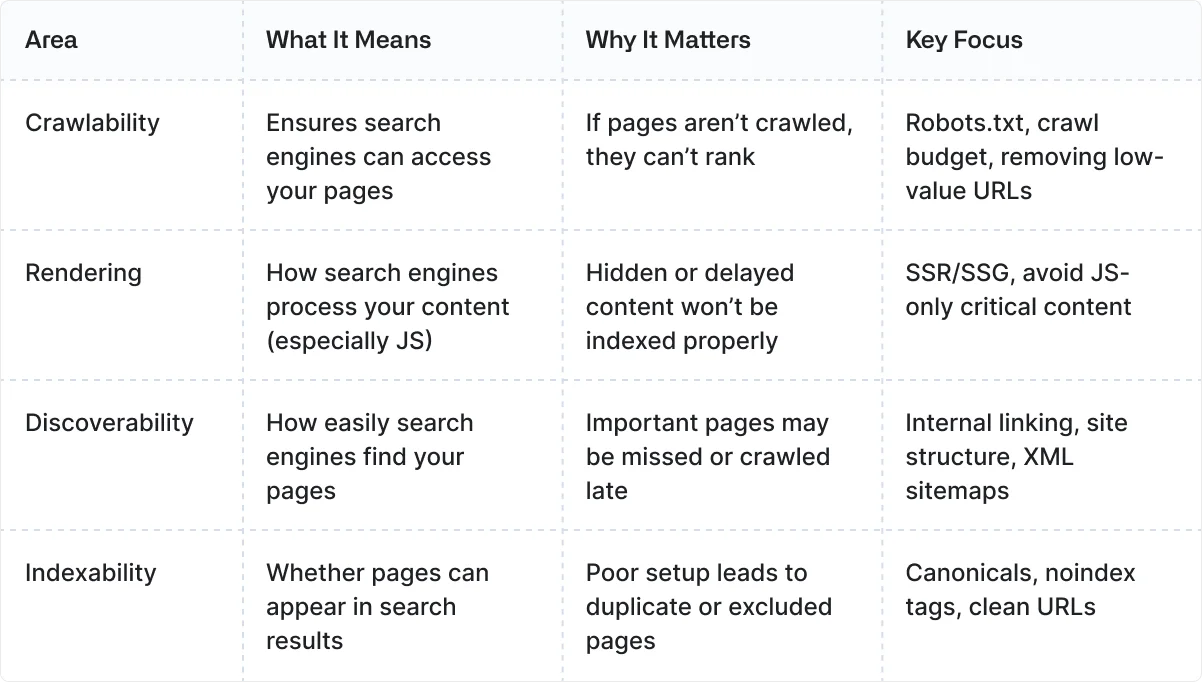
Technical SEO for enterprise SaaS breaks down into four critical areas:
1.1 Crawlability
Crawlability is making sure that search bots can access and see your website content without barriers. If your pages cannot be crawled, they cannot be indexed or ranked, regardless of how good the content is.
Key crawlability priorities include:
- Robots.txt configuration: Use robots.txt to block crawlers from sections of the site that should not be crawled.
- Crawl budget management: Enterprise SaaS websites often have thousands of pages. Googlebot has a limited crawl budget per site, so wasting it on low-value URLs (e.g., faceted navigation pages, duplicate parameter URLs, pagination) means your most important pages get crawled less frequently.
1.2. Rendering
Rendering is the process by which a search bot loads and processes your page, including executing JavaScript to render the content.
Most modern SaaS websites are built on JavaScript-heavy frameworks such as React, Angular, or Vue.js. While these create excellent user experiences, they introduce serious rendering risks for SEO:
- JavaScript-dependent content: If key content, such as headings, body text, or internal links, is only loaded via JavaScript, Googlebot may not see them at all during its initial crawl. This makes the content invisible to indexing.
- Delayed rendering: Googlebot renders JavaScript in a secondary queue, meaning there can be a significant delay between when a page is crawled and when its JavaScript-rendered content is actually processed and indexed.
- Dynamic elements causing indexation gaps: Features such as tabs, menus, and dynamically loaded product or feature content may not be indexed if they rely entirely on client-side JavaScript to load.
The recommendation for enterprise SaaS companies is to minimize reliance on client-side JavaScript for critical content. Where JavaScript is necessary, implement server-side rendering (SSR) or static site generation (SSG) to ensure that Googlebot receives fully rendered HTML on the first crawl, without needing to execute JavaScript.
Note: The best approach to check how the content is represented to Google is to test the URL inside Google Search Console and see the test results.
1.3. Discoverability
Discoverability is about ensuring search bots can efficiently find all your important pages and understand the structure and priority of your content.
Key discoverability priorities include:
- XML sitemaps: Maintain clean, up-to-date XML sitemaps that include only indexable, canonical URLs. Sitemaps should be segmented by content type (e.g., product pages, blog posts, integration pages) for large enterprise SaaS sites with more than 10.000+ URLs.
- Site architecture: A flat, logical site architecture ensures that important pages are reachable within a small number of clicks from the homepage. Deep page hierarchies increase the risk of pages being discovered late or not at all.
- Internal linking as a discovery signal: Beyond crawlability, internal links communicate to Google which pages are most important and how content relates to one another. Pages that receive many internal links are treated as higher priority.
1.4. Indexability
Even if a page is crawled and rendered correctly, it still needs to pass Google's indexability requirements before it will appear in search results.
Key indexability priorities include:
- Canonical tags: Use canonical tags to consolidate duplicate or near-duplicate content and direct Google to the preferred version of a page. This is especially important for enterprise SaaS sites with multiple URL variations for similar content.
- Noindex directives: Pages that should not appear in search results, such as thank-you pages, internal search results, or staging content, should be explicitly marked with a noindex tag.
- Duplicate content management: Enterprise SaaS websites are highly prone to duplicate content issues caused by URL parameters, session IDs, trailing slashes, and content syndication. Left unresolved, these can dilute ranking signals across multiple page variations.
- HTTP status codes: Ensure all important pages return a 200 status code. Pages returning 4xx or 5xx errors cannot be indexed.
Recommended tools: Screaming Frog SEO Spider, Sitebulb, Google Search Console, Chrome DevTools (for JavaScript rendering inspection), and Ahrefs Site Audit.
Technical SEO for enterprise SaaS is not a one-time task. It requires ongoing monitoring (ideally monthly) and a close working relationship with your engineering team to ensure that issues are identified early, prioritized correctly, and resolved before they spread across the entire site.
2. Keyword Research
Keyword research for enterprise SaaS is not just about finding a list of high-volume keywords and writing content around them, without first understanding the ICP's needs and solutions for it.
It is about mapping search intent across the entire buyer journey and identifying where your solution can capture demand at every stage.
Enterprise SaaS buyers use a wide variety of search queries depending on where they are in the decision-making process. The keyword strategy needs to follow that.
The core content categories to target include:
- Bottom-of-funnel (BoFu) keywords: High-intent queries such as "best project management software for enterprises" or "enterprise CRM platform." These drive the most qualified traffic and can be prioritized first.
- Comparison and alternative keywords: Queries like "[Your Brand] vs [Competitor]" or "best [Competitor] alternatives" capture prospects already in the buying mode. These are extremely valuable and often overlooked.
- Problem-aware and informational keywords: Queries such as "how to automate financial reporting" or "what is headless CMS" target users in the awareness and consideration stages. These build topical authority and drive top-of-funnel demand.
- Integration and use-case keywords: Queries like "[Your Product] + [Tool] integration" or "[Your Product] for [industry]" capture highly specific, high-converting traffic.
- Long-tail keywords: Lower volume but higher intent. Enterprise SaaS buyers often use very specific search queries, and capturing these at scale can generate significant qualified traffic.
- FAQs: Queries that start with "how," "what," "why," or "can" (e.g., "how does enterprise CRM work" or "what is the best SaaS tool for financial reporting") represent a high volume of informational searches across every stage of the buyer journey.
- Case study keywords: Queries like "[Your Product] case study" or "[industry] SaaS success story" target prospects in the late consideration and decision stages who are looking for proof of results before committing.
- Engagement content keywords: Queries targeting reports, tools, calculators, and statistics (e.g., "SaaS churn rate statistics 2024" or "enterprise software ROI calculator") attract high-authority backlinks naturally, drive recurring organic traffic, and position your brand as a credible industry resource.
Recommended tools: Ahrefs, Semrush, Google Search Console (for identifying existing keyword opportunities), Google Keyword Planner, and AlsoAsked (for FAQs).
A strong keyword research process also involves analyzing competitor keyword gaps using tools like Ahrefs' Content Gap or Semrush's Keyword Gap feature. This reveals which high-value terms your competitors are ranking for that you are currently missing.
3. On-page SEO
On-page SEO is the process of optimizing the whole website and individual pages so that both search engines and users can clearly understand what the page is about, why it is relevant, and why it deserves to rank at the top of the search results.
For enterprise SaaS companies, on-page SEO needs to be applied consistently across hundreds or thousands of pages, making a clear, repeatable optimization framework essential rather than optional.
A single improvement applied at the template level can positively impact thousands of pages at once, but the same is true for mistakes.
The core on-page SEO elements for enterprise SaaS include:
3.1. Title Tags & Meta Descriptions
Title tags and meta descriptions are the first things a potential customer sees in the search results. These tags directly influence CTRs (click-through rates) and signal to Google what the page is about.
- Each page should have a unique, keyword-optimized title tag (under 60 characters) that clearly communicates the page's topic and value.
- Meta descriptions (under 155 characters) should be written to drive clicks, not just describe the page. Think of them as a micro ad for your content.
- Avoid duplicate title tags across the site (common issue on enterprise SaaS websites with large numbers of product, feature, and integration pages).
3.2. Heading Structure
A clear heading hierarchy (H1–H5) helps search engines understand the structure of your content and improves readability for users.
- Every page should have one H1 that aligns directly with the primary target keyword and clearly states what the page covers.
- H2s and H3s should be used to organize content into logical sections, naturally incorporating secondary and semantically related keywords.
- Avoid skipping heading levels or using headings purely for styling (the heading structure should reflect the content hierarchy, not design preferences).
3.3. Internal Linking
Internal linking is one of the most underrated on-page SEO tactics at the enterprise level.
A well-executed internal linking strategy distributes PageRank across the site, helps Google discover new pages faster, and strengthens the topical relevance of your content clusters.
- High-priority pages, such as product pages, solution pages, and high-converting landing pages, should receive the most amount of internal links.
- Use descriptive, keyword-relevant anchor text rather than generic phrases like "click here" or "learn more."
- Regularly audit for orphaned pages, pages with no internal links pointing to them, as these are often under-crawled and under-ranked.
3.4. Canonical Tags
Canonical tags tell search bots which version of a page is the authoritative one.
Based on the huge site structure that a lot of enterprise SaaS websites have (they need it), it can cause duplicate content issues caused by URL parameters, filtered views, pagination, and content that appears across multiple URLs. Canonical tags tell Google which version of a page is the authoritative one.
Every page falls into one of two canonical states:
- Canonicalized: The page points to a different URL as the authoritative version. This is used when similar or duplicate content exists across multiple URLs, and you want to consolidate all ranking signals to a single preferred page (e.g., filtered product pages, URL parameter variations, or paginated content pointing back to the main page).
- Self-referencing canonicalized: The page points to itself as the authoritative version. This is used on pages that are unique, indexable, and have no duplicate variations. A self-referencing canonical reinforces to Google that this specific URL is the version that should be indexed and ranked.
Incorrect canonical implementation can cause significant indexation problems that scale quickly across hundreds or thousands of pages.
Typical canonical tag issues on enterprise SaaS websites are:
- canonicalizing to a noindexed page,
- pointing to redirected (3xx) or dead (4xx) pages,
- having conflicting canonical and hreflang signals, or
- leaving pages without any canonical tag
3.5. Hreflang Tags
Operating across multiple regions and languages, hreflang tags are essential. They tell search bots which version of a page to serve to users based on their language and location.
Hreflang must be implemented correctly across all language and regional variations of your site. Errors in hreflang implementation are extremely common and can result in the wrong page version ranking in the wrong market.
Each page variation should reference all other language/regional versions, including a self-referencing hreflang tag.
Hreflang errors should be monitored regularly using tools like Screaming Frog or Ahrefs Site Audit, as even small mistakes can affect visibility across entire international markets.
The x-default tag indicates the main version of the page. When multiple hreflang variations exist, they should always point to your primary global URL.
Example of Hreflang tag implementation:
A correctly structured hreflang implementation should look like this:
<link rel="alternate" hreflang="en" href="https://example.com/en/" />
<link rel="alternate" hreflang="en-us" href="https://example.com/en-us/" />
<link rel="alternate" hreflang="en-gb" href="https://example.com/en-gb/" />
<link rel="alternate" hreflang="de" href="https://example.com/de/" />
<link rel="alternate" hreflang="fr" href="https://example.com/fr/" />
<link rel="alternate" hreflang="x-default" href="https://example.com/en/" />
Every page in every language variation must include the full set of hreflang references, pointing to all other versions as well as itself. A one-sided or incomplete implementation (where only some pages reference the others) is one of the most common hreflang mistakes on enterprise SaaS websites.
Hreflang errors should be monitored regularly using tools like Screaming Frog or Ahrefs Site Audit, as even small mistakes can affect visibility across entire international markets.
3.6. Mobile Optimization
Google uses mobile-first indexing, meaning it primarily uses the mobile version of your website for crawling, indexing, and ranking. For enterprise SaaS companies, ensuring a fully optimized mobile experience is not optional.
- All pages should be fully responsive and render correctly across different screen sizes and devices.
- Mobile page speed is a direct ranking factor. Heavy JavaScript, unoptimized images, and render-blocking resources are the most common culprits on enterprise SaaS websites.
- Use Google Search Console's Mobile Usability report to identify and fix pages with mobile-specific issues such as text too small to read, clickable elements too close together, or content wider than the screen.
3.7. Page Speed
Page speed is both a ranking factor and a direct driver of user experience and conversion rates. For enterprise SaaS companies, slow pages mean lost rankings and lost revenue.
- Core Web Vitals: Largest Contentful Paint (LCP), Interaction to Next Paint (INP), and Cumulative Layout Shift (CLS) are Google's primary page experience signals and should be monitored continuously.
- The most common page speed issues on enterprise SaaS websites include unoptimized images, excessive JavaScript execution, render-blocking resources, and a lack of caching.
- Use Google PageSpeed Insights and Lighthouse to audit individual pages, and Google Search Console's Core Web Vitals report for a site-wide view of performance issues.
3. 8. Content-to-Intent Alignment
Every page must match the search intent behind its target keyword. This means Google needs to see that the format, depth, and angle of your content match what users are actually looking for when they type that query.
- A page targeting "enterprise CRM software" should be a product or category page, not a blog post.
- A page targeting "how to reduce SaaS churn" should be an educational guide, not a product landing page.
- Misaligned intent is one of the most common reasons well-optimized pages fail to rank, regardless of how strong the content quality is.
Recommended tools: Screaming Frog (site-wide on-page audits), Ahrefs, Semrush On-Page SEO Checker, Google Search Console, Google PageSpeed Insights, Lighthouse.
4. Content Marketing
Content marketing is one of the most scalable and compounding growth levers in enterprise SaaS SEO. A well-executed content strategy drives organic traffic across every stage of the funnel, builds topical authority, and creates assets that generate backlinks naturally over time.
For enterprise SaaS companies, content marketing needs to be strategic and intent-driven. Publishing content without a clear keyword strategy and funnel mapping is one of the most common reasons enterprise content programs fail to generate measurable results.
Content marketing for enterprise SaaS breaks down into two core activities:
1. Creating New Content
New content should always be rooted in keyword research, but keyword research alone is not enough to decide what to create.
- Do not rely solely on search volume; a keyword with 50 monthly searches can drive more pipeline than one with 5,000 if the intent is right.
- Always cross-reference keyword data with Google Search Console to understand how your existing pages are already performing and where real demand exists before investing in new content.
Content should be created across all three stages of the buyer journey:
- Bottom-of-funnel (BoFu) content: This is the highest priority. Product pages, solution pages, comparison pages, alternative pages, and use case pages target prospects who are actively evaluating solutions. These pages drive the most qualified traffic and have the highest conversion potential. Examples: "best enterprise CRM software", "[Your Brand] vs [Competitor]", "[Your Product] for financial teams."
- Middle-of-funnel (MoFu) content: Case studies, ROI guides, deep-dive feature explainers, and integration pages target prospects who are aware of the problem and actively researching solutions. This content supports the evaluation process and builds trust before a buying decision is made.
- Top-of-funnel (ToFu) content: Educational blog posts, industry guides, reports, and tools target users in the awareness stage who are searching for problems your product solves. This content builds topical authority, drives brand discovery, and feeds long-term demand generation.
Note: It’s important to create a content cluster that will complete the full customer journey, from not knowing anything to making him buy.
2. Refreshing Old Content
Creating new content is not always the highest-impact activity. For enterprise SaaS companies with an existing content library, refreshing underperforming pages is often faster, more cost-effective, and more likely to generate results in the short term.
Content refresh priorities should be identified through Google Search Console rather than keyword tools alone. Look for:
- Pages that are ranking in positions 4–20 for valuable keywords but have not been updated in 12+ months
- Pages that are receiving impressions but generating low click-through rates, indicating a title tag or meta description that needs improvement
- Pages that previously ranked well but have seen a consistent decline in clicks or positions over time
- Pages that were built around keywords with low search volume assumptions, but are showing unexpected impression volume in Search Console
When refreshing content, the goal is not just to update the publish date. A proper refresh involves improving content depth, updating outdated statistics and information, strengthening internal linking, realigning the content to current search intent, and addressing any on-page SEO gaps that may have been missed originally.
Note: Most importantly, every refresh must ensure the content contains accurate, up-to-date information. Outdated statistics, incorrect claims, or misleading data do not just hurt the performance of that individual page; they signal to Google that your website cannot be trusted as a reliable source. This can negatively impact your overall domain authority and tank the performance of your entire website, not just the page in question.
5. Link Building
Backlinks remain one of the strongest ranking signals in Google's algorithm. For enterprise SaaS companies, link building is not just about acquiring more links; it is about building domain authority, establishing credibility in highly competitive SERPs, and earning links that drive qualified referral traffic alongside rankings.
Enterprise SaaS operates in highly competitive niches where top-ranking pages often have hundreds or thousands of referring domains. Without a consistent link-building strategy, it is very difficult to compete for high-value commercial keywords regardless of how strong your content and on-page SEO are. For SaaS companies targeting several countries, an international link building team can coordinate relevant placements across different markets.
The most effective link-building strategies for enterprise SaaS include:
5. 1. Link Exchanges
Link exchanges involve partnering with other relevant, authoritative websites to mutually exchange backlinks.
When done correctly and selectively, this can be an effective and scalable way to build links, particularly for enterprise SaaS companies that already have an established network of partners, integrations, and industry relationships.
- Focus only on relevant websites that are topically aligned with your product and industry and have great DR (domain rating). A link exchange with an unrelated website carries little SEO value and can raise red flags with Google.
- Avoid large-scale or manipulative link exchange schemes. Google's guidelines explicitly target excessive reciprocal linking, so quality and relevance should always take priority over volume.
- The most natural form of link exchange happens through partnership pages, co-marketing content, and integration directories, where both parties genuinely benefit from referencing each other.
5. 2. Paid Links
Paid link building can be done through sponsored guest posts or link insertions into existing content; it is a widely used strategy in enterprise SaaS SEO.
While Google's guidelines technically discourage paid links, they remain a common and effective tactic when executed with care and relevance.
- Guest posts involve publishing an original article on a third-party website in exchange for a backlink. Focus on relevant, high-authority publications in your niche. A guest post on a low-quality or irrelevant site carries little value and can do more harm than good.
- Link insertions involve placing a backlink into an already-published, indexed piece of content on an authoritative website. These are often faster to execute than guest posts and can be highly effective when placed in topically relevant, well-ranking articles.
- Always prioritize relevance, domain authority, and organic traffic of the target website over price. A single link from a high-authority, relevant publication is worth significantly more than ten links from low-quality sites.
- Use tools like Ahrefs or Semrush to vet potential link prospects before committing, checking their organic traffic, domain rating, and backlink profile for signs of manipulation.
5. 3. Digital PR
Digital PR is one of the most powerful and scalable link-building strategies for enterprise SaaS companies.
It involves creating content, typically original research, data reports, industry studies, or unique insights, that journalists, bloggers, and industry publications want to reference and link to naturally.
- Original research and data-driven reports are the most effective digital PR assets. A well-executed industry study or annual report can generate dozens of high-authority backlinks from a single piece of content, and continue earning links passively over time.
5. 4. Turning Mentions into Links (Link Reclamation)
Many enterprise SaaS companies are already being mentioned across the web, in articles, blog posts, industry roundups, and news coverage, without receiving a backlink.
Turning these unlinked mentions into backlinks is one of the fastest and most efficient link-building tactics available, because the hard work of earning the mention has already been done.
- Use tools like Ahrefs Alerts, Semrush Brand Monitoring, or Google Alerts to track unlinked mentions of your brand name, product name, and key team members across the web.
- When you identify an unlinked mention, reach out to the author or editor with a short, polite request to add a link to the mention. Conversion rates for these outreach emails tend to be significantly higher than cold link-building outreach, since the website has already shown a willingness to reference your brand.
6. Off-page SEO
Off-page SEO covers everything that happens outside of your website that influences your search engine rankings and overall online authority.
For enterprise SaaS companies, managing your off-page presence is not just about building new links; it is equally about protecting and maintaining the quality and health of your existing backlink profile.
A strong off-page SEO strategy for enterprise SaaS consists of two core ongoing activities:
6. 1. Monitoring Your Backlink Profile
Your backlink profile is not static. New links are constantly being acquired, intentionally through link building and unintentionally through mentions, aggregators, and third-party directories, while existing links are lost, changed, or degraded over time. Continuous monitoring is essential to maintain a healthy and effective profile.
Two key dimensions to monitor regularly:
- Dofollow vs. Nofollow links: Dofollow links pass PageRank and directly contribute to your domain authority and rankings. No-follow links do not pass PageRank but still contribute to a natural-looking backlink profile. An unusually high ratio of nofollow links relative to dofollow links can signal a low-quality link profile that is not generating the ranking impact it should be.
- Branded vs. non-branded anchor text: A healthy backlink profile contains a natural mix of branded anchors (your company or product name), generic anchors ("click here", "learn more"), and keyword-rich anchors. Over-optimized anchor text, where a disproportionate number of links use exact-match commercial keywords as anchor text, is a well-known Google penalty trigger. Monitoring anchor text distribution helps you identify and correct this before it becomes a problem.
Use tools like Ahrefs or Semrush to track new and lost backlinks, monitor anchor text distribution, and identify changes in your backlink profile over time.
Set up automated alerts so you are notified immediately when significant changes occur.
6. 2. Disavowing Toxic Backlinks
Not all backlinks are beneficial. Low-quality, spammy, or manipulative links pointing to your website can actively harm your rankings and trigger manual penalties from Google.
For enterprise SaaS companies, particularly those that have been active online for several years or have previously used aggressive link-building tactics, toxic backlinks are a real and ongoing risk.
- Toxic links typically come from link farms, private blog networks (PBNs), irrelevant foreign-language directories, hacked websites, or sites with no organic traffic and artificially inflated metrics.
- When toxic links are identified, the first step is always to attempt manual removal by contacting the website owner and requesting that the link be taken down.
- If manual removal is not possible or goes unanswered, use Google's Disavow Tool via Google Search Console to instruct Google to ignore those links when evaluating your site. This should be done carefully and selectively; disavowing good links by mistake can negatively impact your rankings.
- Toxic backlink audits should be conducted on a regular basis, not just reactively. Use Ahrefs, Semrush, or Majestic to identify links with low domain authority, high spam scores, or suspicious link patterns that warrant disavowal.
Conclusion
Enterprise SaaS SEO is not a one-time initiative; it’s a compounding growth system that drives qualified demand, reduces CAC, and builds long-term competitive advantage.
Each of the core pillars, technical SEO, keyword strategy, content, and link building, works together. The strongest results come when none are skipped, and execution stays consistent across teams and markets.
Start with a solid technical foundation, align content with search intent, and build authority over time. That’s how enterprise SaaS companies turn SEO into a predictable, scalable growth channel.
If you're not sure where to start or need help executing at scale, working with an enterprise SaaS SEO agency like Omnius can accelerate results and remove internal bottlenecks.
Book a free 30-minute consultation to explore how we help enterprise SaaS companies turn SEO into a predictable source of qualified growth.
Frequently Asked Questions (FAQs)
How much does enterprise SaaS SEO cost?
Enterprise SaaS SEO typically costs $5,000–$30,000+ per month, depending on scope, competition, and execution. It includes technical SEO, content, and link building. Unlike paid channels, SEO compounds over time, reducing CAC and driving long-term growth.
What are the mistakes in the enterprise SaaS SEO process?
Common mistakes include ignoring technical SEO, targeting low-intent traffic, weak internal alignment, scaling low-quality content, poor linking, and weak backlinks. Many also fail to track ROI or refresh existing content, limiting long-term growth and impact.


.png)

.svg)
















.svg)



























.svg)
%20for%20B2B%20SaaS%20%5BFull%20Guide%5D.webp)

.webp)