.png)

Key Takeaways
- Most SaaS companies rank for the wrong keywords at the wrong stage; traffic only converts when it reaches the right person at the right moment.
- The vast majority of deals are won by vendors already on the day-one shortlist. Being absent during problem validation and comparison means you're never considered.
- Technical SEO is the prerequisite; JS-heavy sites can be invisible to both Googlebot and AI crawlers before any content or backlink strategy can work.
- Most SaaS sites only have blogs and miss the bottom funnel entirely. Comparison, alternative, integration, and proof pages are where buying decisions are actually made.
- SEO fills the funnel, CRO converts it, and running them combined produces traffic to unconverted pages and optimized pages that don't rank.
SaaS companies have an SEO problem they don't know about. It's not that they're not ranking. It's that the traffic they're getting was never going to sign up in the first place.
Wrong pages, wrong keywords, wrong stage of the journey, and no amount of link building can fix a strategy aimed at the wrong target.
Search traffic is only valuable if it reaches the right person at the right moment with the right information. When those three things align, SEO becomes one of the most scalable acquisition channels a SaaS business can own. When they don't, you get sessions without intent, and intent without conversion.
This article breaks down the specific SEO improvements that actually drive sign-ups, not just visits.
Let’s dive in!
SaaS Buyers Customer Journey
SaaS buyers do not follow a clean, standard funnel. The reality is non-linear by design: a buyer might run a category search, land on a competitor's comparison page, check G2 reviews, visit your pricing page, go quiet for three weeks, and then come back through a retargeting ad.
There is no fixed sequence, and for anything beyond a simple self-serve signup, the research phase alone can stretch 18 months before a prospect ever talks to sales.
Gartner maps six distinct buying jobs: problem identification, solution exploration, requirements building, supplier selection, validation, and consensus creation.
In practice, buyers don't complete them in order. They run them in parallel, loop back, and restart when new information changes the picture. Buying groups now average 5 or more stakeholders, each operating at a different stage, which means the "journey" is often several parallel journeys colliding.
Three behaviors have the most direct bearing on whether SEO converts:
1. Problem validation
Before evaluating any tool, buyers need to confirm the problem is worth solving. They're searching for evidence, quantified inefficiencies, time loss, and revenue impact.
Content that speaks to this stage doesn't pitch your product. It confirms the cost of inaction. If you're not present here, a competitor earns your customers' trust before your brand is even considered.
2. Solution comparison
Once the problem is validated, buyers explore options, and they're rarely comparing just two tools. They're weighing tools against workflows, build-versus-buy tradeoffs, and entirely different approaches to the same problem.
Around 54% of SaaS buyers start this phase with a Google search, which quickly routes them to review sites, and 86% will check third-party reviews before shortlisting anyone.
Your SEO needs to account for both surfaces (third parties), not just your own pages.
3. Risk reduction
By the time a buyer is close to signing up, they're not looking for more features; they're looking for reasons not to walk away.
Use cases, integrations, team-size fit, and honest limitations. Content that addresses this directly closes the gap between intent and action. It's also the stage most SaaS companies ignore entirely.
Notably, 91% of buyers arrive at a first sales meeting already well-informed, meaning the decision is largely shaped before any human conversation takes place.
The stakes are rising. Buyer shortlists are no longer expanding during the journey; they’re formed on day one. Buyers evaluate around 4-5 vendors, and 95% of deals are won by companies already on that initial shortlist.
4 Best SEO Improvements For SaaS Sign-Ups Increase
Understanding how buyers move is only half the equation. The other half is making sure your SaaS website is built to meet them at every stage, and lead to the conversion.
The 4 SEO improvements below address the most common gaps between SEO traffic and actual sign-ups.
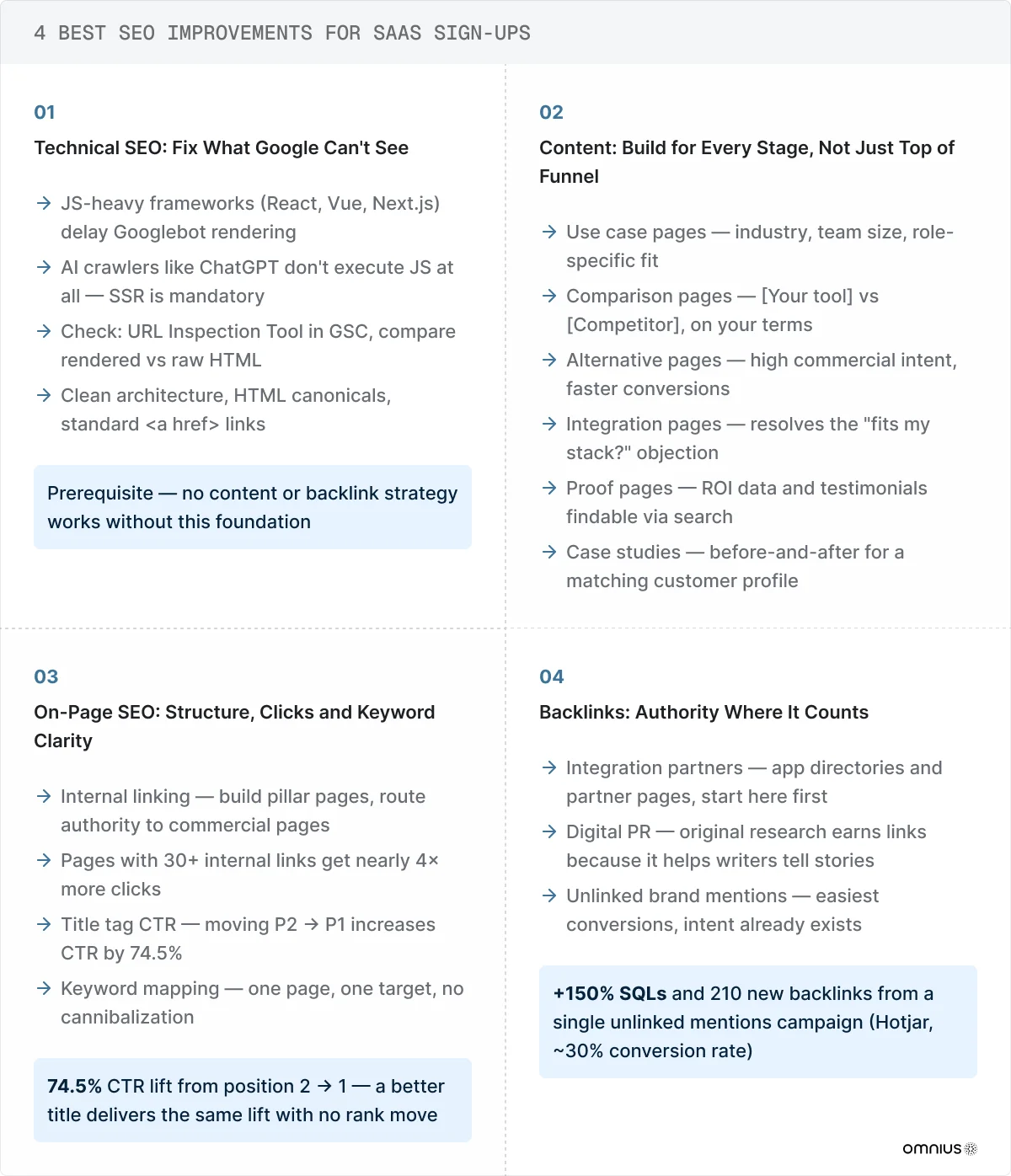
1. Technical SEO: Fix What Google Can't See
Before any content or keyword strategy can work, Google needs to be able to crawl, render, and index your pages properly.
For many SaaS websites, this is where the first problem hides.
Most SaaS applications are built on JavaScript-heavy frameworks (React, Vue, Angular, Next.js). That's fine for the product, but it creates a real risk for the rendering and indexing part from the search crawlers.
With an unoptimized JavaScript-driven site, Googlebot may not see the most important (conversion) content you want indexed and ranked.
The reason is how Google processes these pages: Googlebot queues all pages for rendering, but the page may wait in that queue for a few seconds, or significantly longer, before a headless Chromium instance actually executes the JavaScript. During that window, your content effectively doesn't exist for search.
The practical check: open Google Search Console, run the “Test Live URL” under URL Inspection Tool on your most important pages (homepage, pricing, features, solutions, comparisons, case studies, use case pages), and compare the rendered screenshot with the raw HTML.
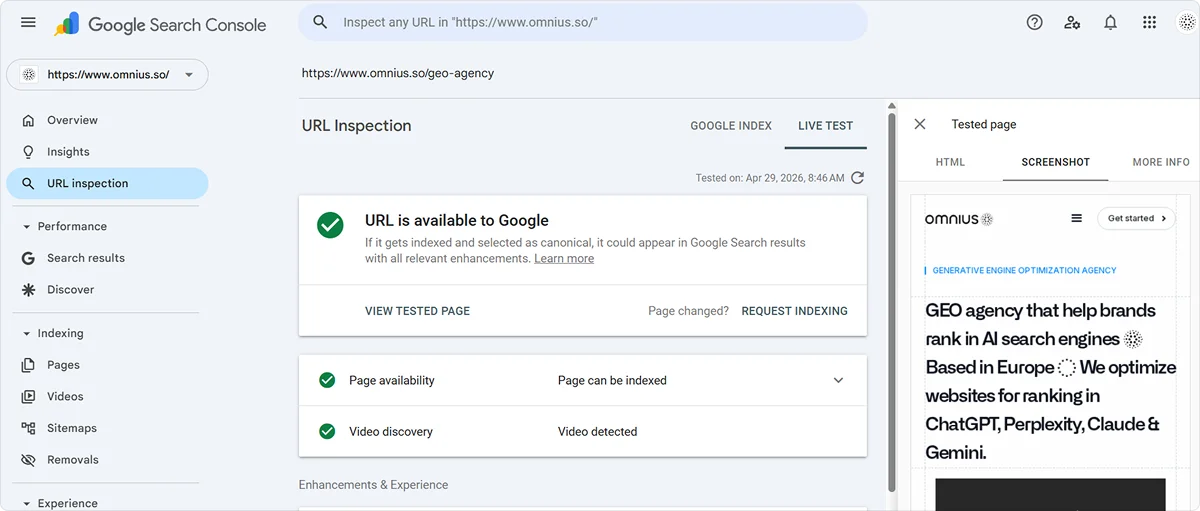
If the rendered version is missing headlines, body copy, or CTAs, you have a rendering problem that no amount of backlinks will fix.
One more thing worth flagging: most AI crawlers (including ChatGPT) don't execute JavaScript at all. If your key pages rely on client-side rendering, they're invisible to the systems increasingly shaping how software gets discovered. Server-side rendering isn't optional anymore.
Beyond rendering, the fundamentals still apply: clean site architecture, no duplicate content issues, canonical tags in HTML rather than injected via JavaScript, and internal links that are standard <a href> elements rather than JavaScript-driven navigation.
None of these is exciting. All of them are prerequisites.
2. Content: Build for Every Stage, Not Just the Top of the Funnel
Product and feature pages are the foundation; they capture buyers who already know what they want and are close to a decision.
But as we covered earlier, most buyers aren't there yet when they first find you.
Keyword research can reveal the full opportunity. Around every core product or feature, buyers are running searches at every stage of their journey to confirm the problem is real, explore approaches, compare options, and reduce risk.
That demand maps consistently to six content categories that cover the entire path from first search to sign-up.
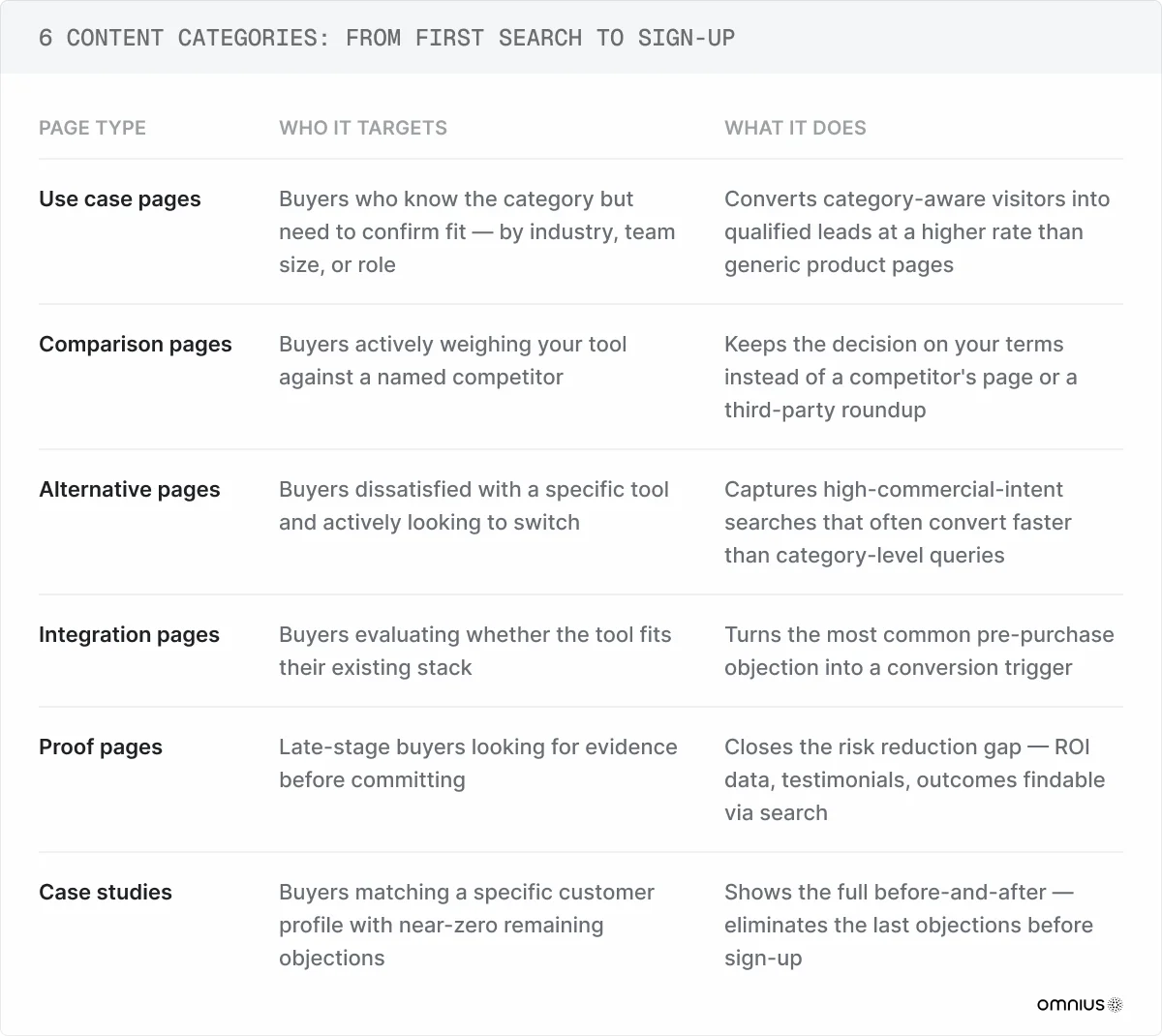
1. Use case pages
Target buyers who already know the category but need to confirm the product fits their specific situation, team size, industry, workflow, or job role. "Project management software for remote engineering teams" is a different page than "project management software," and it converts at a different rate.
2. Comparison pages
Meet buyers when they're actively weighing options. A "[Your Tool] vs [Competitor]" page that's honest about differences earns trust and keeps the decision on your terms, rather than a competitor's page or a third-party roundup.
3. Alternative pages
Capture a separate, high-intent search pattern for buyers who are dissatisfied with a specific tool and are actively looking to switch. "Best [Competitor] alternatives" searches carry strong commercial intent and often convert faster than category-level queries.
4. Integration pages
Address one of the most common pre-purchase objections: will this fit my existing stack? A dedicated page for each key integration, with real workflow context, not just a logo, turns a blocker into a conversion trigger.
5. Proof pages
Close the risk reduction gap. Aggregated customer results, ROI data, outcome-focused testimonials, and trust-building video stories give late-stage buyers the evidence they need to move forward. These pages need to be findable via search, not buried behind a form or scattered across a homepage carousel.
6. Case studies
Go one level deeper than proof pages by showing the full before-and-after for a specific customer type. A buyer who matches the profile in your case study has almost no remaining objections to address.
None of this needs to happen at once. Start with the content category that maps closest to where your buyers are currently dropping off, one well-built use case page, or a single honest comparison will outperform ten generic blog posts. Build by capability and priority, not by trying to cover everything simultaneously.
3. On-Page SEO: Structure, Clicks, and Keyword Clarity
Rankings mean nothing if the wrong pages rank for the wrong terms, or if the right pages don't get clicked.
Three on-page levers have an outsized impact on whether your SEO traffic actually converts.
1. Internal linking: point authority where it matters
Every external backlink your site earns lands on a specific page. From there, authority flows through internal links, and most SaaS sites distribute it poorly.
Blog posts accumulate links while pricing pages, use case pages, and comparison pages, the ones that directly drive sign-ups, sit deep in the site with few internal links pointing to them.
The fix is deliberate, not complicated. Build pillar pages for each product category, linking to all related subpages: features, use cases, integrations, comparisons. When any page in the cluster earns links, authority is distributed across the whole structure.
Three things determine how well that structure actually works:
- Anchor text consistency: Each page should have a specific anchor. If multiple pages across your site point to different destinations using the same anchor text, you're sending Google a contradictory signal about which page actually covers that topic. That confusion dilutes ranking potential across both pages instead of concentrating it on one.
- Navigation and footer placement: Your most important feature and product pages should appear in the nav menu and footer. Every page on your site links to the nav and footer by default, which means these placements pass authority site-wide. If a page matters for conversion, it should be there. Leaving key pages out of the navigation is one of the most common and costly structural mistakes on SaaS sites.
- Cluster-to-cluster linking: Content within the same topic cluster should link to other pages in that cluster, not just back up to the pillar page. A use case page for "remote teams" should link to your integrations page, your comparison pages, and relevant case studies. That cross-linking reinforces topical relevance and keeps buyers moving through related content rather than hitting a dead end.
Pages with 30 or more internal links receive nearly four times as many clicks as pages with only a few.
That gap is rarely about content quality. It's about structure.
2. Title tag CTR: the traffic you're leaving on the table
You can rank on page one and still lose to a weaker competitor if their title tag speaks more directly to what the searcher wants.
Moving from position two to position one increases relative CTR by 74.5%, but the same logic applies horizontally: a better title at the same position can produce the same lift without moving a single rank.
The process is straightforward. Open Google Search Console, filter by impressions, and find pages with strong rankings but below-average click-through rates.
To benchmark what "underperforming" actually means by position, this CTR study breaks it down with current 2025 data, useful before you start testing anything.
Those are your highest-leverage opportunities. Title tag changes typically show CTR impact within two to four weeks, and the full pipeline effect, more qualified sessions, demo requests, and sign-ups, shows within 60 to 90 days.
Treat title tags the same way you'd treat ad copy: test with intent in mind, not keyword density.
3. Keyword mapping: one page, one target, no cannibalization
Every product and feature page should have a single primary keyword it's built to rank for.
When two or more pages on the same site compete for the same term, Google has to choose, and it often chooses the wrong one, or splits ranking signals between both, leaving neither performing at full potential.
This is keyword cannibalization, and it's more common on SaaS sites than most founders realize.
The audit is simple:
- Map each important page to its target keyword in a spreadsheet,
- Check whether any terms appear more than once, and
- Consolidate or differentiate where they do.
Done once, it removes a structural drag that no amount of new content will overcome. Done regularly as the site grows, it keeps your content architecture clean and your rankings concentrated rather than diluted.
4. Backlinks: Authority Where It Counts
Backlinks remain one of the strongest signals Google uses to determine which pages deserve to rank. But volume without relevance is wasted effort, and for SaaS, the quality of what you build matters far more than how fast and how much you build it.
Authority and link quality
Not all backlinks move rankings equally. Two factors determine whether a link actually does anything for you: the authority of the linking domain, and the relevance of the context it comes from.
The site linking to you should be a site your buyers have already read. A link from a high-traffic industry publication that covers your exact category carries far more weight than ten links from generic blogs with no topical connection to your product. If the source isn't relevant, the link may contribute to domain authority in aggregate, but it won't move the pages that drive sign-ups.
Anchor text is the second-most common variable that SaaS companies get wrong. Over-optimized anchors, where every link uses the exact same keyword phrase, look manipulative.
Vague ones like "click here" or "this article" throw away the relevance signal entirely. The target is natural variation around a consistent theme: your product name, your category, your core use case.
Your overall backlink profile should look like any naturally acquired profile. In practice, that means brand anchors should make up the largest share: your company name, your product name, your domain.
This is the safest and most defensible anchor distribution because it mirrors how real people link when they're not optimizing for anything. Keyword-rich anchors have their place, but they should be a minority of the total, not the default.
There's also a structural problem worth naming. Links that land on your blog don't help your pricing page rank. Commercial pages rarely earn links naturally, so combine external link building with deliberate internal linking to route authority from wherever it lands toward the pages that actually convert.
Methods for Getting Backlinks to a SaaS Website
Here are the three backlink methods that consistently deliver for SaaS:
1. Integration partners
This is the highest-leverage opportunity most SaaS companies ignore. If your tool integrates with other platforms, many of those platforms have partner pages, app directories, or marketplace listings that will link to you. Even those without dedicated integration pages are often open to content collaborations that earn a backlink and introduce your brand to a relevant audience. These links are topically relevant, come from authoritative domains, and are obtainable through a partnership conversation rather than a cold outreach campaign. Start here before anything else.
2. Digital PR and original research
Digital PR with data-led hooks is rated the most effective link-building tactic by SEOs in 2025. If your product generates usage data, customer insights, or industry benchmarks, packaging that into a publishable report creates an asset people want to cite repeatedly over time. Original research earns referring domains because it helps writers tell a better story. One well-executed study can generate more high-quality links than six months of manual outreach.
3. Unlinked brand mentions
As your brand grows, people will write about you without linking. These are the easiest conversions because the intent is already there.
When Hotjar ran a focused campaign to convert unlinked mentions into links, they earned 210 new backlinks with a ~30% conversion rate, and sales-qualified leads rose by 150% during the same period. Set up brand alerts and run this process monthly.
Why Most SaaS SEO Doesn't Convert
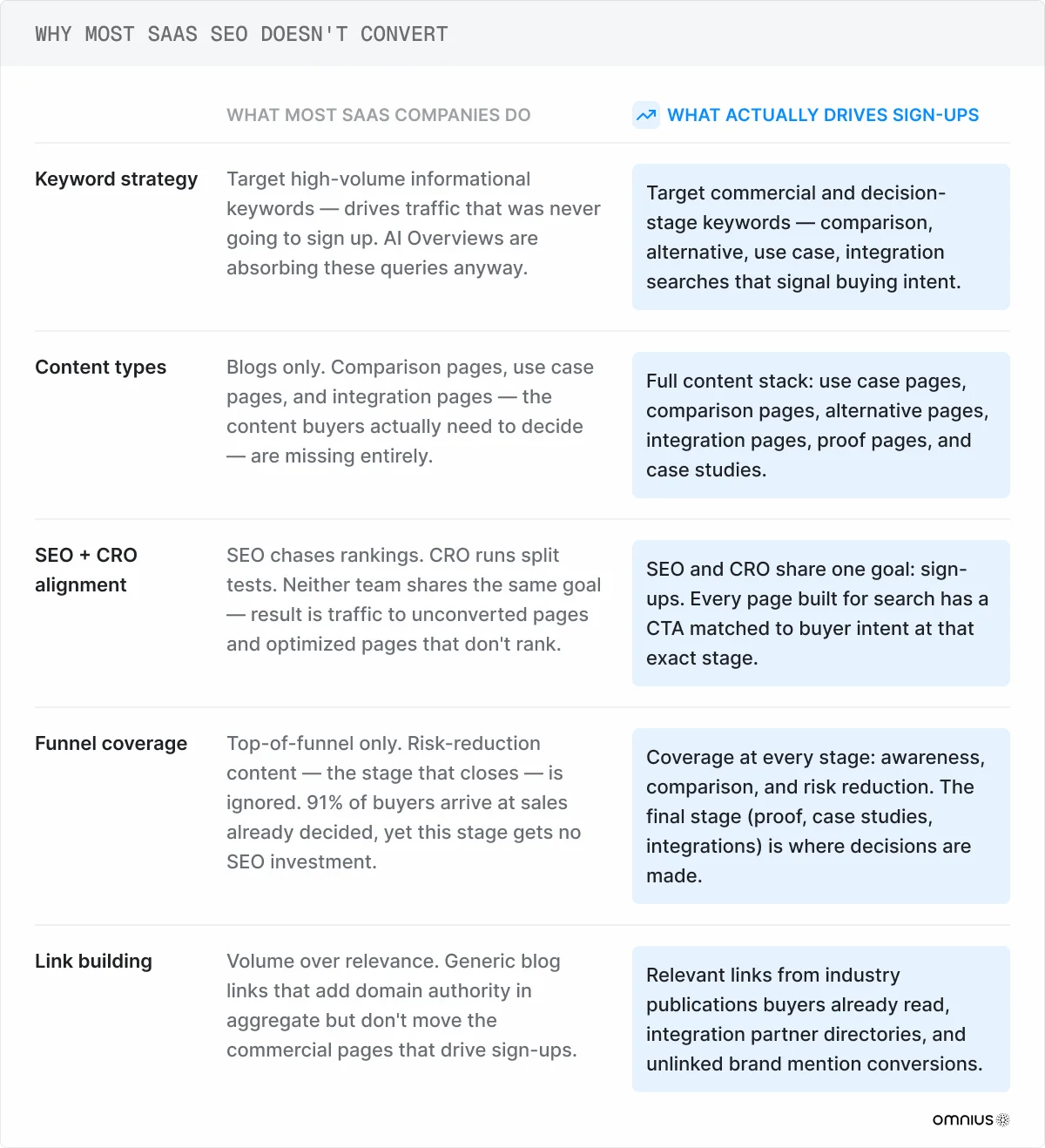
Most SaaS SEO fails for one reason: it's optimized for traffic, not decisions.
The wrong keyword strategy
The default playbook, publish high-volume blog posts, rank for informational keywords, build links to content, can produce impressive traffic numbers and still move zero sign-ups.
The most common mistake is focusing too heavily on top-of-funnel, high-volume keywords that drive traffic but rarely convert, an approach that's become even less effective as AI search engines and Google AI Overviews absorb informational queries.
Missing the decision-stage content
The problem compounds when you look at what's missing. Most SaaS sites have blogs. Few have a complete set of comparison pages, use case pages, and integration pages, the content that captures buyers when they're actually deciding.
Traffic from "what is project management" doesn't convert the same way traffic from "Asana alternative for engineering teams" does.
The intent is different. The proximity to a sign-up is different.
SEO and CRO running in silos
There's also a structural disconnect. SEO teams chase rankings while CRO teams run split tests, and the pipeline stays flat, because SEO drives traffic to pages with no conversion optimization, while CRO optimizes pages that barely rank. When these two functions don't share the same goal, you get sessions without intent and rankings without revenue.
The fix isn't more content. It's content mapped to where buyers actually are, on pages built to move them forward. This is exactly the kind of strategic shift a specialized SaaS SEO agency can accelerate.
SEO + CRO = Sign-Up Growth Engine
Rankings get you traffic. What happens after the click determines whether that traffic becomes a sign-up.
The gap most SaaS companies ignore
Most SaaS companies treat SEO as an acquisition channel and CRO as a separate conversion project, running them in parallel without connecting them. The result is a gap between visibility and revenue that neither team can close on its own.
SEO drives traffic to pages that aren't built to convert. CRO optimizes pages that don't rank. Both functions work hard and produce half the result (worst scenario).
How alignment actually works
When SEO and CRO share the same goal, the logic is straightforward: SEO brings the right person to the right page, and CRO makes sure that page does its job.
That means every piece of content built for search also needs a clear next step, a CTA that matches the intent of the person who just searched for that term.
A buyer reading a comparison page is closer to a decision than a buyer reading an awareness post. The CTA on each should reflect that difference.
The practical process
Use keyword and intent data to identify which pages attract high-intent visitors. Then use behavioral data, scroll depth, click maps, and session recordings to find where those visitors drop off. Fix the drop-off. Test the CTA. Repeat.
SEO fills the funnel. CRO converts it. Neither works at full potential without the other.
Conclusion
SEO that drives sign-ups isn't a different discipline from SEO that drives traffic. It's the same discipline, applied with a clearer understanding of what SaaS buyers are actually doing when they search.
They're not looking for content. They're making a decision, slowly, non-linearly, across multiple sessions. The companies that win are the ones whose SEO is built around that reality.
Each improvement in this article compounds into the next. A clean technical foundation makes content indexable, strong content earns links, links build authority, and authority makes everything rank better. Pick the improvement that addresses your biggest current gap and start there.
If you're not sure where your biggest gap is or need help building the full system, Omnius works exclusively with SaaS and Fintech companies on SEO & GEO strategies built around the pipeline, not just traffic.
Book a free 30-minute consultation to find out exactly what's standing between your current SEO and the sign-ups it should be driving.


.png)

.svg)
















.svg)



























.svg)

%20for%20B2B%20SaaS%20%5BFull%20Guide%5D.webp)
.webp)