.png)

Key Takeaways
- SEO is a long-term, compounding growth channel, not a quick win, most SaaS startups won’t see meaningful results before 6–12 months, but those who stay consistent benefit from traffic and pipeline that continue growing over time.
- SEO only works when there is existing search demand and clear product-market fit, without people actively searching for your solution, organic search cannot generate demand, making other channels more effective early on.
- Early-stage SaaS startups should focus on BOFU and high-intent keywords like alternatives, comparisons, and use-case pages, as these convert faster and are easier to rank for than broad informational content.
- Technical SEO and backlinks are foundational, not optional, even the best content will not rank if search engines cannot properly crawl your site or if your domain lacks authority.
- The SaaS companies that win with SEO are the ones that commit early and stay consistent, allowing the compounding effect to kick in while competitors abandon the channel too soon.
Most SaaS startups approach growth the same way: they turn on paid ads, experiment with outbound, and treat SEO as something to figure out later. It feels slower, harder to measure, and less urgent compared to channels that deliver immediate feedback.
But that approach comes with a hidden cost. By the time SEO becomes a priority, competitors who invested early have already built authority, ranked content, and a steady stream of inbound demand that is difficult to catch up with.
The reality is simple: SEO is not just another marketing channel for SaaS startups. When done correctly, it becomes a compounding growth engine that lowers acquisition costs, improves lead quality, and builds long-term leverage.
In this guide, we will break down when SEO actually makes sense for a SaaS startup, what most companies get wrong, and how to build an SEO strategy that drives real pipeline, not just traffic.
Is SEO The Best Marketing Channel for Your SaaS Startup?
Most SaaS startups underinvest in SEO. They spin up a Google Ads account on day one, burn through budget chasing clicks that stop the moment the campaign pauses, and treat SEO as something to "get to later." Later rarely comes, and by the time it does, competitors who committed early have already built a moat that takes years to close.
Here is the uncomfortable truth: SEO is probably the most underrated growth channel available to a SaaS startup, and most founders overlook it because it does not show results fast enough to feel urgent.
Most Founders Come In With the Wrong Mental Model
Many founders arrive at the SEO conversation carrying baggage, a blog that never ranked, an agency that overpromised, or a four-month experiment that got pulled before it had a chance to work.
That experience is real, but it is rarely evidence that SEO does not work. It is evidence that it was done wrong, under-resourced, misaligned, or built on the wrong strategy. SEO without technical foundations, backlinks, and intent-driven targeting is just writing for an empty room.
Before dismissing the channel based on a past experience, it is worth asking: was it SEO that failed, or an underfunded version of it?
The Numbers Make the Case
The data is hard to argue with. According to HubSpot, SEO leads close at a 14.6% rate compared to just 1.7% for outbound leads. That is not a marginal difference; it is nearly nine times higher. The reason is intent: organic visitors arrive already searching for a solution. You are not interrupting them; you are answering them.
Paid ads generate clicks. SEO generates demand from people who are already in buying mode.
It Is the Only Channel That Compounds
Every other acquisition channel is linear. You spend, you get results. You stop spending, results stop. Paid ads, sponsorships, and cold outbound all follow the same pattern. The moment the budget dries up, or the campaign ends, the pipeline dries up with it.
SEO does not work that way. A well-ranked page keeps generating traffic and a pipeline for months or years after the initial investment. The CAC from organic search decreases over time, the content cost is fixed, but the returns keep accumulating. For a capital-constrained startup, that compounding dynamic is not just attractive; it is strategically decisive.
It Builds an Asset, Not a Dependency
Startups that rely entirely on paid acquisition are one algorithm change, one budget cut, or one investor decision away from a pipeline crisis. SEO, done right, builds something no one can take away: a library of ranked content, a domain with authority, and a sustainable source of inbound demand that belongs to you.
That is not a tactic. That is infrastructure.
Key Takeaway: Most SaaS startups treat SEO as optional. The ones that win treat it as the foundation. It is slower to start, harder to measure early, and easy to deprioritize, which is exactly why it remains underrated, and exactly why committing to it early is a competitive advantage.
Why SEO is Different for SaaS Startups Compared to Other Verticals?
Doing SEO for a SaaS startup is not the same game as SEO for an established SaaS company, and it is definitely not the same as SEO for e-commerce, local businesses, or media sites.
The startup context changes everything: you have:
- no domain authority,
- a limited budget,
- a small team, and
- zero margin for a 12-month experiment that goes nowhere.
That pressure makes SaaS startup SEO its own discipline entirely.
Here is what sets it apart:
1. Zero Domain Authority in a Saturated Market
Established SaaS players have spent years building domain authority, thousands of backlinks, and content libraries with hundreds of indexed pages. You are entering that same competitive market with a brand-new domain, no ranking history, and probably no dedicated SEO resource.
This means broad keyword targeting is not an option early on. A startup cannot outrank HubSpot for "CRM software" in month three.
And here is the part most founders get wrong: they think starting small and scaling up once results appear is a safe, logical approach.
SEO expert Mark Williams-Cook puts it well: entering SEO with a minimal budget is like joining a marathon after it has already started. Your competitors are not ahead of you by chance; they have been running for years. Deciding to jog slowly and speed up only if you start catching up is not a strategy; it is a way to expend energy with no gain. As he tells clients: "Jump with both feet, or don't jump."
The strategic implication is clear: you need to find the gaps: specific, high-intent, lower-competition queries where a newer domain can actually break through and where ranking translates directly to pipeline, but the strategy should, from the start, be oriented on the long-term, not chasing shortcuts.
2. Runway Pressure Changes Your ROI Expectations
A funded startup has 18-24 months of runway. An SEO program typically takes 6–12 months to show meaningful results. That math creates a real strategic tension that established companies simply do not face.
This is why sequencing matters more for startups than for anyone else.
You cannot afford to spend the first six months publishing top-of-funnel blog posts about broad industry topics.
Startups need to front-load BOFU and MOFU content: alternatives pages, competitor comparisons, use-case landing pages, and content that captures buyers who are already in-market, even before the domain has built enough authority to rank for high-volume informational terms. And every priority page needs backlink support from day one, without it, even the right content will not rank.
3. Every SEO Decision Carries an Opportunity Cost
A funded SaaS company might have a five-person content team. A startup typically has one marketer wearing three hats, or a founder doing it themselves. There is no room for low-leverage SEO work.
This changes how you approach content production, keyword prioritization, link building, and technical SEO. Every decision has to be evaluated against the question: Does this move the needle on rankings and pipeline within our current runway? Startups need a leaner, more intentional version of SaaS SEO, not a scaled-down copy of what enterprise companies do.
4. The Buyer Funnel Is the Same - Your Priorities Are Not
SaaS buyers move through a structured journey from awareness to decision. That is true whether the vendor is a startup or a market leader. What changes for startups is where to invest first:
- BOFU first: Alternative pages, competitor comparisons, "[your category] software for [specific use case]" - high intent, lower volume, faster to convert
- MOFU second: Evaluation content, feature comparison guides, integration-specific landing pages
- TOFU last: Broad educational content - valuable long-term, but the slowest to generate pipeline
5. SEO Works Only When It's Wired Into the Business
For a SaaS startup, SEO cannot operate as a separate content initiative. It needs to be connected to:
- Product: Feature naming and positioning should reflect how buyers actually search
- Sales: SEO content should inform sales conversations, not exist in a separate silo
- Onboarding: If SEO drives signups but onboarding fails to activate them, the channel looks broken when it is not
Key Takeaway: For SaaS startups, SEO is not about doing what the big players do immediately; it is about doing the right things in the right order with limited resources. Authority is earned over time, but smart sequencing, intent-driven targeting, and cross-functional alignment can compress that timeline and make SEO a real growth driver even in the early stages.
Common SaaS SEO Mistakes for Startups
Most SaaS startups do not fail at SEO because the channel does not work. They fail because of the same repeatable mistakes. Here are the six most common ones and how to fix them.
#1 Quitting too fast
SEO takes 6 to 12 months minimum. Most startups pull the plug at month three, right before results would have started showing. Fix: track impressions, indexing, and ranking movement early so you have data to justify staying the course.
#2 Targeting broad keywords too early
Founders want to rank for the terms that describe their category. Those terms are owned by players with years of authority and thousands of backlinks. Fix: start with long-tail, high-intent keywords a newer domain can actually compete for.
#3 Ignoring long-tail keywords
Low search volume makes them look unattractive. But they convert better and are far easier to rank for early on. Fix: build your content plan around long-tail BOFU and MOFU terms first.
#4 Over-investing in blog content
Top-of-funnel articles feel productive but rarely convert. Fix: prioritize alternatives pages, comparisons, and use-case landing pages before going heavy on educational content.
#5 Weak technical SEO
JavaScript-heavy SaaS websites are often invisible to Googlebot. Fix: use Google Search Console's URL Inspection Tool on every priority page before anything else.
#6 No backlinks
Good content on a new domain without backlinks does not rank. Fix: treat link building as a parallel workstream from day one, not an afterthought.
5 Best SEO Strategies for SaaS Startups
Here are the five most effective SEO strategies SaaS startups should focus on to build traction, generate pipeline, and scale sustainably.
1. Technical SEO: Each page should be visible to search bots
Most SaaS startups jump straight into content and wonder why nothing ranks. The reason is almost always the same: Google cannot properly crawl, render, or index the site.
No amount of great content or backlinks will compensate for a technically broken foundation.
Technical SEO is not glamorous, but it is the prerequisite for everything else. Think of it as the infrastructure layer, if it is broken, the entire SEO program runs at a fraction of its potential.
For SaaS startups specifically, technical SEO matters more than most founders realize. Modern SaaS websites are often built on JavaScript-heavy frameworks (React, Next.js, Vue), which can create serious crawling and rendering issues if not configured correctly.
A page that looks perfect in a browser can be completely invisible to Googlebot.
Note: This is one of the most typicall issues that website owners make. Build dynamic website without checking if Google bot can see it.
What to Actually Do
The best tool for technical SEO is Google Search Console's URL Inspection Tool. Do not just run it on your homepage, check every page type that matters for your SEO strategy:
- Landing pages: product pages, feature pages, use-case pages
- Blog posts: especially your highest-priority BOFU and MOFU content
- Alternative and comparison pages: these are often the most valuable pages for a SaaS startup and the most commonly misconfigured
For each page, the URL Inspection Tool shows you exactly how Googlebot sees it, whether it is indexed, whether it is being rendered correctly, and whether there are any crawl errors blocking it.
2. Keyword Research: Make a plan
Most SaaS founders already have a working list of keywords in their heads, they know their features, their use cases, and how buyers describe the problem.
That intuition is a valuable starting point, but it is not a strategy.
The gap between what founders think people search for and what they actually search for is where most content budgets get wasted.
Start With What You Know, Then Validate
List every feature, use case, and problem your product addresses. This is your seed keyword list. Then take it into a keyword research tools (Ahrefs or Semrush) and check the real metrics:
- search volume,
- keyword difficulty, and
- search intent.
Some terms you assumed were high-volume will come back empty. Others you had not considered will show strong opportunity.
Do Not Let Zero Search Volume Kill a Good Keyword
If your product solves a specific problem and you know your buyers experience it, create the content anyway. Keyword tools miss long-tail queries, undercount niche searches, and cannot capture emerging terminology. Trust your product knowledge alongside the data, not instead of it.
Cluster and Plan
Group related keywords into topic clusters, then assign each cluster a priority tier based on funnel stage and ranking potential:
- Tier 1: BOFU and MOFU content (alternatives, comparisons, use-case pages)
- Tier 2: Problem-aware content that supports Tier 1 through internal linking
- Tier 3: Broad educational and glossary content for long-term topical authority
Mapped across 6–12 months, this becomes your content plan, not a list of random blog ideas, but a structured roadmap where every piece has a purpose, a target keyword, and a defined role in your SEO architecture.
3. Content Marketing
Content marketing is the engine of SaaS startups, but only when every piece is built around a specific keyword, funnel stage, and buyer intent. Publishing without that structure is just noise.
For SaaS startups, these are the content types that matter:
- Articles: The foundation of any SaaS content strategy. Every article should target a specific keyword and be written or reviewed by a credible author with visible expertise — Google's E-E-A-T signals matter, and an anonymous article carries less weight than one tied to a real person with relevant credentials.
- Alternatives pages: "Best [Competitor] alternatives", some of the highest-converting pages a SaaS startup can publish. Buyers searching these terms are already in decision mode.
- Comparisons: "[Your product] vs [Competitor]" pages capture buyers who are actively evaluating options. These rank well and convert fast.
- Programmatic SEO pages: Scalable, template-driven pages targeting long-tail keywords at scale (e.g., “[feature] for [industry]” or “[tool] for [use case]”). When done right, programmatic SEO allows SaaS startups to capture large volumes of highly specific search demand with minimal manual effort, accelerating traffic growth and expanding keyword coverage.
- Reports: Original data and research earns backlinks naturally and builds topical authority. Even a small survey with genuine insights can become a linkable asset.
- Tools: Free calculators, graders, or templates attract organic traffic and generate leads without a hard sales pitch.
- Glossary: Defining key terms in your category builds topical authority over time and captures informational queries from early-stage buyers.
- Webinars and events: Lower direct SEO value, but strong for building brand authority and generating content that can be repurposed.
- News: Timely content around industry developments can capture traffic spikes, but requires consistency to be worth the investment.
- Videos: Increasingly indexed by Google and valuable for product demonstrations, tutorials, and thought leadership.
4. Backlinks: Build Authority Before You Need It
Content and technical SEO get your house in order. Backlinks are what tell Google your house is worth visiting. No matter how well-optimized your pages are, a new domain with no backlinks will struggle to rank, especially in competitive SaaS categories where established players have thousands of referring domains pointing to them.
For SaaS startups, link building is not optional. It is the variable that most directly determines how quickly your content starts moving up the rankings.
Quality Over Quantity (Always)
Not all backlinks are equal. A single link from a high-authority industry publication does more for your rankings than fifty links from low-quality directories.
The goal for a SaaS startup is to pursue links from authoritative, niche-relevant websites - industry blogs, software review publications, technology news sites, and established voices in your category. These links carry genuine authority and send Google a clear signal about who your site is for.
Avoid chasing volume for its own sake. A bloated backlink profile full of irrelevant or low-quality links can do more harm than good.
Get Your Anchor Text Strategy Right From Day One
One of the most common link building mistakes startups make is going too hard on exact-match keyword anchors early on. Aggressively targeting anchors like "best CRM software" or "project management tool" on a brand-new domain is a red flag to Google and can trigger algorithmic penalties.
In the early stages, the majority of your anchors should be branded, your company name, your domain, or natural phrases like "according to [Brand]" or "via [Brand]." As your domain matures and authority builds, you can gradually introduce more keyword-rich anchors. A healthy target range for exact-match keyword anchors is 5–15% of your total backlink profile — enough to signal relevance, not enough to look manipulative.
Check Your Competitors Before You Build
Before you reach out to a single site, spend time analyzing where your competitors are getting their links. Tools like Ahrefs or Semrush will show you every referring domain pointing to competing pages. This does two things: it tells you which sites in your niche are willing to link to SaaS products like yours, and it surfaces specific opportunities, publications, roundups, resource pages, that you can target directly.
If a site linked to three of your competitors, it is a strong candidate to link to you too.
Build Consistently, Not in Bursts
A sudden spike of new backlinks followed by months of nothing looks unnatural and can suppress rankings rather than boost them. Consistency matters more than volume. A principle holds: steady, relevant, high-quality link acquisition compounds over time in the same way your content does.
5. On-Page SEO
Most SaaS startups treat on-page SEO as a checklist item. It is not. It is the difference between a page that ranks and a page that sits on page two forever.
Here are the list of the 4 main factors that SaaS startups should care about:
- CTR (title tags and meta descriptions): Your title tag and meta description are your ad copy in the search results. Lead the title tag with your primary keyword, keep it under 60 characters, and give the searcher a clear reason to click. Meta descriptions stay under 155 characters and reinforce the value proposition. If Search Console shows high impressions but low CTR, your copy is the problem.
- Domain history: If you acquired the domain, reused an expired one, or rebranded onto an existing URL, check its history via Wayback Machine before building anything. A toxic backlink profile, different website topic, or past Google penalty can suppress rankings before you publish a single page.
- Page speed: Use PageSpeed Insights to check your scores. The two numbers to prioritize: First Contentful Paint (FCP) under 1 second and Largest Contentful Paint (LCP) under 2.5 seconds. Most startup websites fail on LCP first, usually due to unoptimized images or render-blocking scripts.
- Mobile-friendly: Google indexes the mobile version of your site first. Responsive design is the baseline, not the finish line. Test every key page type using Google's Mobile-Friendly Test and check tap target sizes, font readability, and navigation behavior on smaller screens.
Key Takeaway: On-page SEO does not require a big budget. It requires discipline: checking every priority page against a short list of standards before publishing, and revisiting pages that rank but underperform.
Timeline & Expectations
SEO is a long game. If you are expecting results in 30 days, you are in the wrong channel. For SaaS startups especially, the honest minimum is 6 to 12 months, and that is only if the foundation is built correctly from day one.
Here is what that timeline actually looks like:
- Months 1–3 (Setup): This is the infrastructure phase. Technical SEO, keyword research, content architecture, and your first priority pages go live. Nothing ranks yet. That is normal. The work you do here determines how fast you move in the next phase.
- Months 3–6 (Rankings movement): Pages start getting indexed and picking up impressions. Some BOFU content begins moving into the top 20. Backlink acquisition is accelerating. You are not generating pipeline yet, but the signals are there if you know where to look.
- Months 6–12 (Pipeline): Rankings consolidate, organic traffic becomes measurable, and the first attribution to SEO starts showing up in your pipeline. This is where the compounding effect that makes SEO so valuable for SaaS startups becomes visible.
What to track before the pipeline arrives
Do not wait for conversions to measure progress. Most SaaS startups make this mistake and pull the budget too early. In the first months, these are the metrics that tell you whether the program is working:
- Impressions: Google is seeing your pages and showing them in results. Growth here is the earliest positive signal.
- Indexing: Are your priority pages actually indexed? Check Search Console regularly. A page that is not indexed cannot rank.
- Ranking movement: Track your target keywords week over week. Movement from position 50 to position 20 is progress, even if it does not feel like it yet.
- Share of voice: What percentage of your target keyword set are you visible for? This gives you a broader view of category presence beyond individual keyword positions.
Key Takeaway: The SaaS startups that win at SEO are the ones that do not pull the plug at month four. The timeline is predictable if you know what to look for. Track the right metrics early, and you will have the data to defend the investment before the pipeline shows up.
When to Hire an SEO Agency To Help Your SaaS Startup?
There is no single right time to bring in outside SEO help. But there are three moments where it makes the most sense for SaaS startups.
#1 From the start
The best time to hire an SEO agency or specialist is before you have burned months going in the wrong direction. A strong SEO foundation built early compounds. A broken one built early costs twice as much to fix. If SEO is part of your growth strategy, treat it like product development: bring in the expertise before you need it, not after.
#2 When you have tried it yourself and nothing is moving
You have published content, done some keyword research, maybe built a few links. But rankings are flat, traffic is not growing, and you cannot tell what is wrong. This is the most common moment SaaS startups come to an agency. The problem is usually one of three things: weak technical foundations, wrong keyword targeting, or no backlinks. An experienced SEO can diagnose it in days.
#3 When SEO is working and you want to scale it
You have early traction, some pages ranking, and organic is starting to contribute to pipeline. Now the question is how to expand faster than your in-house capacity allows. This is where an agency adds the most leverage: more content production, more link building, more market coverage.
Agency vs. In-House: Which One?
Both can work. The decision comes down to stage and budget.
An in-house SEO specialist makes sense when SEO is a core channel and you need someone deeply embedded in the product, the sales process, and the roadmap. They move slower to hire but build compounding institutional knowledge over time.
An SEO agency makes sense when you need results faster than hiring allows, when you want a team rather than a single person, or when your SEO needs are project-based rather than ongoing. The best SaaS SEO agencies bring playbooks, tools, and experience across dozens of similar companies that no single hire can replicate.
Key Takeaway: The worst time to hire SEO help is when you are already six months behind and desperate for results. The best time is before that. Whether you go agency or in-house, the decision should be driven by where you are in your SEO journey, not by how urgent the pipeline feels right now.
3 Best SEO agencies for SaaS Startups
Here are three of the best SEO agencies for SaaS startups that consistently deliver measurable growth and pipeline impact.
1. Omnius - Best for Revenue Growth
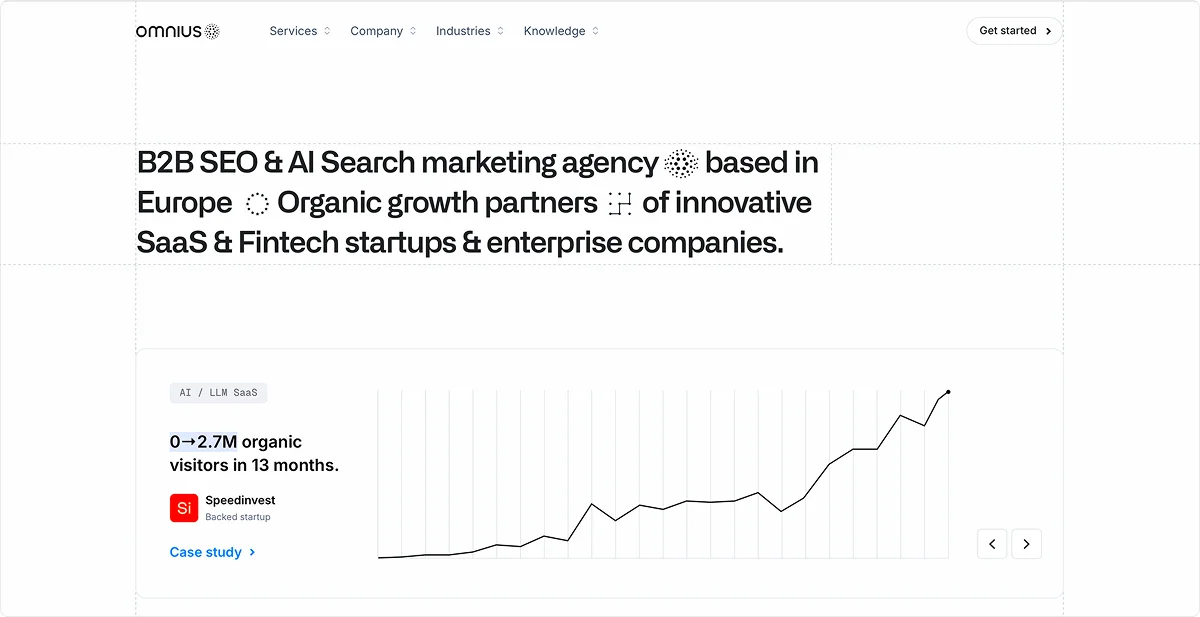
Omnius is a SaaS-focused SEO agency that works exclusively with B2B SaaS companies to drive revenue-driven organic growth from early-stage traction to scale.
With more than a decade of experience in SaaS marketing, the team has a deep understanding of subscription business models, including key metrics like MRR, churn, and LTV, as well as the unique growth challenges SaaS companies face at different stages.
Rather than taking a generalist approach, Omnius combines specialized SaaS expertise with advanced technical SEO, using a reverse funnel strategy that prioritizes bottom-of-funnel content to maximize SQL generation and pipeline impact.
Location: London, UK
Company Size: 11–50
Focus Industries: SaaS, Fintech, AI, MarTech
Notable Clients: Anna Money, Native Teams, Meniga, AuthoredUp, Global App Testing, Zencoder, Signify, TextCortex, and more
Clutch Rating: /
SaaS Startup SEO Fit Score: 4.9
What Services Does Omnius Provide?
Omnius offers a range of services designed to help SaaS companies grow their organic presence and generate pipeline:
- Search engine optimization (SEO) services: Development of comprehensive SEO strategies covering both technical optimization and content execution to support sustainable growth.
- Generative Engine Optimization (GEO) services / AEO: Optimization for AI-driven platforms like ChatGPT and Perplexity to ensure your content is surfaced as a trusted source in AI-generated responses.
- Programmatic SEO services: Scalable page creation using automation, structured data, and research to capture large volumes of relevant search demand.
- Content Marketing services: Creation of high-quality, intent-driven content that attracts qualified traffic and converts visitors into users.
- Link Building: Execution of white-hat strategies to secure authoritative backlinks and strengthen domain authority.
- Keyword Research: Identification and prioritization of high-intent, long-tail keywords aligned with real buying behavior.
Pricing
Omnius does not offer fixed pricing tiers. Instead, every engagement is tailored based on the client’s specific goals, market conditions, competition level, and required scope of work.
Pricing depends on factors such as complexity, timeline, growth targets, and resources needed, allowing the agency to deliver highly customized solutions rather than generic packages.
Companies interested in working with Omnius are encouraged to reach out for a personalized consultation and proposal aligned with their objectives.
Case Studies
- Explore how AuthoredUp achieved a 64% increase in conversions with proven SEO and content strategies, followed by modern web design.
- See how AI tool grew from 67 to 2100+ monthly signups in 10 months.
- Discover how targeted strategies helped Myos increase signups by an astounding 227.9% within only 6 months.
- Learn how a SaaS tool grew traffic from 0 to 2.73 million organic clicks in just 13 months.
Check out all Omnius case studies.
2. Siege Media - Best for Content-Led SEO at Scale
Siege Media is a SaaS-focused SEO and content marketing agency that helps B2B companies increase organic visibility, traffic value, and pipeline through high-impact content strategies.
With a strong emphasis on combining technical SEO with product-led, bottom-of-funnel content, the agency focuses on making SaaS brands not just visible in search, but positioned as the authoritative answer across both traditional search and AI-driven platforms.
Unlike traditional agencies, Siege Media brings together senior marketers, experienced writers, and design teams to deliver premium content at scale, with a strong focus on conversion and long-term organic growth.
Location: Austin, TX
Founded Date: 2012
Company Size: 50-249
Focus Industries: SaaS, Fintech, Travel, Ecommerce, Education, Health, Real Estate
Notable Clients: Zendesk, Zoom, Figma, Airbnb, Zapier
Clutch Rating: 4.9 (46 reviews)
SaaS Startup SEO Fit Score: 4.8
What Services Does Siege Media Provide?
Siege Media focuses on four core services that help SaaS companies grow organic traffic and pipeline:
- Content Strategy: Data-driven planning that identifies high-impact SEO opportunities and aligns content with real search demand and business goals.
- Content Marketing & Creation: End-to-end production of high-quality, design-led content built to rank, attract links, and convert users into customers.
- Product SEO: Optimization of product, feature, and use-case pages to capture bottom-of-funnel traffic and support product-led growth.
- Digital PR & Link Building: Content-led campaigns designed to earn authoritative backlinks, increase domain authority, and scale organic visibility.
Pricing
Pricing is tailored to each project, depending on content scale, site complexity, and the level of SEO practices required.
3. First Page Sage - Best for Thought Leadership & Lead Generation
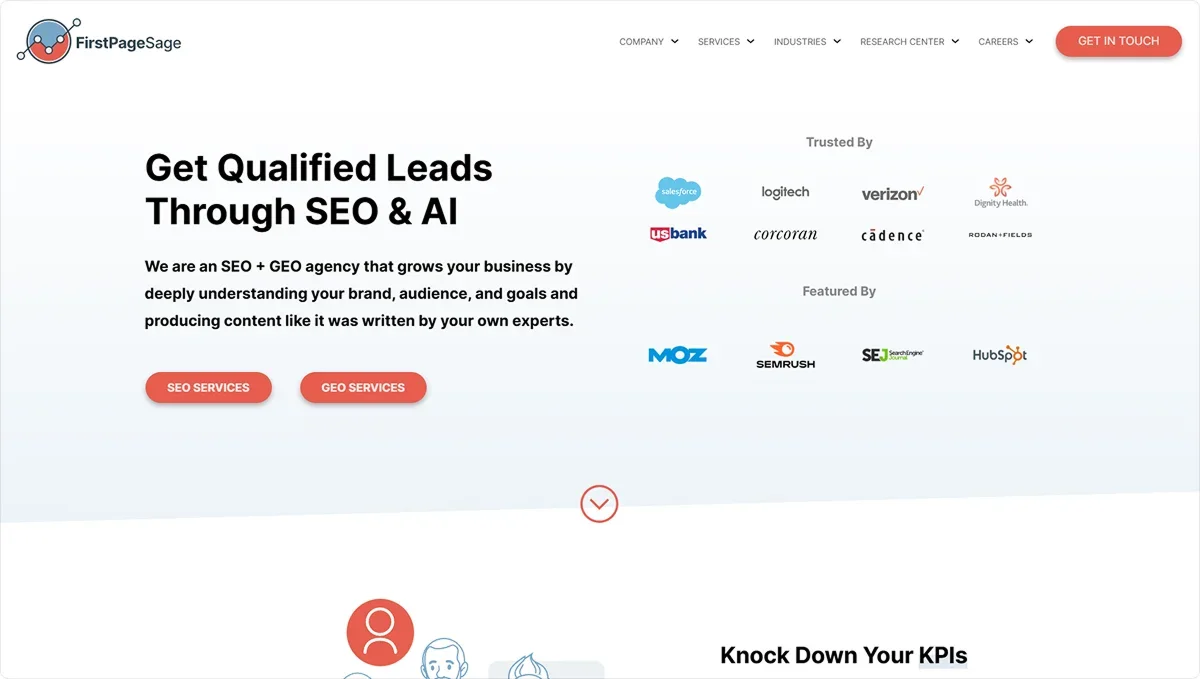
First Page Sage is a B2B SaaS SEO agency focused on helping companies generate consistent, high-quality leads through organic search.
With a strong emphasis on strategy, thought leadership, and lead generation, the agency builds SEO programs designed not just to increase traffic, but to drive measurable business outcomes. Their approach combines deep keyword research, conversion-focused content, and long-term search intent analysis to position SaaS companies as leaders in their category.
Unlike traditional SEO providers, First Page Sage prioritizes thought leadership content and full-funnel optimization, ensuring every piece of content supports both rankings and conversions.
Location: Berkeley, CA
Founded Date: 2009
Company Size: 50 - 249
Focus Industries: Construction & Real Estate, Consumer, Energy, Financial Services, Healthcare, Industrial, Professional Services, Technology
Notable Clients: Cadence Design Systems, iGPS
Clutch Rating: /
SaaS Startup SEO Fit Score: 4.7
What Services Does First Page Sage Provide?
First Page Sage offers a focused set of services designed to generate pipeline through SEO:
- Thought Leadership SEO: Their signature service, combining high-quality content creation with SEO to build authority, improve rankings, and position brands as industry leaders.
- Strategic SEO Planning: In-depth analysis of your website, market, and competitors to create a custom SEO roadmap focused on high-impact keywords and conversion opportunities.
- Lead Generation SEO: Optimization of content and pages to attract high-intent traffic and convert visitors into qualified leads for your sales team.
- Analytics & Reporting Systems: Implementation of tracking, dashboards, and performance reporting to measure SEO impact, conversion paths, and ROI over time.
Pricing
Pricing is customized based on the scope of the SEO program, content requirements, and the level of strategic and analytical support needed.
Conclusion
SEO is not a quick win. It is the growth channel most SaaS startup founders underestimate, underfund, and abandon too early.
But the ones who commit early, who build the right foundation, target realistic opportunities, and stay consistent long enough for compounding to kick in, end up with something their competitors cannot replicate overnight: a sustainable, scalable source of inbound demand they actually own.
SEO rewards patience and punishes shortcuts. For a capital-constrained SaaS startup, that is an advantage, not a drawback. While others burn budget on paid acquisition, SEO remains one of the few channels where consistent execution still compounds into long-term leverage.
The best time to start was six months ago. The second best time is today.
Most SaaS startups spend those six months going in the wrong direction before they ask for help. If you want to skip that part, Omnius works exclusively with SaaS companies to build SEO programs that generate pipeline, not just traffic.
Book a free 30-minute consultation and see exactly what it would take to make SEO work for your startup.
Frequently Asked Questions (FAQs)
How much does SEO for SaaS startups cost?
SEO for SaaS startups typically ranges from $2,000 to $10,000+ per month, depending on competition and scope. Early-stage startups can start lean with core pages and technical fixes, then scale into content and link building. Unlike paid ads, SEO is an ongoing investment, but over time, acquisition costs decrease as content continues to generate traffic and conversions without additional spend.
Is SEO worth for SaaS startups?
SEO is worth it when there is existing search demand, product-market fit, and a low-friction conversion path. In those cases, it becomes a highly scalable, cost-efficient channel. If not, it may be too slow to deliver results.


.png)

.svg)
















.svg)



























.svg)