.png)

Webflow SEO for SaaS focuses on optimizing your website to drive organic traffic, generate qualified leads, and increase revenue through scalable, search-driven strategies tailored to SaaS business models.
Did you know that leads coming from SEO convert from MQL to SQL at nearly double the rate of paid traffic, with 51% compared to just 26% for PPC?
For SaaS businesses, this makes SEO one of the most effective ways to attract high-quality, revenue-ready leads.
Webflow is one of the best CMS solutions SaaS companies can use for SEO. The CMS is user-friendly, and many of its features can be managed without ongoing developer support.
In this article, we’ll cover the 8 Webflow SEO best practices every SaaS business should follow to boost visibility and conversions.
Key Takeaways
- SEO drives high-quality leads with higher conversion rates than paid channels
- Webflow enables easy SEO implementation without heavy developer reliance
- SaaS SEO includes technical SEO, content, link building, and keyword research
- Strong SEO builds long-term, scalable growth and authority
- Combining technical foundations with content and links creates sustainable organic performance
What is Webflow SaaS SEO?
Webflow SaaS SEO refers to the strategies and practices used to optimize a Webflow-built SaaS website for search engines, with the goal of increasing organic traffic, MRR, ARR, and qualified leads.
SaaS SEO Includes:
- Technical SEO
- Content Marketing & Optimization
- Link Building
- Keyword Research
- Page Speed Optimization
For SaaS businesses, implementing Webflow SEO is important not just for visibility, but for generating high-quality, revenue-ready leads that can scale sustainably over time.
Why Webflow is a Great CMS for SaaS SEO?
Webflow is an ideal CMS for SaaS businesses looking to scale their organic growth because it combines flexibility, speed, and built-in SEO features on a single platform.
Its visual editor and intuitive interface allow marketing teams to update content, optimize pages, and implement SEO best practices without constantly relying on developers.
On top of that, Webflow covers the important SEO parts, such as:
- customizable meta titles and descriptions,
- XML sitemaps,
- robots.txt management,
- canonical tags,
- 301 redirects, and
- fast, responsive design, ensuring your site performs well on both search engines and user devices.
With Webflow, SaaS teams can also optimize page speed and mobile experience, both critical ranking factors, while maintaining complete control over URL structures and site hierarchy.
Overall, Webflow allows SaaS businesses to implement scalable SEO strategies that drive more organic traffic, higher-quality leads, and sustainable revenue growth, all without the need for complex technical development, which is why most Webflow SEO agencies recommend it as the go-to platform for SaaS organic growth.
8 Best Webflow SEO Practices That Your SaaS Business Should Follow
The following 8 Webflow SaaS SEO practices cover the technical foundations to content and authority building, implement them consistently, and you'll have a strong, scalable SEO system working in your favor.
1. Keyword Research
Keyword research is the foundation of any successful SaaS SEO strategy, and it should happen before you build a single page, publish a blog post, or plan a content campaign.
Whether you're launching a new Webflow site or expanding an existing one, keyword research is always the starting point, not an afterthought.
For SaaS teams, the go-to keyword research tools are Ahrefs, Semrush, and Google Keyword Planner for discovering and validating keywords, plus People Also Asked, a tool that surfaces real audience questions, perfect for building FAQ content that targets long-tail keywords.
One important thing to keep in mind: don't over-rely on search volume metrics.
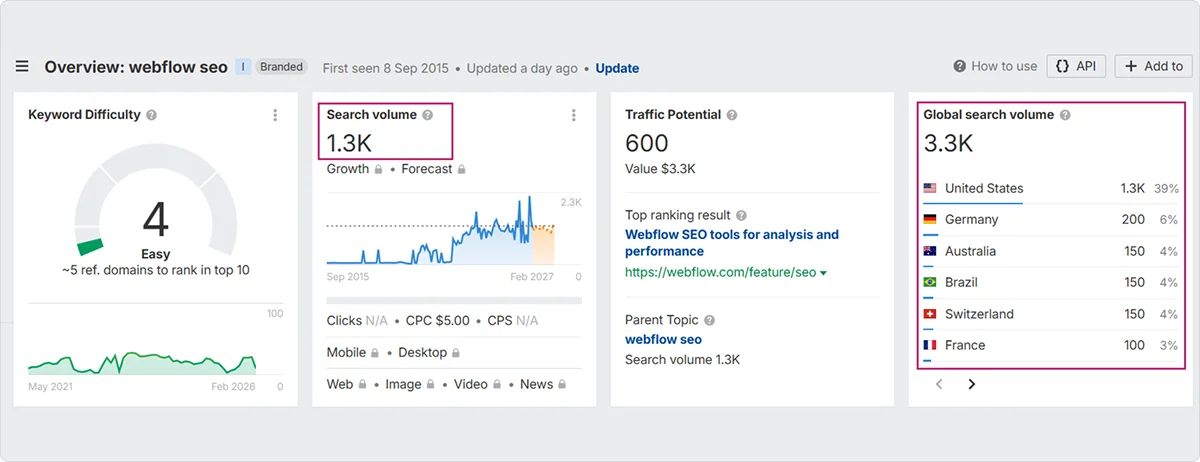
The numbers you see in these tools are estimates, and real-world search demand is almost always higher than reported. Use volume as a directional signal, not a hard filter, when deciding which keywords are worth targeting.
When building your strategy, always focus on your core topic clusters first. Google rewards topical authority; sites that go deep on a specific niche consistently outperform those that spread thin across loosely related topics.
Own your primary clusters before expanding into adjacent ones, and you'll build the kind of credibility that compounds into sustainable organic growth over time.
2. On-Page SEO (Technical SEO)
Technical SEO is what ensures search engines can find, crawl, and understand your website.
Without it, even the best SEO strategy will underperform. For SaaS businesses on Webflow, the platform handles many technical fundamentals natively, but you still need to configure and monitor them correctly.
Here are the core elements to get right:
- Crawlability: Ensure search engines can access and navigate your site without running into blocked pages or broken links. Use the URL inspection tool in your Google Search Console.
- Dynamic Elements: Avoid relying on JavaScript to render critical content like headings, body text, or pricing sections. Google may not process it immediately, leaving your pages indexed without their most important content. Use Webflow's native CMS and keep key content in raw HTML wherever possible.
- XML Sitemaps: Webflow generates these automatically, but you can also manually upload them if the automation version is not working well; make sure they're submitted to Google Search Console and stay up to date.
- Robots.txt: Controls which pages crawlers can and cannot access; review it carefully to avoid accidentally blocking important pages.
- Website Structure: Keep your site hierarchy clean and logical, with a clear flow from homepage to category to individual pages, making it easy for both users and crawlers to navigate.
- HTTP/HTTPS & SSL Certificate: Your site must run on HTTPS with a valid SSL certificate, a confirmed Google ranking signal, and a basic level of trust.
- 301 Redirects: Any changed or deleted URLs should have proper, unique redirection in place to preserve link equity and avoid dead ends.
- Page Titles: Your primary signal to search engines about what the page is about; keep them unique, keyword-focused, and under 60 characters.
- Meta Descriptions: A concise summary that influences click-through rates; write them for humans, not just crawlers, max 155 characters.
- H1 Tags: Every page should have one clear H1 that reflects the page's main topic and target keyword.
- Alt Texts: Describe every image accurately; this helps with both accessibility and image search visibility.
- Image Optimization: Always compress images before uploading to Webflow; use TinyPNG to reduce file sizes below 100KB without losing visual quality, keeping your pages fast and crawlable. The recommended image version is WEBP.
- Speed Optimization: Page speed is a confirmed Google ranking factor. Minimize render-blocking scripts, compress images, and leverage Webflow's built-in CDN to ensure fast load times across all devices. Use Google PageSpeed Insights to monitor and identify areas for improvement.
For SaaS businesses, getting these fundamentals right isn't a one-time task — it's an ongoing process. Regularly auditing your technical SEO ensures that as your Webflow site grows with new pages, blog posts, and landing pages, nothing slips through the cracks and undermines the organic growth you're working hard to build.
3. Content Marketing
Content is what drives organic visibility, builds topical authority, and in the end brings the right audience to your SaaS product that will convert.
But not all content is created equal. What Google rewards is reliable, high-quality content that genuinely covers the topics and keywords identified during your keyword research process.
Before creating any new content, always check the current SERP situation for your target keywords.
Analyze what is already ranking, what format those pages use, and what user intent they satisfy. This tells you exactly what Google currently considers the most relevant answer for that query, and your content needs to match or outperform it, not just in depth but in format, structure, and intent alignment.
Another important framework to apply when planning content is TOFU, MOFU, and BOFU. Each stage targets users at a different point in their buying journey:
- TOFU (Top of Funnel): Awareness-stage content targeting broad, informational keywords. Blog posts, guides, and educational articles that attract new audiences who may not know your product yet.
- MOFU (Middle of Funnel): Consideration-stage content for users actively evaluating solutions. Comparison pages, use case articles, and in-depth guides that position your SaaS as the right choice.
- BOFU (Bottom of Funnel): Decision-stage content targeting high-intent keywords. Landing pages, case studies, and feature pages are designed to convert ready-to-buy visitors.
A strong SaaS content strategy covers all three stages, ensuring you capture demand at every point in the funnel.
The types of content that work best for SaaS SEO include:
- Blog Posts & Articles: The backbone of most SaaS content strategies; target your core keyword clusters with in-depth, well-structured articles that answer real user questions.
- Research & Reports: Original data and industry reports build authority, earn backlinks naturally, and position your brand as a trusted source in your niche.
- Videos (YouTube): YouTube is increasingly becoming a powerful SEO partner. Publishing video content builds additional trust with both Google and users, and YouTube videos frequently appear directly in search results.
- Reactive PR Articles: Timely content that responds to industry news or trends can capture short-term traffic spikes while strengthening your brand's presence.
- Programmatic SEO: A great way to scale content across large keyword sets, but don't rely fully on AI-generated output. Avoid publishing large volumes of thin pages in a short period; Google is quick to penalize sites that prioritize quantity over quality, especially if it represents a sudden shift from your usual publishing flow.
4. Content Optimization
Creating new content is only half the job. Regularly revisiting and updating existing pages is just as important, both for rankings and for the overall credibility of your brand.
Outdated or inaccurate information signals to Google and users alike that your site isn't trustworthy.
For pages with date-sensitive information, aim to review and refresh them monthly. For evergreen pages that don't reference specific dates or time-sensitive data, a quarterly review is sufficient.
Check for outdated statistics, broken links, and any information that no longer reflects the current state of your product or industry.
Keeping your content accurate isn't just an SEO tactic; it's a reflection of how seriously your brand takes its audience.
5. Link Building
Relying solely on on-page and technical SEO signals is not enough to rank competitively in most SaaS markets.
Backlinks, links from third-party websites pointing to yours, play an important role in improving both rankings and overall online visibility. When another website links to yours, it sends an immediate trust signal to Google, indicating that your content is credible, relevant, and worth referencing.
The more quality backlinks your site earns, the stronger its authority becomes in the eyes of search engines, and authority is one of the hardest things for competitors to replicate quickly.
Here are the 3 ways to build backlinks:
- Passive Link Earning: Creating genuinely valuable content, original research, reports, data-driven articles, that others naturally reference and link to over time. This is the slowest approach but produces the most organic, high-quality links.
- Guest Posts & Link Exchanges: Writing content for other relevant websites in your industry or exchanging links with complementary SaaS brands. When done selectively and on relevant sites, this remains an effective strategy.
- Paid Link Placements & Digital PR: Paying for link insertions on quality websites or running Digital PR campaigns that earn coverage and mentions across authoritative publications. The keyword here is quality; one strong backlink from a trusted, high-traffic site is worth far more than dozens from low-quality ones.
How to Evaluate Backlink Quality
Not all backlinks are created equal, and chasing the wrong ones can do more harm than good. Before pursuing or accepting a backlink, always check:
- Organic Traffic: Is the site actively receiving traffic? Is it growing or declining? A site that has been hit by a Google Core Update and is losing traffic steadily is a red flag.
- DR & DA Scores: Domain Rating (Ahrefs) and Domain Authority (Semrush) give you a quick snapshot of a site's overall authority. Use these as directional indicators, not absolute rules.
- Relevance: A backlink from a website in your industry or niche carries significantly more weight than one from an unrelated site.
When building links, prioritize earning them on the anchor texts that match your target keywords, the ones you're actively trying to rank for. A backlink is most powerful when the anchor text is relevant to the page it's pointing to, reinforcing the topical signal you're sending to Google.
For tracking and analyzing your backlink profile, Ahrefs and Semrush are the go-to tools. Additionally, Google Search Console has a dedicated external links section that gives you a free overview of who is linking to your site and which pages are earning the most links.
6. Internal Linking
Internal linking is one of the most underrated SEO practices in SaaS, and one that a surprising number of teams overlook entirely. Yet it plays a significant role in how Google understands your site structure, distributes authority across pages, and determines which pages matter most.
The logic is simple: the more internal links a page receives, the more important Google considers it. This means your internal linking structure is essentially a vote: every link you add from one page to another signals priority and relevance.
For SaaS websites, which almost always include a blog, internal linking should follow your content clusters.
Articles within the same cluster should link to each other using natural, contextually relevant anchor texts, not just your primary keyword, but secondary ones too.
To find those secondary keywords, use Google Search Console, inspect each URL, and identify which additional queries each page is already ranking or showing impressions for. Use those as anchor opportunities when linking from related articles.
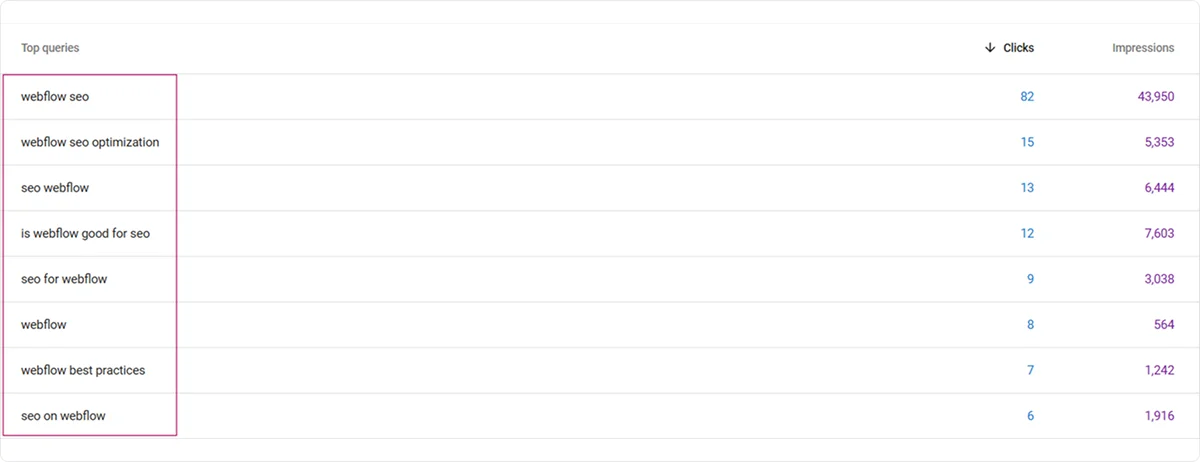
One important rule to follow: each anchor should point to one specific page. If multiple articles target the same keyword and link to different destinations, you're creating confusion for Google. Keep it consistent and intentional.
The simplest way to find internal linking opportunities manually is to use Google's site search operator directly in the search bar:
site:yourwebsite.com "target anchor"
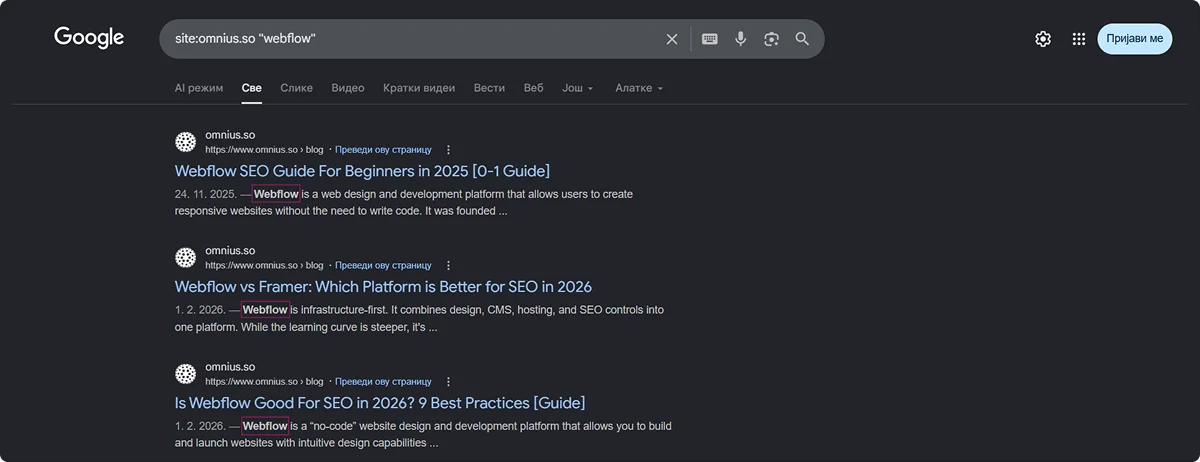
This surfaces all pages on your site that mention a specific keyword, making it easy to identify where to add a new internal link naturally.
Note: For teams managing larger sites, this process can also be automated using Screaming Frog, which can crawl your entire site and map internal linking opportunities at scale.
Here is a great tutorial on how to set this up:

7. Structured Data
Structured data is a way of communicating directly with Google, giving it explicit, organized information about who you are, what your pages contain, and how that content should be understood. Rather than leaving search engines to interpret your content on their own, schema markup removes the guesswork — and in return, Google can reward your pages with rich results, enhanced SERP appearances, and greater visibility compared to standard listings.
For SaaS businesses, implementing the right schema markups across the right pages can meaningfully improve click-through rates without changing a single ranking position.
The most relevant schema types to implement, depending on your content, are:
- Organization Schema: Communicates your company name, logo, contact information, and social profiles. A foundational markup that helps establish your brand identity in Google's knowledge graph.
- Article Schema: Includes published date, author, and headline. Critical for blog posts and news content, as it helps Google understand freshness and authorship.
- Product Schema: Displays price, availability, reviews, and specifications directly in search results. Highly valuable for SaaS landing pages showcasing plans or features.
- FAQ Schema: Structures question and answer pairs that Google can pull directly into search results, expanding your SERP footprint without requiring a higher ranking.
- HowTo Schema: Marks up step-by-step instructional content, making it eligible for enhanced rich result displays that stand out on the SERP.
- Breadcrumb Schema: Defines the navigational path of a page within your site structure. Helps Google understand your site hierarchy and displays the breadcrumb trail directly in search results, improving both crawlability and SERP appearance.
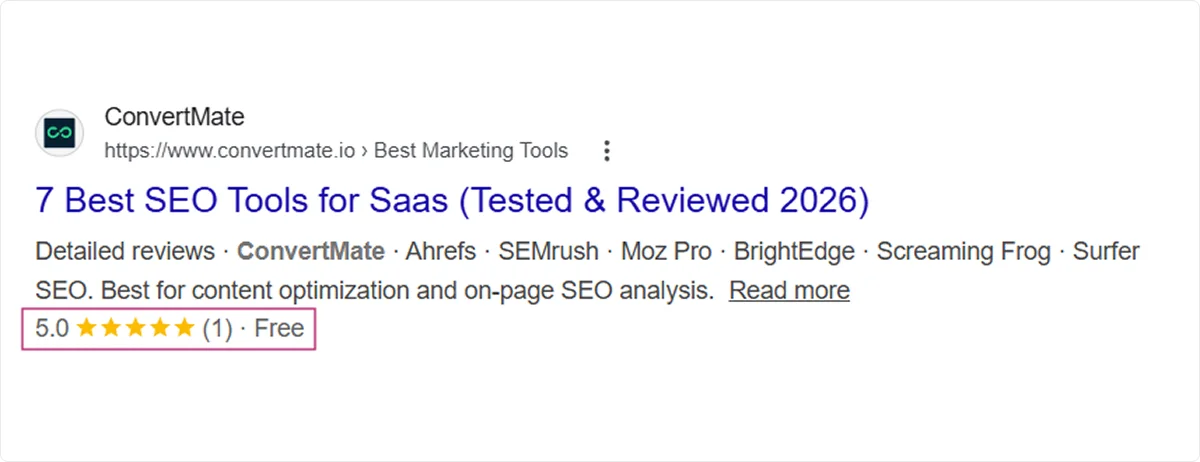
- Review Schema (Aggregate Rating): Displays your overall rating score and number of reviews directly in search results. A powerful trust signal that improves click-through rates by showing social proof before a user even visits your page.
Implementing “aggregate rating schema” properly can add to your website “stars” in the SERP, potentially increasing your CTR:
Make sure each schema markup is implemented accurately according to its specific guidelines; incorrect or incomplete markup won't be recognized by Google and can be flagged as an error.
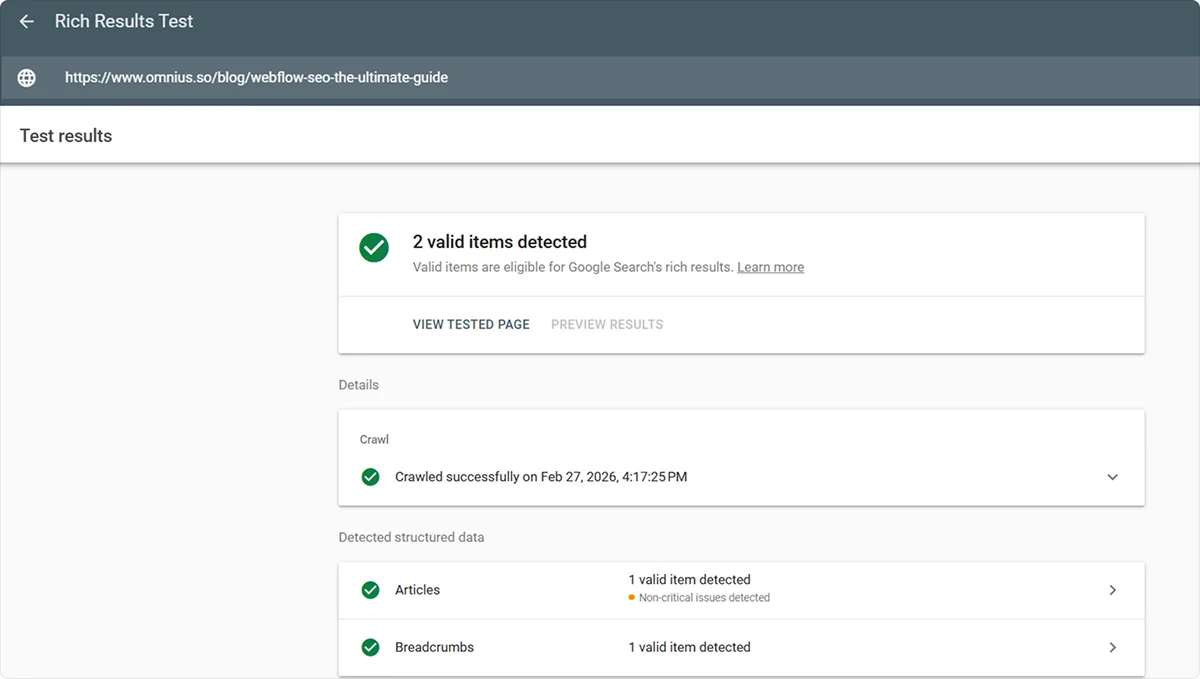
Always validate your implementation using Google's Rich Results Test before and after publishing to confirm everything is working as intended.
8. Mobile Optimization
Google uses a mobile-first indexing approach, meaning it primarily crawls, indexes, and ranks the mobile version of your website, not the desktop version. This makes mobile optimization non-negotiable for any SaaS business serious about organic growth.
A common mistake SaaS teams make is focusing solely on how the site looks and performs on desktop, while neglecting the mobile experience.
A poorly structured mobile version doesn't just frustrate users; it directly impacts your rankings.
Make sure your Webflow site is fully responsive, with layouts, fonts, buttons, and navigation that adapt cleanly across all screen sizes.
Takeaway
Webflow SEO for SaaS is not a one-time setup; it's a compounding system that builds authority, visibility, and revenue over time.
Each of the eight practices covered in this guide works together; the strongest results come when none are skipped. Start with your keyword research and technical foundations, then layer in content, links, and structured data as you scale.
If you're not sure where to start or simply don't have the bandwidth to do it all, working with a Webflow SEO agency like Omnius can make all the difference.
Book a free 30-minute consultation and learn how we help SaaS businesses use Webflow SEO to grow organic traffic and generate qualified leads consistently.
FAQs
What is Webflow SEO for SaaS?
Webflow SEO for SaaS is the process of optimizing a Webflow-built website to increase organic traffic, generate qualified leads, and drive recurring revenue through search engines.
Is Webflow good for SEO for SaaS companies?
Yes, Webflow is highly suitable for SaaS SEO because it offers built-in features like clean code, fast performance, customizable metadata, and full control over site structure without needing developers.
How long does it take to see results from Webflow SEO?
Most SaaS companies start seeing initial SEO improvements within 3–6 months, while significant growth in traffic, rankings, and conversions typically happens within 6–12 months.


.png)

.svg)
















.svg)



























.svg)