Services
Company
Industries
Knowledge
Projects

UK


Organic search was a Series B RegTech company's best-converting inbound channel. The opportunity was to connect that channel with the screening-vendor comparisons compliance teams make before procurement and security reviews.
We set a strategy around those comparisons, wrote alternatives guides and best-solution lists for each screening need, and rewrote the solution pages they link to, with the regulatory precision and source discipline the category demands.
In five months, AI answers to alternatives questions named the company far more often, and its high-intent pages took a much larger share of its Google clicks, in the channel that already converted best.
Over five months, the company's share of AI answers to questions about alternatives to the category's largest vendors grew 11x. Google clicks to its high-intent pages grew 4.7x.
The client is a Series B RegTech company that builds AI software for financial crime compliance, from sanctions and watchlist screening and adverse media to KYC and KYB data. Compliance teams at regulated institutions use it to screen, investigate, and monitor the companies and people they do business with.
Industry: RegTech / Financial crime compliance / AML and KYC
Location: United States
Funding: Series B
Customers: Compliance teams at banks, fintechs, payments companies, and corporates
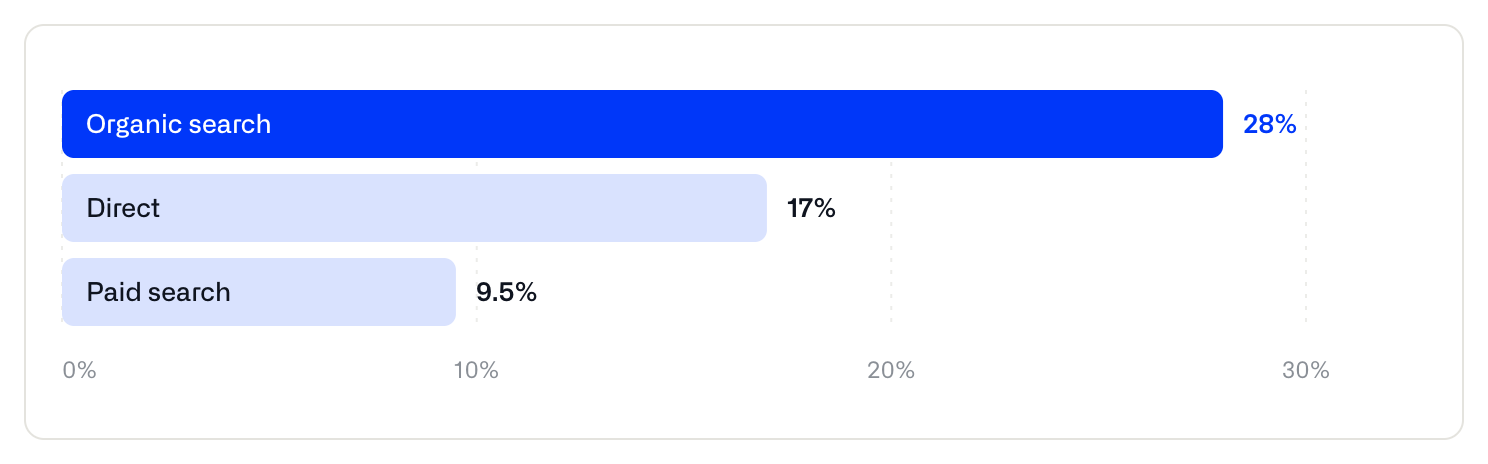
Organic search converted best for the company, but AI answers to the comparisons compliance teams make before procurement drew on other companies' lists. Its CRM showed organic contacts turning into opportunities at 28%, against 17% for direct traffic and 9.5% for paid search.
Financial crime compliance software is bought by senior compliance, financial crime, risk, and technology leaders. A purchase passes procurement, security, and model-governance reviews, often with a trial. Those teams build shortlists from comparisons: alternatives to the incumbents, "best software" lists for each screening need, and head-to-head pages. An alternatives answer puts vendors in front of a compliance team comparing screening platforms before procurement.
In July 2026, the company appeared in 2.9% of AI answers to questions about alternatives to the category's largest vendors, and it was not yet part of the answers for one of those vendors. The answers drew on software review and listing websites, other vendors' alternatives lists, trade publications, and a compliance forum.
The content itself is held to compliance standards. Sanctions screening, PEP screening, adverse media, and enhanced due diligence have precise regulatory meanings, and Google places greater weight on experience, expertise, authority, and trust for topics that could affect financial stability. Every product claim had to match the company's published figures, and every statistic needed an independent source.
That meant the job was to put the company's high-intent pages into the comparison, in Google and in the sources AI answers draw on, with the accuracy a compliance officer expects.
Compliance teams choosing a screening platform compare vendors through alternatives guides, "best software" lists, and head-to-head pages. The client's plan was built from that market: the screening needs its platform covers, the institutions it serves, and the way their compliance teams shortlist vendors. Our methodology set the order of the work, from Foundations through measurement, learning, and adjustment.
Search and AI answers ran as one practice with one team, because Google and AI engines judge a company on research, technical work, content, and authority at once. At the company, that meant improving its existing screening solution pages alongside the new guides and comparisons.
Volume-led keyword lists favor definitions and broad guides, while the searches a compliance team runs just before a shortlist are few and specific. We start with the business model, not with keyword tools.
Foundations works in five steps:
At the company, the high intent sat in the comparisons a compliance team makes before procurement, such as alternatives to the incumbents and "best AML screening software for banks". Comparison lists were treated as decision-stage pages, linked to the solution page for each screening need, and definitions and process guides ran alongside them.
A visibility score from a fixed set of prompts samples answers that change with the engine, the model, and the day, so a plan that follows one score follows its noise too.
Our strategy work builds a Search Ontology, a company-specific model of the client's search market, and runs it through our data processing technology in five steps:
For this client, the model mapped each screening need the platform covers, from sanctions and watchlist screening and PEP screening to adverse media and KYC and KYB data. Each was set against the institutions that buy it and the incumbents they compare it with. The CRM analysis made the commercial case for comparison pages linked to the company's screening solutions.
A content plan built as a list of articles lets new guides compete with the solution pages, and leaves out the pages a compliance team needs to compare vendors.
Our information architecture work has four steps:
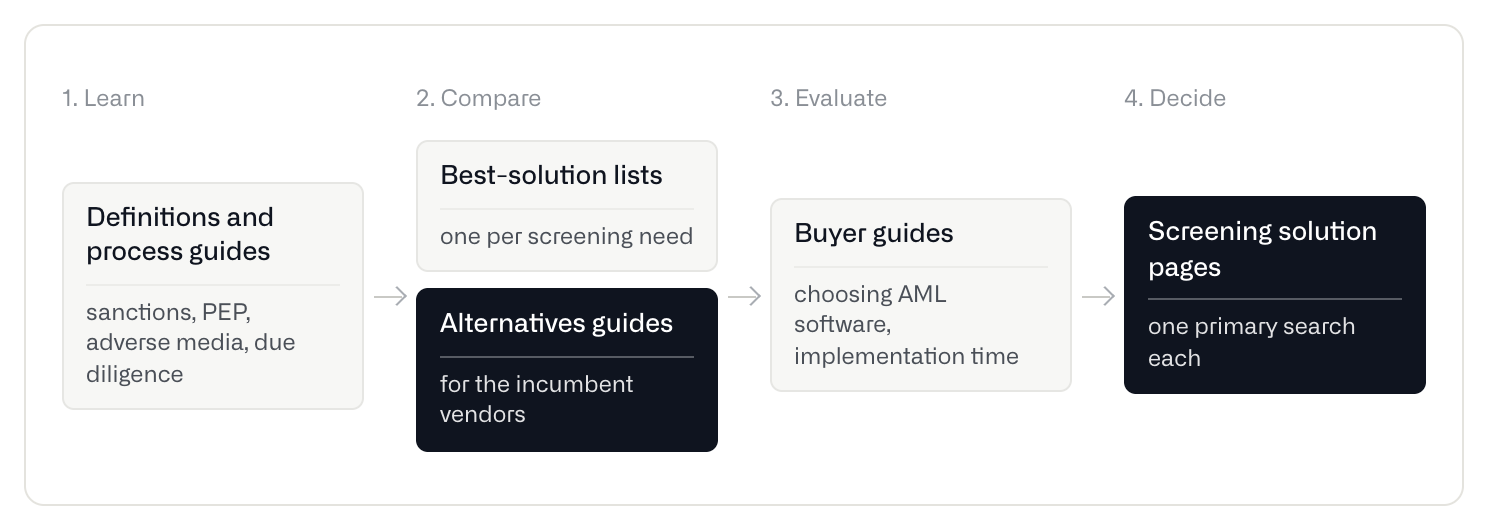
Each of the company's pages got one primary search, and the guides were kept apart from the solution pages they support. Alternatives guides answered searches for alternatives to the incumbents. Best-solution lists covered each screening need, from sanctions and watchlist screening to customer and enhanced due diligence, and each linked to the matching solution page. Separate guides explained how to choose AML software and how long implementation takes, the questions a compliance team asks during procurement. We also planned head-to-head pages and pages for banks, corporates, and fintechs.
AI engines lift single passages into their answers, and before that they decide which pages get into the pool they retrieve from at all. A page can miss the answer because it reads as self-promotional or lacks corroboration.
For compliance content, our answer engine optimization work follows five steps:
A passage quoted in an AI answer appears without the paragraphs around it, as we explain in technical SEO for AI search, so each passage has to carry its own answer.
For this client, our writers and editors wrote the guides, best-solution lists, and alternatives guides in this format. Their readers check claims the way they check a screening result. When a statistic that made a guide's point traced only to a rival vendor's own study, our editors kept the point and dropped the number, or replaced it with an independent source. Product claims, from "up to" performance figures to certification wording, were checked against the company's published figures, and every draft was checked against its knowledge base.
We also rewrote the company's solution pages and its head-to-head comparison page so each opens with the answer a compliance team is looking for, and audited the website for Google and AI crawlers, starting with the solution and guide pages.
AI engines weigh what other websites say about a company. In the company's category, those websites were review and listing directories, other vendors' lists, and trade publications, and a domain score alone doesn't show which of them the engines read.
Our link work has three steps:
In a category where AI answers drew on directories, vendors' lists, and trade publications, we studied where the incumbents earn their backlinks and ran link building alongside the company's financial crime compliance guides and screening-page rewrites.
How we worked together: We took on the strategic, managerial, and operational sides of the work and kept it simple, with responsive communication and transparency as two of our core values. With this client, that meant direct Slack access to our team, a shared Notion workspace for the roadmap and content plan, and reporting in Atomic AGI, our analytics platform.
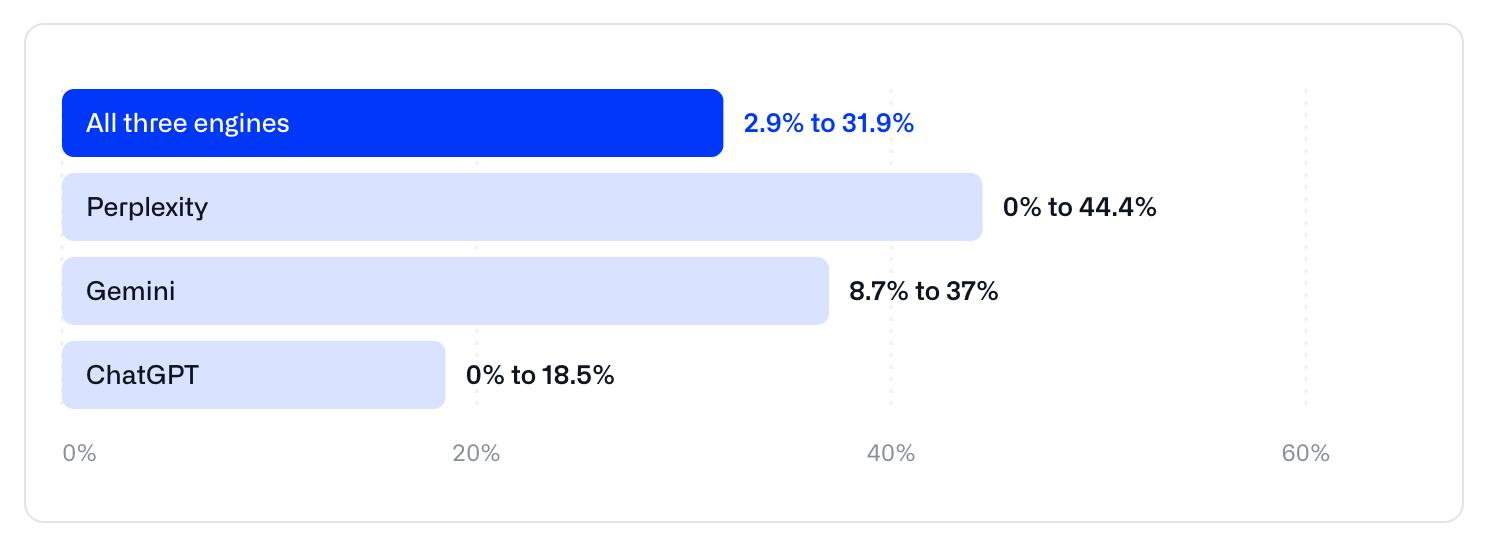
The company's share of AI answers to alternatives questions grew 11x, from 2.9% to 31.9%, with increases on all three engines.
Perplexity showed the largest increase, from 0% to 44.4%.
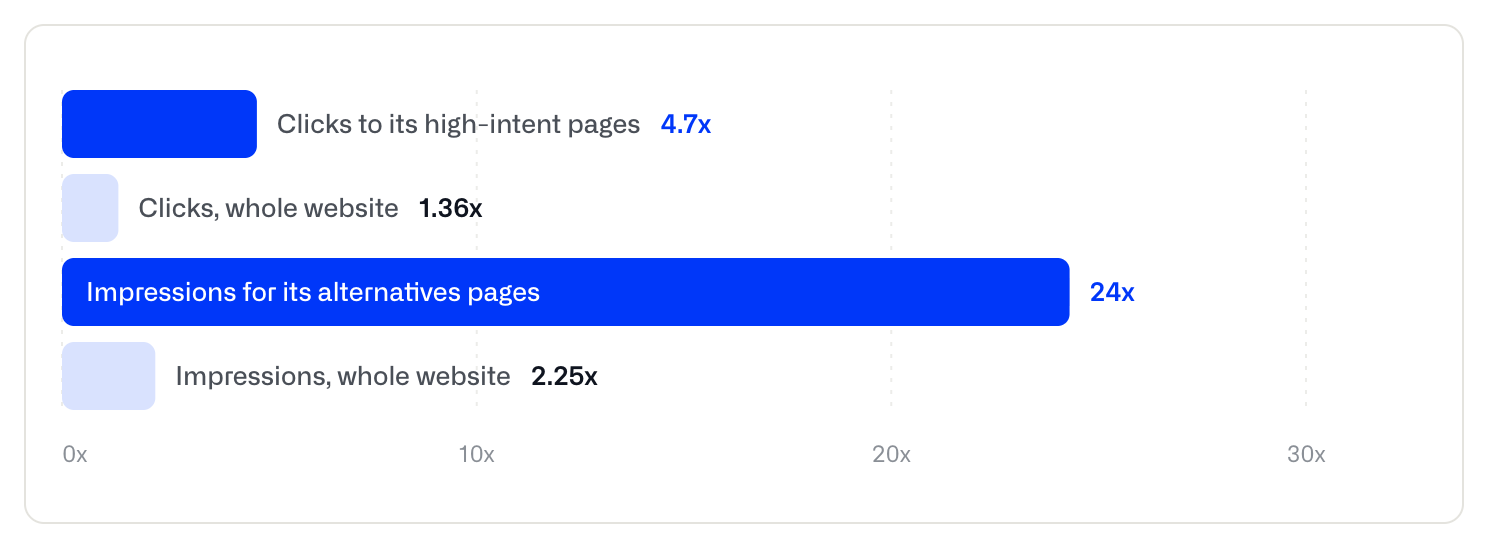
Google impressions grew 24x for the alternatives pages, against 2.25x for the whole website, between May and October 2026, at an average position of 6.2.
Google clicks to the high-intent pages grew 4.7x, counting the solution pages, alternatives pages, and best-software list together, against 36% for the whole website. Those pages went from about 2% to about 7% of the website's Google clicks.
Its alternatives guide became a source the engines cite. In July, its guide for alternatives to one of the category's largest vendors didn't exist yet. It was written under the guides' editorial rule: statistics only from independent sources. By October, all three engines cited it for that question, and answers naming the company there went from none to 45.8%.
On another of those alternatives questions, the company was the first alternative listed in 20.8% of answers, up from 4.2%.
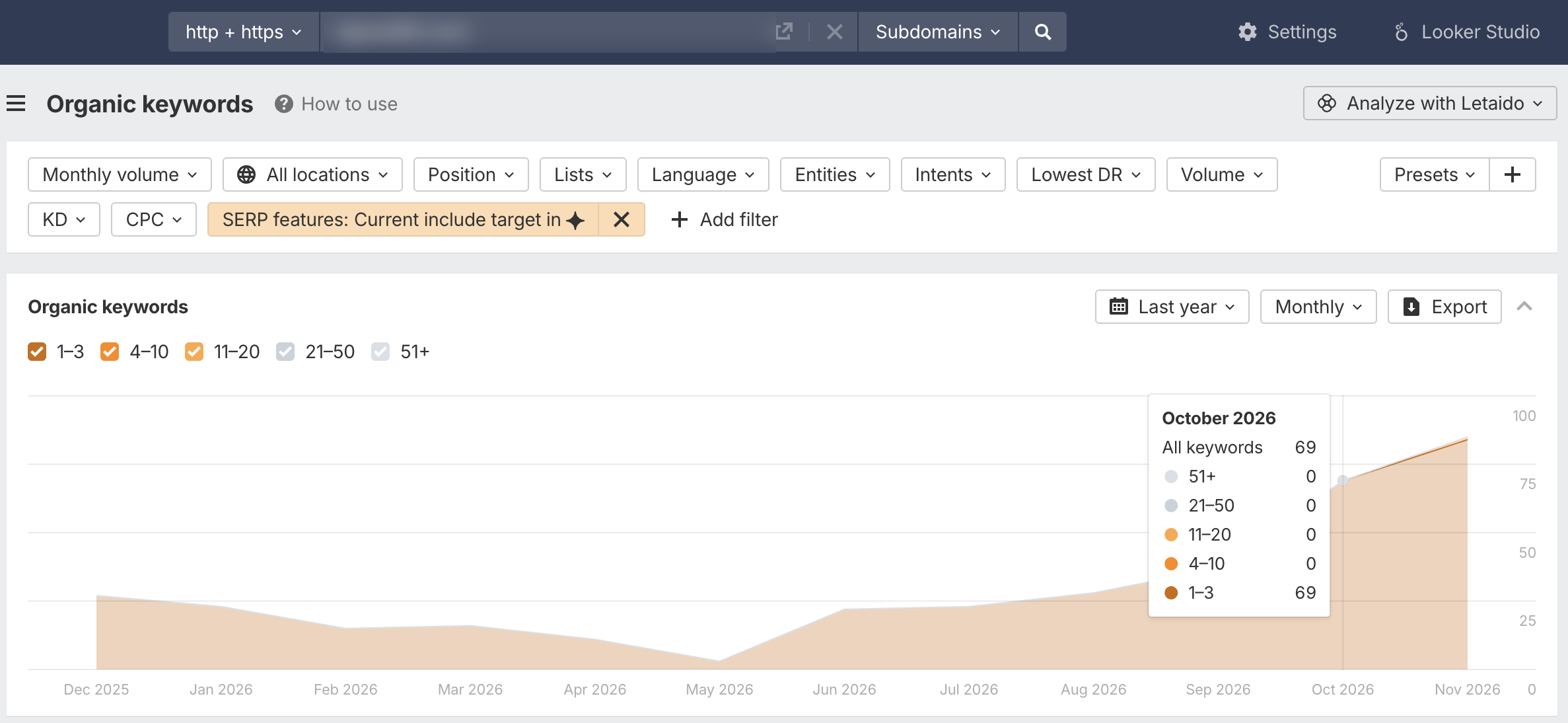
The keywords whose Google AI Overview includes the company's website rose from 3 in May to 69 in October (Ahrefs), more than twice its best month in the half-year before the work. For the category's core screening search, Google's AI Overview cites one of the solution pages we rewrote.
Across the full set of tracked compliance-software questions, answers naming the company rose from 10.6% to 16.2%.
The alternatives pages outgrew the website's overall Google visibility while the alternatives guide became a source for AI answers. Those are the pages a compliance team reads just before a shortlist. High-intent pages also gained click share, from about 2% to about 7% of the website's Google clicks, in the channel its CRM showed converting best.
Our reading is that the company gave the engines a directly relevant source for the alternatives question, with checkable claims and links to its screening solution pages, and that a page Google already shows is easier for them to find. We have long published this position: if a company doesn't rank, AI won't cite it, and ChatGPT itself uses Google search.
The alternatives guides linked to the screening solution pages, which got answer-first rewrites, and link building ran alongside both.
Comparison questions moved far more than the company's overall answer presence. Its alternatives mention rate grew 11x, while its share across the full question set rose from 10.6% to 16.2%.
Perplexity showed the largest increase, from 0% to 44.4%. On the alternatives questions, that was more than ChatGPT or Gemini, which fits our view that AI answers are built from the pages engines retrieve when they search, as we explain in how to rank on Perplexity.
The guide all three engines cite followed an independent-source rule. Our view is that a guide leaning on a rival vendor's own study gives a compliance officer, and an engine, a reason to discount it. The company's guides kept their points and replaced or dropped figures that only a rival's study supported.
For a compliance or other regulated software company, four checks show where it stands:
Sources and windows:
Over five months, the company built a connected comparison path for compliance teams, from incumbent alternatives and screening needs to the matching solution pages, in the channel that already converted best.
Our view is that in a category compared through lists, a vendor that publishes a checkable comparison gives the engines something to cite. At the company, alternatives guides linked to distinct screening solution pages, and product claims were checked against its published figures. For a screening platform, each new comparison can connect a sanctions, PEP, adverse media, KYC, or KYB question to the matching solution page.
Our answer engine optimization services are built for that kind of category.
Learn how to scale user acquisition without scaling costs from our findings. We spent years exploring, so you don't have to.
Omnius is an AI-native SEO & GEO agency maximizing the probability of B2B SaaS & Fintech companies being included in AI answers, selected by agents, and chosen by humans.