


Why we own our technology

A lot of our work is based on technology, and most of it isn't AI. It is the technology of tracking, cleaning, and processing big data to understand AI search better, and the vertical automation built on top of it.
"Whoever owns the data will own the market." That was my thinking in 2023, about where Google and AI search were heading.
What we saw after ChatGPT launched
After ChatGPT launched on November 30, 2022, one problem kept showing up for us. AI search was growing fast, and LLMs were becoming an unignorable place where people find information. But the data on it was either missing or unreliable.
SEO was inevitably changing, which was very clear from the data we had access to, and working with a lot of AI companies made it even more obvious.
We saw agencies rebrand their traditional SEO services as AEO, GEO, AIO, or whatever-O offerings, and we couldn't see evidence that any of it worked.
The measurement on offer was Google Analytics and Search Console, plus a new wave of AI tracking tools promising to explain AI search and win first positions on ChatGPT and Perplexity. In reality, most of the ones we tried were built on synthetic prompt tracking: samples of model answers, compiled into nice dashboards, that are sensitive to which prompts get picked and say little about how real customers behave.
We tested (probably) every tool on the market, and none was comprehensive enough. Each was either too Google-heavy or too AI-heavy, built on either behavioral data or synthetic modeling, and most were dashboards full of static data that didn't tell anyone what to do.
So we built it for ourselves first
My logic was simple, and in practice far more complex: build software that helps us understand multi-engine search data better. By better, I mean:
- More comprehensive: multiple engines, not one.
- More precise and closer to real time.
- Centralized, not siloed, because much of the value comes from how all of that data connects.
For the first time, building software meant solving my own problems, because I couldn't find tools that were efficient enough. I saw it as an investment in stronger internal infrastructure, on the hypothesis that it would lead to more scalable growth.
We built Atomic AGI internally to solve our own problem first. It worked, then our clients wanted it, and then companies outside our client base did.
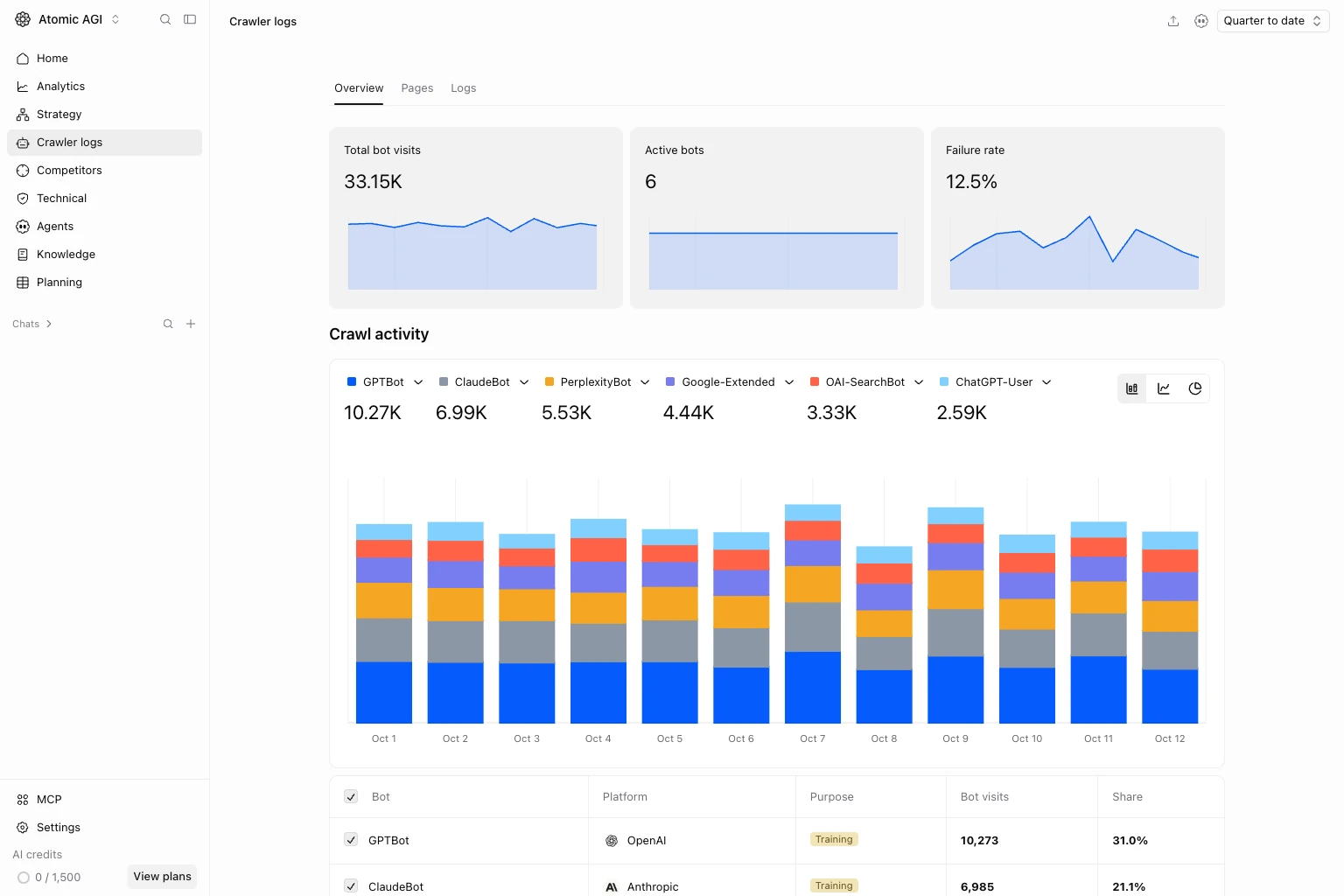
With that software, our know-how, and large datasets, we could start separating the patterns that bring results in AI search from pure speculation. Successful experiments became protocols, and in early 2025 we introduced AI search optimization as a service.
Today Atomic tracks AI search and Google data in one place, turns that data into prioritized opportunities, and runs agents and workflows that make marketing teams more efficient. Organizations such as MIT, Samsung, and Salesforce trust it.
Own the data, own the market
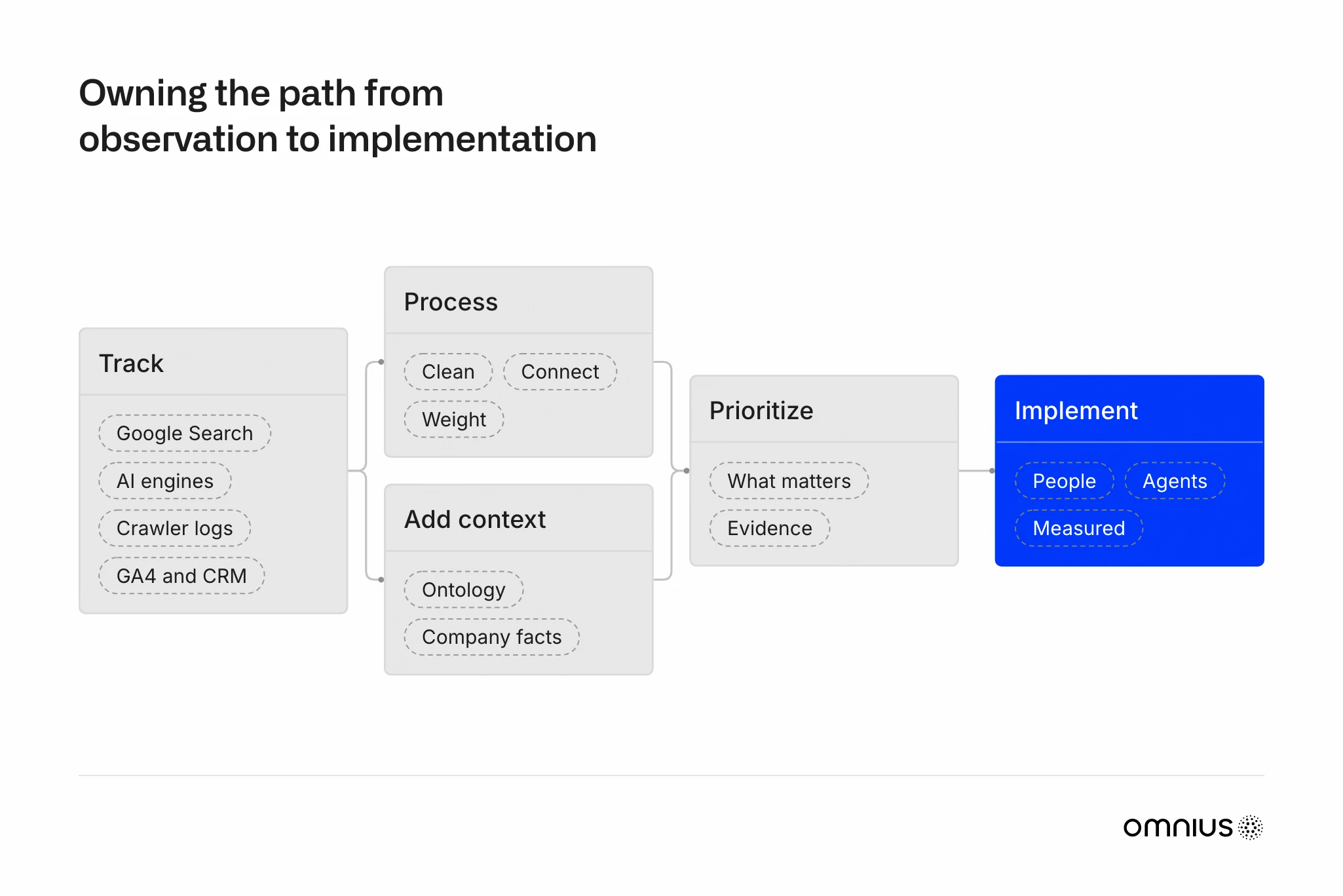
Whenever a big market change happens, I think the company that can track, analyze, and understand it, and make the path from observation to implementation the shortest, wins the market.
- Renaissance Technologies built its investing on mathematical models that look for patterns other investors weren't seeing.
- BlackRock built Aladdin into the investment and risk platform that other asset managers, including its competitors, run on. It turned its own infrastructure into a product other firms rely on.
- Stripe built a transaction data layer across millions of businesses that use its payments. In my view, that compounding data helps make its products harder for competitors to replicate.
Owning that layer is, I believe, the only defensible way to grow long-term: tracking, then analysis, then processing, then implementation. That is the hypothesis we built Atomic on.
The difference moves to what feeds the models
We believe AI adoption is inevitable, and that this is not a bad thing. But it will push a lot of companies toward zero differentiation. When everyone has access to the same models, the same connectors, and, increasingly, the same agents and workflows, access itself stops being an advantage: commoditization through equal access.
If everyone has the same models, connectors, tools, and agents, the competitive difference moves to two places:
- what feeds them;
- what the strategies delegated to them are actually based on.
For us, that means processed data, company context, an ontology (a model of the entities in a market and how they relate), evaluation, and proprietary infrastructure underneath both strategy and execution.
ChatGPT can produce an SEO strategy that sounds right. Without the company's internal data, it may miss the ideal customer profile and what converts, and it can lose earlier context as a long chat goes on. It is the old rule of garbage in, garbage out, applied to context. In our work, the gap between agent output that's useful and output that just fills a page comes mostly from what the model knows before it starts.
When we started developing Atomic under Omnius, my guess was that most company departments would, in a way, need to become data centers: closed data that feeds, evaluates, contextualizes, and fact-checks whatever the output is. I expected that data, alongside proprietary workflows, to stay the only lasting, defensible edge.
Software that processes, not software that displays
The starting idea behind Atomic was software that makes our own work easier: more productive, more precise, and less dependent on headcount.
I would say software in general is heading the same way. A lot of 1.0 tools are one-way streets, classic BI and dashboard tools that display data and leave people to interpret it. They will feel more and more static as people get used to agentic software.
| Software 1.0 | Software 2.0 | |
|---|---|---|
| What it does | Displays data | Processes data and automates the work |
| What it asks of the user | Time, a complex interface, and a long wait for value | Little time, a simple interface, and fast value |
One example from our own work is page-level analysis of an entire website: each page, its weaknesses, and a suggested fix, updated from Google and AI search data, NLP content analysis, technical audits, and internal links. It saves us a lot of hours in spreadsheets, spots correlations people would miss, and lets us fix issues faster.
Why the technology sits inside a service company
Y Combinator's 2025 requests for startups included AI-enabled service companies, which it calls full-stack AI companies: instead of selling tools to incumbents, build the company that replaces them. My bet is that many of the next large companies won't sell software at all. They will use their own closed technology as infrastructure for their services and own the implementation, which is probably the biggest bottleneck in adopting vertical agentic software.
Full-stack AI Companies (Y Combinator)
In May 2026, Anthropic and OpenAI both announced businesses to help companies deploy AI through hands-on engineering and implementation. I read that as model quality becoming a secondary factor as capable models become widely available. The model is no longer the moat; the implementation is.
That is how we use our technology: as a multiplier of quality and efficiency for the people doing the work, without trading one for the other. In September 2026 we made the broader stack public as Omnius technology: infrastructure for AI search optimization that connects big data, ontology, company context, search intelligence, evaluation, and vertical automation.
The standard we hold it to is simple: each model release should increase what the system can do without removing the reason it exists.
More thoughts.


Omnius is an AI-native SEO & GEO agency maximizing the probability of B2B SaaS & Fintech companies being included in AI answers, selected by agents, and chosen by humans.