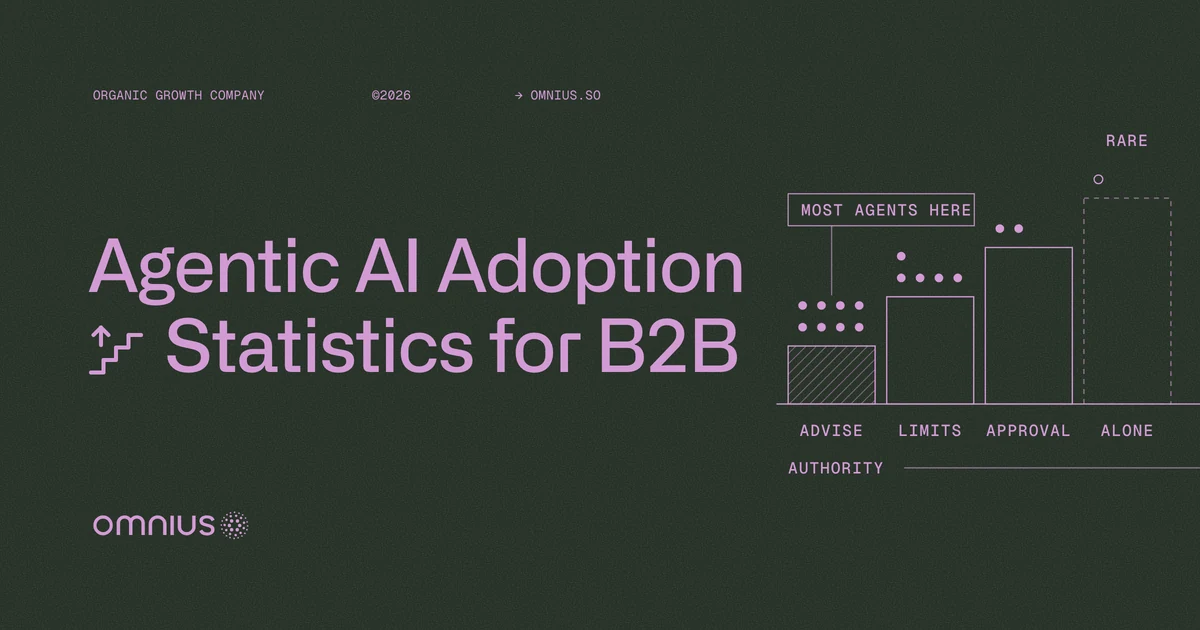
Agentic AI adoption statistics for 2026 show most surveyed large companies building or running AI agents, largely as supervised helpers on narrow tasks, while far fewer scale them across the organization or let them act alone.
In the Bank of England survey published with the Financial Conduct Authority (FCA) on October 26, 2026, only 2% of responding financial firms let agents act with broad autonomy.
For a SaaS or fintech vendor, the planning question is where agents already do useful work and where they still need approval. Purchasers also use research agents to compare vendors, and a figure quoted without its stage puts the wrong number on a board slide. This guide shows the statistics by stage and authority, why agent projects stall, how far agentic commerce has gone, what we expect in 2027, and how vendors should prepare.
Key takeaways
- The headline figure depends on what a survey counts, from 10% of organizations with agentic AI in production (Gartner) to 80% of responding UK financial firms with decision-support agents.
- Organization-wide scale is still rare, reached by about two in ten McKinsey respondents.
- Data gaps top the barriers to scale, with 72% of Deloitte's US respondents at piloting companies naming a missing data foundation.
- Reliability stays limited on long work, since the best official OSWorld run finished 44% of long computer workflows.
- Agent payments stay tied to approvals, and only 7% of UK and US fashion shoppers would let an assistant buy without approval.
- Research agents already evaluate vendors, as 41% of the B2B software purchasers G2 surveyed use Deep Research tools to evaluate software.
What agentic AI adoption means, and why statistics range from 10% to 80%
An AI agent is software built on a language model that plans and carries out a multi-step task with tools, such as a browser or a company's own software. It chooses some of the steps itself, while a basic generative AI chatbot answers and waits, and scripted automation follows fixed rules.
Adoption has two dimensions. The stage runs from pilots to production in one function, then to scale across functions. The authority follows the four levels the UK regulators use:
- Decision support: Agents recommend, and people decide and act.
- Constrained execution: Agents act within preset limits.
- Conditional autonomy: Agents ask approval for some actions.
- Broad autonomy: Agents act with little real-time human involvement.

Why do the numbers disagree? Surveys define agents differently, and PwC noted in 2025 that many employees use agentic features built into enterprise applications for routine tasks.
For this reason, we compare figures only after checking each one's definition, stage, population, and date. Three releases since September added payments and regulator evidence to the surveys:
- September 30, 2026: Mastercard added trust and intelligence services to Agent Pay, its program for agent payments.
- October 20, 2026: Visa launched a live pilot with BILL, a finance platform, and Billtrust in which AI agents complete approved invoice payments between companies.
- October 26, 2026: The Bank of England and FCA reported how much authority responding UK financial firms give their agents.
For vendors, the change starts before any payment. 41% of B2B software purchasers use Deep Research tools for structured software evaluations, according to G2's March 2026 survey of 1,076 of them.
AI answers also shape the shortlists people start from.

Agentic AI adoption statistics for 2026, by stage and authority
The table lists the main 2026 figures by measure.
| Statistic | What it measures | Who was asked | Source and date |
|---|---|---|---|
| 62% are building, deploying, or developing AI agents | Any agent activity | 314 US leaders at $1 billion-plus firms | KPMG, September 24, 2026 |
| 37% have deployed AI agents, and 34% plan to within 12 months | Deployment | Chief information officers and technology executives, 2027 survey | Gartner, August 31, 2026 |
| 66% have agents in limited or scaled production | Production | Over 1,000 B2B software purchasers | G2, October 14, 2026 |
| 80% run decision-support agents, and 2% grant broad autonomy | Authority in production | UK financial firms (105 full responses) | Bank of England and FCA, October 26, 2026 |
| 57% of fintechs at least pilot agentic AI, against 45% of traditional institutions | Piloting or beyond | 203 fintechs, 149 traditional institutions | University of Cambridge, April 2026 |
| 40% scale agents in a function at $1 billion-plus organizations, against 22% at smaller ones | Scale in one function | 1,719 respondents, 97 countries | McKinsey, August 25, 2026 |
| About 2 in 10 scale agents across the organization | Organization-wide scale | Same McKinsey sample | McKinsey, August 25, 2026 |
| 15% reach orchestrated multi-agent scale | Multi-agent scale across functions | 501 US leaders at firms already piloting | Deloitte, August 2026 |
| 72% name a missing data foundation as a barrier | Blockers to scale | Same Deloitte sample | Deloitte, August 2026 |
| 45% say oversight eats over a quarter of expected gains | Cost of checking work | Same G2 sample | G2, October 14, 2026 |
| 44% of long computer workflows are completed | Reliability (benchmark) | Best run on release 2.1, 108 tasks | OSWorld, October 15, 2026 |
| 7% would let an assistant buy without approval | Consumer permission | 3,194 UK and US fashion shoppers aged 18 to 65 | ACI Worldwide and YouGov, September 16, 2026 |
| 41% use Deep Research tools to evaluate software | Agent-type research | 1,076 B2B software purchasers | G2, March 2026 (fieldwork) |
Building and deploying. KPMG, an audit and advisory firm, found the share of leaders building, deploying, or developing agents rising from 53% to 62% in one quarter, a measure of activity, never of production.
Production in one function. Scaling concentrates in lower-risk, repeatable work with a near-term return, such as customer service, information technology (IT), and engineering, Deloitte found. Operations and IT also lead the UK regulator's table, and we think these functions go first because a person can check their output quickly.
Among McKinsey's respondents at $1 billion-plus organizations, scaling in at least one function rose from 27% to 40% in a year, while smaller organizations stayed flat.
Scale across the organization. In Deloitte's survey, this stage means orchestrated multi-agent systems, several agents coordinated across many workflows and functions.
Authority, from recommending to acting alone. Decision support leads or ties in every business area of the UK survey, and no business area passes 1% at broad autonomy.

Payments sit near the bottom: 7% of responding UK financial firms reported decision-support agents in payments, and none reported broad autonomy there.
Which figure belongs on a board slide, then? The one whose stage matches the claim: how common agents are, how far they reach, or how much they decide alone.
What it means for SaaS and fintech teams: Quote every adoption figure with its stage, population, and date, and re-check it when KPMG or McKinsey publishes a new wave.
Why AI agent projects stall before scale and autonomy
We see four constraints: Data foundations and the cost of checking agents' work limit scale, while reliability on long tasks and the limits companies set on purpose keep autonomy narrow.
1. Data and integration gaps block scale. In Deloitte's study of US leaders at companies already piloting agents, 72% named a missing unified data foundation as a reason they can't scale. Many also layer agents on top of existing processes, and without process redesign, Deloitte expects layering to stall at simple efficiency gains. What to do: Ship connectors and data mappings for the software customers already run, and document them publicly.
2. Checking agents' work costs time. G2 calls that oversight bot-sitting, and 45% of the B2B software purchasers it surveyed say overseeing and correcting agent mistakes eats more than a quarter of the productivity gains they expected.
McKinsey describes operating costs as "not yet a widespread constraint," while G2 tells vendors to make oversight costs visible. What to do: Show oversight time per completed task next to operating cost in demos and case studies.
3. Agents still fail most long tasks. OSWorld, a benchmark, tests autonomous agents on 108 computer workflows that take people a median of 1.6 hours. In one task, an agent saw purchase approvals arrive late in Slack and still submitted an order sheet that left them out, a mid-task miss of the kind its authors name as a main cause of failure.
The best official run on the current release, OSWorld 2.1, finished 44% of them and earned a 78% partial score, which counts the checkpoints a task's end state meets, while a finish needs all of them. Releases change the tasks, so June's lower rate isn't a like-for-like baseline. What to do: Scope agent features to tasks a person can check in minutes, and publish completion rates on real customer tasks.

4. Companies limit autonomy on purpose. Nearly half of KPMG's leaders (49%) have defined high-risk uses where agents may not decide alone.
Approval requirements rise with agent authority. A customer's risk review covers which data a vendor's agent sees, which tools it uses without approval, and who reviews its actions. What to do: Ship approval steps, audit logs, permission scopes, and a pause control, and list them on the security page.
Agentic commerce statistics: How many shoppers and companies let AI agents pay
Hundreds of controlled agent-initiated transactions had run on Visa by December 2025, when Visa forecast millions of consumers buying through agents by the 2026 holidays.
AI Pay had processed 300 million transactions in China by May 2026, Alipay reported, a count that covers several kinds of AI-enabled payment.
Will shoppers let an agent pay on its own? Few will yet, since only 7% of UK and US fashion shoppers in a June 2026 YouGov survey for ACI, a payment software company, would permit autonomous purchasing under predefined conditions.
Most shoppers are uncomfortable: 53% of the fashion shoppers in the same ACI and YouGov survey were uncomfortable letting an AI assistant buy for them.
In business payments, approval comes first. In the Visa, BILL, and Billtrust pilot, an authorized agent pays invoices the customer has approved, end to end through supplier portals, within the instructions and payment controls that form its mandate.
An International Monetary Fund (IMF) note splits agent payments into three layers: intent, authorization against the mandate, and settlement.
Sarah Breeden, a Bank of England deputy governor, said in June 2026 that "consumers and merchants have so far mainly used AI agents in recommendation mode, with humans still executing transactions."
She added that a human in the loop for every agent action is unlikely to be realistic, and named consent for multiple transactions, dispute settlement, and liability among the biggest open issues.

In UK finance, no more than 9% of responding firms expect agents to initiate, execute, or block payments, counting 12-month plans.
A Mastercard-commissioned futurist report projects more than one in 10 online shoppers routinely buying through agents by 2030.
What it means for fintech teams: Build for mandates first, through network programs such as Mastercard Agent Pay, with agent identity, an authorization record for each payment, and liability terms a customer can read.
What we expect from agentic AI adoption in 2027
Three predictions, each with the evidence that would prove it wrong:
1. Organization-wide scale stays a minority. Data and integration gaps lead the reported barriers, so we expect fewer than half of McKinsey's respondents to report scaling agents organization-wide in its next survey, and half or more would prove us wrong.
2. Agent payments on card networks grow faster in B2B accounts payable. An approved invoice already sets the instructions an agent pays within, for example in the Visa pilot. Faster consumer growth over the same period in comparable network data would prove us wrong.
3. Deep Research use keeps rising in software evaluation. We expect G2's next survey to show it, and no rise would prove us wrong. Gartner's October 2025 forecast puts 90% of B2B buying through AI agents by 2028.
How SaaS and fintech vendors should prepare for AI agents
Where does a vendor meet agents first? At the research step, where Forrester forecasts that agentic buying will play a role in 75% of B2B purchases in 2027, mostly in bounded tasks such as supplier discovery. It also expects two-thirds of providers to lose deals over claims people can't verify when they check what agents return.
In a hypothetical case, a finance lead at a mid-sized company asks a Deep Research tool to compare BILL, Ramp, and Tipalti for invoice approvals. The tool runs supplier discovery and reads each vendor's pricing, integration, and security pages.
Its report can run 10 to 20 pages, and G2 notes that winning means being one of the brands recommended at the end.
Vendors' own pages are among its sources, and in our fintech study, 107 of 120 vendor-check answers in ChatGPT and Google AI Mode cited at least one named company's own website.
The finance lead then cross-checks other assistants, where inconsistency reads as a red flag, and talks to people before buying. Three priorities follow, in order:
1. Keep product facts accurate, structured, and consistent. Product, pricing, security, privacy, compliance, and performance information should be "accurate, structured, and accessible" to the agents purchasers use, Forrester advises.
In our pricing study, ChatGPT put a price on every contact-sales vendor and cited marketplace listings for several, so the facts have to match everywhere they appear, third-party profiles included.

2. Price and package agents for usage as well as seats. Only 9% of G2's respondents call per-seat pricing fairest for agent products. Coding agents also replace some purchases outright; 32% of McKinsey's respondents said their organizations passed on a software product or feature because coding agents let them build it.
3. Track how AI research describes the company. Ask the category's vendor-research questions in ChatGPT, Claude, Perplexity, Gemini, and Copilot every month, and log which vendors each answer recommends and, separately, which pages it cites.
Then track automated requests to pricing, docs, and product pages in server logs, verified against the user-agent names and network addresses AI companies publish, and report AI assistant referrals in Google Analytics separately.
What can wait: agent checkout for SaaS subscriptions, until customers ask for it and payment controls support it.
How we read agent adoption for SaaS and fintech companies
The first iteration of AI search changed where humans do research, and the agentic web changes who does the research in the first place.
We expect buying software to become a task an agent performs, and winning an agent's recommendation is a different problem from winning a click at the top of a funnel.
Search engines, language models, and agents retrieve and weigh information differently, yet each depends on a company being clear, consistently represented, and supported by evidence. Across 25 requirement-based answers in five B2B SaaS categories, the original first recommendation lost the top spot in 16, and Claude asked to confirm a security certification that one vendor documents in its trust portal.
Because agents compare vendors fact by fact, we build a Company Information Model before we optimize how a company is represented. It holds products, categories, use cases, integrations, and certifications, each marked confirmed, inferred, or open.
Structured data can express those facts in machine-readable form, but it can't create independent evidence for a claim. When a company lacks ties to its categories and use cases, it can drop out of the candidate pool before an agent narrows it to a few names.
Answers are non-deterministic, so we measure selection share, the share of repeated, requirement-based answers that put a company on the shortlist. Like visibility, it is a step toward qualified pipeline, the result we measure it against.

Read together, the 2026 figures put a vendor's first work at the research step, where agents already read, compare, and check its facts, while agent payments wait on mandates and controls.
FAQ
What percentage of companies use AI agents in 2026?
The percentage of companies using AI agents depends on the stage counted, and Gartner's 2027 survey of chief information officers and technology executives puts deployment at 37%. The often-quoted 79% is older and broader, since it comes from PwC's April 2025 survey of US executives and counts agents "being adopted" at any level.
How many agentic AI projects fail?
The often-quoted agentic AI failure rate is a forecast. In June 2025, Gartner predicted that over 40% of agentic AI projects will be canceled by the end of 2027, citing costs, unclear business value, and inadequate risk controls. Nearly two-thirds of executives at large AI adopters reported pausing lower-value AI projects in Capgemini's November 2025 survey, a measure of AI in general.
What is the agentic AI market size?
Agentic AI market-size figures are estimates of a whole market, while product revenue, such as Salesforce's, covers one vendor's offerings. Salesforce reported Agentforce annual recurring revenue above $1.5 billion in August 2026, once the measure included Slackbot and Headless 360.
Is there an AI agent adoption rate for SaaS or fintech companies?
Yes for fintech. In the University of Cambridge's 2026 study, 57% of fintechs were at least piloting agentic AI, against 45% of traditional financial institutions.
For SaaS, no survey here measures vendors' own adoption, and G2's figures describe software purchasers.
Methodology
This report uses public data read through November 5, 2026.
- Sources. Surveys, a regulator survey, a benchmark file, company releases, and three Omnius datasets. No new tests were run.
- Reading the figures. The table gives each figure's population and date (fieldwork where marked), and forecasts are labeled.
- Limits. KPMG, McKinsey, Deloitte, PwC, and Capgemini are consultancies; Gartner and Forrester sell research; G2 sells to software vendors; ACI sells payment software. Visa, Mastercard, BILL, Alipay, and Salesforce report on their own products, and Omnius sells AI search services.
Sources
The sources form four groups:
- Surveys and analyst research: Gartner, CIO survey, Gartner, Hype Cycle, Gartner, C-suite guide, Gartner, B2B purchasers, Gartner, cancellations forecast, Gartner, top predictions, McKinsey, State of AI, KPMG, AI Pulse, Deloitte, agentic transformation, G2, AI Agents Report, PwC, agent survey, Capgemini, AI realism, ACI, fashion shoppers, Forrester, 2027 predictions, Forrester, press release, and Cambridge, AI in finance
- Institutions: IMF, agent payments
- Benchmarks: OSWorld results
- Company announcements: Visa, agent transactions, Mastercard, Agent Pay, Alipay, AI Pay, and Salesforce, Q2 fiscal 2027