AI platforms sent between 0.3% and 1.1% of website traffic across the large 2025 and 2026 panels we compared, and ChatGPT sent most of it. That measured share is a floor. A large part of AI-driven visits arrives without a referrer, never clicks through, or comes back later through branded search.
Timing matters here because one product change moved the whole channel. On May 7, 2026, ChatGPT made brand links in its answers more prominent, and measured ChatGPT referrals rose 157.7% within a week in Similarweb's desktop panel. This report gives B2B marketing teams benchmarks by platform and sector, the measurement gaps that hide AI traffic, and seven steps to measure and grow it.
What this report found
- AI is a small but growing measured channel. Across 2025 and 2026 panels, AI referrals accounted for 0.3% to 1.1% of website traffic. In Omnius datasets, AI reached 2.12% of Google organic plus AI sessions in Q3 2026, up from 1.73% in Q2.
- Every measured AI number is a floor. App visits without a referrer land in Direct, many people read the answer and never visit, and others return later through branded search.
- B2B companies can sit far above the average. On omnius.so, AI engines sent traffic equal to about 21% of our Google traffic, roughly ten times the ratio across Omnius datasets.
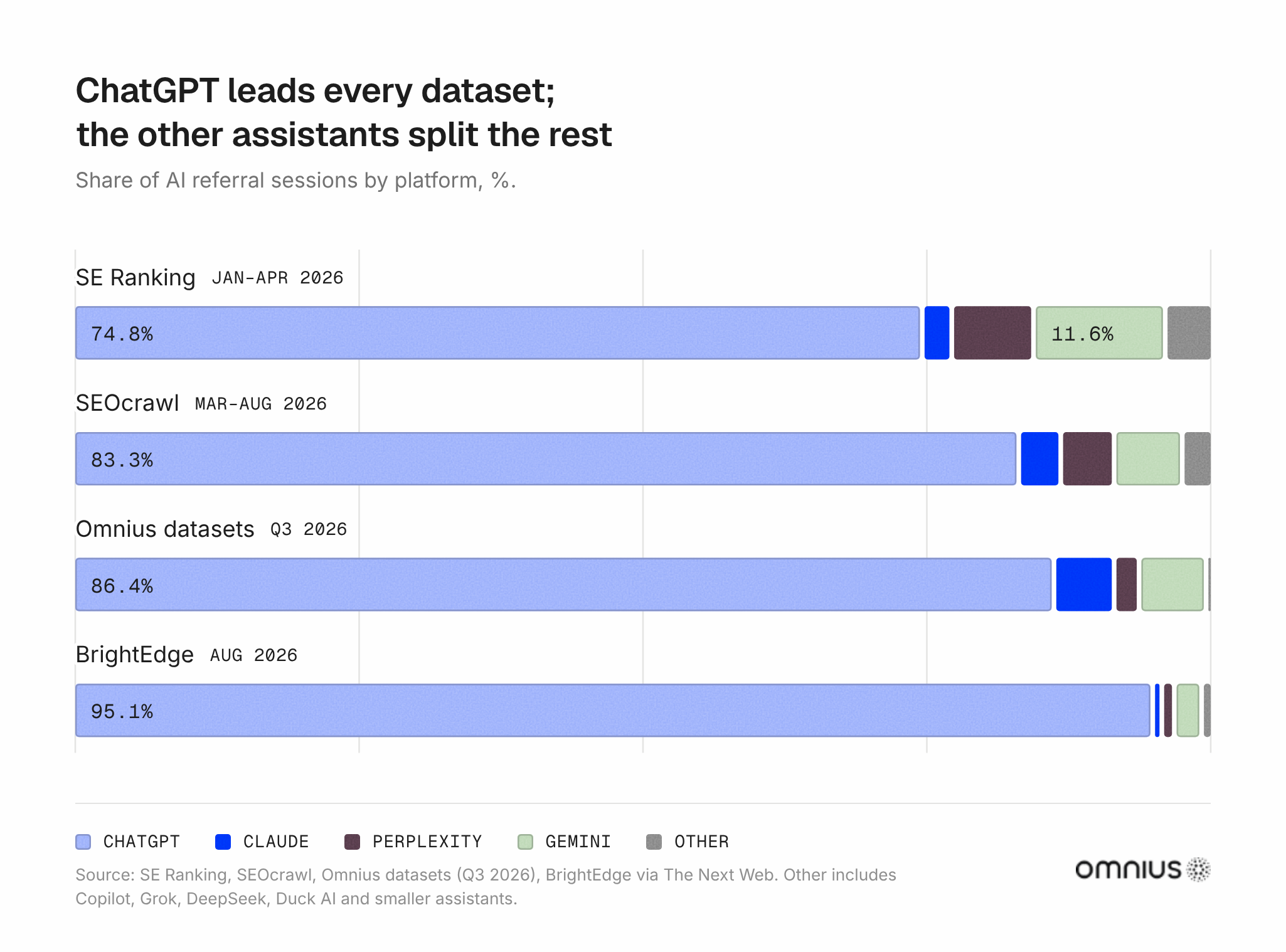
- ChatGPT sends most AI referrals. It accounted for 72% to 95% across eight datasets, and for 86.44% of AI visits in Omnius datasets in Q3 2026.
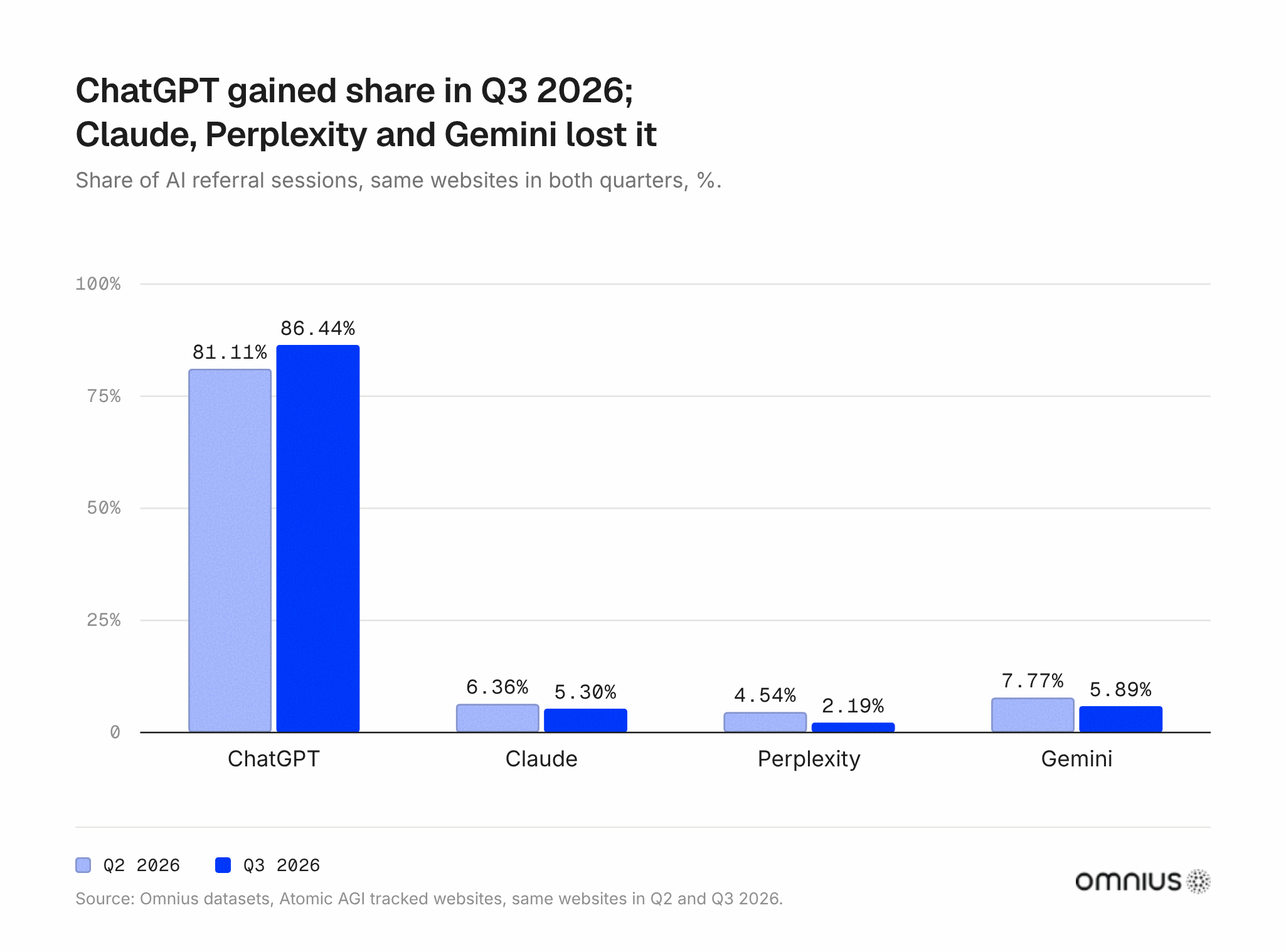
- Claude and Gemini rose in the spring, then slipped in Q3. Claude's share of total website traffic grew 386% from January to April 2026. Between Q2 and Q3, Omnius datasets show Claude falling from 6.36% to 5.30% of AI visits and Gemini from 7.77% to 5.89%.
- Perplexity is fading in more than one dataset. Its share of AI visits in Omnius datasets fell from 4.54% to 2.19% in Q3.
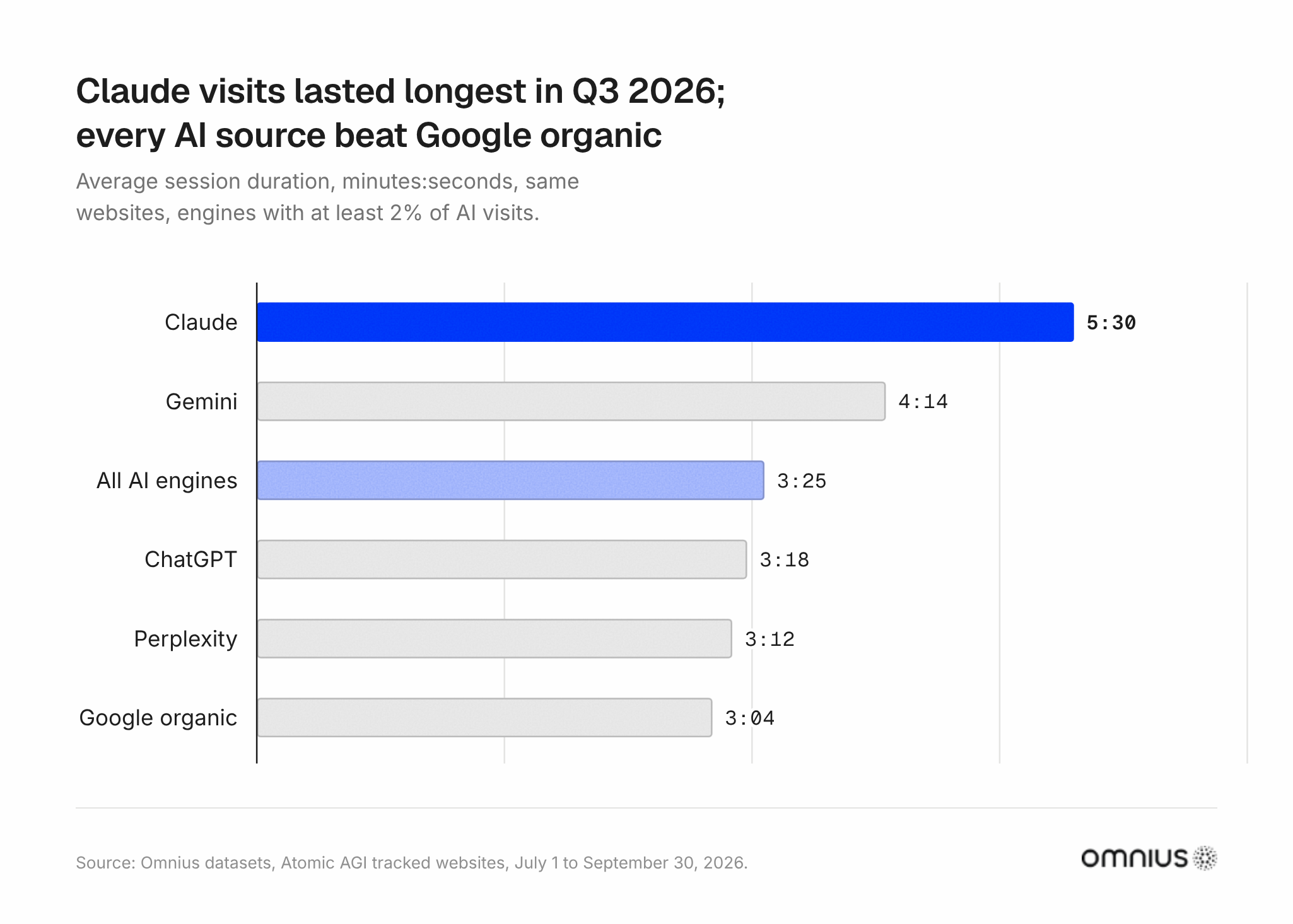
- AI visitors stay longer. In Q3 2026, Claude visits averaged 5 minutes 30 seconds against 3 minutes 4 seconds for Google organic.
- Measured conversion understates AI. Last-click reports credit many AI-influenced conversions to Direct and organic. Where tracking is cleaner, AI converts better: Adobe measured a 90% higher purchase conversion rate for AI retail visits in September 2026.
- AI referrals do not offset organic declines in these panels. Top-result CTR was 58% lower on queries with an AI Overview, and separate data recorded a median 24% decline in Google clicks for SaaS and tech websites.
How we built this benchmark
We compared more than a dozen public studies from 2025 and 2026, led by datasets from SE Ranking, SEOcrawl, Conductor, Demandbase, Octane11, BrightEdge, Similarweb, Ahrefs and Adobe. Every figure links to its source, and we checked each number, period and sample against the original page. Agency studies appear without names or links, described by their sample and period.
Omnius datasets add a B2B view for the same period. They come from Atomic AGI's Q3 2026 AI search quarter report, built on Google Analytics data from more than 15,700 domains, mostly B2B websites in SaaS, fintech, AI and enterprise software. The report covers July 1 to September 30, 2026, and compares Q3 with Q2 on the same websites. Atomic AGI is an Omnius product.
In this report, an AI referral is a session with a recognized AI assistant as its referrer. That definition excludes clicks from Google AI Overviews and AI Mode, which analytics tools count as organic search. Because studies use different samples, periods and denominators, we show ranges and keep each denominator next to its number.
What changed in AI search between mid-2025 and late 2026
Product design drove the largest change in measured referrals in 2026. On May 7, ChatGPT made brand links in its answers more prominent, and measured referrals jumped within a week. Six days later, Google Analytics gave AI assistants their own default channel, which made the jump easier to see.
| Date | Event | Effect on measured referrals |
|---|---|---|
| Nov 10, 2026 | OpenAI launches Business Hub for ChatGPT, with 28-day mentions, website clicks and discovery topics for verified businesses | First click data from an AI assistant itself; online mentions require a website reference |
| Oct 28, 2026 | Alphabet reports the Gemini app passed 1 billion monthly active users, up from 650 million a year earlier | A larger audience, though Gemini still sends a fraction of ChatGPT's referrals |
| Oct 21, 2026 | OpenAI expands ChatGPT Ads to 89 countries and states that 1.2 billion people use ChatGPT each week | Paid ChatGPT clicks now need separating from earned referrals |
| Oct 15, 2026 | Google adds more inline links and more prominent related-article links to AI Mode and AI Overviews | Possibly more clicks from Google AI surfaces, still counted as organic |
| Jul to Sep 2026 | In Omnius datasets, ChatGPT's share of AI visits rises from 81.11% to 86.44% | Claude, Perplexity and Gemini all lose share |
| Aug 31, 2026 | Google completes the rollout of generative AI impression reports in Search Console | AI impressions become visible; AI-specific clicks do not |
| Aug 2026 | BrightEdge reports ChatGPT sent 95.1% of AI referral traffic, with referrals up 36% month over month | Peak concentration on one platform |
| Jul 22, 2026 | Alphabet says AI Mode passed 1 billion monthly active users | Clicks from AI Mode count as Google organic |
| Jun 2026 | seoClarity measures AI referral traffic rising 110% month over month, with ChatGPT up 130% | First full month after the brand-link change |
| Jun 16, 2026 | Bing Webmaster Tools adds AI visibility insights and Citation Share | A citation metric for Copilot and Bing answers |
| May 13, 2026 | Google Analytics adds an AI Assistant default channel | Sessions with a recognized AI referrer leave the Referral channel |
| May 7, 2026 | ChatGPT makes brand links more prominent. In Similarweb's desktop panel, referrals rose 157.7% in a week, and about 60% landed on homepages | A sharp one-week increase in measured ChatGPT referrals |
| Mar 2026 | Claude's referral share of total traffic jumps 2.6x in one month | Claude's largest monthly gain on record in that panel |
| Feb 4, 2026 | Ahrefs finds top-result CTR 58% lower on AI Overview queries, against 34.5% in its April 2025 study | Fewer organic clicks on the queries that fed B2B blogs |
| Nov 2025 | A panel of 166 GA4 properties shows ChatGPT sessions falling about 52% in one month, then recovering in December | The cause is uncertain |
| Jul 21, 2025 | A separate 52% decline in ChatGPT referrals begins, as covered in our analysis of the ChatGPT referral crash | Historical: the first large swing in the channel |
Two separate 52% drops, in July and November 2025, show how quickly one platform can swing. We forecast AI referrals as a volatile channel and review them monthly.
How much traffic AI platforms send to websites in 2026
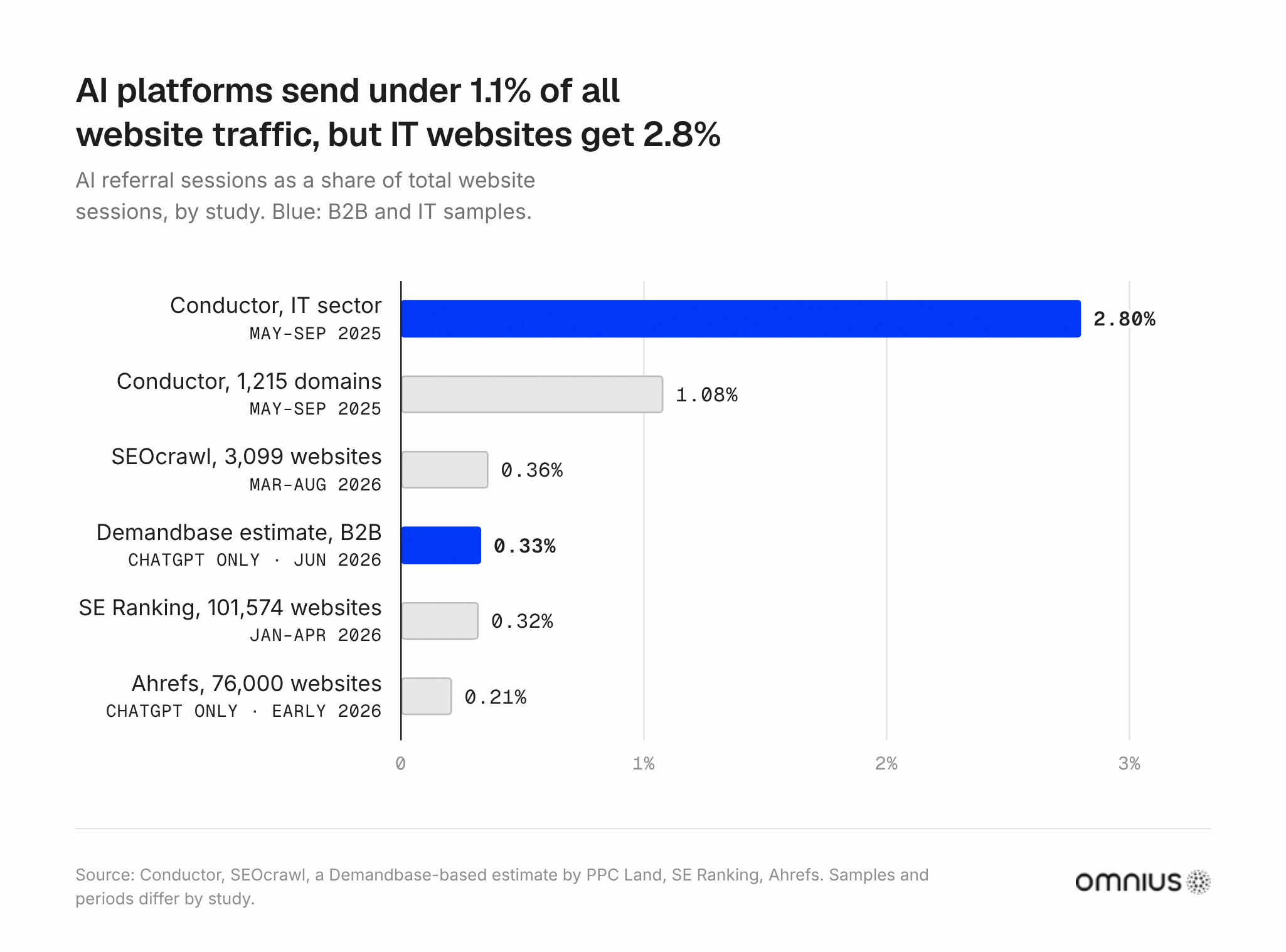
Across the large public panels for 2025 and 2026, AI platforms sent between 0.3% and 1.1% of website traffic. Who gets measured explains the spread: broad panels of small and mid-size websites land near 0.3%, while enterprise and IT-heavy samples land near 1% or higher.
| Study | Sample | Period | Growth signal |
|---|---|---|---|
| SEOcrawl (Nov 2026) | 3,099 GA4 websites with complete histories, of 3,949 analyzed | Mar-Aug 2026 | AI sessions up 44.6% year over year; 57.6% of websites grew; 0.42% share in August alone |
| SE Ranking (Jun 2026) | 101,574 websites worldwide | Jan-Apr 2026 | 0.02% in 2024 and 0.24% in 2025, about 16x in two years |
| Ahrefs (Feb 2026) | 76,000 websites | Early 2026 | Google sends 190x more traffic than ChatGPT |
| Demandbase Labs (Aug 2026) | 1,584 B2B instances, 11B+ visits | Jun 2025-Jul 2026 | Monthly ChatGPT referrals up 303%, from about 645,000 to 2.6 million; the share is a rough estimate by PPC Land |
| Conductor (Nov 2025) | 1,215 traffic domains, 3.3B sessions | May-Sep 2025 (US) | About 1% month over month; 2.80% for the IT sector |
| Omnius datasets (Nov 2026) | Mostly B2B websites tracked in Atomic AGI, same websites in both quarters | Q2 to Q3 2026 | 1.73% to 2.12% of Google organic plus AI sessions |
Software and IT rank near the top of every industry cut. Conductor's IT figure is about 2.6 times its 1.08% average, and SEOcrawl ranks SaaS and tech second for AI sessions relative to Google organic, behind education.
Organic search still sends far more visits. Across two panels, organic search sends roughly 80 to 134 times as many visits as AI platforms. SE Ranking puts organic at 42.75% of all traffic.
Why does the AI share rise even when AI traffic stays flat? Part of the rise comes from organic shrinking. In the same SEOcrawl dataset, Google organic clicks fell 15.0% year over year and the median website lost 20.1%, so we check raw session counts before calling a higher share a gain.
Which AI platforms send the traffic: ChatGPT, Claude, Perplexity and Gemini
ChatGPT sends most AI referral traffic in every dataset we reviewed, from 72% to 95% depending on the sample and month. Claude and Gemini gained share through the spring of 2026, then slipped in Q3, while Perplexity declined in several independent datasets.
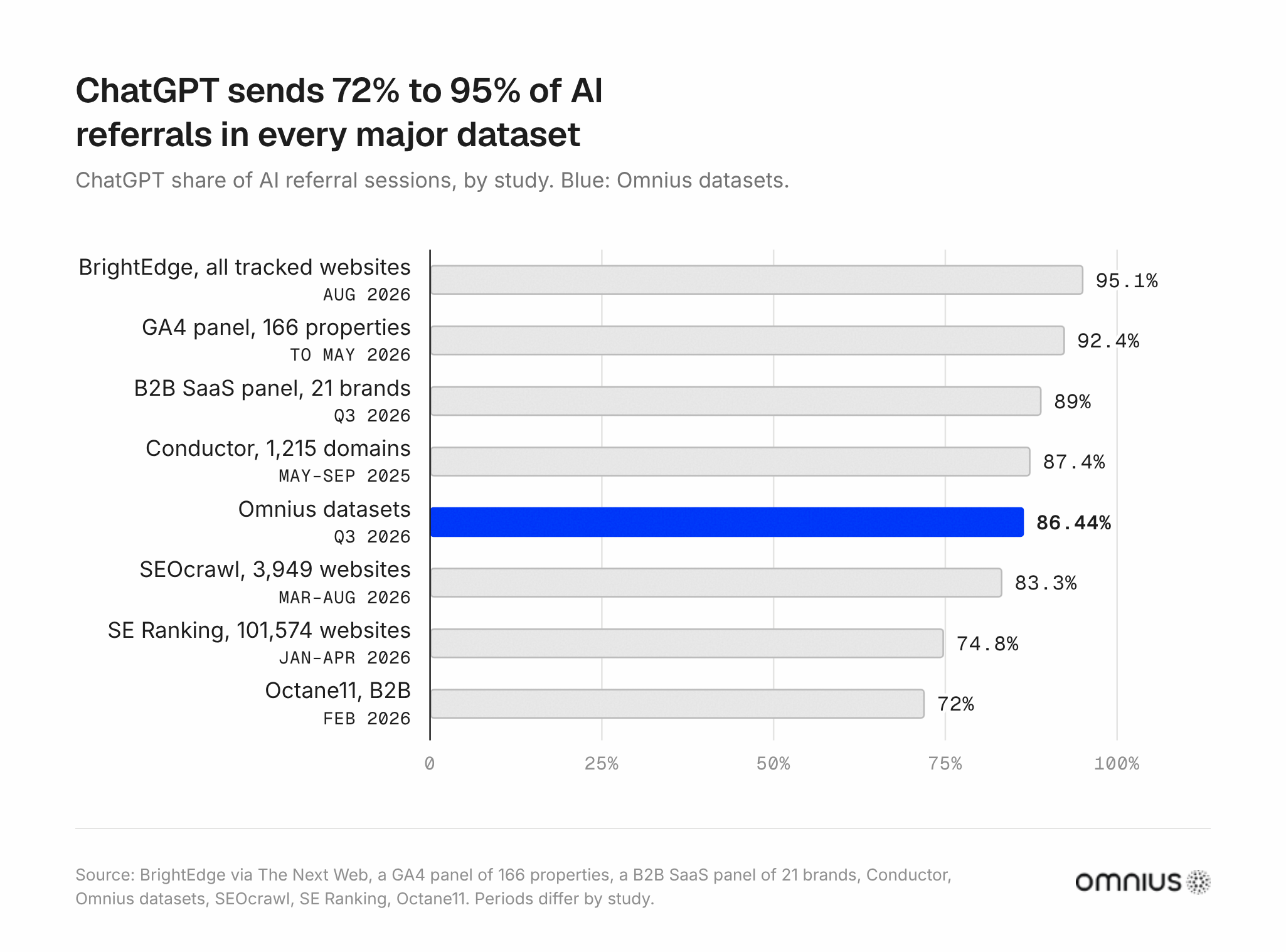
Why does ChatGPT's share vary so much? The sample decides it. Broad panels with many consumer and publisher websites, such as SE Ranking's, show more Gemini and Perplexity traffic, while panels measured after the May 2026 link change, such as BrightEdge's August figure, catch ChatGPT at its peak.
How engine shares moved from Q2 to Q3 2026
ChatGPT pulled further ahead in Q3. In Omnius datasets, its share of AI visits rose from 81.11% to 86.44% as its sessions grew 21.99%. Over the same quarter, Perplexity sessions fell 44.83%, Gemini's 13.25% and Claude's 4.6%.
Earlier in the year, the direction ran the other way. In Octane11's B2B data, Gemini rose from 4.5% to 13.0% of B2B AI referrals between September 2025 and February 2026, and Claude from 2.1% to 6.2%, while ChatGPT fell from 81% to 72%.
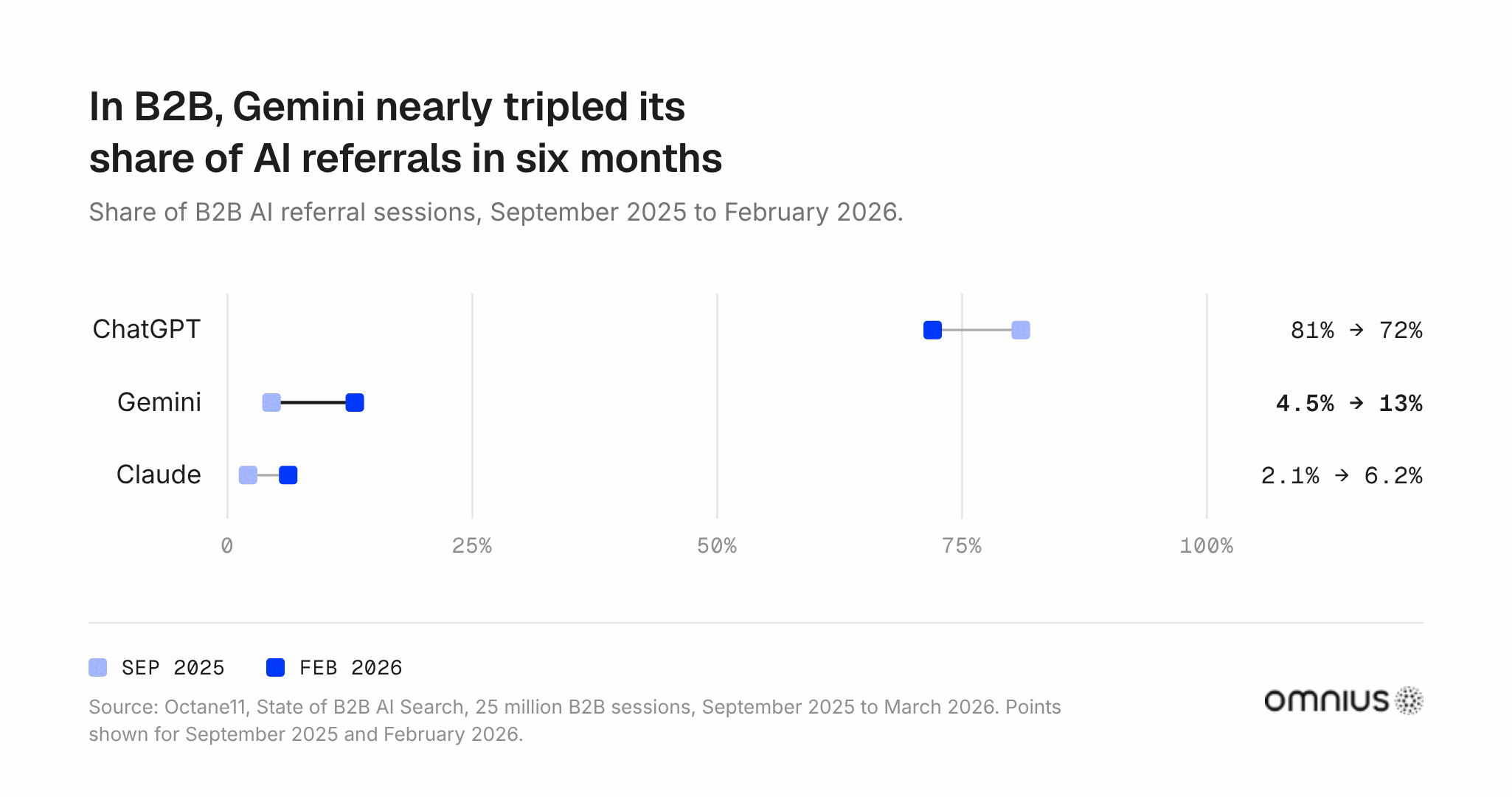
Taken together, the challengers gained through the spring and gave part of it back once ChatGPT's brand links became more prominent in May.
Claude: The fastest grower in early 2026, and larger in B2B
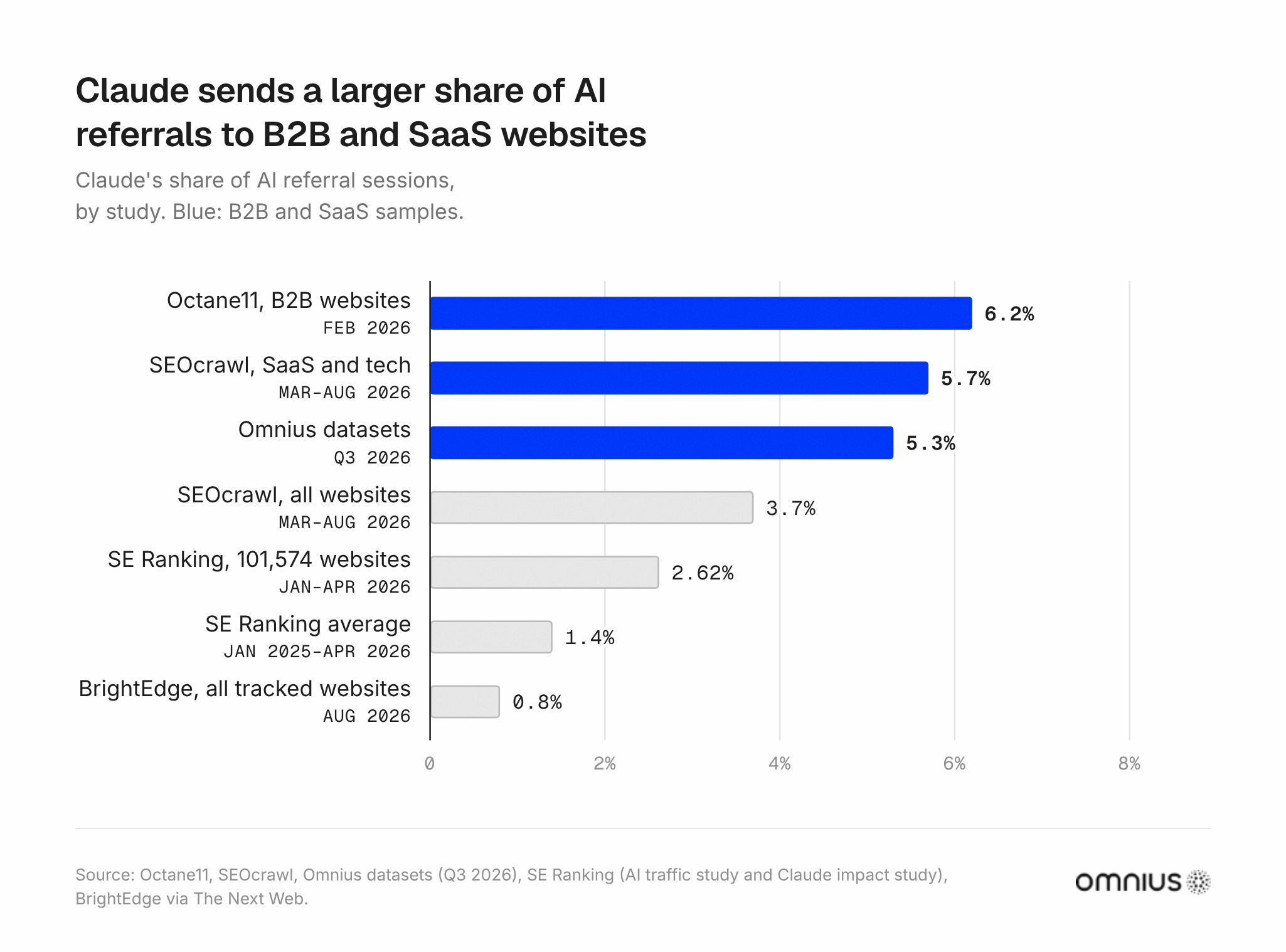
Claude grew faster than any other assistant in early 2026, and it matters more to B2B websites than its global share suggests. In B2B and SaaS samples, Claude sends 5% to 6% of AI referrals, about 1.4 to 8 times its share in broad panels.
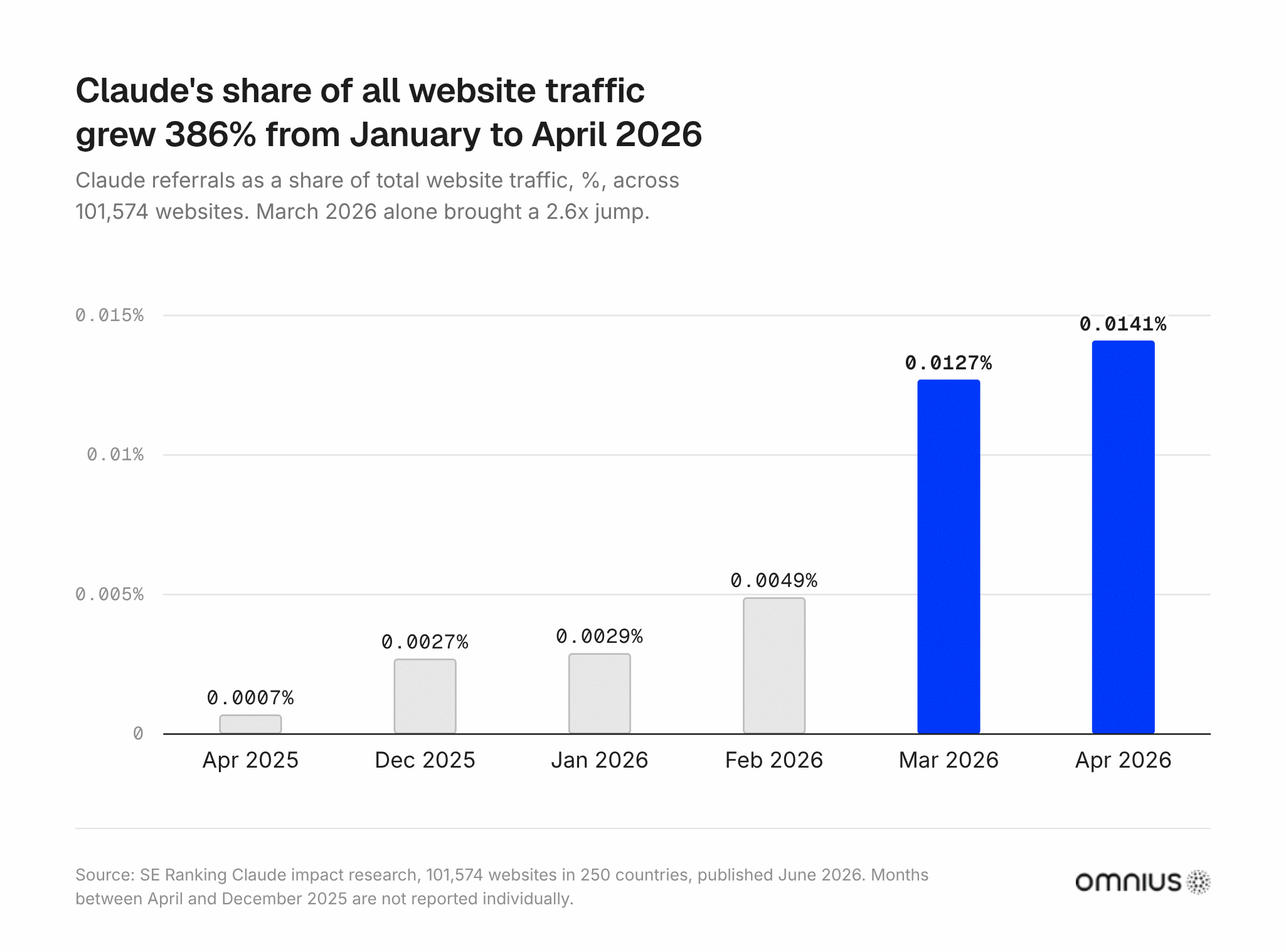
- Fastest growth in early 2026. Claude's share of all website traffic rose from 0.0029% to 0.0141% between January and April 2026, while ChatGPT grew 1.53% and Gemini 63% in SE Ranking's panel. Claude still ranked fifth there.
- Strongest in the US. In April 2026, Claude referrals reached 0.0186% of total traffic in the US, 0.0100% in the EU and 0.0054% in the UK.
- More traffic back per page crawled. Cloudflare Radar data compiled by TechnologyChecker shows Anthropic's crawlers fetched 36,551 pages per referral in Q3 2025 and 988 in Q3 2026, the latter provisional.
- A fast-growing audience. Sensor Tower estimates the Claude app had 56 million monthly active users in Q2 2026, up about 640% year over year.
- A softer Q3. In Omnius datasets, Claude's share of AI visits fell from 6.36% to 5.30%. Demandbase also saw Claude referrals to B2B websites stay flat through mid-2026.
Claude visitors stay longest of any source. In Q3 2026, Claude visits averaged 5 minutes 30 seconds, 79% longer than Google organic, so we track Claude as its own line in reporting.
Platform audiences and referral shares
| Platform | Audience (latest disclosed) | Share of AI referrals, 2026 range | Direction in 2026 |
|---|---|---|---|
| ChatGPT | 1.2 billion weekly users (OpenAI, Oct 2026) | 72% to 95% | Referrals up 101% from January to August (BrightEdge); 86.44% of AI visits in Q3 (Omnius datasets) |
| Claude | 56M monthly active app users (Sensor Tower estimate, Q2 2026) | 0.8% to 6.2% | Up 386% January to April (SE Ranking); 5.30% in Q3, down from 6.36% (Omnius datasets) |
| Perplexity | 100M+ monthly active users | 1.1% to 7.2% | Share fell from 13.1% to 4.7% (SEOcrawl) and from 4.54% to 2.19% in Q3 (Omnius datasets); one B2B panel recorded a 62% session decline from Q1 to Q3, with a possible tracking change |
| Gemini | 1B+ monthly users (Alphabet, Q3 2026) | 2.4% to 13% | Share of total website traffic up 231% in SE Ranking's 2025 to 2026 comparison; 5.89% in Q3, down from 7.77% (Omnius datasets) |
| Copilot | 150M+ monthly users across the Copilot family (Microsoft, Oct 2025) | About 0.05% to 3.5% | Sessions down 96% from an August 2025 peak in a 166-property GA4 panel |
Audience size and referral volume are separate measures. Gemini has over 1 billion monthly users, yet it sends a fraction of ChatGPT's referrals. For visits, ChatGPT visibility matters most; for influence on the answer itself, Gemini and Google's AI Mode matter as much.
What a normal AI referral number looks like for B2B websites
Across Omnius datasets, AI engines sent about 2.2 sessions for every 100 Google organic sessions in Q3 2026. That ratio is the broadest B2B benchmark in this report, and it is a floor, because it counts only sessions with a recognized AI referrer.
The share is still climbing. AI made up 2.12% of Google organic plus AI sessions in Q3, up from 1.73% in Q2 on the same websites, and AI visits grew 14% across all engines over the quarter.
B2B companies that AI engines cite often run far above that average. On omnius.so, AI engines sent traffic equal to about 21% of our Google traffic in the weeks before August 13, 2026, roughly ten times the ratio across Omnius datasets. The periods differ, so we read our own number as an example of the upper range, and the measurement section explains why even that figure undercounts.
How one B2B panel spreads across percentiles
One B2B panel's median AI-to-organic ratio was about 3% in June and July 2026. It covered 64 SaaS and tech companies and roughly 240,000 LLM visits from January to July. Its definition included Google AI surfaces, so it runs higher than referral-only measures such as the Omnius ratio.
| Position in the panel | AI sessions as % of organic sessions | What it usually reflects |
|---|---|---|
| Bottom quartile (P25) | 1.8% | AI engines rarely cite or link the website |
| Median (P50) | 3.0% | Typical for the panel in mid-2026 |
| Top quartile (P75) | 4.8% | Cited on commercial prompts as well as informational ones |
| Top decile (P90) | 7.3% | Among the most-cited brands in the category |
We place a website on these bands by dividing its AI referral sessions by its organic sessions for the same month. In that panel, company size was essentially unrelated to the ratio.
Why totals grew while the typical website stood still
- Totals up, median flat. In a like-for-like panel of 21 B2B SaaS brands, total LLM sessions grew 2.4 times from Q1 to Q3 2026, while the median brand stayed flat at 0.99 times. Ten brands grew and eleven shrank.
- SaaS lagged other industries. SEOcrawl found the median SaaS and tech website lost 18% of AI referrals from March-August 2025 to March-August 2026, while travel gained 120% and ecommerce 54%.
- ChatGPT drove the B2B step change. Demandbase measured monthly ChatGPT referrals to B2B websites rising from about 645,000 in June 2025 to 2.6 million in June 2026, with volume more than doubling in May 2026. Perplexity referrals declined, and Gemini and Claude stayed flat in that dataset.
- Search still dominates B2B discovery traffic. Octane11's analysis of 25 million B2B sessions puts AI search at under 2% of B2B search referral traffic.
Each of these benchmarks is a floor. All of them count only sessions that arrive with a recognized AI referrer, so app visits, answers read without a click and later branded searches sit outside them.
Why every measured AI number is a floor
A large share of AI-driven visits never shows up as an AI referral. Visits from apps arrive without a referrer and land in Direct, many people read the answer and never visit, and others return days later through branded search. As a result, every AI figure in this report is a lower bound, and the gap shapes how the benchmark and conversion sections should be read.
| Gap | What happens | How large it is | How we measure around it |
|---|---|---|---|
| Lost referrers | Visits from the ChatGPT apps often arrive without a referrer and land in Direct, as SEOcrawl notes | Not measurable directly | We watch Direct sessions to deep pages and to the homepage after AI mentions |
| Google AI surfaces | Clicks from AI Overviews and AI Mode count as Google organic | AI Mode alone has 1B+ monthly users | We track AI Overview presence next to Search Console clicks |
| Channel rules | GA4's AI Assistant channel relies on a recognized referrer, and it appeared on May 13, 2026 | Comparisons that span that date mix two classifications | We keep a custom channel group for history and for smaller assistants |
| Answers without a click | People read the answer, then search the brand or type the URL later | Shows up as branded search and Direct | We track branded queries in Search Console next to AI referrals |
Google's own help page is explicit on the second gap. Its definition of the AI Assistant channel says it "excludes Google's AI Overviews and AI Mode."
How large the gap is on our own pipeline
Self-reported discovery runs far ahead of measured traffic. Among high-intent, ICP-matching companies that booked a meeting with us, 59% named an LLM as their discovery source in a post-meeting form. Over the same weeks, measured AI traffic to omnius.so equaled about 21% of our Google traffic.
How should the two numbers be read together? They use different denominators, so the 59% is not a share of revenue. Even so, they show AI influence on B2B decision-makers running several times ahead of what referral reports capture, and a self-attribution question on booking forms is the cheapest way to see it.
What last-click form data shows, and what it misses
Omnius datasets also record form submissions per 100 visits by source for Q3 2026: Google organic 1.98, Claude 2.27, Gemini 2.13 and ChatGPT 0.51. These are last-click form submissions. They miss AI-influenced conversions that arrive through app visits, Direct and later branded searches, so they cannot show that any AI source converts worse. ChatGPT, with the largest app audience, is the most exposed to lost referrers.
Tracking can also break in the opposite direction. One B2B panel recorded a 62% decline in Perplexity sessions from Q1 to Q3 2026 and flagged a possible tracking change. Omnius datasets show a smaller Perplexity decline of 44.83% in Q3 sessions, so we confirm referrer data before cutting any platform from a plan.
What the new first-party AI reports show
Three platforms now report AI visibility directly. Google and Bing show impressions or citations, ChatGPT counts website clicks, and none of them reports revenue.
| Tool | What it reports | Limit to know |
|---|---|---|
| Google Search Console generative AI reports (rollout completed Aug 31, 2026) | Impressions in Google's generative AI features in Search and Discover | No AI-specific clicks or CTR; low volumes can hide the report |
| Bing Webmaster Tools Citation Share (preview since Jun 16, 2026) | Share of citations for the same grounding query in Bing and Copilot answers | Visibility only; no competitor domains |
| ChatGPT Business Hub (launched Nov 10, 2026) | 28-day mentions, website clicks and discovery topics after verification | Online mentions require a website reference; local mentions count location results |
OpenAI's own tooltip draws the same line between a click and a visit. It notes that clicks "don't confirm website visits or conversions."
Why AI visitors convert better than reports show
AI-referred visitors convert better than Google visitors once attribution is accounted for. A measured parity, or a lower measured rate, comes from the attribution gap: AI-influenced conversions get credited to Direct and organic. Our analysis of AI search traffic quality covers that evidence in depth.
Where tracking is cleaner, the advantage shows. Adobe found that in September 2026, AI referrals to US retail websites had a 90% higher purchase conversion rate and 83% higher revenue per visit than combined non-AI traffic. In August 2025, the same rate had been 9% lower, so the gap opened within about a year. These are retail purchases compared with all non-AI traffic, which makes them a direction for B2B rather than a lead benchmark.
| Study | Sample | Metric | AI referrals | Comparison | What the measurement misses |
|---|---|---|---|---|---|
| Adobe (Oct 2026) | US retail websites, September 2026 | Purchase conversion rate | 90% higher | Combined non-AI traffic | Retail purchases only |
| Microsoft Clarity (2025) | 1,200+ publisher and news websites | Sign-up CTR | 1.66% | 0.15% from search | Publisher websites only |
| Ahrefs (Jun 2025) | ahrefs.com, 30 days | Share of signups | 12.1% of signups from 0.5% of visits, about 23x organic | Organic search | One SaaS website |
Microsoft's researchers summarized their result plainly: the readers LLMs send "are more likely to convert."
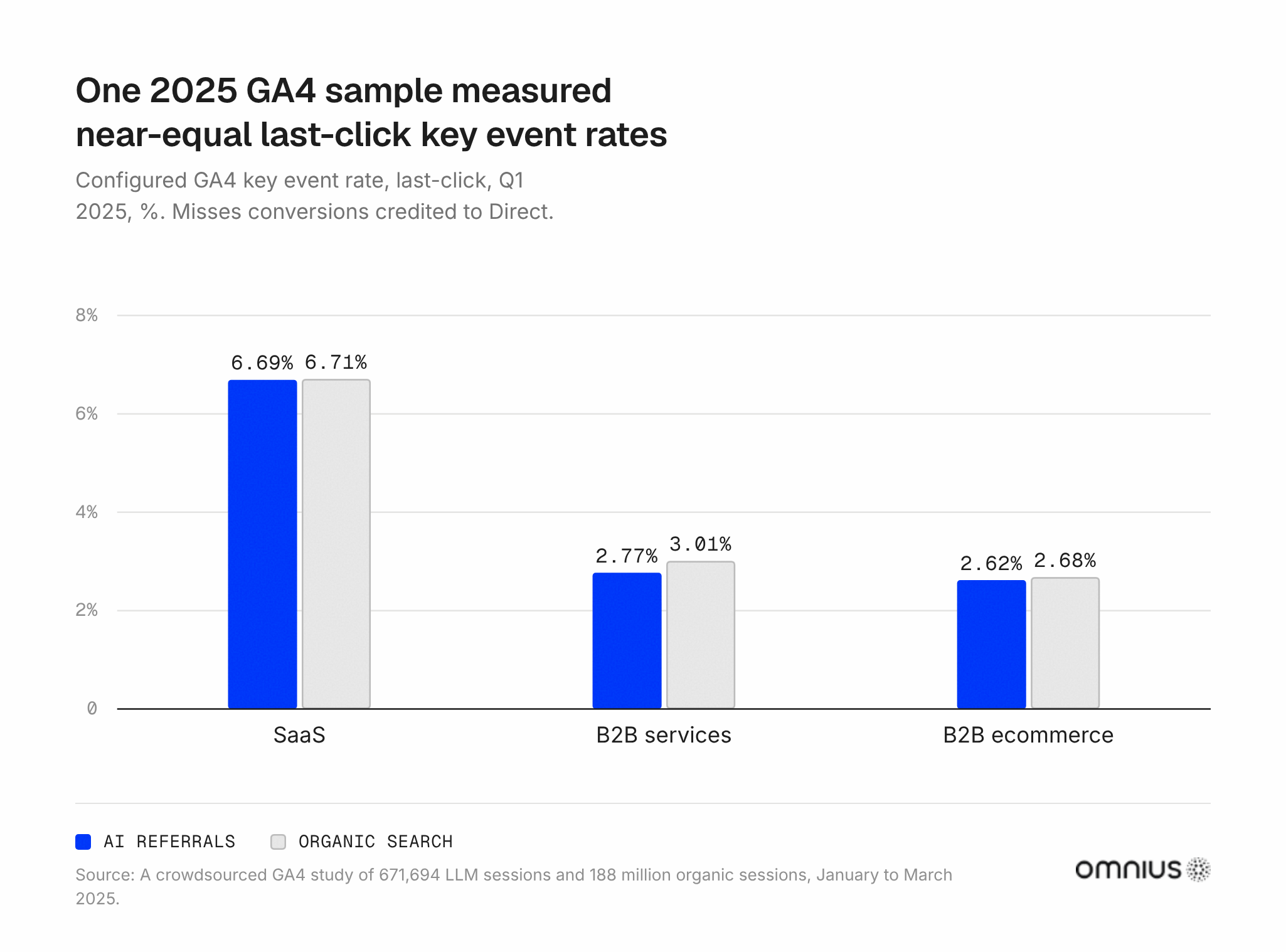
What about studies that measure parity? One SaaS sample had nearly equal key event rates, 6.69% from AI and 6.71% from organic. Those are configured GA4 key events under last-click attribution, so the AI bars miss every conversion that came back through Direct or branded search.
AI visitors stay longer in our data. In Q3 2026, AI visits averaged 3 minutes 25 seconds against 3 minutes 4 seconds for Google organic, about 11% longer, and Claude visits ran longest. Engagement varies by sample, though: SE Ranking's 2025 panel recorded longer AI visits, while Ahrefs recorded shorter ones on its own website. After the May 2026 link change, Similarweb also saw page views per ChatGPT visit rise from 3.8 to 4.7.
LLMs make all organic traffic more valuable. People who research in ChatGPT, Claude, Perplexity or Gemini reach Google, Bing or a typed URL already informed about the category and the shortlist. Part of the conversion lift that AI creates therefore shows up in organic and Direct, which is one more reason measured AI conversion understates the channel.
How much organic traffic AI Overviews take from B2B websites
In the panels we reviewed, AI referrals were too small to offset the observed organic declines. Google's own AI features keep a growing share of clicks on the results page.
- Lower CTR where AI Overviews appear. In Ahrefs' desktop data, top-result CTR was 58% lower on queries with an AI Overview, based on 300,000 keywords and December 2025 data. Its April 2025 study had measured 34.5%, and lower positions lost clicks too, from about half at position 2 to nearly 20% at position 10.
- Few clicks on cited sources. Pew Research Center tracked 68,879 searches by 900 US adults. People clicked a traditional result in 8% of visits with an AI summary and 15% without one, and a link inside the summary in 1% of visits.
- Commercial queries are exposed too. On a fixed panel of 400 US commercial keywords in banking, software and ecommerce, Semrush found AI Overview coverage rising from 45.75% to 88% between September 2025 and August 2026, and 97.08% when weighted by search volume.
- SaaS and tech recorded larger declines. SEOcrawl measured a 15.0% drop in Google organic clicks across 16,661 websites from September 2025 to August 2026, with a median 24% drop for SaaS and tech.
What the net math looks like for a SaaS website
Take a SaaS website with 10,000 monthly organic sessions in 2025. If organic sessions fell 24% and AI referrals equaled 2.24% of the remainder, AI would add about 170 sessions against 2,400 lost, roughly 7% of the decline. This is an illustration of the assumptions, because it combines separate cohorts, periods and metrics.
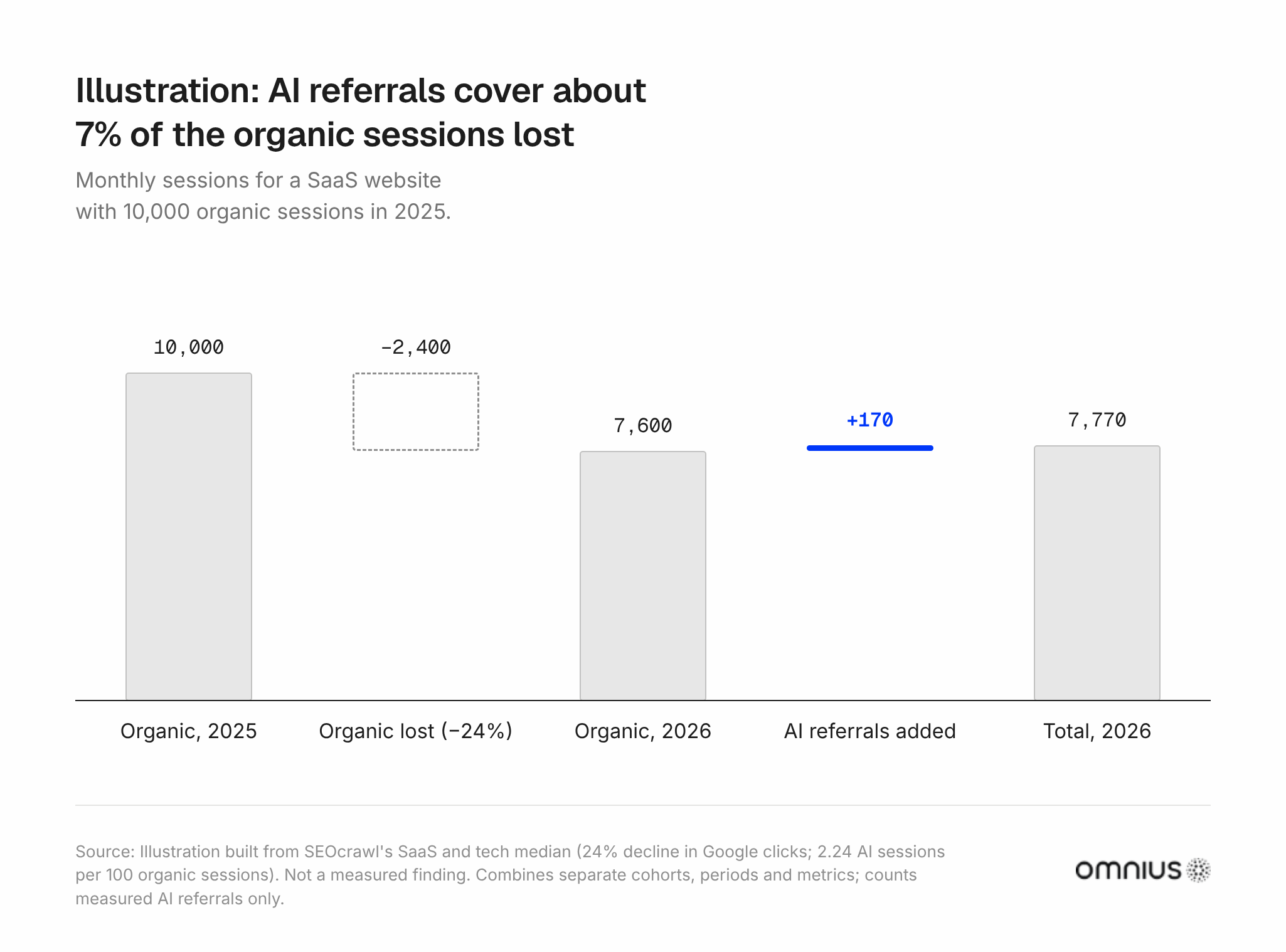
The stronger case for AI search in 2026 is presence in the answer, where B2B decision-makers form their shortlists. Clicks from AI Overviews and AI Mode also count as organic, so the AI share in this illustration is understated as well.
How to measure and grow AI referral traffic in seven steps
We measure AI referrals as one of three signals, then grow them by earning citations on commercial prompts and making the landing pages convert. Each step ties to a finding above.
- Turn on the AI Assistant channel report. In GA4, open Reports, Acquisition, Traffic acquisition, and add the AI Assistant row to the standard view. Keep a custom channel group for chatgpt.com, claude.ai, perplexity.ai, gemini.google.com and copilot.microsoft.com to cover the months before May 13, 2026.
- Set the baseline against Google organic. Divide monthly AI referral sessions by Google organic sessions. Omnius datasets put this near 2.2 per 100 in Q3 2026, and B2B companies that AI engines cite often sit several times higher.
- Report three signals together. Chart AI referrals, branded search clicks from Search Console and Direct sessions to the homepage and pricing page in one view.
- Add a self-attribution question. Put a discovery-source field on demo and contact forms, with AI assistants as one of the options.
- Build the homepage for AI-referred visitors. In Similarweb's May panel, about 60% of ChatGPT referrals landed on homepages, so the homepage should state the pricing model, who the product is for, proof and the next step.
- Track commercial prompts per engine. Monitor 20 to 50 prompts where B2B decision-makers compare vendors, such as "best [category] for [use case]" and "[competitor] alternatives", with ChatGPT, Claude, Perplexity and Gemini each as a separate line.
- Earn mentions on the third-party pages engines cite. Use the prompt tracking to find the comparison pages, review websites and publications each engine cites, get listed there and keep product facts consistent across them.
What our 2026 experiments found about B2B answers
Our own 2026 tests of how AI engines build B2B answers support steps 5 to 7. Each is a small observational study, so we read them as direction.
| Finding | What we tested | What it means for B2B pages |
|---|---|---|
| ChatGPT gave prices in 91 of 100 budget-constrained shortlist answers vs 39 of 100 without a budget | 400 tests of 300 prompts across 20 AI customer-service vendors, Oct 20-21, 2026 | Prospects who state a budget get pricing in the answer, so a closed pricing page lets other vendors' numbers fill the gap |
| Listicles made up 32% of citations in fintech shortlist answers vs 8% for problem questions, and company websites appeared in 89% of vendor-check answers | 360 answers from two engines covering 60 B2B fintechs, Oct 27-28, 2026 | Third-party comparison pages win the shortlist stage; vendor websites win the verification stage |
| Across 25 answers with hard requirements, the generic-answer leader kept first place nine times and disappeared eight times | Five SaaS categories, five engines, generic vs three-requirement prompts, Oct 11, 2026 | Rank on generic prompts says little about requirement-driven prompts, so we track both |
| After matching website and page mix, sameAs schema appeared on 46.4% of cited pages vs 47.0% of uncited pages | 482 pages, 2,915 citations, Jul 13-Oct 11, 2026 | Schema alone does not explain AI citations; content and third-party presence come first |
What we expect in 2027
AI referrals will keep growing in steps while organic clicks keep falling. Each projection below rests on a signal from this report.
- AI will pass 3% of Google organic plus AI sessions in Omnius datasets by the end of 2027. Signal: the share rose from 1.73% to 2.12% in a single quarter.
- ChatGPT will stay above 75% of B2B AI referrals, with Claude and Gemini trading second place. Signal: ChatGPT reached 86.44% in Q3, while Gemini (5.89%) and Claude (5.30%) sat close together.
- At least one platform change will move AI referrals by 50% or more within a month. Signal: two separate 52% drops in 2025 and a 157.7% one-week rise in May 2026. The cause of the November 2025 drop is still unclear.
- AI Overviews will take a larger share of top-position clicks. Signal: Ahrefs measured a 34.5% lower top-result CTR in April 2025 and 58% in its February 2026 update.
- Self-attribution and first-party AI reports will become standard in B2B reporting. Signal: GA4's AI Assistant channel, Search Console's AI impressions, Bing's Citation Share and ChatGPT's click counts all launched in 2026, and none of them sees app visits without a referrer.
- Claude will stay ahead of Perplexity as a source of B2B AI referrals. Signal: in Q3 2026, Claude sent 5.30% of AI visits in Omnius datasets against 2.19% for Perplexity.
What this means for B2B marketing teams
AI platforms send B2B websites a small, volatile and highly engaged stream of visits, and the measured share understates their reach. ChatGPT sends most of it, Claude visitors stay longest, and a single interface change can move the whole channel within a week.
LLMs also educate prospects before the first click. Visits that arrive through Google, Bing and Direct are better informed than they were, so part of the value AI creates lands in channels that never carry an AI label. The teams that do well in 2027 will report all three signals together and compete for the commercial prompts where shortlists form.
How we measure AI referral traffic at Omnius
At Omnius, we measure AI referrals as one of three signals, never as the whole channel. We're an SEO and AI search agency for SaaS, fintech and AI companies, and every report we build sets AI referrals next to branded search and Direct traffic. On our own website, 59% of high-intent companies that booked a meeting named an LLM as their discovery source, while measured AI traffic equaled about 21% of our Google traffic, so we read the referral line as a floor. Our AI referral work has four parts, channel setup, three-signal reporting, self-attribution and prompt tracking:
- Channel setup: we configure GA4's AI Assistant channel and keep a custom channel group for smaller assistants and for the months before May 13, 2026.
- Three-signal reporting: we chart AI referrals, branded search clicks and Direct sessions to the homepage and pricing page in one monthly view.
- Self-attribution: we add a discovery-source question to demo and contact forms and record each answer on the opportunity.
- Prompt tracking: we track commercial prompts on ChatGPT, Claude, Perplexity and Gemini as separate lines, along with the third-party pages each engine cites.
We track those prompts and referrals in Atomic AGI, the AI search product built inside Omnius, which follows more than 15,700 domains across Google and the major AI engines. This report's Omnius datasets come from the same tracking.
More on how we track AI search for B2B companies: AI search tracking.
Frequently asked questions
How much traffic does ChatGPT send to websites in 2026?
ChatGPT sends a small share of all website traffic but most AI referrals. Ahrefs measured ChatGPT at 0.21% of traffic across 76,000 websites in early 2026, while ChatGPT accounted for 86.44% of AI visits in Omnius datasets for Q3 2026. App visits without a referrer make both numbers a floor.
What percentage of website traffic comes from AI search?
AI referrals accounted for 0.3% to 1.1% of website traffic across 2025 and 2026 panels, with enterprise and IT samples at the top of that range. Each of those figures counts only sessions with a recognized AI referrer, so the real share of AI-driven visits is higher.
What is a good AI referral benchmark for B2B websites?
Across Omnius datasets, AI sessions equaled about 2.2% of Google organic sessions in Q3 2026. B2B companies that AI engines cite often run far higher; on omnius.so, AI traffic equaled about 21% of Google traffic. Both ratios count measured referrals only.
Which AI platform sends the most traffic to B2B websites?
ChatGPT sends the most, by a wide margin. It accounted for 86.44% of AI visits in Omnius datasets for Q3 2026. Claude and Gemini each sent around 5% to 6%, and Perplexity about 2%, after both Claude and Gemini lost share in Q3.
How much traffic does Claude send to B2B websites?
Claude sends about 5% of AI referrals to B2B websites, more than its share in broad panels. Its visitors also stay longest of any source, averaging 5 minutes 30 seconds in Q3 2026. Claude's share of all website traffic grew fastest of any assistant in early 2026.
Does Perplexity still send traffic to B2B websites?
Perplexity still sends traffic, but less each quarter. Its share of AI visits in Omnius datasets fell from 4.54% to 2.19% between Q2 and Q3 2026. One B2B panel recorded a steeper decline and flagged a possible tracking change, so the full size of the drop is still uncertain.
Do AI referral visitors convert better than organic visitors?
AI-referred visitors convert better once attribution is accounted for. Last-click reports credit many AI-influenced conversions to Direct and organic, which pulls measured AI rates down. Where tracking is cleaner, the gap shows: Adobe measured a 90% higher purchase conversion rate for AI retail visits in September 2026.
Why did ChatGPT referral traffic jump in May 2026?
ChatGPT made brand links in its answers more prominent on May 7, 2026. In Similarweb's desktop panel, ChatGPT referrals rose 157.7% in the following week, and about 60% of those visits landed on homepages.
How can AI referral traffic be tracked in GA4?
GA4 groups sessions from recognized AI assistants in the AI Assistant default channel, under Reports, Acquisition, Traffic acquisition. The channel excludes Google AI Overviews and AI Mode and misses app visits without a referrer, so we pair it with branded search and Direct traffic.
Is AI referral traffic replacing Google organic traffic?
AI referrals were too small to offset organic declines in the panels we reviewed. SaaS and tech websites recorded a median 24% drop in Google clicks, while AI added about 2 sessions per 100 organic sessions. The larger effect of AI is on the answer itself, where shortlists form.
Related Omnius research
- B2B AI Search Report, Q3 2026
- AI search attribution: what referral reports miss
- Why AI search traffic converts better than Google
- The ChatGPT referral crash of July 2025
Sources
- Adobe: AI traffic drives 83% higher revenue per visit, October 2026
- Ahrefs: AI Overviews reduce clicks by 58%, February 2026
- Ahrefs: ChatGPT has 12% of Google's search volume, February 2026
- Ahrefs: AI search traffic conversions, June 2025
- Alphabet Q2 2026 earnings remarks, July 2026
- Bing Webmaster Tools: AI visibility insights, June 2026
- BrightEdge August 2026 data via The Next Web, September 2026
- Conductor: AEO / GEO Benchmarks Report, November 2025
- Demandbase: ChatGPT referrals to B2B websites, August 2026
- Google Analytics Help: Traffic-source dimensions and the AI Assistant channel
- Google Search Central: Generative AI performance reports, June 2026
- Microsoft Clarity: AI traffic converts at 3x the rate of other channels, 2025
- Microsoft FY2026 Q1 earnings, October 2025
- Mobile World Live: Sensor Tower data on ChatGPT and Claude app users, June 2026
- Octane11: State of B2B AI Search, April 2026
- OpenAI: ChatGPT Ads expands to 26 new countries, October 2026
- OpenAI Help: Setting up your business on ChatGPT, November 2026
- Pew Research Center findings via Search Engine Roundtable, July 2025
- PPC Land: Gemini app passes 1 billion users, October 2026
- Sacra: Perplexity
- SE Ranking: AI traffic research study, June 2026
- SE Ranking: Claude impact research, June 2026
- Search Engine Journal: Google Analytics adds AI Assistant channel, May 2026
- Search Engine Roundtable: ChatGPT Business Hub click data, November 2026
- Semrush: AI Overviews on commercial keywords, October 2026
- SEOcrawl: AI traffic vs Google organic in 2026, November 2026
- seoClarity: ChatGPT inline citations and AI referral traffic, July 2026
- Similarweb: ChatGPT referral traffic triples, May 2026
- TechnologyChecker: Claude statistics with Cloudflare Radar data, Q3 2026 data