
AI spam is becoming harder to detect because generative AI can produce huge volumes of content that looks different on the surface while following the same underlying template. New Google research describes a different approach: instead of judging every piece of content independently, the system looks for shared semantic patterns, publishing behavior, and relationships between accounts to identify coordinated clusters of synthetic spam.
Generative AI has changed the economics of content production.
Creating thousands of articles, videos, scripts, or social posts no longer requires a large editorial operation. A relatively small number of automated systems can produce huge volumes of material, vary the wording, localize the output, and publish it across multiple accounts.
That creates a problem for traditional spam detection.
If every piece of spam is slightly different, comparing individual pages or uploads becomes increasingly difficult. A system can generate functionally identical content while changing enough words, sentences, images, or metadata to make each individual item look unique.
Google researchers recently described a different way of approaching this problem in a paper on the Scalable Cluster Termination System (S-CTS). The research focuses on coordinated synthetic abuse on online video platforms rather than directly describing a Google Search ranking system, but its detection architecture is highly relevant to the broader discussion around AI-generated spam.
The interesting part is that the system does not rely on identifying one universal "AI writing fingerprint."
Instead, it combines semantic similarity, content patterns, publishing behavior, account relationships, and infrastructure signals to identify groups of accounts that appear to be working together.
That shift - from detecting individual pieces of spam to detecting the network producing them - is the key idea behind the research.
Key takeaways
- Google's research describes the Scalable Cluster Termination System (S-CTS), designed to detect coordinated clusters of accounts producing synthetic spam.
- The system combines a Coordinated Bot-Net Detector with a Synthetic Pattern Classifier, rather than relying on one AI detector.
- The research discusses text embeddings, salient terms, repetitive narratives, and publishing patterns as signals for synthetic content.
- Sentence-BERT is referenced as an example of technology capable of producing semantically meaningful sentence embeddings, but the paper describes the actual S-CTS components as using Google's proprietary algorithms rather than saying that S-CTS itself is simply a Sentence-BERT detector.
- The system is designed to detect clusters of coordinated accounts, allowing enforcement against a network rather than treating every upload separately.
- In the reported evaluation, the system used a dataset of 16,250 weekly candidate channels across six synthetic-abuse categories and reported a false-positive rate below 0.05% for coordinated synthetic-spam identification.
- The LLM-driven component achieved a 74% automated triage routing rate, while the paper reports more than 1,100 operational review hours saved per week and investigation turnaround improvements of up to 50%.
- The research distinguishes creative AI use from coordinated adversarial synthetic abuse, rather than treating AI generation itself as a violation.
- Google's existing Search policies similarly focus on scaled content abuse and manipulation, rather than banning content simply because AI was used to create it.
What is AI spam?
AI spam is not simply content that was written with ChatGPT, Gemini, Claude, or another generative AI system.
That distinction is important.
A company can use AI to help research, draft, summarize, translate, or structure useful content without necessarily creating spam. Google's guidance states that the use of generative AI itself is not what makes content spam. The problem arises when large amounts of content are generated primarily to manipulate Search rankings and provide little or no value to users.
Google calls this scaled content abuse.
Its current Search documentation defines scaled content abuse as creating many pages primarily to manipulate rankings rather than help users, regardless of whether those pages were produced by automation, humans, or a combination of both. Examples include mass-generating pages with generative AI, scraping and transforming existing content, and creating large numbers of low-value pages around search queries.
So the real distinction is:
AI-assisted content ≠ AI spam
Mass-produced, low-value content created to manipulate search = spam
The new research takes that concept into a more coordinated environment, where the problem is not necessarily one bad page or one bad upload, but an entire network generating synthetic material at scale.
Why traditional spam detection struggles with AI content
The fundamental problem is variation.
An automated spammer can take one underlying idea and generate hundreds of different versions.
The headlines can change.
The sentence order can change.
The vocabulary can change.
The images can change.
The metadata can change.
Even the language or geographic context can change.
Yet the underlying content strategy can remain essentially identical.
Google's research describes this as unique, localized variations of functionally identical content. The researchers argue that traditional content-centric moderation can struggle when malicious actors intentionally create enough variation to overwhelm individual-content filters.
Imagine a network generating 100,000 pieces of content.
If the system evaluates each piece independently, it has to answer 100,000 questions:
Is this spam?
But there may be a more useful question:
Why are these 100,000 pieces being generated in the same way, at the same time, by related accounts?
That is where cluster-based detection comes in.
How Google uses semantic similarity to find patterns
One of the most interesting parts of the research is the use of text embeddings. Search Engine Journal explains how Google’s research uses Sentence-BERT, text embeddings, and semantic similarity to identify patterns in AI-generated spam.
A text embedding converts language into a numerical representation that captures semantic characteristics. Instead of comparing two texts solely by looking for identical words, an embedding system can help determine whether the texts express similar meanings or follow similar semantic patterns.
Sentence-BERT, or SBERT, is a well-known example of this approach. It was designed to create sentence embeddings that can be compared using measures such as cosine similarity.
This is where the AI-spam discussion becomes interesting.
The Google paper references text embeddings as a way to identify semantic patterns in AI-generated scripts. But it does not state that S-CTS is simply a Sentence-BERT-powered AI detector. Instead, the paper describes proprietary algorithms that analyze text embeddings alongside other signals, while the Sentence-BERT work is referenced as related research supporting the underlying semantic-similarity approach.
That distinction matters.
The research is better understood as:
semantic embeddings + content patterns + behavioral signals + account relationships
rather than:
Sentence-BERT detects AI text
This is a much broader detection strategy.
What is a text embedding fingerprint?
The idea of a "fingerprint" can be useful for explaining the concept, but it should not be interpreted as a literal watermark embedded inside every AI-generated sentence.
A semantic fingerprint is closer to a pattern of similarity.
Suppose a spam network generates thousands of articles around different products.
The wording might change from page to page, but the underlying structure could remain remarkably similar:
- short introduction
- generic product description
- repeated claims
- predictable comparison section
- similar conclusion
- same call to action
An embedding-based system can potentially recognize that these pages occupy similar regions in semantic space even when their exact wording differs.
Google's research describes looking for repetitive, templated narratives and semantic information as part of its synthetic-content classifier.
That makes semantic similarity particularly useful against AI spam because the goal is not necessarily to identify one sentence that "sounds like AI."
It is to identify repeated patterns across large quantities of content.
Google looks beyond the content itself
Semantic similarity is only one component of the system.
The research describes two primary machine-learning components:
Coordinated Bot-Net Detector and Synthetic Pattern Classifier.
The first looks at account relationships and infrastructure-level signals. The second evaluates the content itself for synthetic patterns.
The infrastructure analysis can include signals associated with:
- API usage patterns
- event timing
- publishing behavior
- account relationships
- automated activity
- shared generation infrastructure
The paper describes using these signals to identify clusters of accounts statistically likely to be controlled by the same actor or automated script.
This is an important change in perspective.
A suspicious piece of content may not be enough to trigger a strong decision.
But hundreds of accounts publishing highly similar material according to the same production pattern tell a very different story.
Publishing behavior can reveal AI spam networks
Content itself is only part of the fingerprint.
Timing can also matter.
Google's research specifically mentions upload pacing and time to first upload as signals used alongside semantic and visual features. The purpose is to identify non-human, high-frequency publishing behavior associated with automation.
This creates a broader behavioral profile.
For example, a system may observe:
None of these signals necessarily proves spam by itself.
The strength comes from combining multiple signals.
That is one of the most important ideas in the paper.
The shift from page-level detection to cluster-level detection
Traditional moderation tends to ask whether a specific piece of content violates a rule.
S-CTS introduces a broader question:
Which accounts are behaving as part of the same coordinated system?
The research describes "Generation Clusters" as groups of accounts likely to be using the same API or script. Potentially malicious clusters are identified where high-confidence account relationships overlap with synthetic-content signals.
That allows the system to work at a network level.
Instead of:
Page A → investigate
Page B → investigate
Page C → investigate
the system can potentially determine:
A, B, and C are part of the same coordinated generation cluster.
This has a major scalability advantage.
The paper specifically notes that grouping accounts can reduce computational costs compared with making decisions independently for each video.
What does "cluster termination" mean?
The name S-CTS comes from Scalable Cluster Termination System.
The key idea is that enforcement can target the coordinated cluster rather than fighting individual uploads one at a time.
When the system combines high-confidence account-relatedness signals with synthetic-content evidence, the resulting cluster can enter an enforcement workflow. The research describes automated violation and approval thresholds, with ambiguous cases routed to human review.
This is particularly useful against attackers who can create new pages or accounts faster than human moderators can remove them.
Deleting one piece of spam does little if the same automated system can immediately create 100 more.
Removing or disabling the underlying network can address the source of the activity instead.
How accurate is the system?
The research reports strong results, but they need to be understood in context.
The evaluation covered 16,250 weekly candidate channels across six synthetic-abuse verticals and reported a false-positive rate below 0.05% for identifying coordinated synthetic spam networks. The research also reports a 74% automated triage routing rate.
The operational results are also notable.
The paper reports:
- 32% reduction in average cluster-validation turnaround time
- 50% reduction in synthetic-content review turnaround time
- more than 1,100 operational review hours saved per week
- automated enforcement precision in the 92–95% range for the reported threshold configurations
- an under-1% overturn rate in the reported operational evaluation
These numbers come from Google's reported evaluation and operational results, rather than an independent audit.
That distinction is important when interpreting them.
Google is not trying to detect every use of AI
One of the strongest parts of the research is its distinction between AI-assisted creation and adversarial synthetic abuse.
An AI-generated video can be legitimate.
An AI-generated article can be legitimate.
An AI-generated image can be legitimate.
The problem arises when synthetic content becomes part of a coordinated operation designed to exploit a platform at scale.
The paper explicitly discusses the risk of over-enforcement against legitimate creators and says its approach prioritizes precision over recall. It also uses the cluster requirement as a safeguard so that individual creators experimenting with AI are less likely to be targeted solely because synthetic content is detected.
This is an important distinction for SEO and content teams.
The detection of AI-generated content is not the same thing as the detection of spam.
How Google's approach could affect SEO
The research is focused on online video platforms, so it would be incorrect to claim that S-CTS is currently being used as a Google Search ranking system for web pages.
However, the underlying ideas are highly relevant to SEO because Google already has systems designed to identify scaled content abuse and other manipulative patterns in Search. Google says its spam policies apply to attempts to manipulate both traditional Search results and generative AI responses within Search.
The interesting development is therefore not:
Google can detect AI-written articles.
It is:
Google's research shows increasingly sophisticated ways to identify coordinated patterns surrounding synthetic content.
That is a much more meaningful distinction.
A site producing useful AI-assisted content is fundamentally different from a network producing thousands of low-value pages using automated templates.
AI spam detection is likely to become multi-signal
A useful way to think about the future of AI spam detection is as a stack of signals.
- Semantic signals
Does content repeatedly express the same ideas or follow the same semantic structure? - Content signals
Does it contain templated narratives, repetitive claims, or synthetic artifacts? - Behavioral signals
How frequently is content being published? Is the timing unusually regular? - Network signals
Are multiple accounts or domains behaving as though they share the same origin? - Infrastructure signals
Do accounts appear connected through common APIs, scripts, or technical infrastructure? - Provenance signals
Can the content's origin be verified through cryptographic or watermarking systems?
Google's research explicitly combines several of these layers, and its future-work section mentions integrating C2PA credentials and digital watermarks such as SynthID as additional provenance signals.
That points toward a broader shift from simply asking:
Was this generated by AI?
to:
Where did this content come from, how was it produced, and does its surrounding behavior indicate coordinated abuse?
Why AI detection alone is not enough
There is a fundamental problem with trying to detect AI writing purely from the final text.
Generative models change.
Models can be fine-tuned.
Prompts can change.
Human editors can modify outputs.
Content can be translated.
Multiple models can be combined.
A spammer can deliberately introduce variation.
That makes a single-content detector easier to adapt around.
Google's research explicitly discusses adversarial adaptation, where attackers change their generation techniques in response to detection systems. The paper therefore emphasizes a framework that can adapt quickly to new synthetic trends rather than relying on one permanent signature.
The researchers use LoRA and Automatic Prompt Optimization (APO) to adapt the classifier to emerging synthetic trends without fully retraining the underlying model. The paper explains that this can allow faster adaptation when attackers switch to new generative models.
This creates an ongoing cycle:
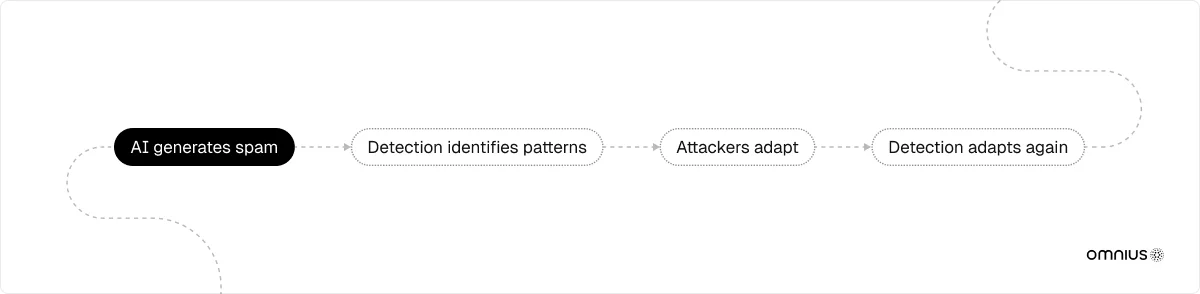
The technology therefore needs to evolve continuously.
What this means for content teams
The research has a practical implication for publishers and SEO teams: AI should be treated as a production tool, not as a content strategy by itself.
Using AI to accelerate research, organize information, generate drafts, or assist writers is very different from generating hundreds of pages whose primary purpose is capturing search demand.
Google's Search guidance emphasizes valuable, unique content and warns against generating large volumes of pages without adding value, regardless of whether AI or another production method was used.
A safer content workflow therefore looks more like:
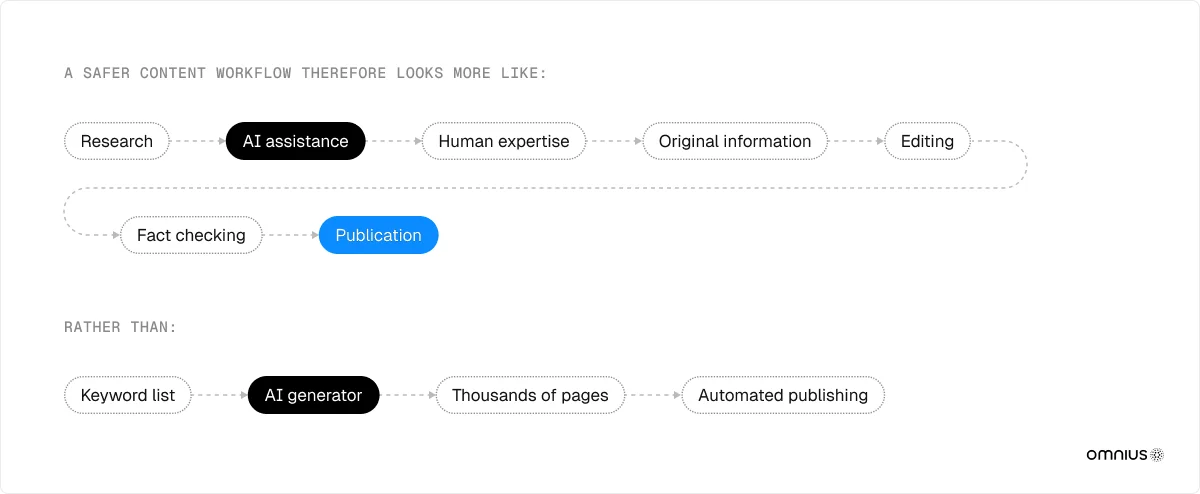
The difference is not whether AI appears somewhere in the workflow.
It is whether the resulting content provides genuine value.
What this means for GEO
The connection to Generative Engine Optimization is also important.
AI search systems increasingly need reliable sources to answer user questions. That makes content quality and source distinctiveness important not only for traditional search rankings, but also for being retrieved and cited by AI systems.
A site producing large quantities of generic content may technically increase its number of indexed pages, but that does not mean those pages will become valuable sources for AI-generated answers.
In fact, Google's current guidance for optimizing for generative AI features explicitly warns against creating separate content for every possible query or fan-out variation primarily to manipulate generative AI responses.
That makes the connection between SEO, GEO, and spam prevention increasingly clear.
The same systems that try to understand which content is useful also have to distinguish legitimate content production from large-scale manipulation.
The future of AI spam detection is about networks, not fingerprints
The biggest lesson from Google's research is that AI spam may be easier to understand when viewed as a system rather than a document.
- An individual page may look original.
- An individual video may look harmless.
- An individual account may not immediately appear suspicious.
But when thousands of pieces of content are considered together, patterns emerge.
The same narratives repeat.
Publishing schedules become unusual.
Accounts become statistically related.
Infrastructure overlaps.
Semantic similarities appear.
Synthetic content becomes disproportionately common within a cluster.
Those signals become much harder to disguise simultaneously.
That is what makes cluster-level detection so interesting.
Instead of trying to find the one sentence that proves something was generated by AI, the system can ask whether the broader behavior looks like a coordinated synthetic operation.
Conclusion
AI has made content production dramatically easier, but it has also created new opportunities for large-scale spam operations.
Google's S-CTS research shows one way the problem can be approached: combine semantic patterns with account relationships, publishing behavior, infrastructure signals, and AI-assisted classification to identify coordinated clusters of synthetic abuse.
Sentence-BERT is relevant because semantic embeddings provide a way to measure similarities between pieces of text, but the research goes well beyond a simple AI-text detector. The actual system combines multiple signals and operates at the cluster level rather than relying on a single content fingerprint.
The distinction between AI-generated content and AI-generated spam is just as important. Google does not treat the use of AI itself as a spam violation. Its Search policies focus on content created at scale to manipulate rankings or otherwise abuse Search.
For SEO and GEO, the takeaway is straightforward: using AI to create useful content is not the same as using AI to manufacture search-engine content at scale. As detection systems become more capable of recognizing coordinated patterns, genuine expertise, original information, and people-first content become increasingly important.
Omnius helps brands build SEO and GEO strategies around useful, original content while monitoring how AI search systems discover, interpret, and surface that content.
FAQ
Can Google tell whether an article was written by ChatGPT?
There is no public evidence that Google relies on a universal detector that simply labels individual webpages as "written by ChatGPT." Google has said that it uses multiple systems to identify spam and focuses on the behavior and purpose of content rather than banning AI-generated content itself.
Is AI-generated content automatically considered spam by Google?
No. Google's policy focuses on scaled content abuse: creating large amounts of content primarily to manipulate Search rankings rather than help users. The policy applies regardless of whether the content was created with AI, automation, humans, or a combination of methods.
What is the difference between an AI content detector and Google's S-CTS approach?
A conventional AI detector may focus primarily on characteristics of an individual piece of content. S-CTS is designed around a broader set of signals, combining synthetic-content classification with account relatedness, behavioral patterns, and infrastructure-level relationships to identify coordinated clusters.
Can changing AI-generated text help avoid detection?
Changing wording can make individual pieces harder to match directly, but the Google research specifically addresses adversarial variation and coordinated behavior. Semantic similarity is only one signal; publishing patterns, account relationships, and infrastructure signals can also contribute to detection.
Could provenance technology eventually replace AI detection?
Probably not entirely. Google's research describes C2PA credentials and digital watermarks such as SynthID as potential additional signals for future provenance verification, but it still describes them as complementary to broader synthetic-content and coordination detection.