Yes, content freshness influences AI search visibility. But it is not a universal ranking factor, and it is not the same thing as changing a date.
Freshness matters most when the answer itself can change: news, product releases, software features, regulations, pricing, market data, statistics and trends. It matters far less when the underlying concept is stable.
The strongest available evidence supports this. Ahrefs analysed 16.97 million cited URLs across seven AI and search platforms and found that pages cited by AI assistants were 25.7% fresher on average than pages appearing in traditional organic results.
Google, meanwhile, explicitly runs "query deserves freshness" systems designed to surface newer content when the query calls for it.
But Google is equally explicit in the other direction: changing dates, or adding and removing content primarily to make a site look fresh, is not a strategy.
The objective is not recency. It's current, accurate, substantively maintained information.
Introduction
SEOs have argued about content freshness for over a decade. The answer from Google has always been more nuanced than "newer is better."
A query like: “latest Google algorithm update” has an obvious need for recent information.
A query like: “how does compound interest work?” does not.
The concept has not changed because the page was written three years ago.
AI search adds a genuine new dimension to this. When ChatGPT, Gemini, Perplexity, Copilot or Google AI Mode generates an answer, it isn't ranking ten blue links, it is selecting a handful of sources to ground a single synthesised response. That selection step has its own logic, its own biases, and in several documented cases, its own explicit recency weighting.
There's also a structural reason freshness became more important in AI search than it ever was in classic search. Base LLMs have training cutoffs. Left alone, they return stale knowledge or hallucinate current facts. Retrieval is what closes that gap, which means every AI answer about a changing topic is, by design, a freshness problem.
So the useful question is not:
"Does AI prefer new content?"
It is:
"When does freshness make a source more useful, and how much does it actually move the needle?"
That's what this article covers.
Key takeaways
- AI assistants show a measurable preference for newer sources. AI-cited URLs were 25.7% fresher than organic results across ~17M citations.
- Freshness is query-dependent, not universal. Google activates freshness systems when the query indicates recency is useful.
- Freshness varies by platform. ChatGPT skewed newest; Google AI Overviews behaved closest to traditional Search.
- Freshness is one signal among many - and not always the strongest. A September 2026 CiteSurge study found source position separated cited from uncited pages far more sharply than recency did.
- Correlation is not causation. The major freshness studies are observational. No public controlled experiment has yet proven that updating a page causes more AI citations.
- Substantive updates ≠ cosmetic edits. New data, corrected claims, revised recommendations and replaced examples are meaningful. A new timestamp is not.
- Freshness has to propagate. An updated page still needs to be crawled, re-indexed and re-retrieved before it can influence an answer.
- Prioritise by topic volatility, not by calendar. A blanket "refresh everything quarterly" rule wastes budget on pages that haven't decayed.
What "content freshness" actually means
Freshness is not the date at the top of the article. There are at least four distinct things people mean by it, and confusing them is where most freshness strategies go wrong.
Publication freshness
When the page was originally published.
Update freshness
When the page was last meaningfully revised.
Information freshness
How current the facts, statistics, examples, recommendations and claims actually are.
Retrieval freshness
How recently a search or AI system crawled, indexed and processed the current version of the page.
These are not interchangeable.
A page published yesterday can contain outdated information. A page published in 2022 can be entirely current if it has been properly maintained.
Information retrieval research draws a second distinction that's useful here:
For marketers, information freshness is the concept that matters. For retrieval engineers, temporal relevance is the one that matters. Neither of them is "publication date."
Google already treats freshness as query-dependent
Google's ranking systems documentation describes freshness systems directly, using examples like a newly released film or a recent earthquake - cases where users are more likely to want recent material than older material.
This is the critical framing: freshness is activated by query intent, not applied as a blanket boost.
The shelf life of your content depends on the shelf life of the information inside it.
How AI systems actually use fresh content
AI search inherits Google's logic and adds mechanisms of its own. Google states that its generative features use retrieval from the Search index to improve the quality, accuracy and freshness of responses.
There are five plausible mechanisms at work:
1. Retrieval. Current pages get fetched when the system determines the query needs recent information. Without retrieval, a base model can only answer from training data - which is precisely why grounding exists.
2. Re-ranking. This is where freshness is most often implemented in practice. A common RAG approach is time-weighted re-ranking: multiply the semantic relevance score by a decay function on document age, so newer documents rise without older ones being discarded outright. Published implementations of temporal re-ranking report large drops in the average age of retrieved results - though these are engineering demos, not audits of any commercial AI search product.
3. Query fan-out. Google explains that AI Overviews and AI Mode can issue multiple related searches to gather information across subtopics and sources. A complex prompt can therefore generate subqueries that carry their own recency requirements.
4. Source selection. When multiple sources cover the same ground, the system compares them and picks the one that better reflects the current state of the topic.
5. Grounding. Citing live web sources reduces the risk of answering from outdated training data.
So a query like: “What changed in Google's latest Search update?” could pull across Google's own documentation, recent announcements, industry analysis, updated technical guidance and current examples. A page that accurately reflects the latest state of things has a much stronger chance of being selected than an otherwise excellent article last touched in 2023.
The strongest data point: 17 million AI citations
The most useful public dataset on this question comes from Ahrefs, which analysed 16.975 million cited URLs across ChatGPT, Perplexity, Gemini, Copilot, Google AI Overviews and Google organic search.
Time since last update showed the same pattern, though more weakly:
- AI citations: 909 days
- Organic results: 1,047 days
- Difference: 13.1%
That gap is real and consistent. But note what it is and isn't: it tells us what AI systems cited. It does not tell us what would have happened if those same pages had been deliberately updated. That distinction runs through the rest of this article.
Freshness varies significantly by platform
The same study found meaningful differences between systems:
ChatGPT leans newest. Google AI Overviews behaves much like traditional Google Search - unsurprising, given it's grounded in the same index and ranking systems.
Which makes a statement like "AI search always prefers fresh content" too simplistic to act on. Different systems have different retrieval architectures, source preferences and ranking layers. And even within one platform, the behaviour changes by query.
The counter-evidence: freshness is not always the strongest signal
This is where a lot of GEO advice overreaches.
A September 2026 study from CiteSurge ran 180 Claude and Grok answers across 18 prompts, analysing 7,397 listed sources and 2,515 pages. The headline finding was that source position separated cited from uncited pages far more sharply than freshness did.
They also found that a detected modification date was associated with higher citation share on Grok but not on Claude - and that having a date within the previous three months did not materially change citation rates in either system.
The study is small and limited to two systems and one industry dataset, so it shouldn't be generalised. But it's a useful corrective.
Semrush points in a similar direction from a different angle. Analysing thousands of AI citations in 2026, it found strong positive associations between citation behaviour and clarity and summarisation (+32.83%), E-E-A-T signals (+30.64%), Q&A format (+25.45%), section structure (+22.91%) and structured data elements (+21.60%).
The right reading is not freshness beats quality. It's:
Freshness strengthens an already useful source when the query needs current information. It cannot rescue a weak one.
A brand-new article still gets ignored if it's generic, inaccurate, poorly structured, unsupported or overly promotional.
How freshness gets measured (and why it's hard)
Standard IR metrics - nDCG, MRR - ignore time entirely. A stale document and a current one scoring identically on semantic similarity are indistinguishable to them.
Temporal IR research has proposed metrics to fix that. These are research constructs rather than industry standards, but they're useful for thinking about trade-offs:
The value of these metrics is that they make the trade-off explicit: adding a freshness boost usually costs you some raw semantic relevance, because highly similar but older documents get pushed down. That's not a bug; it's the design decision. Whether it's the right decision depends entirely on the query.
Newer temporal benchmarks have started separating these concerns into relevance-focused, recency-focused and hybrid query sets, which is the direction evaluation needs to move. Standard benchmarks like MS MARCO and Natural Questions barely capture time dynamics at all.
Content freshness vs content decay
A distinction worth making explicit.
Freshness asks: How current is this information?
Content decay asks: Has this page become less useful than it once was?
They overlap but aren't identical. A page can stay highly useful without changing at all.
“How to calculate compound interest” experiences almost no meaningful decay.
“Top AI SEO tools” can decay in months, because the market moves constantly.
That gives three broad categories:
The mistake is applying one refresh schedule to all three.
Don't confuse freshness with recency
Recency means something happened recently. Freshness means the information is current and useful.
A 2026 article can contain stale information. A 2023 article can be perfectly current.
Consider a page that says:
Updated September 2026
while the body still reads:
"According to our 2023 research…" and "These are the best tools for 2024…"
The date is new. The information is not.
Google explicitly warns against changing dates merely to make pages seem fresh when the content hasn't substantially changed, and against adding or removing large volumes of content primarily to create a freshness signal.
Separately, Google recommends showing accurate publication and modification dates and using datePublished and dateModified where appropriate..
The principle is simple: Update the information, not the timestamp.
There's a longer-term risk here too. If date manipulation becomes widespread - call it chronological spam - search and AI providers have every incentive to discount trivial date changes, which would penalise exactly the teams who optimised for the signal instead of the substance.
What counts as a meaningful update?
That is what creates information freshness. Everything else is cosmetic.
One caveat worth flagging: some SEO analyses claim very specific multipliers for content updates - e.g. that revising a fixed percentage of a page multiplies citation rates by a set factor. Treat those numbers with caution. They circulate widely, rarely link to a reproducible methodology, and as the next section explains, the causal claim underneath them hasn't been cleanly established.
The evidence gap nobody should skip past
We have strong observational evidence that AI systems cite fresher content on average.
We have strong documentation that Google considers freshness when freshness is relevant.
Neither of those proves:
Updating a page today will cause ChatGPT or Google AI Mode to cite it tomorrow.
That causal relationship has not been definitively established across the major AI platforms. A September 2026 registered research project by Ritik Namdev notes explicitly that "keep content fresh" is widely repeated in GEO advice, but that a controlled test isolating the effect of genuine content updates on AI citation rates was still lacking at the time of registration.
This is an important limitation, and an honest agency should say so.
The research supports freshness as a plausible and measurable factor. It does not justify promising a client that a content refresh will automatically produce more AI citations.
Freshness also depends on retrieval speed
A page can't benefit from an update until an AI system can discover and process it. Call this freshness propagation:
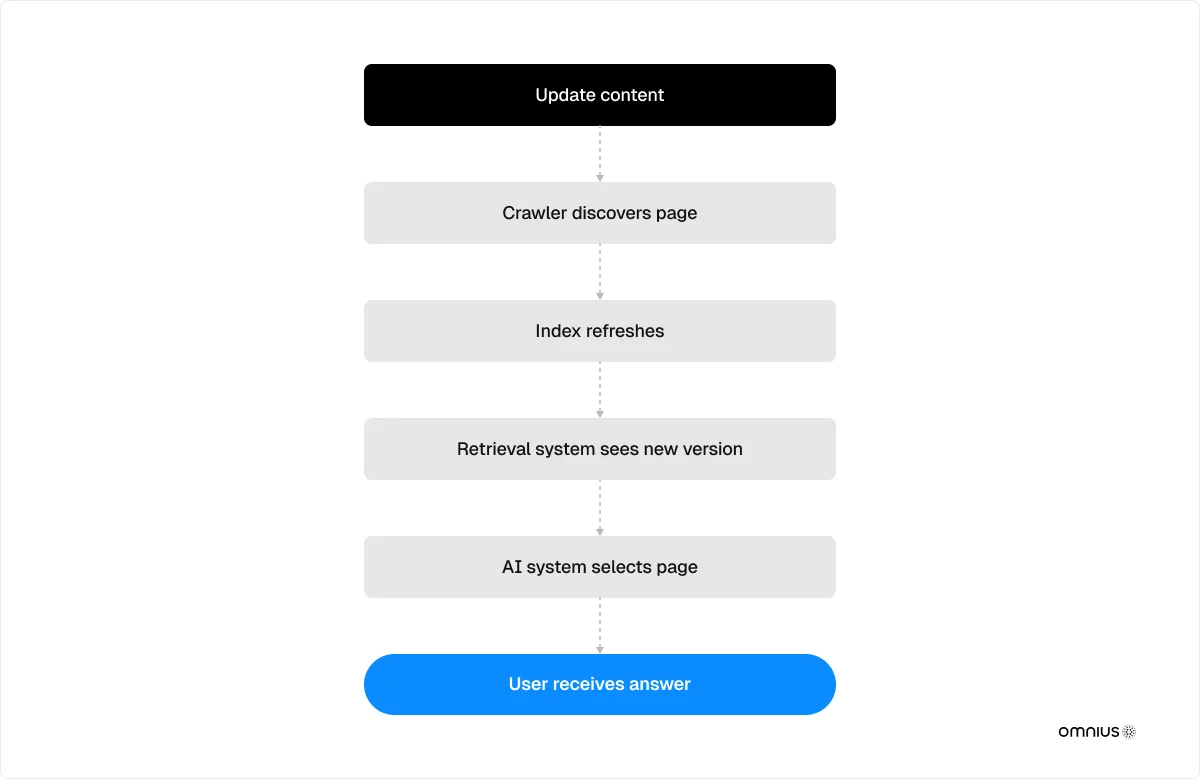
Every stage adds latency, and the latency is not uniform.
OpenAI's documentation notes that indexed content may refresh on different schedules depending on factors like crawl access, caching, popularity and site structure - and states plainly that there is no fixed refresh SLA for a given URL in its offline web-search system.
So a genuinely updated article does not instantly become a "fresh" source in AI search. Technical discoverability still gates everything, which is the clearest illustration of why GEO cannot exist without SEO. If Google and Bing can't crawl, parse and index the new version quickly, no amount of content quality will surface it inside an AI answer.
Freshness and authority work together, not against each other
Suppose an AI system needs information about Google's latest Search update.
A brand-new page from an unknown site may be fresh but carry limited authority. An established Google documentation page may be older than a news article and still be the most authoritative source available.
The ideal source combines:
authority + accuracy + relevance + freshness
This matters most for YMYL, technical and regulated topics. A financial article shouldn't be updated because it's six months old. It should be reviewed because:
- regulation changed
- rates changed
- thresholds changed
- market conditions changed
- new official guidance appeared
Freshness should follow material change, not an arbitrary calendar.
There's an accuracy dimension here too. A recency-heavy system can surface information before it's been properly vetted. The trade-off between up-to-the-minute and well-established is unresolved - which is another argument for pairing your updates with strong primary sources rather than the newest thing you can find.
What should SEO and GEO teams actually refresh?
Score your content by volatility, not by age.
This avoids the most common and most expensive mistake: spending equal resources across every URL.
The goal is not update everything every three months. The goal is update the content where the information changes.
A practical content freshness workflow
1. Identify volatile pages
Start with pages containing dates, statistics, product lists, pricing, regulations, rankings, market forecasts or annual trends.
2. Compare the page against reality
- Are the statistics current?
- Are the recommendations still valid?
- Are the cited sources still live?
- Has the market changed?
- Have competitors or products changed?
- Has search intent shifted?
3. Make substantive updates
Not just Updated September 2026. Add actual value.
4. Preserve useful authority
Don't rewrite a strong evergreen article from scratch to make it look newer. Keep the sections and evidence that remain accurate. Accumulated authority is an asset, not a liability.
5. Structure for extraction
While rewriting, tighten headings and keep answers direct and modular. This isn't strictly a freshness tactic, but it's what makes a page easy for an AI system to quote - and easy for you to update next time. Semrush's data on Q&A format and section structure is the supporting evidence here.
6. Update dates accurately and trigger recrawl
Where a meaningful revision was made, keep visible dates accurate and consistent with your structured data. Then ping the index so propagation doesn't stall.
7. Reassess AI visibility
Monitor whether the page is being cited, mentioned, recommended, replaced by newer sources, or surfaced for different prompts. That feedback loop is the whole point.
How often should you update?
There is no universal schedule. Base cadence on topic volatility.
A calendar helps with discipline. But the trigger should always be information decay, not the date.
Open questions worth watching
Anyone selling certainty here is overselling. Several things remain genuinely unresolved:
- Freshness vs. verification. Recency-weighted retrieval can surface claims before they've been checked. How systems balance timeliness against established truth is active research.
- Intent detection. Reliably classifying whether a query wants current or evergreen information is still an open NLP problem - and it's the thing that determines whether freshness helps or hurts.
- Evaluation gaps. Mainstream IR benchmarks barely model time. Newer temporal benchmarks help, but adoption is limited and user-satisfaction studies are thin.
- Model-level temporal awareness. Will future models become temporally aware natively, or will recency stay an explicit retrieval-layer concern?
- Abuse and response. If date manipulation scales, providers will likely discount it. Build for the version of the system that has already adapted.
- AI answers are unstable. Ahrefs found that in a separate study of over 43,000 keywords, the content of an AI Overview changed from one observation to the next about 70% of the time - though the underlying entities and semantic message were considerably more stable. Visibility achieved once is not visibility held.
What this means for an SEO + GEO programme
Content freshness belongs in the content lifecycle, not in a one-off optimisation sprint:
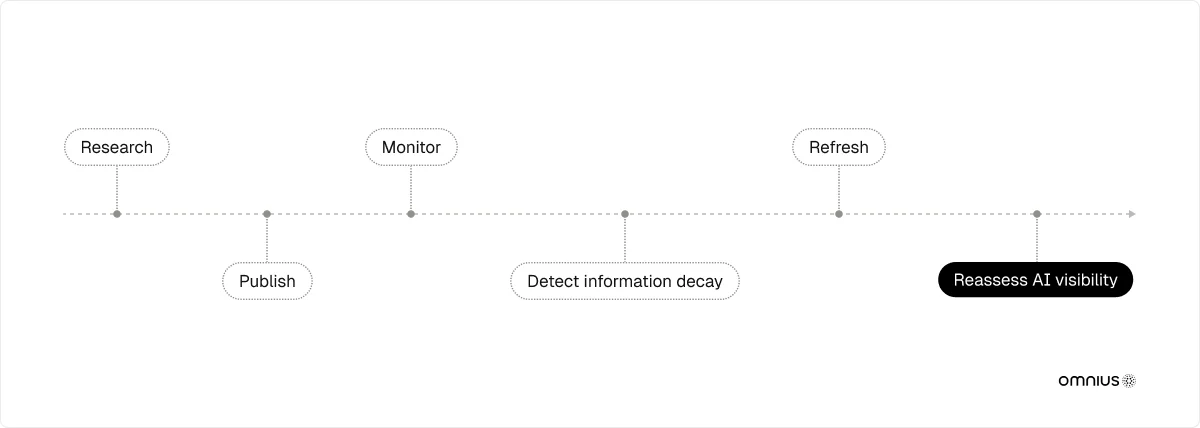
The SEO side monitors rankings, traffic, CTR, search demand and SERP changes. The GEO side monitors AI citations, mentions, competitor visibility, prompt coverage and source changes.
Read together, those signals tell you which pages actually need attention - instead of guessing from publication dates.
This matters most for clients in fast-moving sectors. In fintech, a page covering UK fintech regulations decays quickly; a page covering what is a payment gateway can hold for years. Same site, same author, completely different maintenance profile. The same split applies across SaaS, AI, cybersecurity, ecommerce, legal, healthcare and finance.
Tooling helps close the loop. Platforms like AtomicAGI sit inside this workflow by tracking AI visibility and showing where brands and competitors appear across generative search - which is how you tell whether a refresh actually changed anything.
The objective is never to update for the sake of updating. It's to keep the information available to search engines and AI systems accurate, useful and competitive.
Conclusion
So, does content freshness influence AI search?
Yes. But not in the simplistic way "newer content always wins."
AI assistants do cite newer content on average: 25.7% fresher than organic results across nearly 17 million citations. Google explicitly uses freshness systems for queries where users need current information, and says its generative features rely on Search retrieval to improve answer freshness.
But freshness is one input among many. Relevance, authority, clarity, evidence and structure all still matter, platforms behave differently from one another, and the most recent research suggests freshness can be weaker than factors like source position or overall relevance.
The takeaway for SEO and GEO teams is short:
Don't update content because the date looks old. Update it because the information is old.
Refresh the statistics. Replace outdated examples. Recheck the recommendations. Add new research. Correct inaccurate claims. Remove what's obsolete. Then make sure search engines and AI systems can actually discover the change.
Freshness is not a content strategy on its own.
It's the maintenance layer that keeps good content useful as the world changes.
Search is redistributing, not disappearing - book a free consultation with Omnius and let's build a freshness strategy that actually earns AI citations, not just new timestamps.
FAQs
Does freshness matter more for some topics?
Yes. It matters most where the answer changes over time - news, regulations, pricing, software features, market data, current trends. Stable educational topics need far less frequent review.
Can evergreen content still perform well in AI search?
Absolutely. Evergreen content stays valuable for years when it's authoritative, accurate and comprehensive. Match refresh effort to how quickly the subject actually changes.
How quickly does an update show up in AI answers?
There's no guaranteed timeline. OpenAI notes that indexed content refreshes on varying schedules depending on crawl access, caching, popularity and site structure, with no fixed refresh SLA per URL.
Does publishing more new content keep a site "fresh"?
Not automatically. Google says adding large amounts of content or removing old content primarily to make a site appear fresh will not improve search performance.
Is there proof that refreshing a page increases AI citations?
Not yet, publicly. The major studies are observational. A September 2026 registered research project notes that a controlled test isolating the effect of genuine content updates on AI citation rates was still lacking.
Should SEO and GEO teams have a content refresh strategy?
Yes, one that combines SEO signals (rankings, traffic, demand) with GEO signals (AI citations, mentions, competitor visibility) to find where information has actually gone stale, and prioritises by topic volatility rather than by publication date.