.png)

_%20Must-Know%20Facts%20for%20B2B%20SaaS%20Growth%20Leaders.webp)
Generative engine optimization (GEO) is a set of strategies that help your brand get cited by generative AI engines that cite multiple sources, such as Perplexity and Google AI Overviews.
B2B buyers increasingly use AI to research, form opinions, and make decisions. Earning a citation helps build trust and drive highly qualified traffic to your website. AI search traffic converts at 12–16%, compared to 2.8% for Google organic (Superprompt, 2025).
These visitors have done the research and arrive ready to make a decision. At Omnius, applying GEO to our own site produced 36 SQLs from AI-referred traffic in six months - a 414% increase over the prior period.
This guide breaks down what generative engine optimization is, why it's becoming a non-negotiable investment for B2B SaaS growth, and how to consistently earn your spot in AI's citations.
Author’s note: GEO is sometimes used as an umbrella term for all activities that improve AI visibility. However, some experts consider it a specific discipline, differentiating it from answer engine optimization (AEO). AEO helps you land in AI’s answers, while GEO helps you end up among generative AI’s linked sources. Omnius adopts the second perspective in this article.
Key Takeaways
- AI search traffic converts at roughly 5x the rate of Google organic. Only 12% of AI-cited URLs overlap with Google's top 10, meaning strong SEO alone doesn't guarantee visibility in the AI results where your buyers are forming shortlists.
- Engines retrieve many sources but cite only a few. Selection depends on factors like content freshness, topical authority, domain credibility, content structure, and informational gain - with each engine weighting these differently.
- Make sure AI engines can access and extract from your content. Confirm AI crawler access in robots.txt and Cloudflare settings. Additionally, implement schema markup (FAQ, Product, HowTo), and structure content so individual claims are easily extractable.
- Make your content impossible to skip during citation selection. Publish original data, name your sources, answer real buyer questions, and build off-site authority through mentions on Reddit, LinkedIn, and G2.
- Measure GEO performance every month. Track citation rate, position, share of voice, and platform coverage monthly. Run a consistent set of buyer-aligned prompts across multiple engines with repeated sampling.
Why You Should Care About GEO
GEO matters for B2B SaaS because it impacts how buyers perceive and engage with your brand. Consistently getting cited with a link indicates that AI considers your brand a trusted source of information, and improves organic visibility and traffic.
This is not to say that SEO doesn’t matter. AI still relies on traditional search. Their technical foundations are the same. However, the sources these two types of engines use don’t necessarily overlap. Ahrefs found that only 12% of URLs cited by ChatGPT, Perplexity, and Copilot rank in Google's top 10 in 2025.
Cited Brands Get More Clicks and Conversions
CTR for the #1 organic position drops from 27% to 11% when Google AI Overviews (AIOs) are present (Sistrix, 2026). The biggest impact may be on comparison queries, for which AIOs can appear as often as 95% of the time (Seer Interactive, 2026).
Brands cited in AI Overviews earn 35% higher organic CTR and 91% higher paid CTR (Seer Interactive, 2025). When an AI Overview appears on Google, pages cited inside it get a ~2.1% CTR, while pages on the same results page that are not cited get ~0.9% CTR (Seer Interactive, 2026).
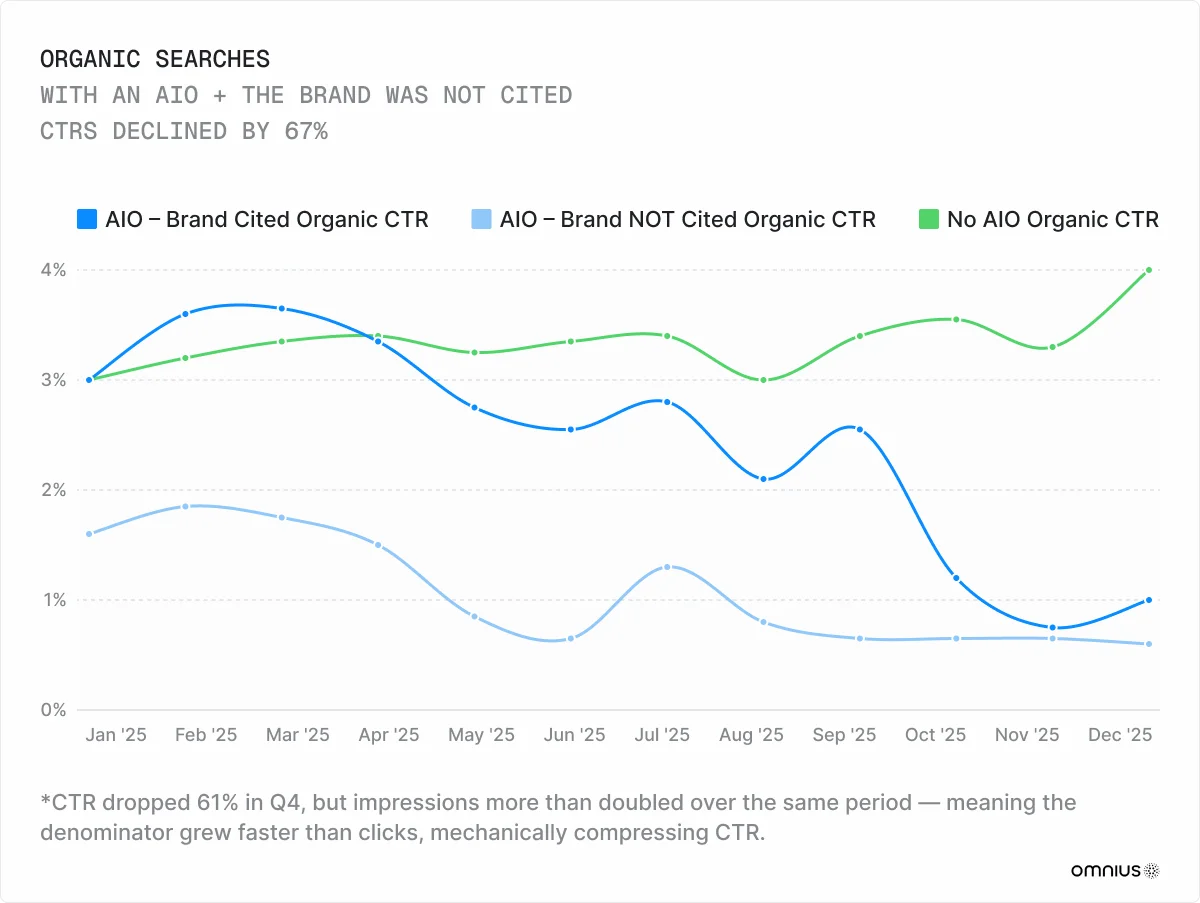
The effect is even more pronounced on Perplexity, where users click through to cited sources 6.2x more often than users on any other AI platform (Stackmatix, 2026). And the overall AI traffic that comes through converts at roughly 5x the rate of Google organic traffic (Superprompt, 2025).
"Conversion rates are higher from ChatGPT because the LLM does a far better job of understanding the user's query and matching them to exactly what they needed than a traditional search result, which was limited to string matching and likely had over-SEO'ed garbage in the results."
- Eli Schwartz, SEO advisor and author of Product-Led SEO
The overall percentage of users who click cited links remains small, but these are high-intent visitors who have already evaluated the AI's summary and chosen to go deeper.
Mid-funnel comparison queries (“best CRM for mid-market”, “X vs. Y”) are where buyers form shortlists. These are exactly the queries where multi-source generative results appear. Being absent from the citation list means being absent from the shortlist.
What Generative Engines Look For
When a user enters a specialized prompt into GenAI, such as “best tool for XYZ”, the model will usually look to external sources to find information. We call this process retrieval-augmented generation (RAG). Once it retrieves sources, the model then ranks them, selects information, and generates the answer.
Complex queries usually involve query fan-out, a process in which the engine breaks a single prompt into multiple sub-queries and retrieves sources across all of them.
Only the most relevant sources are retrieved, and even fewer survive the selection step to appear among citations. Perplexity, for example, retrieves around 10 pages per prompt, but cites only 3–4 (Strauss et al., 2025). Selection criteria usually include:
- Content freshness: Around 50% of Perplexity citations come from the current year. AIOs exhibit the strongest recency bias of any platform: 85% of its citations were published in the last two years (Seer Interactive, 2025).
- Topical coverage: Niche authority matters more than general popularity for citations. AI recognizes your brand when you consistently publish extensive deep dives on specialized topics.
- Semantic compatibility: AI favors content that meaningfully responds to queries that actual buyers search. While AI doesn’t value keyword stuffing, the content should still use relevant language.
- Content structure: A clear heading hierarchy, frontloaded value, Q&A formats, and self-contained paragraphs make it easier for AI to scan and cite your content.
- Brand authority: AI is more likely to cite your brand if it’s mentioned across sites it trusts, such as expert community forums and well-known publications. Offering information gain allows you to achieve that.
- Informational gain: Content featuring original statistics sees 30–40% higher visibility in AI responses (Averi.ai, April 2026). Data-rich websites earn 4.31x more citation occurrences per URL than directory listings (Yext, Q4 2025).
Engines Approach Citations Differently
Building your visibility based on the above criteria will produce results across any engine. Still, LLMs differ in citation frequency and choice.
For example, Google AI Overviews lead in citation frequency, providing more than 3 sources in 88% of summaries (Pew Research, 2025). Perplexity cites sources in 12.28% of responses; ChatGPT in 10.36% (Omnius, Q1 2026).
As for citation selection, we found that ChatGPT strongly favors structured lists, while Gemini prioritizes clear, concise definitions.
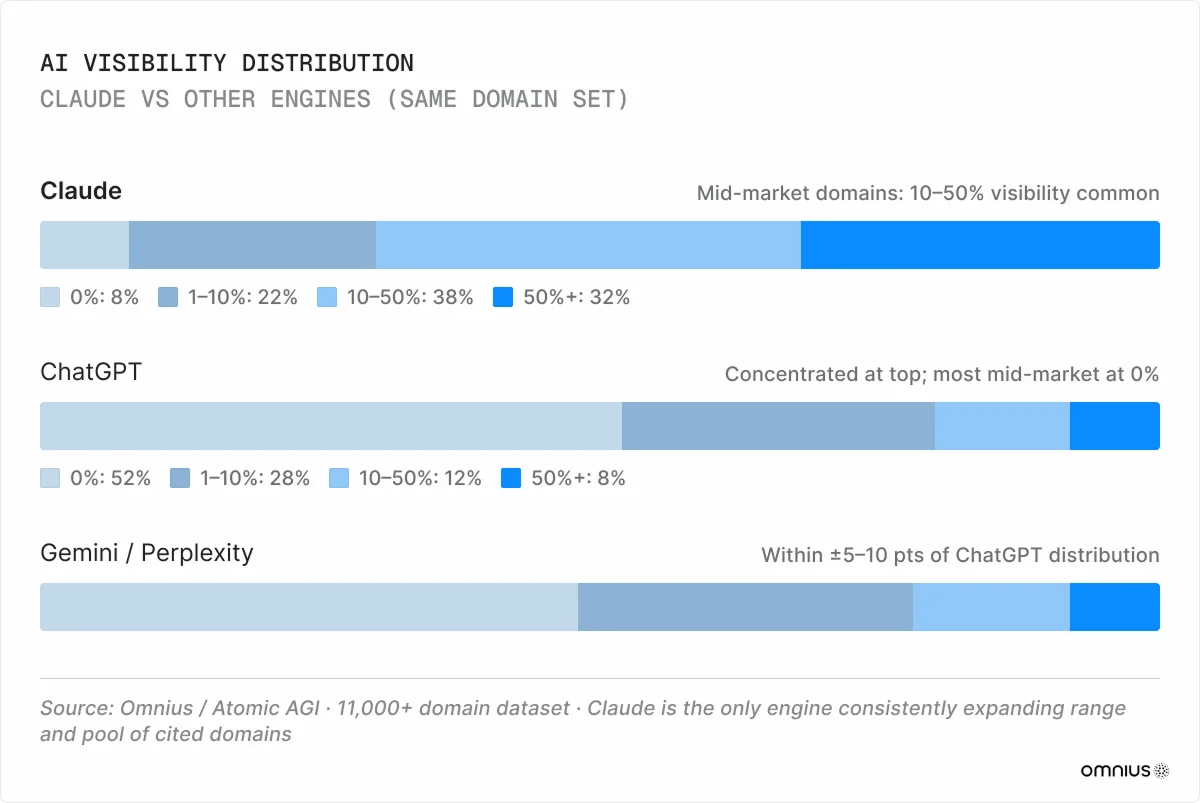
Claude has the most stringent criteria of all engines, requiring content to pass five sequential gates before deeming it citation-worthy. It also gives more visibility to mid-market domains with technical expertise than to longstanding domains with lower-quality content (Omnius data based on 11,000 domains, 2026).
Generative Engine Optimization Strategies for B2B SaaS
Getting cited requires continuous monitoring, trial-and-error, and work across multiple layers, including the technical infrastructure, content, and off-site brand signals. We’ve summed it all up into 8 generative optimization best practices:
Step Zero: Ensure AI Crawler Access
AI crawlers need to be able to access your website to retrieve the content and potentially select it for citation. If you skip this step, none of your other generative engine optimization strategies will matter. In our Q1 2026 AI search report, we found that 48.60% of landing pages received zero AI traffic.
Many pages are blocked unintentionally, and the problem often goes undetected until losses accumulate.
Here’s what to do:
- Check your robots.txt and Cloudflare settings.
- Make sure there are no configurations or wildcard rules blocking bots.
- Allow both training and retrieval bots on your key pages.
- Apply the technical SEO fundamentals: HTTPS, clean crawl paths, and no broken links or redirect loops.
When this matters most: Always
Implement Schema Markup
Schema helps engines understand and extract your content precisely. By adding schema, you make it easy for an engine to pull a specific claim from your page, attribute it to you, and include it as one of several cited sources.
AirOps’ 2026 report found that pages with 3+ schema types have a 13% higher likelihood of being cited.
The FAQ schema, which helps engines map answers to queries directly, has the greatest impact on citation likelihood. It appears in 10.5% of ChatGPT’s cited pages (AirOps, 2026). For SaaS, Product schemas are also essential because they provide structured data, such as pricing and features, to answer comparison queries.
Here’s what to do:
- Implement FAQ, Product/Service, HowTo, Article, and Organization schemas.
- Test with Google's Rich Results Test. If Google reads it, AI engines can extract from it.
- Follow its suggestions for improvement. Address errors and missing fields.
When this matters most: When your pages haven’t been picked up by AI yet
Structure Content for Citation
When an AI engine forms its answer based on multiple sources, it then needs to decide which pages to attribute specific claims to. You need to structure your content so that individual claims are easily extractable as citation units - short, self-contained, and clearly labeled.
Elements like tables and lists make your content easier to extract:
Answer Your Buyers’ Questions
Formatting headings as questions and the text below as direct answers means the model doesn’t have to extract meaning from surrounding content. The answer is clear and easily attributed to your content.
In 2026, visibility doesn’t come from keyword stuffing. It’s built by answering real buyer questions, and doing so in a way AI engines can parse and attribute.
Here’s what else to do:
- Add TL;DR summary blocks at the ends of sections.
- Keep paragraphs short, ideally under 3 lines.
- Include explicit niche qualifiers, such as SaaS and B2B.
- Provide clear “best for” statements.
- Avoid fluff and vague language. Be as specific as possible.
- Audit competitor pages cited for your target prompts, and analyze what they have in common.
When this matters most: When your content ranks well in traditional search and covers the right topics, but AI engines consistently cite competitors for the same queries
Embed Statistics, Data, and Expert Attribution
AI engines preferentially cite content with verifiable data, named expertise, and information they can’t find elsewhere. Data-rich websites earn 4.31x more citation occurrences per URL than directory listings (Yext, 2025).
Here’s what to do:
- Publish proprietary benchmarks, customer metrics, usage data, and conversion rates.
- Cite sources explicitly within your content.
- Include quotes and attribute them to the appropriate expert.
When this matters most: When your content covers the same ground as competitors but doesn't get selected
Keep Content Fresh and Accurate
Publishing and updating content regularly raises your chance of being cited. An engine choosing between two pages covering the same topic will cite the one with more current data, because citing outdated information poses a reputational risk to the engine. Pages that don’t get updated quarterly are 3x more likely to lose citations (LLM Pulse, 2026).
Here’s what to do:
- Update your content at least every quarter.
- Prioritize pricing, features, integration info, and comparisons when updating.
- Don’t forget to update the statistics within your content as well.
- Include the “last updated” metadata. Change it only after updating the content.
When this matters most: When you've been cited before but notice citation frequency dropping over time, or when competitors with newer content are replacing you in responses for queries you used to own
Build Authority Through Third-Party Mentions
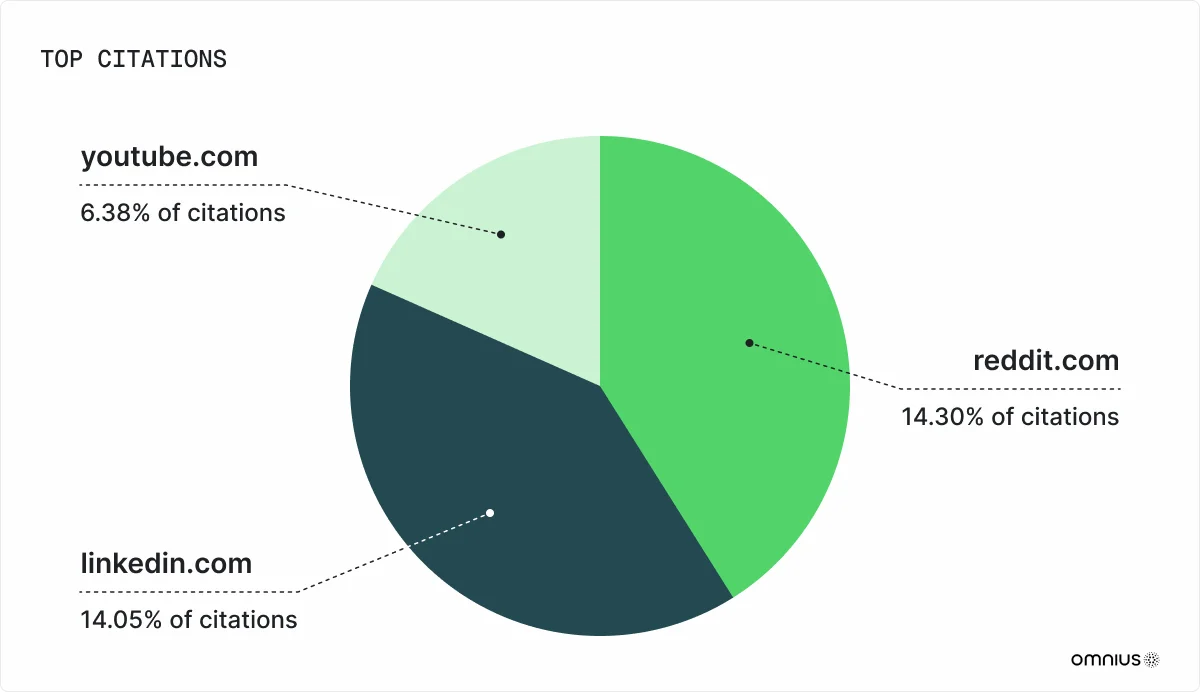
How your brand appears outside of your website matters immensely for generative engine optimization. Our Q1 2026 data reveals that Reddit, LinkedIn, and YouTube are the leading AI citation sources. Competing with these giants is impossible. But you can build expertise so you naturally get mentioned there.
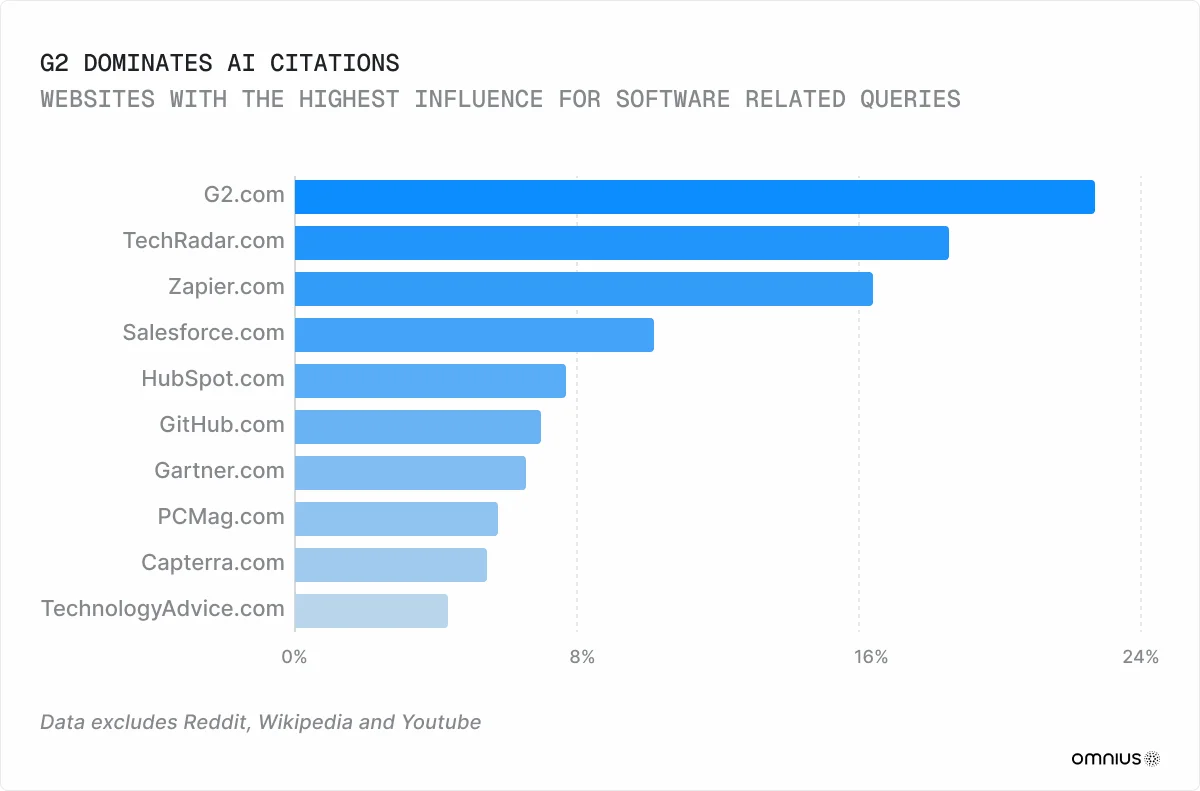
Review sites are also valuable AI citation sources in the B2B SaaS sphere. Radix’s 2025 analysis on software-relevant queries showed that 1 in 5 product discovery queries cite G2, followed by TechRadar.
Here’s what to do:
- Participate in relevant Reddit threads with genuine expertise.
- Post on LinkedIn and YouTube with substantive, data-backed insights.
- Maintain and actively manage your G2, Capterra, and Trustpilot profiles.
- Earn mentions in industry publications with original research and claims.
When this matters most: When your on-site content is strong, but AI engines still prefer competitor domains
Expand Topic Coverage Through Content Clusters
Engines don't cite single pages in isolation. They evaluate whether a domain demonstrates broad authority across a topic. This maps directly to the query fan-out behavior. Buyers usually research using sequences of questions, and engines look for sources that can support answers across those sequences.
Here’s what to do:
- Consistently publish well-researched, extensive articles in your niche.
- Cover categories from multiple angles - comparisons, use cases, implementation guides, pricing breakdowns, and industry-specific variants.
When this matters most: When you're cited for a narrow set of queries, but absent from related ones your buyers also ask
Monitor AI Citations Across Generative Engines
Track metrics like citation rate and position to identify gaps, prioritize and implement GEO strategies, and evaluate progress. Since AI search results produce different citations each time, you need repeated sampling for relevant queries over specific periods.
Here’s what to do:
- Build a set of 20–30 prompts that mirror your buyers' actual queries.
- Make sure to include BOFU and comparison prompts.
- Run each prompt across multiple platforms, especially Perplexity, Google (AIO), and ChatGPT with web search.
- Document whether you’re cited with a link, without a link, or not cited at all.
- Document when and which of your competitors get a citation.
- Note the recurring phrasing patterns.
- Repeat this at least 3 times because the results vary each time.
- Set up custom channels for AI-referred tracking in Google Analytics 4.
- Repeat monthly or quarterly to monitor progress.
Once you have your first set of data, evaluate it based on the following metrics:
When this matters most: Always - but especially before investing in any of the strategies. Without baseline citation data, you're optimizing blind.
Pro tip: Use a tool like AtomicAGI to automate your tracking process and save time. Atomic lets you view all your key AI search visibility data in one place, including engines that cite you, AI-referred clicks and conversions, and citation share. As a result, you spend less time collecting data and more time improving it.
GEO Is a Lot of Moving Parts. We Can Help.
Generative engine optimization is no longer optional for B2B SaaS brands competing for mid-funnel visibility. Buyers are forming shortlists using AI-generated summaries, and the brands that get cited are the ones that remain under consideration.
But executing on GEO is harder than understanding it. You're optimizing for engines that don't publish explicit ranking factors, return different citations on every run, and weigh signals differently. GEO requires continuous tracking across multiple engines. There's no Search Console equivalent handing you the data.
Omnius solves this problem. We help B2B SaaS, fintech, and AI brands audit their AI search visibility, identify citation gaps across engines, and build the content and authority strategies that close them. Schedule a consultation with our experts today.
Frequently Asked Questions
What’s the difference between GEO and SEO?
SEO optimizes your content to rank in traditional search engine results, while GEO optimizes it to get cited inside AI-generated responses that pull from multiple sources. The two share a technical foundation - crawlability, site speed, structured data - but diverge in what "winning" looks like.
Only 12% of URLs cited by AI engines also rank in Google's top 10 (Ahrefs, 2025), so strong SEO alone doesn't guarantee AI visibility.
Will GEO replace SEO?
No. AI engines still depend on traditional search infrastructure to retrieve and evaluate sources, so SEO remains the foundation. GEO and SEO work best as complementary strategies. SEO gets your pages indexed and ranked, GEO gets them cited in the AI layer that increasingly dominates search.
What is a generative engine optimization audit?
A GEO audit evaluates how well AI engines can discover, understand, and cite your content. Activities may include examining crawler access, schema markup, and content structure, and analyzing metrics such as citation rate, position, and share of voice across engines and prompts.
The output is a prioritized view of where you're being cited, where you're not, and what to fix first.


.png)

.svg)
















.svg)



























.svg)

%20for%20B2B%20SaaS%20%5BFull%20Guide%5D.webp)
.webp)