Services
Company
Industries
Knowledge
Projects

UK


An AI coding tool needed its pages in front of developers at the point where they compare coding tools. Before the work, AI-referred visits already reached a few of its comparison guides. The opportunity was to extend that presence across the tools developers compare, the programming languages they work in, and readers beyond English.
We organized the work around that moment of choice, with comparison guides at the center and an AI search strategy, technical work, and links around them.
Over 12 months, comparison guides took a larger share of the company's AI-referred content visits, and conversions from AI assistants grew faster than conversions overall.
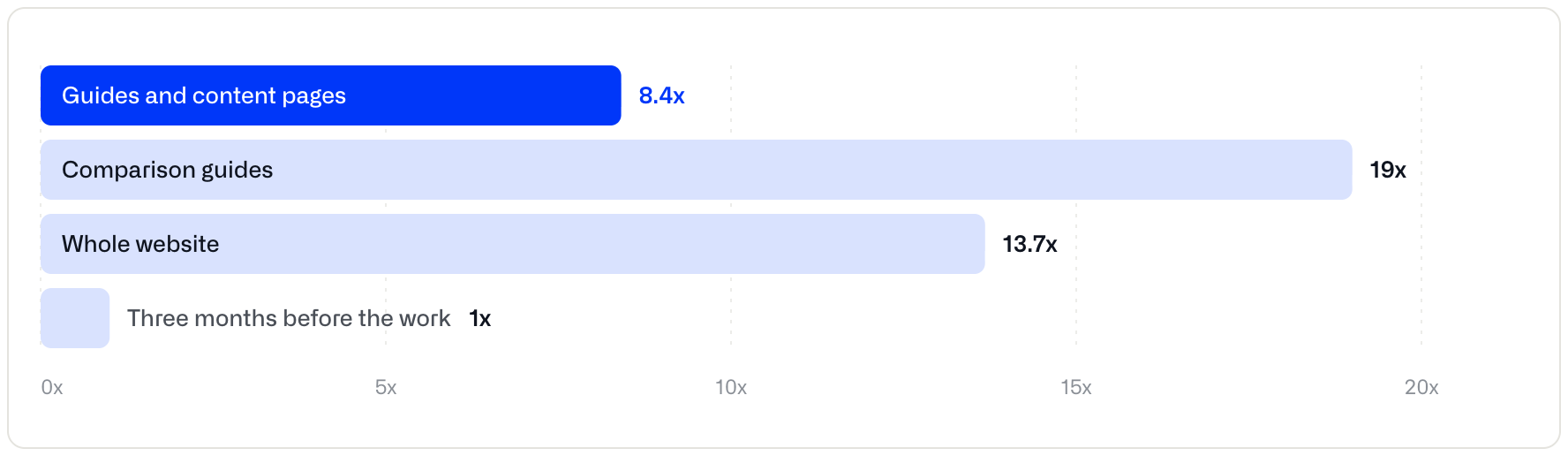
Over 12 months, AI-referred visits to the company's guides and content pages grew 8.4x, comparing November 2024 to January 2025 with the same months a year later.
The client is an AI coding company whose agents help engineering teams write and review code. Developers adopt it through self-serve sign-up, and larger engineering organizations buy its enterprise tier. This case study is published without the company's name, so every result is shown as a multiple or a share of its own first-party data.
Industry: Developer tools / AI coding agents and assistants
Location: California, USA
Stage: Growth
Customers: Software teams, from individual developers to enterprise engineering organizations
Users: Developers, team leads, and engineering managers
Scale: Self-serve adoption by individual developers, with an enterprise tier for larger teams
The company needed to reach developers at the moment they decide which coding tool to try. In the three months before the work, comparison guides drew 18% of its AI-referred content visits. No page written for one programming language or in another language drew any.
Developers evaluate coding tools in three kinds of research: alternatives to the tool they use now, direct comparisons of two tools, and the best option for the language they work in. Product names and model providers in AI coding change within months, as our methodology notes, so last quarter's comparison can already read as dated.
That meant the job was to get the company's own guides among the pages AI assistants and Google surface for those questions, and to keep them accurate as the tools change.
The company's market is developers comparing AI coding tools before a trial, in English and in five other languages. Our methodology gave the plan its order, from Foundations to measurement, learning, and adjustment.
SEO and AI search ran as one practice with one team, because developers who read a comparison in Google also ask ChatGPT and Perplexity which tool to install.
A keyword tool sorts an AI coding market by volume, so a plan built from it opens with broad questions about what AI coding is. We start with the business model, and keyword tools come later.
Foundations works in three steps:
For an AI product, the knowledge base also separates what the product does from the category language around it.
For the company, Foundations covered market research, competitor analysis, a detailed SEO audit, and keyword research with clusters, building on our earlier mapping of the website. The searches closest to a trial were evaluation searches: alternatives to familiar tools, head-to-head comparisons, and the best AI for a given programming language.
A visibility score built from a handful of tracked prompts samples answers that shift with the engine, the model, and the week.
We plan on our Search Ontology, the model of each company's search market that our data processing technology keeps current, in three steps:
Search and AI answers are non-deterministic, so a plan holds up when it rests on many signals weighed by probability.
For the company, the model held keyword clusters for each kind of evaluation search: alternatives, head-to-head matchups, and the best tool for a programming language.
One "alternatives" post that tries to answer every rival and every language leaves most developers reading a page written for someone else.
Our information architecture work has three steps:
A guide written for one language gives a developer a more useful comparison than a general roundup, and in our own testing, a hard requirement such as a programming language changes which tools an AI answer recommends.
For the company, our writers and editors researched, wrote, and refreshed comparison guides, including the best AI for each major programming language. We proposed and researched landing pages for individual programming languages, and reviewed the new ones with conversion recommendations. We also wrote an AI and LLM search optimization strategy, and optimized the top guides for Google's AI Overviews.
When the company translated its content into five languages, we ranked the markets, gave localization guidance, and checked the hreflang setup.
The pages developers use to compare tools sat across the blog, the comparison and landing page sections, and the documentation. A list of audit warnings says little about whether Google and AI assistants can read all of them.
We work in three steps:
Google and AI assistants rely on the same foundations: a page a crawler can't parse is a page an assistant can't use.
For the company, we audited the website, analyzed indexing, and added structured data to the documentation pages. For the documentation itself, we supplied a restructuring plan with a URL map, redirects, and metadata, following our guide to technical SEO for AI search. Outreach links ran as their own workstream beside the comparison guides.
A developer who asks Claude Code or Codex to add a feature often gets a tool the agent picked on its own, before any web search. Claude Code searched the web in 13% of its responses, against over 93% for Claude in chat, and agents that imported libraries in 29.5% of their pull requests added a new dependency in only 1.3%. The tool an agent already knows tends to stay.
We work in four steps:
For a coding tool, many sign-ups depend on whether Claude Code and Codex understand the product and recommend it, because, as our guide puts it, "agents already send signups to developer tools." This is the work we call agentic SEO.
For the company, we ran an Agent Experience audit and an audit of how AI crawlers read the website, from crawler access and llms.txt to structured data and how directly its pages answer questions, in Atomic AGI. We then optimized for agents and for MCP: the plan surfaces the product's existing MCP support and keeps its docs and key actions readable for coding agents. That prepares the product for developers whose coding agent picks the tool.
How we worked together: We took on the strategic, managerial, and operational sides of the work, with two core values: responsive communication and transparency. With the company, that meant a shared Slack channel and regular reports, with AI traffic data from Atomic AGI, our analytics platform.
AI-referred visits to the company's guides and content pages grew 8.4x, a 741% increase, between the three months before the work and November 2025 to January 2026. Its comparison guides led the rise at 19x.
Conversions from AI assistant referrals grew 14x, against 2.2x for all of the company's conversions, over the same weeks of December and January a year apart.
Visits from AI assistants to the whole website grew 13.7x, with every engine up: ChatGPT 19.1x, Perplexity 8.8x, Gemini 3x, and Claude from none. Across the web, AI platforms sent 117% more referral visits from June 2025 to May 2026 than a year earlier, and ChatGPT referrals alone rose 52% year on year from September to November 2025.
AI-referred sessions reached 6x as many distinct website pages, from the guide library to the product's own pages.
Comparison guides took a larger share of AI-referred content visits, rising from 18% to 41%. That fits our analysis of AI search traffic quality: readers who come from an AI answer tend to arrive later in their research.
As we note on our SaaS SEO page, software shortlists now form in ChatGPT and Perplexity.
Guides and landing pages for one programming language took 18% of AI-referred content visits, up from none in the three months before the work. Pages in five languages beyond English drew 15% of those content visits.
The company's comparison library matched two developer decisions, which tool to switch to and which tool fits a programming language. "Best tool" guides for one language belonged to both.
Our reading is that matching those decisions to comparison and language pages, with product facts a developer can check, helped the company reach developers closer to choosing what to try. In our research on B2B buying questions, comparison pages draw a large share of AI citations. We have long published that a company that doesn't rank is rarely the one AI cites, because ChatGPT itself uses Google search.
Translated pages carried the same comparisons to developers who search in other languages, as our multilingual SEO guidance recommends.
Three lessons from this case apply to most developer tools companies, and three checks show where a company stands.
Pages built for one decision draw AI referrals that broad explainers don't. The company's comparison and language guides grew faster than the rest of its content, so the next page worth planning is the comparison a developer still can't find on the website.
Judge an AI channel against the market. ChatGPT visits to the company grew 19.1x while ChatGPT referrals across the web rose 52%, and that gap is the part a website can influence.
Follow AI referrals through to conversions. Conversions from AI assistants grew 14x against 2.2x for all conversions, so AI referrals belong in pipeline reporting as well as traffic reports.
For a developer tools company, three checks show where it stands:
Sources, samples, and windows:
Over 12 months, the company's comparison library grew to cover the tools, programming languages, and markets developers evaluate before choosing what to try.
For this self-serve product, comparison guides answer the questions developers ask just before a trial.
Our memo describes organic growth as a compounding system rather than a campaign switched on and off. Here, that means keeping the company's comparison and language guides current as coding tools change.
Our answer engine optimization services do this work for AI and developer tools companies.
Learn how to scale user acquisition without scaling costs from our findings. We spent years exploring, so you don't have to.
Omnius is an AI-native SEO & GEO agency maximizing the probability of B2B SaaS & Fintech companies being included in AI answers, selected by agents, and chosen by humans.