.png)

Zero-click search is what happens when users get their answers directly on the search results page without ever needing to click through to a website.
The percentage of zero-click searches has grown at an unprecedented rate recently. In the first four months of 2026, 68% of U.S. Google searches ended without a click (SparkToro/Similarweb). The shift is driven by AI summaries appearing across a growing share of Google queries and LLMs becoming a mainstream research channel.
While users today have fewer reasons to visit your website, they can still be exposed to your brand.
This guide explains zero-click search, including how it changes the rules for B2B visibility and how your company can still reach decision-makers.
What Is Zero-Click Search?
AI has shortened the path from question to answer. Before it, buyers searched, skimmed two or three results, and found answers themselves. Today, they can type a specific query and get an instant response.
According to Ahrefs findings, AI Overviews appear in 21% of all Google searches, and more often for longer queries. And when they do appear, click-through rates to the top-ranking result drop by 58%.
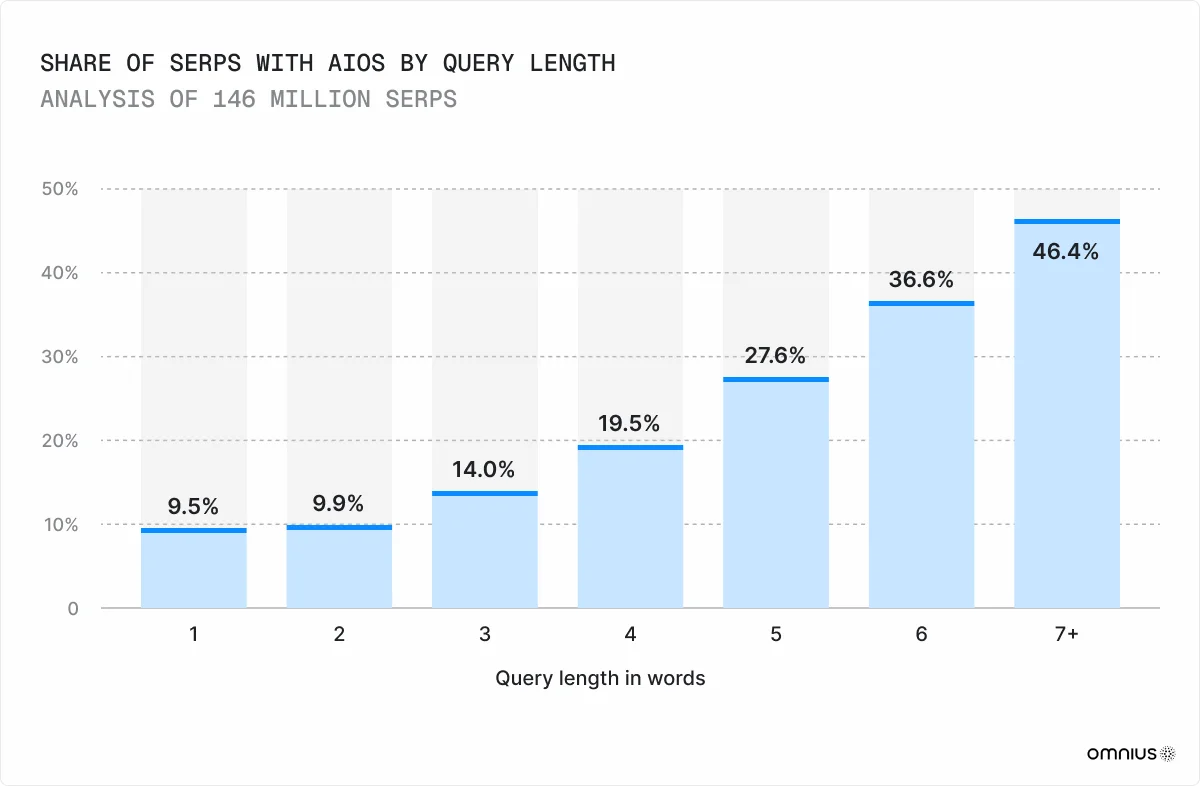
Most searches also have featured snippets, People Also Ask expandable sections, and knowledge panels. All of these provide relevant information on the spot.
If a user still has questions, they can easily get answers in AI Mode instead of visiting the source websites. Google’s own 2026 report shows that AI Mode follow-up queries grew by over 40% per month on average from the feature’s launch in May 2025 through April 2026.
This is all by design, and Google has an incentive to keep it going. The longer the users are on the SERP, the greater the engagement and ad exposure.
SparkToro's 2026 analysis confirms the effect. The share of searches leading to another Google search rose 7.2 percentage points between 2024 and 2026, while clicks to the open web fell roughly 22%.
While zero-click behavior is traditionally attributed to SERP features, AI chatbots deserve an honorable mention since they serve the same purpose.
G2's 2026 AI Search Insight Report found that 51% of B2B software buyers now start their research with an AI chatbot rather than Google, up from 29% a year earlier. LLMs give direct answers, allow users to get specific and customized responses, and support follow-ups within the same session.
What Is an Example of a Zero-Click Search?
Consider two queries a founder of a fintech startup might run on Google:
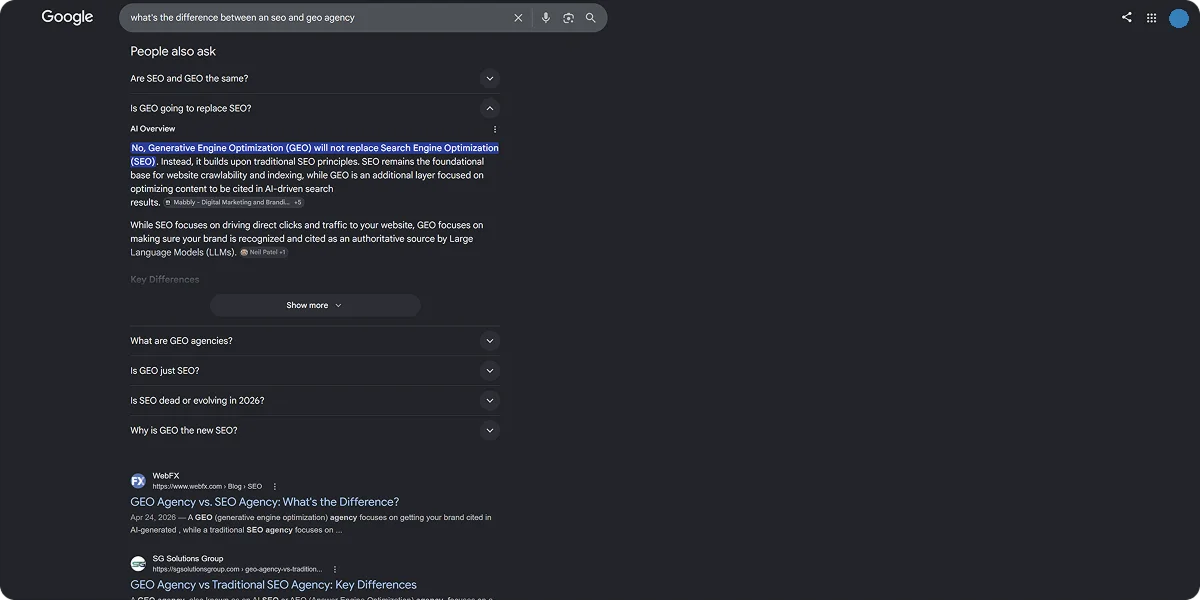
Example #1: What's the difference between an SEO and GEO agency - This is an early-awareness query. The user is still learning about a category distinction. Google's AI Overview synthesizes the answer directly on the results page.
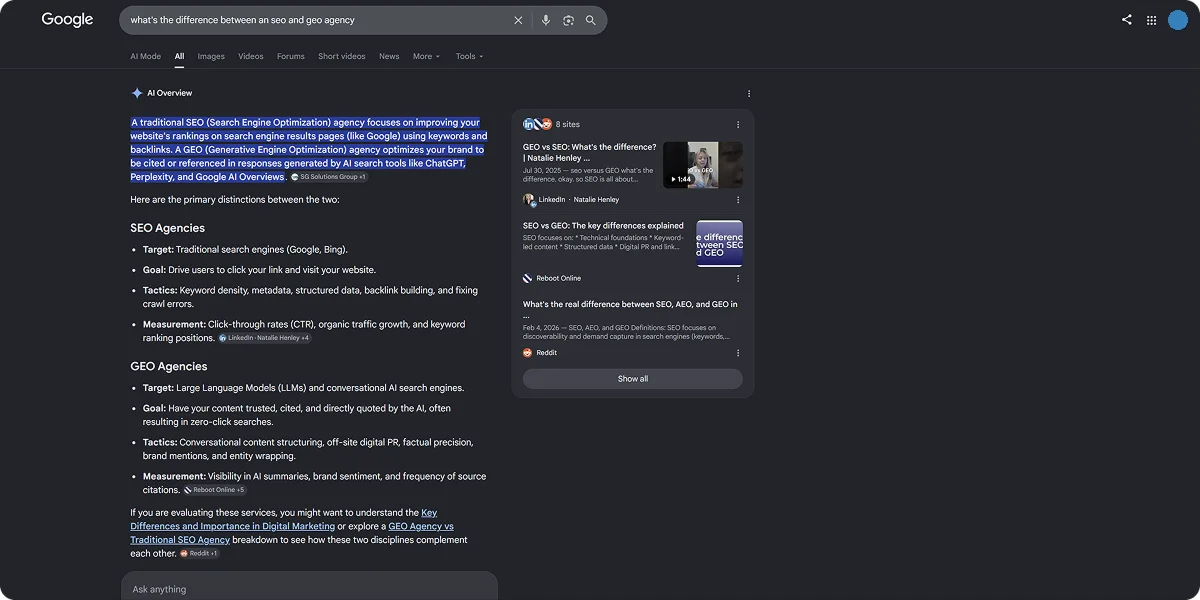
After reading the answer, the user may scroll down to view additional content and further understand the distinction. They might notice a relevant question in the People Also Asked section, and click on it to learn more. New, more niche questions pop up below, giving them more reason to stay on the SERP.
Example #2: What's the best GEO agency for fintech - This is a consideration-stage query. AI Overview lists several agencies with brief descriptions of their specializations. The user scans the summary, notes which names appear, and may use AI Mode or a different AI engine for deeper comparison.
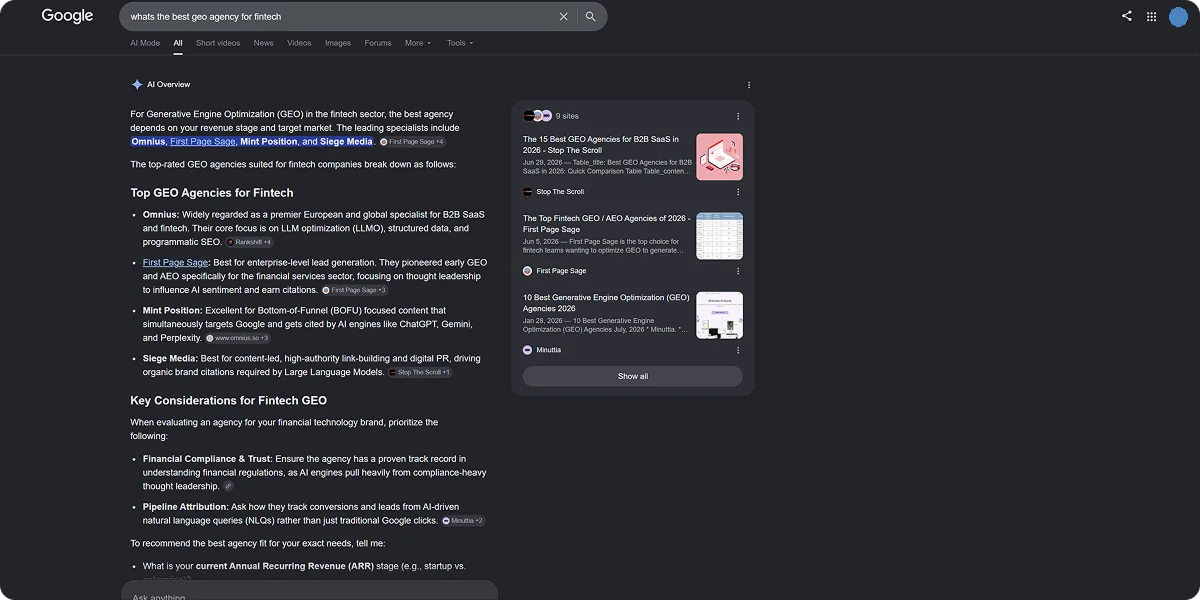
In both cases, the SERP resolved the query. For your brand to even be considered, you need to make sure it’s mentioned in these zero-click features.
What Is Zero-Click Marketing?
Zero-click marketing is a strategy for building brand awareness, trust, and influence without depending on website clicks.
It's marketing where people already are and speaking to them in a way that meets them where they are. You're driving awareness, building affinity, and engaging with your community. And you're not dependent on those referral clicks.
— Rand Fishkin, CEO of SparkToro and author of the book Zero-Click Marketing
In B2B, this comes down to building trust before the buying process starts.
According to 6Sense’s 2025 Buyer Experience Report, B2B buyers evaluate 4.5 vendors on average, and 95% choose a vendor from their Day One shortlist.
If you aren't already the top-of-mind choice before a buyer opens an AI tool, you've likely lost the deal before it started.
Your zero-click marketing should therefore include both technical and content-based optimization of your website, and authority-building strategies for your brand.
It should also strike a healthy balance between pragmatic, evidence-backed techniques known to increase visibility and bold experiments that build the kind of visibility few can catch up to later.
How B2B Brands Can Win in Zero-Click Search
Here are the five must-do tactics for brands that want to land deals in the zero-click internet era:
1. Ensure AI Crawlability
AI search engines need to access your content before they can cite it. Here’s how to make sure they do:
- Check your robots.txt file for disallow rules targeting AI crawlers, such as OAI-SearchBot, ClaudeBot, and Meta-ExternalAgent.
- If you use Cloudflare, verify that Super Bot Fight Mode isn't blocking AI crawlers by default. This is a common unintentional block.
- Serve critical content in clean HTML rather than behind JavaScript rendering. AI crawlers don't always execute JavaScript the way browsers do, and content invisible to bots won't appear in AI-generated responses.
2. Implement Relevant Schema
Schema makes your content machine-readable at a structural level. It directly affects AI engines’ ability to confidently extract and cite specific information from your pages.
Depending on your page content, you may want to deploy:
- Organization schema for company information
- Article schema for blog content with author and publication date
- FAQ schema for question-answer pairs
- Product schema for pricing and feature pages
- HowTo schema for instructional content
3. Identify Your Zero-Click Keywords
Audit your keyword portfolio and categorize each term by its zero-click likelihood and the appropriate strategic response. Some keywords should drive citations and brand impressions, while others should still drive clicks and conversions. Treating them the same wastes resources.
Here are some examples of how you can adapt your strategy according to your zero-click keywords:
4. Optimize Your Content for Zero-Click Search
Your content should focus on landing citations and mentions, not clicks.
AI systems prefer specific content structures that make extraction easier. Those include the Q&A format, sections under 250 words, lists and tables, and self-sufficient paragraphs. Besides that, including statistics with named attribution signals credibility and boosts your chances of being cited in AI summaries and responses.
While the structure is important, the content itself needs to be of high quality and demonstrate expertise. You can achieve that with deep topical coverage and by offering information not found elsewhere, such as original data or perspectives.
Topical authority matters, too. Build it through content clusters rather than isolated pages. A pillar page, supported by eight to twelve related pieces that cover specific angles, comparisons, and use cases, demonstrates the comprehensive coverage that AI engines reward.
5. Build Authority and Manage Positioning
Search engines have always placed heavy weight on external validation when selecting sources. Earned media, original research that journalists and analysts reference, and backlinks from authoritative domains all compound into trust signals, today even more so.
Still, how your company is described in third-party sources matters as much as how many times it’s mentioned. LLMs use these contextual descriptors to understand what you do. A mere mention of the brand name doesn’t tell them much. At the same time, incorrect information or negative sentiment can harm your visibility.
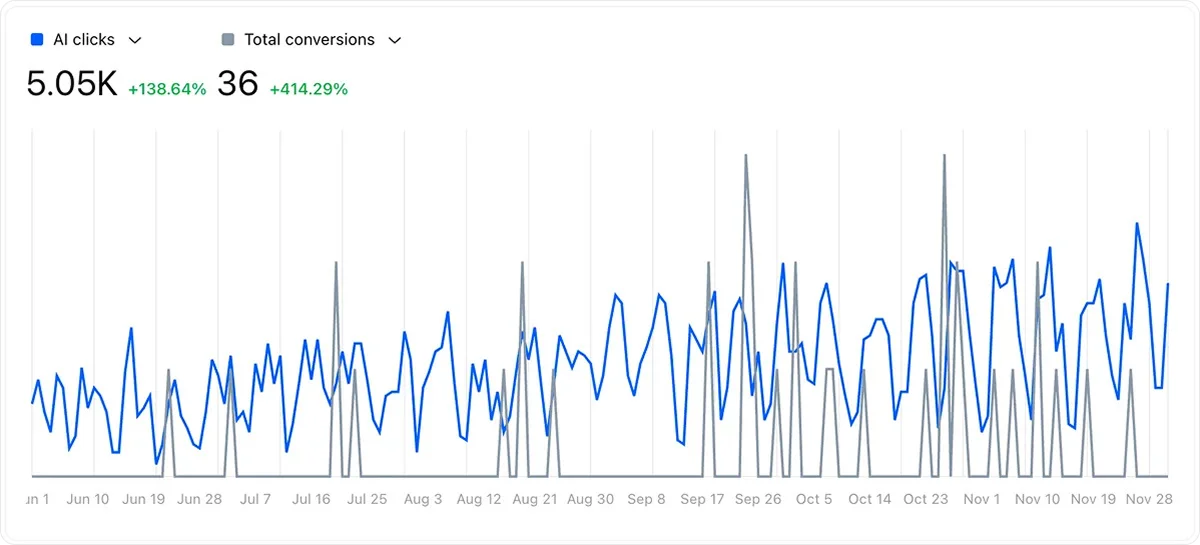
Omnius's own GEO Case Study confirmed the impact of authority-building strategies through competitive AI benchmarking. Brands with clear, specific positioning - dominating one niche rather than claiming broad expertise - were cited more frequently and more consistently by AI engines. Generic messaging resulted in lower citation rates.
Structuring content around explicit niche qualifiers, direct answers in the first 150 words, and comparison-ready formatting resulted in 193 tracked citations and 36 SQLs (414% growth).
Measuring Performance in Zero-Click Search
Zero-click search breaks the traditional measurement model. When most queries never produce a visit, tracking only clicks and sessions tells you less than half the story.
Some of the metrics brands used to report on looked rough in 2025. But there’s been a change in the quality of site visitors and the depth of their engagement. Semrush found that AI-sourced visits convert at roughly 4.4x the rate of typical organic sessions.
There are fewer clicks overall, but the intent behind each one is significantly higher.
That’s why it’s more productive to focus on measuring search impressions and AI reach instead of clicks, and optimize for influence over direct conversions.
Zero-Click Metrics
Metrics most relevant for zero-click search visibility include:
- AI visibility: Real clicks and conversions from AI platforms via GA4, GTM, and server logs
- Citation frequency: How often AI engines cite your domain as a source across platforms
- SERP presence share: Whether your brand appears in AI Overviews, PAA, and featured snippets, regardless of whether anyone clicks
- Entity coverage: How many relevant prompts and AI platforms your brand shows up for, and whether coverage extends across your key topics or clusters around a few
- Sentiment accuracy: Whether LLMs represent your brand with current, correct information or outdated descriptions
Good to Know
A tool like Atomic AGI allows you to track AI visibility at scale.
Atomic unifies citation tracking, brand mention monitoring, competitive benchmarking, and sentiment analysis across chatbots like ChatGPT, Gemini, Perplexity, and Claude.
It combines behavioral analytics with synthetic prompt sampling, so you can measure both the conversions you're getting and the brand presence that never generates a click.
Start Now or Fall Behind
Zero-click search is a structural change in how information reaches buyers.
The response isn't to abandon SEO - it remains a necessary foundation behind zero-click and AI search performance.
Instead, brands should stop measuring success exclusively by clicks and start assessing whether they show up in the answers their buyers receive.
Companies that invest now in AI crawlability, structured content, topical authority, and cross-platform brand building will establish visibility that compounds over time. Those that wait will find the window has already closed.
Building a zero-click strategy alongside SEO requires specialized expertise across both traditional and AI-powered search. If you need help with implementation, consider partnering with Omnius. We work with B2B SaaS, fintech, and AI companies, helping them build visibility across every surface where their buyers research.
Book a call to discuss how your brand currently shows up in zero-click search, where the gaps are, and how Omnius can help you close them.
Frequently Asked Questions
How does a zero-click search provide information if the searcher never clicks off the SERP?
Google surfaces the answer directly on the results page through AI Overviews, featured snippets, knowledge panels, and People Also Ask boxes. These features extract and synthesize information from indexed web pages, offering key information about the topic in different formats.
How do zero-click searches affect SEO?
They reduce click-through rates even for pages that rank well because the user's query is resolved on the SERP itself. For informational queries, brands need to shift their success metric from clicks to SERP visibility and AI citation and mention frequency.
Are zero-click searches increasing?
Yes, and rapidly. SparkToro’s analysis confirms this effectively:
- In 2016, roughly 45% of Google searches were zero-click.
- By 2024, the figure rose to 60%.
- In early 2026, it was 68% - the fastest acceleration in a decade.
The trend will likely continue. A 2025 Innovating with AI survey found that 83% of AI users consider AI-powered tools more efficient than traditional search.
How do you create zero-click content?
Structure content so AI systems can extract and cite it - lead with the answer, use descriptive, question-based headings, and include statistics with proper attribution. The goal is to earn the citation or mention inside the AI-generated response, not a click.
How do you measure zero-click searches?
Shift focus from website clicks to SERP visibility and AI presence. Track AI citation frequency, brand mention volume across platforms, sentiment accuracy, and conversion rates from AI-referred traffic.
Is SEO dead or evolving in 2026?
SEO remains essential in 2026. AI search engines rely on traditional search rankings as trust signals when selecting sources to cite.
But the discipline is evolving to adapt to the zero-click internet. Using and tracking both SEO and AI SEO is necessary for brands looking to maintain and expand their reach.


.png)

.svg)














.svg)

























.svg)


.webp)